

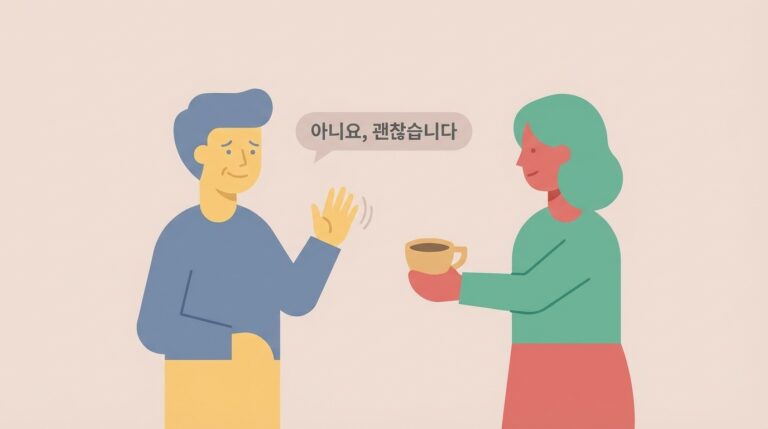
Phase 1: The Empathy Cold Open
Hello, learners! I’m the Lead Editor at Daily Hangul, your local culture navigator and veteran tutor.
Picture this: You’re watching your favorite K-Drama. The notoriously strict boss asks the sweet, overworked protagonist to come into the office on a Sunday. The subtitle clearly reads, “I can’t.” But if you listen closely to the Korean audio, the protagonist doesn’t actually say “No” (아니요). Instead, they scratch the back of their head, force an awkward smile, and drag out a painful, “Ah… well… that might be a bit…”
Why is a simple two-letter word like “No” so incredibly difficult to say in Korea?
If you’ve ever felt confused when a Korean friend vaguely said, “Let’s eat together next time,” or if you’ve accidentally offended someone by bluntly saying “아니요 (Aniyo),” you are not alone. In Korean culture, a direct “No” can often be perceived as cold, aggressive, or even relationship-damaging. Today, we are going to dive deep into the beautiful, slightly frustrating art of the “Korean Soft No.” By the end of this guide, you won’t just speak Korean—you’ll navigate the unwritten rules of Korean Nunchi (눈치) like a true local.
Phase 2: Core Expressions Deep Dive
Here are the top 3 ways Koreans say “No” without actually saying “No.”
1. 아, 그건 좀…
- Pronunciation: [a, geugeon jom…] (The ‘jom’ sounds like you’re hesitating, letting your voice trail off slowly.)
- Meaning: Literal: “Ah, that is a little…” / Real nuance: “I really don’t want to do that / I can’t do that.”
- K-Culture Moment: Imagine you are at a Hoesik (company dinner) and a senior colleague offers you a third shot of Soju, but your limit is two. You gently push the glass away and say, “아, 그건 좀…” The magic here is the trailing silence. You leave the sentence unfinished so the other person can “read the air” and withdraw their request gracefully.
- Editor’s Insight: This phrase is the ultimate polite rejection. By leaving out the negative word (like “bad” or “hard”), you protect the other person’s Kibun (pride/feelings).
- Situation Spectrum:
[🚫 Never] ———— [⚠️ Be Careful] ———— [✅ Freely]
- Close Friends (Casual): ✅
- Coworkers (Semi-formal): ✅
- Boss/Elders (Formal): ⚠️ (You must add “죄송하지만” – I’m sorry, but… first!)
- 🤔 Think About It: Why do Koreans leave sentences unfinished when rejecting someone? Does your native language have a similar way of using silence as a message?
2. 다음에 밥 한 번 같이 먹어요.
- Pronunciation: [daeume bap han beon gachi meogeoyo]
- Meaning: Literal: “Let’s eat together next time.” / Real nuance: “Goodbye for now / Let’s wrap up this conversation.”
- K-Culture Moment: You bump into an old classmate on the busy streets of Hongdae. After a quick catch-up, the conversation stalls. Instead of an awkward “Well, bye,” one of you says this phrase.
- Editor’s Insight: Please, do not pull out your Google Calendar when you hear this! It’s what Koreans call Binmal (빈말, empty words). It’s a warm, polite way to end an interaction without making concrete plans. It shows that you value the relationship theoretically, even if you are too busy practically.
- Situation Spectrum:
[🚫 Never] ———— [⚠️ Be Careful] ———— [✅ Freely]
- Close Friends (Casual): ✅ (Though you’d say “다음에 밥 먹자”)
- Acquaintances (Semi-formal): ✅
- Boss/Elders (Formal): 🚫 (Too casual to suggest a meal to a senior in this way)
- 🤔 Think About It: In many Western cultures, saying “Let’s do lunch” can also be a polite exit. How is the Korean emphasis on “eating rice” (밥) connected to community?
3. 생각해 볼게요.
- Pronunciation: [saenggakhae bolgeyo] (saeng-gak-hay bol-ge-yo)
- Meaning: Literal: “I will try thinking about it.” / Real nuance: “No, thank you. I won’t buy it/do it.”
- K-Culture Moment: You are in a K-Beauty store in Myeongdong. A very enthusiastic salesperson is trying to sell you a 10-step snail mucin skincare routine for $200. You don’t want it. Instead of a blunt “No,” you smile and say this.
- Editor’s Insight: This is the ultimate “Retail Soft No.” It saves the salesperson’s face. They know you aren’t actually going to go home, ponder the snail mucin, and return. It’s a mutually agreed-upon polite exit.
- Situation Spectrum:
[🚫 Never] ———— [⚠️ Be Careful] ———— [✅ Freely]
- Close Friends (Casual): 🚫 (Sounds too business-like)
- Stores/Promotions (Retail): ✅
- Work proposals (Formal): ⚠️ (Can sound indecisive if used too much)
- 🤔 Think About It: Why is saving a stranger’s face important in a fast-paced retail environment like Seoul?
Phase 3: Textbook vs. Real Korean
Let’s compare what language apps teach you with what actual Koreans say on the streets of Seoul.
| Situation | 📖 Textbook Korean | 🗣️ Real Korean | 💡 Why the difference? |
|---|---|---|---|
| Declining an invitation | 아니요, 안 가요. (No, I won’t go.) | 아, 그날 선약이 있어서요… (Ah, I have a prior engagement…) | A direct ‘No’ feels like a rejection of the person, not just the event. ‘Prior engagement’ shifts the blame to the schedule. |
| Refusing to buy something | 안 사요. (I won’t buy it.) | 네~ 둘러보고 올게요. (Yes~ I’ll look around and come back.) | Retail workers work hard; a blunt ‘no’ ruins their Kibun. Promising to return (even as a white lie) softens the blow. |
| Rejecting more food | 더 안 먹겠습니다. (I will not eat more.) | 아우, 배불러서 더 못 먹겠어요~ (Oh, I’m so full I couldn’t possibly eat more~) | Food is love in Korea. Rejecting food requires showing that you physically cannot handle their overwhelming generosity! |
Bottom Note: At a B2 level, your goal is to master these socially lubricated phrases. Transitioning from blunt facts to emotional consideration is the key to fluency.
Phase 4: Cultural Context — K-Culture Deep Dive
4-1. The Non-Verbal “No”
In Korea, it’s not just what you say; it’s how your body says it. When deploying a Soft No, never maintain intense, unwavering eye contact. Instead, break eye contact slightly, let out a soft, breathy laugh (ㅎㅎㅎ), and physically hesitate. This activates your Nunchi (눈치)—the social radar used to gauge the mood. You are signaling: “I want to agree with you, but circumstances prevent me.”
4-2. The K-Drama “Candy” Trope vs. Reality
You’ve definitely seen the “Candy” character in K-Dramas—the poor, incredibly kind protagonist who simply cannot say “No” to their evil coworkers and ends up doing everyone’s work. While exaggerated for TV, this trope reflects a real societal pressure in Korea: the fear of being labeled “이기적인 사람” (a selfish person). Group harmony often supersedes individual convenience.
However, critical warning: In modern Korean corporate culture (especially among Gen Z), this is rapidly changing. While they still use polite phrases, younger Koreans are much better at setting boundaries than the dramatic characters you see on Netflix. You don’t have to be a martyr; you just have to be polite!
Phase 5: Real-Life Roleplay Scenario
Scenario A: The Friday Night Hoesik
Setting: It’s 10:00 PM on a Friday outside a smoky BBQ restaurant in Gangnam. You’ve just finished the first round of a team dinner (Hoesik). You are exhausted.
Characters:
– YOU (Alex): A foreign employee who has been in Seoul for 6 months. You desperately want to go home and watch Netflix.
– Minsu (32): Your friendly, slightly tipsy Korean coworker who loves socializing.
Dialogue:
Minsu: 알렉스! 우리 2차 가야지? 치맥 어때? 🍻
(Alex! Uri 2cha gayaji? Chimaek eottae?)
(Alex! We should go to the second round, right? How about chicken and beer?)
(🎭 Stage Direction: Minsu claps you on the shoulder enthusiastically.)
YOU: 아… 2차요?
(Ah… 2chayo?)
(Ah… the second round?)
Minsu: 응! 저기 바로 앞에 치킨집 진짜 맛있어. 가자!
(Eung! Jeogi baro ape chikin-jip jinjja masisseo. Gaja!)
(Yeah! The chicken place right over there is really good. Let’s go!)
YOU: 아, 진짜 가고 싶은데…
(A, jinjja gago sipeunde…)
(Ah, I really want to go, but…)
Minsu: 에이~ 한 시간만! 딱 한 잔만 하고 가!
(Ei~ han siganman! Ttak han janman hago ga!)
(Come on~ Just for an hour! Just have one drink and leave!)
(🎭 Stage Direction: Minsu uses the classic Korean negotiation tactic: “Just one.”)
🔀 Your Turn! How do you reply?
– A) “아니요, 저는 집에 갈 겁니다. 안녕히 계세요.” (Direct & Cold)
– B) “제가 내일 아침 일찍 중요한 일정이 있어서요. 오늘은 먼저 가보겠습니다.” (Soft No + Excuse)
– C) “대박! 그럼 치킨 사주시는 거예요?” (Accepting the invite playfully)✅ Best Choice: B — Reason: You combined the Soft No with a valid excuse (“important schedule tomorrow”) and a polite exit phrase (“I will leave first”). Minsu’s Kibun is intact, and you get to sleep!
⚠️ Choice A Analysis: While grammatically perfect, it sounds like a robot terminating a mission. It might make Monday morning slightly awkward.
Minsu: 아, 내일 일정 있어? 알았어. 그럼 어쩔 수 없지.
(A, naeil iljeong isseo? Arasseo. Geureom eojjeol su eopji.)
(Ah, you have a schedule tomorrow? Got it. Then it can’t be helped.)
YOU: 네, 너무 아쉬워요. 다음에는 꼭 끝까지 남을게요!
(Ne, neomu aswiwoyo. Daeumeneun kkok kkeutkkaji nameulgeyo!)
(Yes, it’s such a shame. Next time I’ll definitely stay until the end!)
Minsu: 그래, 조심히 들어가! 월요일에 보자.
(Geurae, josimhi deureoga! Woryoire boja.)
(Okay, get home safely! See you on Monday.)
YOU: 네, 주말 잘 보내세요!
(Ne, jumal jal bonaeseyo!)
(Yes, have a great weekend!)
Scenario B: The Myeongdong Cosmetic Trap
(You are browsing a K-Beauty store. A staff member puts a $150 serum in your basket.)
Staff: 손님~ 이거 오늘만 50% 할인이에요! 피부에 진짜 좋아요.
(Sonnim~ igeo oneulman 50% harinieyo! Pibue jinjja joayo.)
(Customer~ This is 50% off just for today! It’s really good for your skin.)
YOU: 아… 네… (Smiling awkwardly)
Staff: 결제 도와드릴까요?
(Gyeolje dowadeurilkkayo?)
(Shall I help you check out?)
YOU: 아, 제가 좀 더 생각해 볼게요. 감사합니다.
(A, jega jom deo saenggakhae bolgeyo. Gamsahamnida.)
(Ah, I will think about it a bit more. Thank you.)
(🎭 Stage Direction: You bow slightly and gracefully exit the store.)
Phase 6: 10-Second Shadowing Drill
Practice making your voice soft and trailing off at the end.
- 🥺 Apologetic: 아, / 진짜 가고 싶은데… / 오늘은 좀 / 힘들 것 같아요.
(a, / jinjja gago sipeunde… / oneureun jom / himdeul geot gatayo.) - 😊 Gentle Retail Rejection: 네~ / 한 번 / 둘러보고 / 올게요!
(ne~ / han beon / dulleobogo / olgeyo!) - 😤 Polite but Firm Boundary: 마음은 감사하지만, / 그건 좀 / 어려울 것 같습니다.
(maeumeun gamsahajiman, / geugeon jom / eoryeoul geot gatseumnida.)
Phase 7: K-Culture Mini Dictionary
| 한국어 | Romanization | English | Context |
|---|---|---|---|
| 눈치 | nunchi | Social intelligence / reading the room | The core of Korean social interactions. If you have “quick nunchi,” you know when someone is saying “No” without them saying it. |
| 기분 | kibun | Mood / Pride / Feelings | When rejecting someone, Koreans prioritize not damaging the other person’s Kibun. |
| 회식 | hoesik | Company dinner | A crucial bonding event in Korean work culture where Soft Nos are tested heavily. |
| 빈말 | binmal | Empty words / White lies | Polite phrases like “Let’s eat later” meant to show affection, not to make actual plans. |
| 선약 | seonyak | Prior engagement | The most bulletproof, culturally accepted excuse to get out of anything in Korea. |
Phase 8: Traveler Survival Kit
Even if you are just visiting Seoul for a week, you will need to say “No.” Street promoters in Hongdae, taxi drivers offering unsolicited tour advice, or restaurant aunts piling food on your plate.
🆘 Survival Expression #1: “괜찮습니다” (Gwaenchanseumnida)
– 🗣️ Pronunciation: [gwaen-chan-seum-ni-da]
– 📍 Where to use: Hongdae streets, markets, when offered flyers.
– 💡 Pro Tip: It literally means “It is okay,” but in this context, it translates to “No, thank you.” Pair it with a slight hand wave and keep walking. Do not stop to explain yourself!🆘 Survival Expression #2: “아우, 배불러서요~” (Au, baebulleoseoyo~)
– 🗣️ Pronunciation: [ah-oo, bae-bul-leo-seo-yo]
– 📍 Where to use: Restaurants when offered more food.
– 💡 Pro Tip: Rub your stomach slightly. The restaurant owner will feel proud that they fed you well, rather than offended that you rejected their food.📌 Editor’s Travel Note
– Flyer Culture: In areas like Gangnam or Hongdae, people will hand you flyers. You don’t have to take them. A polite smile and “괜찮습니다” is perfect.
– Tipping: Remember, there is NO tipping culture in Korea! If a taxi driver tries to round up the fare significantly or a restaurant asks for a tip, you can firmly but politely use your “No” skills. Just say, “잔돈 주세요” (Please give me the change).
Phase 9: Critical Thinking Corner — A Step Deeper
🧠 Think Deeper: Language & Power (The Kibun Ecosystem)
Why does the Korean language have such a complex system of rejecting people? It stems from a deeply rooted agricultural history where communities had to live and work together in small villages for their entire lives. Breaking harmony meant risking your survival. Even today, the Korean social ecosystem runs on Kibun (기분)—the shared emotional state of the group. A direct “No” is seen as a sudden, sharp interruption of that harmony. By using a “Soft No,” you are telling the other person, “I respect our hierarchy and our relationship, even if I cannot fulfill your request right now.”
💬 Your Turn: How do people in your culture handle rejecting invitations from a boss or an elder? Is it direct, or do you also have a version of the “Soft No”? Share in the comments!
Phase 10: FAQ & Avoiding Common Mistakes
❌ Common Mistake #1: Using “아니요 (Aniyo)” like the English “No.”
In English, saying “No, thank you” is perfectly polite. In Korean, “아니요” can sound like “You are wrong.” Always default to “괜찮습니다” (I am okay / No thanks) instead of “아니요” when declining offers.
❌ Common Mistake #2: Setting a date when someone says “Let’s eat next time.”
If a Korean acquaintance says “다음에 밥 먹어요,” do not immediately ask, “Great, is Tuesday at 7 PM okay?” It puts them on the spot! Just reply with, “네, 좋아요!” (Yes, sounds good!) and wait for them to reach out later.
❓ FAQ: Can I use “아, 그건 좀…” to my boss?
No! While it’s great for coworkers, using a trailing, vague sentence to a strict superior can sound disrespectful. For bosses, always use: “죄송하지만, 그건 어려울 것 같습니다” (I am sorry, but that seems difficult.)
Phase 11: Summary & Action Items
- One-Liner Summary: In Korea, protecting the relationship is more important than stating a blunt fact, so master the “Soft No” to keep the Nunchi flowing!
🔥 Action Mission:
– 🥉 Bronze (Solo): Stand in front of a mirror and practice saying “아, 그건 좀…” while awkwardly scratching your head.
– 🥈 Silver (Online): Leave a comment below telling us a time you struggled to say “No” in your own life!
– 🥇 Gold (Real World): Next time you are at a Korean restaurant or market (or interacting with a Korean friend), try using “괜찮습니다” or “생각해 볼게요” instead of a direct “No.”
🎬 K-Culture Mission: Watch one episode of a K-Drama set in an office (like Misaeng or Business Proposal). Spot the exact moment a character tries to say “No” without actually using the word “아니요.” Pay attention to their eyes and hands!
Phase 12: Interactive Quiz
Let’s test your Korean social survival skills!
1. Situational Judgment: You are shopping in Dongdaemun. A vendor aggressively pushes a bright pink jacket on you. You absolutely hate it. What is the BEST phrase to escape?
– A) 아니요. 안 예뻐요. (No. It’s not pretty.)
– B) 생각해 볼게요. (I’ll think about it.)
– C) 아, 그건 좀… (Ah, that’s a bit…)
👉 Answer: B. It’s the standard retail exit code. ‘C’ is a bit too personal for a stranger.
2. True or False – K-Culture Edition:
When a Korean friend you haven’t seen in 2 years texts you “우리 언제 밥 한 번 먹자!” (Let’s eat together sometime!), they are definitely planning to book a restaurant this weekend.
👉 Answer: False. This is classic ‘Binmal’ (빈말). It’s a friendly greeting, not a dinner reservation!
3. Fill in the Blank:
Your coworker asks you to take on their weekend shift. You want to use the “trailing off” technique to reject them gently.
“아… 주말은 _____”
👉 Answer: 좀… (jom…)
Did you enjoy today’s cultural deep dive? Bookmark this page for your next trip to Korea, and never feel awkward about saying “No” again!
Frequently Asked Questions (FAQ)
Q: What does "아, 그건 좀..." mean in Korean and how do you pronounce it?
A: In Korean, "아, 그건 좀..." is pronounced [a, geugeon jom...] and means: Literal: "Ah, that is a little..." / Real nuance: "I really don't want to do that / I can't do that."
Q: What does "다음에 밥 한 번 같이 먹어요." mean in Korean and how do you pronounce it?
A: In Korean, "다음에 밥 한 번 같이 먹어요." is pronounced [daeume bap han beon gachi meogeoyo] and means: Literal: "Let's eat together next time." / Real nuance: "Goodbye for now / Let's wrap up this conversation."
Q: What does "생각해 볼게요." mean in Korean and how do you pronounce it?
A: In Korean, "생각해 볼게요." is pronounced [saenggakhae bolgeyo] and means: Literal: "I will try thinking about it." / Real nuance: "No, thank you. I won't buy it/do it."







