

Hello! I’m the Lead Editor at Daily Hangul, your personal Korean culture navigator and veteran tutor.
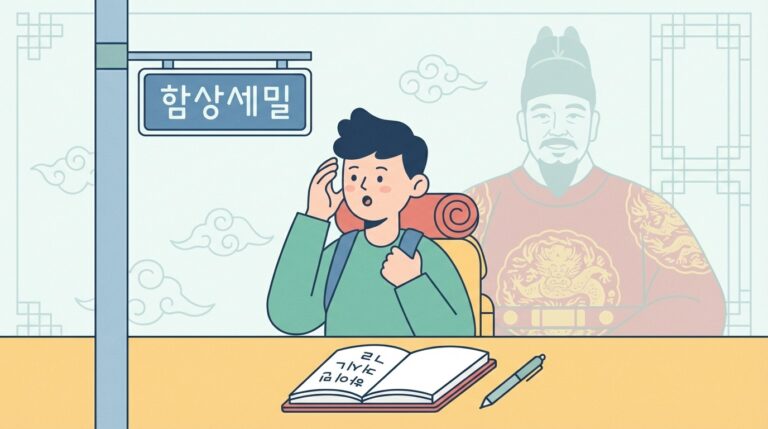
Imagine this: You’re standing in the middle of Seoul. Neon signs are flashing, street food stalls are calling your name, and you look up at a restaurant sign that says 삼겹살. You sound it out… Sam-gyeop-sal. You did it! You read Korean! But wait… what does it actually mean?
If you’ve ever experienced this magical (and slightly frustrating) moment, you have one man to thank: King Sejong the Great. He is the genius behind Hangul (the Korean alphabet), and understanding his story isn’t just history—it’s the ultimate key to understanding the Korean language’s soul.
Today, we aren’t just going to learn textbook history. We’re going to dive deep into the cultural context of Hangul, how it affects modern K-Culture, and the real-life phrases B1 learners must know when talking about their Korean language journey.
Let’s travel back to 1443, and bring it right back to the streets of modern Seoul!
Phase 2: Core Expressions Deep Dive
Before Hangul, Koreans used complex Chinese characters (Hanja). Only the wealthy nobles who had time to study could read. King Sejong thought, “This isn’t fair. My people need a voice.” So, he created an alphabet so scientific and easy that “a wise man can learn it in a morning, and a stupid man can learn it in ten days.”
Here are the most useful expressions related to this Hangul journey.
1. 읽을 줄은 아는데 뜻은 몰라요.
- Pronunciation: il-geul ju-reun a-neun-de tteu-seun mol-la-yo.
- Sound-alike guide: ‘il-geul’ sounds like ‘ill-gull’, ‘tteut’ has a hard double ‘t’ like the ‘t’ in ‘stop’.
- Meaning: I know how to read it, but I don’t know what it means.
- K-Culture Moment: You are at a K-Pop merchandise pop-up store. You read the member’s name perfectly on a photocard, but you can’t understand the handwritten message below it. You say this to the Korean fan next to you, and they instantly sympathize and translate it for you.
- Editor’s Insight: This is the ultimate B1 learner’s anthem! Thanks to King Sejong, Hangul is phonetic and easy to read. But vocabulary takes time. Koreans love hearing this because it proves you’ve mastered our beloved alphabet.
- Situation Spectrum:
[🚫 Never] ———— [⚠️ Caution] ———— [✅ Freely]
- Close Friends (Casual): ✅ (Drop the ‘yo’: 읽을 줄은 아는데 뜻은 몰라)
- Co-workers (Semi-formal): ✅
- Boss/Elders (Formal): ⚠️ (Better to say: 읽을 수는 있지만 의미를 잘 모르겠습니다)
- 🤔 Think About It: Why does Korean have such a stark difference between reading the alphabet and understanding the meaning? (Hint: Nearly 60% of Korean vocabulary has Chinese roots, even though it’s written in phonetic Hangul!)
2. 저 완전 까막눈이었어요.
- Pronunciation: jeo wan-jeon kka-mang-nun-i-eos-seo-yo.
- Sound-alike guide: ‘kka’ is a sharp, tense sound. Imagine a crow saying “Caw!” but sharper.
- Meaning: Literal: I had completely black/crow eyes. / Real nuance: I was completely illiterate (couldn’t read at all).
- K-Culture Moment: You’re having Chimaek (Chicken and Beer) with your language exchange partner. You remember your first day in Korea when subway signs looked like alien symbols. You use this idiom to describe your past self.
- Editor’s Insight:
까막눈(Illiterate) is a very native, slightly self-deprecating idiom. It was the exact condition King Sejong wanted to cure! Using this phrase makes you sound incredibly fluent.- Situation Spectrum:
[🚫 Never] ———— [⚠️ Caution] ———— [✅ Freely]
- Close Friends (Casual): ✅
- Co-workers (Semi-formal): ✅
- Boss/Elders (Formal): ⚠️ (Too colloquial for a business meeting)
- 🤔 Think About It: Does your language have a funny idiom for someone who can’t read or doesn’t know anything about a specific topic?
3. 세종대왕님 덕분에 살았어요.
- Pronunciation: se-jong-dae-wang-nim deok-bun-e sa-ras-seo-yo.
- Meaning: Literal: I lived thanks to King Sejong. / Real nuance: Thank goodness for King Sejong! (Because Hangul is so easy).
- K-Culture Moment: You are watching a historical K-Drama (사극, Sageuk) where scholars are struggling to brush-paint thousands of Chinese characters. You sigh in relief, looking at your simple Hangul textbook.
- Editor’s Insight:
덕분에means “thanks to.” Koreans feel immense pride in King Sejong. If a foreigner praises him, you instantly win “Honorary Korean” status. Always attach님(honorific suffix) to his title out of respect.- Situation Spectrum:
[🚫 Never] ———— [⚠️ Caution] ———— [✅ Freely]
- Everyone: ✅
Phase 3: Textbook vs. Real Korean
| Situation | 📖 Textbook Korean | 🗣️ Real, Natural Korean | 💡 Why the difference? |
|---|---|---|---|
| Telling someone you can read Hangul | 저는 한글을 읽을 수 있습니다. | 저 한글 읽을 줄 알아요. | -(으)ㄹ 줄 알다 sounds much more natural for learned skills than -(으)ㄹ 수 있다 (physical ability). |
| Describing someone who can’t read | 글을 모르는 사람입니다. | 완전 까막눈이에요. | Koreans love using visual idioms (black eyes = can’t see the letters). |
| Expressing Hangul is great | 한글은 아주 과학적입니다. | 한글 진짜 대박이에요! / 한글 짱! | While textbook phrases are polite, “대박” (Jackpot/Awesome) conveys pure, unfiltered emotion. |
Phase 4: Cultural Context — K-Culture Deep Dive
4-1. Non-Verbal Cues: The Gwanghwamun Vibe
When you talk about King Sejong, you are talking about the heart of Seoul. If you are standing in Gwanghwamun Square in front of the massive, golden King Sejong statue, it’s customary to show a bit of awe. When a Korean asks if you know him, a bright smile and a thumbs-up while saying “세종대왕님!” is the perfect non-verbal compliment.
4-2. K-Drama Connection: The “Sageuk” (Historical Drama) Trope
If you watch K-Dramas like “Tree with Deep Roots” (뿌리깊은 나무), you’ll see the intense political battle behind Hangul. The elites (Yangban) wore fancy silk and spoke using heavy Chinese-derived vocabulary. The commoners wore cotton and spoke plain Korean.
Critical Point: Modern Korean still has this split! We have “native Korean words” (순우리말) which are soft and emotional, and “Sino-Korean words” (한자어) which are formal and professional. As a B1 learner, you are now starting to juggle these two. Knowing when to use the native word (e.g., 사람 – person) vs. the Sino-Korean word (e.g., 인간 – human) is your next big hurdle.
Phase 5: Real-life Roleplay Scenario
Setting: A sunny Saturday afternoon at Gwanghwamun Square. You and your Korean language exchange partner, Min-ji (28, friendly and loves sharing Korean history), are walking toward the giant King Sejong statue.
Characters:
– YOU: A B1 Korean learner who has been in Korea for 3 months.
– Min-ji: Your enthusiastic Korean friend.
Dialogue:
Min-ji: 저기 동상 보이죠? 저분이 바로 세종대왕님이에요.
(jeo-gi dong-sang bo-i-jyo? jeo-bun-i ba-ro se-jong-dae-wang-nim-i-e-yo.)
[You see that statue over there? That is King Sejong the Great.]
YOU: 아, 한글을 만드신 분이죠? 저도 알아요!
(a, han-geu-reul man-deu-sin bun-i-jyo? jeo-do a-ra-yo!)
[Ah, the person who made Hangul, right? I know him too!]
Min-ji: 맞아요! OO씨는 이제 한글 다 읽을 수 있죠?
(ma-ja-yo! OO-ssi-neun i-je han-geul da il-geul su it-jyo?)
[Right! You can read all of Hangul now, right?]
YOU: 네, 가나다라는 다 뗐어요. 하지만 문제가 하나 있어요.
(ne, ga-na-da-ra-neun da tte-sseo-yo. ha-ji-man mun-je-ga ha-na is-seo-yo.)
[Yes, I’ve mastered the alphabet. But there is one problem.]
Min-ji: 응? 무슨 문제요? 너무 어려워요?
(eung? mu-seun mun-je-yo? neo-mu eo-ryeo-wo-yo?)
[Huh? What problem? Is it too hard?]
🔀 Your Turn! How should you answer?
– A) “한글은 안 예뻐요.” (Hangul is not pretty.)
– B) “읽을 줄은 아는데, 뜻을 몰라서 완전 까막눈이에요!”
– C) “세종대왕님이 싫어요.”✅ Best Choice: B — “I know how to read it, but I don’t know the meaning, so I’m totally illiterate!”
Why? This perfectly mixes humility, humor, and excellent B1 vocabulary (-(을) 줄 알다,까막눈). Min-ji will definitely laugh and appreciate your wit!
⚠️ Why not A or C? A is insulting to the culture. C will literally make you a public enemy in Gwanghwamun Square! Never disrespect the King!
(Assuming you chose B)
Min-ji: ㅋㅋㅋ 아, 맞아요! 뜻 외우는 게 진짜 어렵죠.
(kkk a, ma-ja-yo! tteut oe-u-neun ge jin-jja eo-ryeop-jyo.)
[Hahaha Ah, right! Memorizing the meanings is really hard.]
YOU: 그래도 세종대왕님 덕분에 길은 안 잃어버려요. 간판은 다 읽거든요!
(geu-rae-do se-jong-dae-wang-nim deok-bun-e gi-reun an i-reo-beo-ryeo-yo. gan-pa-neun da il-geo-deun-yo!)
[Still, thanks to King Sejong, I don’t get lost. I can read all the signs!]
Min-ji: 훌륭해요! 그럼 제가 오늘 까막눈 탈출 기념으로 밥 살게요!
(hul-lyung-hae-yo! geum je-ga o-neul kka-mang-nun tal-chul gi-nyeom-eu-ro bap sal-ge-yo!)
[Excellent! Then to celebrate your escape from being illiterate, I’ll buy lunch today!]
Phase 6: 10-Second Shadowing Drill
Let’s practice reading with the right feeling and pauses!
😆 저도 / 간판을 / 읽을 줄은 아는데 / 뜻은 / 잘 몰라요~
(jeo-do / gan-pa-neul / il-geul ju-reun a-neun-de / tteu-seun / jal mol-la-yo~)
[Smile brightly and use a slightly whining, playful tone at the end.]
Phase 7: K-Culture Mini Dictionary
| Korean | Romanization | English | Context / Meaning |
|---|---|---|---|
| 세종대왕 | Sejong Daewang | King Sejong the Great | The 4th King of the Joseon Dynasty. The ultimate hero of Korea. |
| 훈민정음 | Hunminjeongeum | The original name of Hangul | Translates to: “The correct sounds for the instruction of the people.” |
| 까막눈 | kkamangnun | Illiterate | Slang/Idiom for someone who can’t read. |
| 사극 | sageuk | Historical Drama | K-Dramas set in historical periods (usually Joseon). |
| 가나다라 | ganadara | The Korean ABCs | The first four letters of the Hangul alphabet. Used to mean “the basics.” |
Phase 8: Traveler’s Survival Kit
If you are visiting Seoul, you will visit Gwanghwamun or the National Museum of Korea. Here are the survival phrases you need for historical sites!
🆘 Survival Expression #1: Asking for directions to the Palace
– 🇰🇷 “경복궁 가는 길이 어디예요?” (gyeong-bok-gung ga-neun gi-ri eo-di-ye-yo?)
– 🗣️ English Sound Guide: gyuhng-bok-goong gah-neun gil-ee uh-dee-yeh-yo?
– 📍 Where to use: Subway stations, on the street near Gwanghwamun.
– 💡 Pro Tip: Look for the signs in brown—tourist spots are always marked with brown signs in Korea!🆘 Survival Expression #2: Meeting up at the landmark
– 🇰🇷 “세종대왕 동상 앞에서 만나요.” (se-jong-dae-wang dong-sang a-pae-seo man-na-yo.)
– 🗣️ Meaning: Let’s meet in front of the King Sejong statue.
– 📍 Where to use: Texting friends when arranging a meetup at Gwanghwamun Square.📌 Editor’s Travel Note
– Useful App: Naver Map (Google Maps doesn’t work well for walking directions in Korea due to security laws).
– Secret Spot: Did you know there is a free, hidden museum underneath the King Sejong statue in Gwanghwamun? Look for the small door at the back of the statue! It’s called “The Story of King Sejong.”
Phase 9: Critical Thinking — “One Step Deeper”
1. Language & Power (언어와 권력)
Why did King Sejong face so much opposition when creating Hangul? The elite scholars (Yangban) hated Hangul. Why? Because knowledge is power. When only the rich had the time to memorize 50,000 Chinese characters, they controlled the laws, literature, and politics. By inventing an alphabet that could be learned in a day, King Sejong was essentially democratizing knowledge. He was giving the working class a tool to defend themselves, read the laws, and communicate. Hangul wasn’t just a linguistic invention; it was a profound social revolution.
🧠 Think Deeper:
The creation of Hangul shifted power from the elite to the masses. Do you see similar language barriers in your own country today? For example, is legal or medical jargon made intentionally difficult to understand?💬 Your Turn: How does your culture handle the gap between “academic language” and “everyday street language”? Share your thoughts in the comments!
Phase 10: FAQ & Avoiding Misunderstandings
Q: Can I just call him “세종” (Sejong) instead of “세종대왕” (Sejong Daewang)?
– No! In Korean culture, you must respect historical figures, especially kings. 대왕 means “The Great King.” Dropping it sounds incredibly rude or ignorant. Always add 대왕 and preferably 님 (honorific suffix) -> 세종대왕님.
Q: I hear Koreans say “한국어” and “한글”. Are they the same thing?
– No! This is a very common B1 mistake.
– 한국어 (Hanguk-eo) is the spoken language (Korean vocabulary, grammar).
– 한글 (Hangul) is the writing system (the alphabet).
– King Sejong did not invent the Korean language (people were already speaking it); he invented Hangul (the alphabet to write it down).
❌ Common Mistake #1: “저는 한글을 잘 말해요.” (I speak Hangul well.)
✅ Do this instead: “저는 한국어를 잘 말해요.” (I speak Korean well.) But you can say: “저는 한글을 잘 읽어요.” (I read Hangul well.)
Phase 11: Summary & Action Items
One-Liner Summary: King Sejong created Hangul to give the common people a voice, making it perfectly natural for you to say, “I can read it (읽을 줄 아는데), even if I don’t know the meaning (뜻은 몰라요)!”
Your Mission for Today:
– 🥉 Bronze (Solo): Look at any Korean text (a K-pop album cover, a ramyeon package) and say out loud: “읽을 줄은 아는데 뜻은 몰라요!”
– 🥈 Silver (Online): Go to your favorite K-Pop group’s YouTube video and comment: “세종대왕님 덕분에 오빠/언니 이름 한글로 쓸 줄 알아요!” (Thanks to King Sejong, I know how to write your name in Hangul!)
– 🥇 Gold (Real World): The next time your Korean friend asks how your studying is going, proudly tell them, “저 예전엔 까막눈이었는데, 이제 다 읽을 줄 알아요!”
K-Culture Mission:
Search “The Story of King Sejong Museum Gwanghwamun” on Google or YouTube and take a virtual tour. Imagine yourself standing there!
Phase 12: Interactive Challenge Quiz!
1. Situational Judgment: You are at a Korean BBQ place. You perfectly read the menu item 김치찌개, but you have no idea what food that actually is. The waiter asks if you know what you want. What is the most natural B1 response to explain your situation to your Korean friend next to you?
– A) 한글은 아주 과학적입니다.
– B) 읽을 줄은 아는데 무슨 뜻인지 몰라요.
– C) 저는 까막눈입니다.
2. True or False – K-Culture Edition:
– T/F: King Sejong invented the Korean spoken language (한국어).
3. Fill in the blank:
– 우와! 너 한국어 간판 진짜 잘 읽는다!
– 응, 예전엔 완전 ( _______ )이었는데, 이젠 다 읽을 줄 알아!
(Scroll down for answers)
Answers:
1. B (A is too formal/irrelevant, C means you can’t read the letters at all, but you can read them!).
2. False (He invented Hangul, the writing system. Koreans were already speaking Korean long before!).
3. 까막눈 (kkamangnun – illiterate/blind to letters).
Frequently Asked Questions (FAQ)
Q: What does "읽을 줄은 아는데 뜻은 몰라요." mean in Korean and how do you pronounce it?
A: In Korean, "읽을 줄은 아는데 뜻은 몰라요." is pronounced [il-geul ju-reun a-neun-de tteu-seun mol-la-yo.] and means: a key conversational Korean expression covered in this lesson.
Q: What does "저 완전 까막눈이었어요." mean in Korean and how do you pronounce it?
A: In Korean, "저 완전 까막눈이었어요." is pronounced [jeo wan-jeon kka-mang-nun-i-eos-seo-yo.] and means: a key conversational Korean expression covered in this lesson.
Q: What does "세종대왕님 덕분에 살았어요." mean in Korean and how do you pronounce it?
A: In Korean, "세종대왕님 덕분에 살았어요." is pronounced [se-jong-dae-wang-nim deok-bun-e sa-ras-seo-yo.] and means: Literal: I lived thanks to King Sejong. / Real nuance: Thank goodness for King Sejong! (Because Hangul is so easy).







