

Phase 1: Welcome to the Ultimate Korean Healing Experience
Hello there! It’s your Daily Hangul Editor, back with another insider scoop on surviving and thriving in Korea.
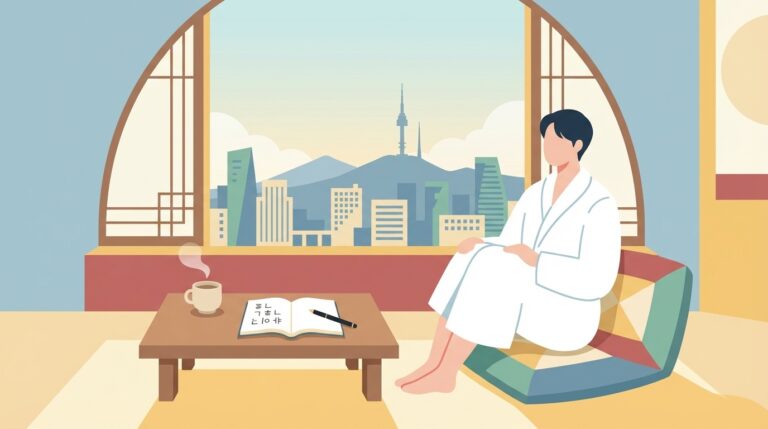
Imagine this classic K-Drama scene: The protagonist has just wrapped up a soul-crushing week. They’ve dealt with an unreasonable boss (the classic gapjil), skipped meals, and worked overtime. Do they just go home to sleep? No. The scene cuts to a sweeping shot of a luxurious hotel lobby. Our hero, now wearing a crisp white bathrobe, is sipping wine while looking out at the dazzling Seoul night skyline.
This isn’t just a drama trope; it’s a massive cultural phenomenon in Korea known as Hocance (호캉스).
In a society driven by the pali-pali (hurry-hurry) mindset, Koreans take their stress relief very seriously. When the burnout hits, they don’t always fly to a tropical island. Instead, they swipe their credit cards and check into a 5-star hotel right in the middle of the city. Why? To completely disconnect.
Today, we’re going to learn how to talk about rewarding yourself in Korean. Knowing these expressions won’t just help you book a nice room—it will make your Korean friends and colleagues nod in deep, emotional solidarity. Let’s dive into the vocabulary of ultimate self-care!
(Transparency note: This guide is crafted from real conversations with my B2-level students who wanted to sound completely natural when talking about their weekend escapes!)
Phase 2: Core Expressions Deep Dive
Let’s look at the absolute must-know phrases when you decide to treat yourself to a hotel getaway.
1. 이번 주말은 호캉스 할 거예요.
- Pronunciation: ibeon jumareun hokangseu hal geo-yeyo (Ee-bun joo-mahl-eun ho-kang-seu hal guh-yeh-yo)
- Meaning: Literal: I will do a ‘hotel vacance’ this weekend. / Real nuance: I am treating myself to a staycation at a hotel this weekend.
- K-Culture Moment: You say this on a Friday afternoon in the office breakroom. The moment the word “Hocance” leaves your lips, your coworkers will literally sigh with envy. It instantly communicates “I am unavailable, I am resting, do not contact me.”
- Editor’s Insight: Hocance is a portmanteau of Hotel + Vacance (the French word for vacation, widely used in Korea). You don’t “go” to a hocance; in Korean, you “do” (하다) a hocance.
- Situation Spectrum:
[🚫 절대 금지] ———— [⚠️ 주의] ———— [✅ 자유롭게]
- Close Friends (Casual): ✅ (호캉스 할 거야!)
- Coworkers (Semi-formal): ✅
- Strict Boss (Formal): ⚠️ (Might sound like you’re bragging, better to just say you are resting at home)
- 🤔 Think About It: Why do Koreans combine foreign words (Hotel + Vacance) to create new slang? How does using an English/French derivative make the activity sound more luxurious or modern?
2. 나에게 주는 보상이에요.
- Pronunciation: na-ege juneun bosang-ieyo (Nah-eh-geh joo-neun bo-sang-ee-eh-yo)
- Meaning: Literal: It is a reward given to myself. / Real nuance: I deserve this; I earned this treat.
- K-Culture Moment: Picture an idol on a V-Live stream eating an insanely expensive piece of Hanwoo (premium Korean beef) or checking into a suite. When fans ask why they are splurging, they’ll smile and say, “This is a reward to myself for finishing the tour.”
- Editor’s Insight: Korea has a strong work ethic, so spending a lot of money on yourself can sometimes feel guilty. Using the word 보상 (reward) justifies the expense. It tells others: “I worked hard enough to earn this.”
- Situation Spectrum:
[🚫 절대 금지] ———— [⚠️ 주의] ———— [✅ 자유롭게]
- Close Friends (Casual): ✅
- Coworkers (Semi-formal): ✅
- Elders/Strict Boss (Formal): ⚠️
- 🤔 Think About It: Do you have a specific phrase in your mother tongue that justifies treating yourself? How does it compare to the concept of “rewarding” oneself in Korean culture?
3. 푹 쉬다 가고 싶어요.
- Pronunciation: puk swida gago sipeoyo (Pook shwee-dah gah-go sheep-uh-yo)
- Meaning: Literal: I want to rest deeply and then go. / Real nuance: I’m here to completely unwind and do nothing.
- K-Culture Moment: You say this to the friendly hotel receptionist at check-in. It sets the tone. You aren’t here for sightseeing; you are here for pure healing.
- Editor’s Insight: The adverb 푹 (puk) is magical. It sounds exactly like what it means—dropping heavily onto a soft mattress. It means completely, deeply, and without interruption. Always pair it with resting (쉬다) or sleeping (자다).
- Situation Spectrum:
[🚫 절대 금지] ———— [⚠️ 주의] ———— [✅ 자유롭게]
- Anyone: ✅ (A universally understood and respected desire!)
Phase 3: Textbook vs. Real Korean
Let’s compare what you learned in the classroom with what you’ll actually hear at a trendy hotel in Gangnam.
| Situation | 📖 Textbook Korean | 🗣️ Real Korean | 💡 Why the difference? |
|---|---|---|---|
| Explaining weekend plans | 저는 호텔에 가서 쉴 것입니다. (I will go to a hotel to rest.) | 이번 주말엔 무조건 호캉스! (This weekend is unconditionally Hocance!) | Real Korean emphasizes the event (Hocance) rather than the literal action, adding a trendy vibe. |
| Splurging on yourself | 제가 열심히 일해서 선물을 삽니다. (I worked hard so I buy a gift.) | 나를 위한 플렉스(Flex)죠! (It’s a flex for myself!) | The hip-hop term ‘Flex’ has become mainstream slang for treating oneself without guilt. |
| Complimenting the room | 창문 밖 경치가 정말 아름답네요. (The scenery outside the window is very beautiful.) | 와, 여기 완전 뷰맛집이네! (Wow, this place is totally a view-restaurant!) | In modern slang, “맛집” (good restaurant) is added to anything excellent, like a good view! |
Bottom Note: At the B2 level, confidently throwing in words like 뷰맛집 or 플렉스 will instantly impress native speakers. Just remember to use them in casual or semi-formal settings!
Phase 4: Cultural Context — K-Culture Deep Dive
4-1. The Non-Verbal “Nunchi” of Resting
In Korea, even resting has an unspoken etiquette. When you return to the office on Monday after a luxurious Hocance, nunchi (reading the room) dictates that you don’t brag too much if your colleagues had a miserable weekend working. A humble “주말에 그냥 푹 쉬었어요” (I just rested well over the weekend) is often safer than showing off your 5-star room service photos right away.
4-2. The “Healing” Obsession (K-Travel & Society)
If you watch K-Dramas, you’ll notice characters constantly escaping to nice hotels, spas, or Jeju Island when they hit an emotional wall. This is rooted in the Korean concept of 힐링 (Healing).
Why a hotel in the same city you live in? Because traveling far means traffic jams (차 막힘) and planning (스트레스). A Hocance provides instant isolation. The ultimate goal is to order expensive room service, wear the hotel bathrobe, take an aesthetic photo for Instagram (the mandatory ‘bed shot’), and literally not step outside the building for 48 hours. It’s the ultimate counterbalance to Korea’s hyper-competitive society.
Phase 5: Real-Life Roleplay Scenario
Let’s put you in the protagonist’s seat.
Setting: It’s Friday, 6:00 PM. You and your Korean coworker, Min-su, have just submitted a massive, month-long project. You are both standing by the office coffee machine, looking completely drained.
Characters:
– YOU: A foreign professional working in Seoul, desperate for a break.
– Min-su (30): Your friendly, overworked Korean coworker.
Dialogue:
Min-su: 아… 드디어 끝났네요. 이번 주 진짜 죽는 줄 알았어요. 😫
(Ah… deudieo kkeutnanneyo. Ibeon ju jinjja jungneun jul arasseoyo.)
[Ah… it’s finally over. I thought I was going to die this week.]
YOU: 제 말이요. 수고 많으셨어요, 민수 씨.
(Je mariyo. Sugo maneusyeosseoyo, Minsu ssi.)
[Tell me about it. You worked so hard, Min-su.]
Min-su: 주말에 뭐 할 거예요? 약속 있어요?
(Jumare mwo hal geo-yeyo? Yaksok isseoyo?)
[What are you doing this weekend? Any plans?]
YOU: 아니요, 이번 주말은 무조건 호캉스 할 거예요.
(Aniyo, ibeon jumareun mujogeon hokangseu hal geo-yeyo.)
[No, this weekend I am absolutely doing a Hocance.]
Min-su: 와, 대박! 진짜 부럽다. 어느 호텔로 가요?
(Wa, daebak! Jinjja bureopda. Eoneu hotello gayo?)
[Wow, awesome! I’m so jealous. Which hotel are you going to?]
YOU: 강남에 있는 호텔이요. 나에게 주는 보상이에요.
(Gangname inneun hoteriyo. Na-ege juneun bosang-ieyo.)
[A hotel in Gangnam. It’s a reward to myself.]
Min-su: 맞아요, 그럴 자격 충분해요! 가서 뭐 할 거예요?
(Majayo, geureol jagyeok chungbunhaeyo! Gaseo mwo hal geo-yeyo?)
[You’re right, you totally deserve it! What are you going to do there?]
🔀 Your Turn! How will you answer?
– A) “하루 종일 푹 쉬다 올 거예요.” (I’m going to rest deeply all day.)
– B) “민수 씨도 같이 갈래요?” (Do you want to come with me, Min-su?)
– C) “수영장 가서 인스타 사진 찍어야죠!” (I need to go to the pool and take Insta pics!)✅ Best Choice: A — It perfectly aligns with the purpose of a Hocance.
⚠️ Choice B Analysis: Unless you and Min-su are romantically involved or extremely close same-sex friends, inviting a coworker on a Hocance is a massive cultural faux pas!
💡 Choice C Analysis: A very realistic and funny answer if you are close with Min-su!
Bonus Roleplay: At the Hotel Check-in
You: 예약했습니다. 제 이름은 [Name]입니다.
Staff: 네, 확인되셨습니다. 기본 시티뷰 객실이시네요.
You: 혹시… 남산타워가 보이는 뷰 좋은 방으로 배정해 주실 수 있나요? 푹 쉬다 가고 싶어서요.
(Hoksi… Namsan taweoga boineun byu joeun bang-euro baejeonghae jusil su innayo?)
[By any chance… could you assign a room with a nice view where I can see Namsan Tower? I want to get some deep rest.]
Phase 6: 10-Second Shadowing Drill
Speak out loud like a drama lead who just decided to treat themselves!
😤 이번 주말은 / (ibeon jumareun)
😤 무조건! / (mujogeon!)
😊 호캉스 하면서 / (hokangseu hamyeonseo)
😌 푹~~~ 쉴 거예요. / (puk~~~ swil geo-yeyo.)
Pro tip: Drag out the “푹” (puk~~~) to emphasize just how deeply you plan to rest!
Phase 7: K-Culture Mini Dictionary
| Korean | Romanization | English Meaning | Cultural Context |
|---|---|---|---|
| 호캉스 | hokangseu | Hotel + Vacance (Staycation) | The ultimate urban escape for stressed Koreans. |
| 소확행 | sohwakhaeng | Small but certain happiness | A lifestyle trend of finding joy in little things (like a nice hotel coffee) rather than grand goals. |
| 플렉스 | peullekseu | Flex (to show off / splurge) | Used when spending a lot of money on yourself without regret. |
| 뷰맛집 | byumatjip | View + Good Restaurant | Slang for any place (hotel, cafe) with an incredibly aesthetic view. |
| 힐링 | hilling | Healing | The act of recovering mental and physical energy through relaxing activities. |
Phase 8: Traveler Survival Kit
If you are actually booking a hotel in Korea right now, you MUST know these phrases.
🆘 Survival Expression #1: Late Check-out
– 🇰🇷 “체크아웃 시간 조금 연장할 수 있을까요?” (chekeu-aut sigan jogeum yeonjanghal su isseulkkayo?)
– 🗣️ Meaning: Could I extend the check-out time a little bit?
– 📍 Where to use: The front desk.🆘 Survival Expression #2: Luggage Storage
– 🇰🇷 “짐 좀 맡겨주실 수 있나요?” (jim jom matgyeojusil su innayo?)
– 🗣️ Meaning: Could you keep my luggage for a bit?
– 📍 Where to use: Front desk before check-in or after check-out.📌 Editor’s Travel Note
– Eco-Laws in Korea: Recently, the Korean government banned hotels (over 50 rooms) from providing free disposable toothbrushes and toothpaste. You must bring your own or buy them at the front desk! Don’t panic if your luxury bathroom is missing a toothbrush.
– Best Booking Apps: Koreans frequently use Yanolja (야놀자) or Yeogi Eottae (여기어때) alongside global apps like Agoda for the best local deals.
Phase 9: Critical Thinking Corner — “One Step Deeper”
🧠 Think Deeper: Media vs Reality — The Price of “Pali-Pali”
The glitz and glamour of a luxury Hocance shown in K-Dramas and on Instagram isn’t just about showing off wealth; it’s actually a mirror reflecting the intense pressure of Korean society. The pali-pali (hurry up) culture demands extreme productivity and long hours. Because everyday life is so fast-paced, resting isn’t just a casual evening on the couch—it requires an equally extreme, deliberate, and sometimes expensive “event” to forcefully disconnect from the pressure. A Hocance is essentially a temporary fortress against burnout.
💬 Your Turn:
How does your culture handle severe burnout? Do people splurge on luxury isolation, or is stress relief more about community and nature? Let me know in the comments!
Phase 10: FAQ & Avoiding Misunderstandings
Q: Can I just say “저는 호텔에 가요” (I go to a hotel)?
Yes, but it sounds slightly ambiguous. Native speakers might wonder, “Are you going for a business meeting? A wedding?” Saying “호캉스 하러 가요” instantly clarifies that it is 100% for leisure and self-care.
Q: Do I need to tip the hotel staff who bring my room service?
No! Korea is strictly a no-tip culture. Giving a tip to the bellboy or room service attendant might actually cause awkwardness. A polite “감사합니다” (Thank you) with a slight bow is all you need.
❌ Common Mistake: Saying “호텔 바캉스” (Hotel vacance).
✅ Do this instead: Always use the shortened slang “호캉스” (Hocance). Native speakers rarely say the full phrase!
Phase 11: Summary & Action Items
One-Liner Summary: When you need a break from the world, declare a 호캉스 (Hocance) and tell the world you are going to 푹 쉬다 (rest deeply) as a 보상 (reward) to yourself!
Action Mission:
– 🥉 Bronze: Say “나에게 주는 보상이에요” out loud three times while drinking your favorite coffee today.
– 🥈 Silver: Write a post on your social media or language learning app: “이번 주말엔 푹 쉬고 싶어요. 호캉스 추천해 주세요!” (I want to rest deeply this weekend. Please recommend a hocance!)
– 🥇 Gold: Actually go to a hotel in Korea (or your local city) and use the phrase “푹 쉬다 가겠습니다” to the receptionist!
🎧 K-Culture Mission:
Go to Instagram and search the hashtag #호캉스 or #뷰맛집. Scroll through the top posts to see what Koreans actually do in their hotel rooms (hint: lots of afternoon tea sets and infinity pools!).
What is your dream Hocance destination in Korea? A city-view in Seoul or an ocean-view in Busan? Let’s chat in the comments! 👇
Phase 12: Quiz — Interactive Challenge
Test your new “Healing” skills!
1. Situational Judgment: You just finished a 60-hour work week. Your friend asks why you booked an expensive hotel room. What is the most natural, native-sounding response?
A) 제가 호텔에 가는 이유는 잠을 자기 위해서입니다.
B) 나에게 주는 보상이야. 푹 쉴 거야.
C) 저는 부자라서 호텔에 갑니다.
2. True or False (K-Culture Edition):
“When you stay at a 5-star hotel in Seoul today, you will always find free disposable toothbrushes in the bathroom.”
3. Fill in the blank:
Wow, look at the night view from this hotel room! This place is totally a ________!
와, 이 호텔 야경 좀 봐! 여기 완전 ________이네!
(Answers)
Click to reveal answers!
1. B (It’s a reward to myself. I’m going to rest deeply.) A sounds like a robot, C sounds arrogant.
2. False. Due to recent eco-laws, large hotels in Korea no longer provide free disposable toothbrushes!
3. 뷰맛집 (byumatjip) – View restaurant!
Frequently Asked Questions (FAQ)
Q: What does "이번 주말은 호캉스 할 거예요." mean in Korean and how do you pronounce it?
A: In Korean, "이번 주말은 호캉스 할 거예요." is pronounced [ibeon jumareun hokangseu hal geo-yeyo (Ee-bun joo-mahl-eun ho-kang-seu hal guh-yeh-yo] and means: Literal: I will do a 'hotel vacance' this weekend. / Real nuance: I am treating myself to a staycation at a hotel this weekend.
Q: What does "나에게 주는 보상이에요." mean in Korean and how do you pronounce it?
A: In Korean, "나에게 주는 보상이에요." is pronounced [na-ege juneun bosang-ieyo (Nah-eh-geh joo-neun bo-sang-ee-eh-yo] and means: Literal: It is a reward given to myself. / Real nuance: I deserve this; I earned this treat.
Q: What does "푹 쉬다 가고 싶어요." mean in Korean and how do you pronounce it?
A: In Korean, "푹 쉬다 가고 싶어요." is pronounced [puk swida gago sipeoyo (Pook shwee-dah gah-go sheep-uh-yo] and means: Literal: I want to rest deeply and then go. / Real nuance: I’m here to completely unwind and do nothing.







