

Phase 1: Empathy & Immersion (Cold Open)
Hello there! It’s your Daily Hangul Editor.
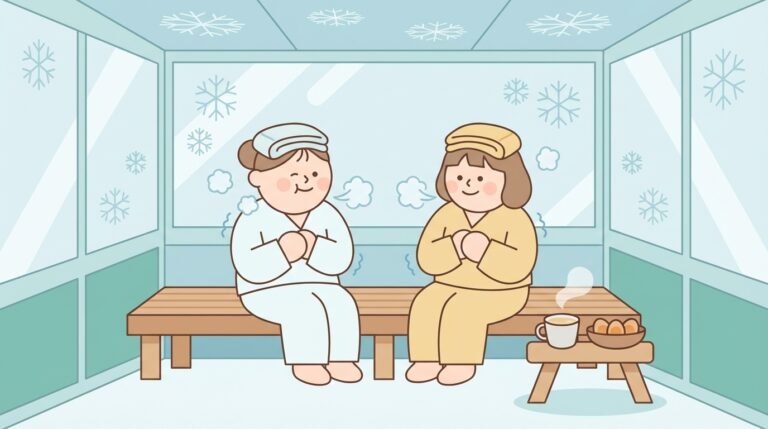
Picture this: You are watching your favorite Korean variety show (like Running Man), and the cast members are playing games in a Korean sauna, the Jjimjilbang (찜질방). After sweating buckets in a scorching 90-degree Celsius room, they sprint into a room covered in frost and ice. They shiver violently, wrap their arms around themselves, and scream…
“Ah! Si-won-ha-da! (It’s refreshing!)”
Wait, what? They just stepped into a giant freezer, and they are calling it “refreshing”? If you just translate it directly, it makes no sense. But once you understand the cultural magic of the Ice Room (아이스방), you’ll feel like a true Korean insider.
If you ever plan to visit Korea, going to a Jjimjilbang is an absolute must-do. But if you only know textbook Korean, you might miss out on the fun—or freeze in silence! Don’t worry, this guide is built from the real experiences of my beginner-level (A2) students who survived the Ice Room and lived to tell the tale. Let’s dive in!
Phase 2: Core Expressions Deep Dive
Here are the 3 essential expressions you need when you step into the Ice Room.
1. 아우, 너무 추워요!
- Pronunciation: a-u, neo-mu chu-wo-yo! [Sound-alike: Ah-ooh, no-moo choo-wuh-yo!]
- Meaning: Brr, it’s too cold! (Literal: Oh, very cold!)
- K-Culture Moment: You open the heavy Ice Room door, the frosty air hits your face, and you instinctively cross your arms. This is the exact phrase you say while doing a little bouncy dance to stay warm.
- Editor’s Insight: “아우” (a-u) is a natural Korean exclamation, like “Brr” or “Ugh.” Adding this makes you sound 100% native, rather than just mechanically saying “It is cold.”
- Situation Spectrum:
[🚫 Never] ———— [⚠️ Caution] ———— [✅ Freely]
- Close Friends (Casual): ✅ (Drop the ‘요’ -> 아우, 너무 추워!)
- Coworkers/Acquaintances (Semi-formal): ✅ (Keep the ‘요’)
- Boss/Elders (Formal): ⚠️ (Use without ‘아우’ to be polite: 너무 춥네요)
- 🤔 Think About It: Why do Koreans love adding sounds like “아우” or “아이고” before sentences? How do people express physical shock in your native language?
2. 으아~ 시원하다!
- Pronunciation: eu-a~ si-won-ha-da! [Sound-alike: Uh-ah~ shee-won-ha-dah!]
- Meaning: Ah, how refreshing! / That hits the spot!
- K-Culture Moment: K-Drama dads always say this! Whether they are drinking piping hot soup or stepping into a freezing ice room, the word is the same. It means the tension in your body is melting (or freezing) away.
- Editor’s Insight: To say this right, you have to drag out the first part: “Euuuu-ah!” It’s not just a temperature word; it’s a feeling of total relief.
- Situation Spectrum:
[🚫 Never] ———— [⚠️ Caution] ———— [✅ Freely]
- Close Friends (Casual): ✅
- Coworkers/Acquaintances (Semi-formal): ✅ (Change to 시원해요)
- Boss/Elders (Formal): ✅ (Change to 시원하네요)
- 🤔 Think About It: In English, “cool” can mean temperature or “awesome.” In Korean, “시원하다” means cool temperature, but also “relief.” Does your language have a temperature word with a double meaning?
3. 우리 이제 나갈까요?
- Pronunciation: u-ri i-je na-gal-kka-yo? [Sound-alike: oo-ree ee-jeh nah-gal-kka-yo?]
- Meaning: Shall we go out now?
- K-Culture Moment: You’ve been in the ice room for 2 minutes. Your nose is red. You look at your friend with desperate eyes. You don’t want to demand “Let’s leave!” because Koreans value harmony. So, you gently suggest it.
- Editor’s Insight: The “~(으)ㄹ까요?” (Shall we?) ending is the ultimate “Nunchi” (reading the room) grammar. It’s polite, indirect, and considerate of the other person’s feelings.
- Situation Spectrum:
[🚫 Never] ———— [⚠️ Caution] ———— [✅ Freely]
- Close Friends (Casual): ✅ (Drop ‘요’ -> 우리 이제 나갈까?)
- Coworkers/Acquaintances (Semi-formal): ✅
- Boss/Elders (Formal): ⚠️ (Better: 이제 나가시는 게 어떨까요?)
Phase 3: Textbook vs. Real Korean
Let’s see why your textbook might sound a bit robotic in a Jjimjilbang.
| Situation | 📖 Textbook Korean | 🗣️ Real Korean | 💡 Why is it different? |
|---|---|---|---|
| Expressing it’s cold | 온도가 매우 낮습니다. (The temp is very low.) | 아우! 너무 추워요! (Brr! Too cold!) | In real life, Koreans emphasize feelings with exclamations (아우) and adverbs (너무). |
| Feeling refreshed | 기분이 좋습니다. (I feel good.) | 아~ 시원하다! (Ah~ refreshing!) | “시원하다” captures the physical catharsis of temperature contrast. |
| Suggesting to leave | 저는 나가고 싶습니다. (I want to go out.) | 이제 나갈까요? (Shall we go out now?) | Direct statements sound selfish; suggesting (Shall we?) shows care for the group. |
Bottom Note: At the A2 level, mastering the “~을까요?” (Shall we?) form will instantly upgrade your Korean from “tourist” to “friendly local.”
Phase 4: Cultural Context — K-Culture Deep Dive
4-1. Non-Verbal Communication: The “Nunchi” of the Ice Room
The Ice Room is usually quite small—often just a tiny, frosted igloo-like space. This is where Nunchi (눈치, the subtle art of gauging others’ feelings) comes into play. If you see people waiting outside the glass door, the polite thing to do is to cool down for 2-3 minutes and step out so others can have a turn. Don’t treat it like a private lounge!
4-2. K-Culture Connection: The Sheep Head & Sweet Drinks
If you’ve watched K-Dramas like Crash Landing on You or Legend of the Blue Sea, you’ve seen the iconic Yang-meori (양머리, Sheep Head towel). Before you enter the Ice Room, you must roll your towel into this shape!
Also, the ultimate Jjimjilbang sequence is:
1. Sweat in the hot kiln (불가마).
2. Freeze in the Ice Room (아이스방).
3. Step out and immediately drink Sikhye (식혜, sweet rice punch) and crack open a Maekbanseok Gyeran (맥반석 계란, roasted egg) on your friend’s head. (Yes, really! It’s a classic K-variety show prank. But maybe do it gently!)
Phase 5: Real-Life Roleplay Scenario
Setting: A giant Jjimjilbang in Yongsan, Seoul. You and your Korean friend, Minsu (32, humorous and energetic), just spent 15 minutes in a 80°C salt room. You are sweating profusely. Minsu grabs your wrist and drags you into the heavy, frost-covered Ice Room.
Minsu: 와, 아이스방 가자! 빨리 빨리! 🥶
(wa, a-i-seu-bang ga-ja! ppal-li ppal-li!)
[Wow, let’s go to the ice room! Hurry, hurry!]
(🎭 Stage Direction: Minsu pushes the heavy door open. Cold white mist pours out.)
YOU: 헉! 아우, 너무 추워요! ❄️
(heok! a-u, neo-mu chu-wo-yo!)
[Gasp! Brr, it’s too cold!]
Minsu: 에이~ 으아, 시원하다! 안 그래요?
(e-i~ eu-a, si-won-ha-da! an geu-rae-yo?)
[Come on~ Ah, so refreshing! Right?]
🔀 Your Turn! How do you respond?
– A) 네, 아주 시원해요. (Yes, it is very refreshing.)
– B) 시원해요? 저는 얼어 죽을 것 같아요! (Refreshing? I feel like I’m going to freeze to death!)
– C) 온도가 낮습니다. (The temperature is low.)✅ Best Choice: B — “얼어 죽을 것 같아요” (eor-eo ju-geul geot ga-ta-yo / I feel like I’ll freeze to death) is a playful, extremely native exaggeration that Koreans use all the time in winter. It will definitely make Minsu laugh!
⚠️ Choice C Analysis: This sounds like a weather robot. Never use this in casual conversation.
(Continuing with Choice B)
YOU: 시원해요? 저는 얼어 죽을 것 같아요! 🥶
(si-won-hae-yo? jeo-neun eor-eo ju-geul geot ga-ta-yo!)
[Refreshing? I feel like I’m going to freeze to death!]
Minsu: ㅋㅋㅋ 알았어요. 우리 이제 나갈까요? 식혜 먹으러 가요!
(ㅋㅋㅋ a-rass-eo-yo. u-ri i-je na-gal-kka-yo? si-kye meo-geu-reo ga-yo!)
[Hahaha, okay. Shall we go out now? Let’s go drink Sikhye!]
YOU: 아싸! 좋아요. 계란도 먹어요!
(a-ssa! jo-a-yo. gye-ran-do meo-geo-yo!)
[Yay! Sounds good. Let’s eat eggs too!]
🎁 Bonus Roleplay: The Jjimjilbang Kiosk
(Outside the ice room, at the snack bar)
Clerk: 뭐 드릴까요? (What can I get you?)
YOU: 식혜 두 잔이랑 계란 세 개 주세요. (Two glasses of Sikhye and three eggs, please.)
Clerk: 네, 키(key) 대주세요. (Okay, please tap your key.)
YOU: (Taps the wristband on the scanner) 띡! (Beep!)
Phase 6: 10-Second Shadowing Drill
Let’s practice reading with the right feeling. Follow the slashes for pauses!
- 🥶 Shivering: 아우! / 너무 / 추워요!
(a-u! / neo-mu / chu-wo-yo!) - 😊 Relieved: 으아~ / 진짜 / 시원하다!
(eu-a~ / jin-jja / si-won-ha-da!) - 🥺 Pleading: 우리 / 이제 / 나갈까요?
(u-ri / i-je / na-gal-kka-yo?)
Phase 7: K-Culture Mini Dictionary
| Korean | Romanization | English | Context |
|---|---|---|---|
| 찜질방 | jjim-jil-bang | Korean dry sauna | A popular hangout spot, often open 24/7. |
| 아이스방 | a-i-seu-bang | Ice room | The freezing room used to close pores after sweating. |
| 양머리 | yang-meo-ri | Sheep head | A cute way to fold towels and wear them on your head. |
| 식혜 | si-kye | Sweet rice punch | The traditional sweet drink that is mandatory here! |
| 락커키 | rak-keo-ki | Locker key / Wristband | Used as a digital wallet to buy food inside. You pay the real money when you leave! |
Phase 8: Traveler Survival Kit 🆘
If you find yourself lost in a massive 5-story Jjimjilbang in Seoul, these expressions will save your life!
🆘 Survival Phrases
– 🇰🇷 “아이스방이 어디에 있어요?” (a-i-seu-bang-i eo-di-e is-seo-yo?)
– 🗣️ Meaning: Where is the ice room?
– 🇰🇷 “식혜 하나 주세요.” (si-kye ha-na ju-se-yo.)
– 🗣️ Meaning: One Sikhye, please.
– 🇰🇷 “결제는 이걸로 할게요.” (gyeol-je-neun i-geol-lo hal-ge-yo.)
– 🗣️ Meaning: I will pay with this (pointing to your wristband).📌 Editor’s Travel Note
– Cash vs. Wristband: Inside the Jjimjilbang, leave your wallet in your locker! Everything (food, massages, games) is charged by scanning your locker wristband. You pay the total bill at the front desk before you leave.
– Shoes: Never wear outdoor shoes inside! You take them off at the very entrance.
Phase 9: Critical Thinking Corner — “A Step Deeper”
🧠 Think Deeper: Food, Temperature, and Identity
Why do Koreans use the word “시원하다” (cool/refreshing) for both a freezing Ice Room and a boiling hot bowl of Kimchi stew? In Korean culture, true relief comes from “sweating it out” or “shocking the system” to release inner stress (화 – hwa). The sensation of extreme heat or extreme cold opening up your airways and relaxing your tired muscles is the ultimate “시원하다.” It’s not just a temperature; it’s the physical release of modern life’s stress.💬 Your Turn: Does your culture have a unique way of relieving stress? A sauna? A cold plunge? Tell me in the comments!
Phase 10: FAQ & Avoiding Common Mistakes
Q: Can I use “얼어 죽을 것 같아요” (I feel like I’ll freeze to death) with my Korean boss?
A: Maybe! It’s slightly dramatic. If your boss is cool and you are close, it’s funny. If it’s a strict environment, stick to “너무 춥네요” (It is very cold).
Q: How long should I stay in the Ice Room?
A: Usually just 2 to 5 minutes! It is meant to cool down your body quickly after the hot rooms. Don’t stay in there trying to sleep—you’ll catch a cold!
❌ Common Mistake #1: Saying “차가워요” (cha-ga-wo-yo) instead of “추워요” (chu-wo-yo).
✅ How to fix it: “차가워요” is used for objects you touch (like a cold drink). “추워요” is used for the air temperature or how your body feels. In the Ice Room, you say “너무 추워요!”
Phase 11: Summary & Action Items
🎯 One-Liner Summary: When you step into the Ice Room, shout “아우, 너무 추워요!” and suggest leaving politely with “우리 이제 나갈까요?”
🚀 Your Action Missions:
– 🥉 Bronze (Solo): Fold a towel into a “Sheep Head” (search YouTube!), put it on, and say “으아~ 시원하다!” to the mirror.
– 🥈 Silver (Online): Post a picture of your favorite cold weather drink in a learning community with the caption: “[Drink name] 마셔요. 아~ 시원하다!”
– 🥇 Gold (Real World): Visit a local Korean Spa/Jjimjilbang, go into the Ice Room, and use these exact phrases with your friends!
Phase 12: Interactive Quiz — Jjimjilbang Challenge
1. You just bought an ice-cold Sikhye. You hold the cup. Which word is correct?
A) 아, 추워요! (It’s cold! – air)
B) 아, 차가워요! (It’s cold! – object)
(Hint: Check Phase 10!)
2. True or False: You need to bring cash inside the sauna rooms to buy roasted eggs.
(Hint: Remember the wristband!)
3. Fill in the blank: Your friend has been in the Ice Room for 10 minutes. You want to leave. “우리 이제 ______?”
A) 갈래
B) 나갈까요
C) 춥습니다
Answers (Highlight to see):
[1: B – Use 차가워요 for objects! / 2: False – Use your locker key wristband! / 3: B – 나갈까요? is the polite way to suggest leaving.]
Good luck surviving the Ice Room! Let me know how your first Jjimjilbang trip goes! 🧖♀️🧖♂️❄️
Frequently Asked Questions (FAQ)
Q: What does "아우, 너무 추워요!" mean in Korean and how do you pronounce it?
A: In Korean, "아우, 너무 추워요!" is pronounced [a-u, neo-mu chu-wo-yo! [Sound-alike: Ah-ooh, no-moo choo-wuh-yo!] and means: Brr, it's too cold! (Literal: Oh, very cold!)
Q: What does "으아~ 시원하다!" mean in Korean and how do you pronounce it?
A: In Korean, "으아~ 시원하다!" is pronounced [eu-a~ si-won-ha-da! [Sound-alike: Uh-ah~ shee-won-ha-dah!] and means: Ah, how refreshing! / That hits the spot!
Q: What does "우리 이제 나갈까요?" mean in Korean and how do you pronounce it?
A: In Korean, "우리 이제 나갈까요?" is pronounced [u-ri i-je na-gal-kka-yo? [Sound-alike: oo-ree ee-jeh nah-gal-kka-yo?] and means: Shall we go out now?






