

Phase 1: Empathy (The K-Culture Cold Open)
Hello! I’m the Chief Editor of Daily Hangul.
Imagine this. You’re in Seoul. You just visited a gorgeous, Instagram-famous cafe in Seongsu-dong or Hongdae. You enjoyed your perfectly aesthetic Iced Americano and a thick slice of matcha cake. The vibe is immaculate, playing the latest K-Pop chill playlists. You’re having the time of your life.
But then… nature calls.
You confidently walk to the back of the cafe, looking for the restroom door. You find it, grab the handle, and… it doesn’t open. Instead, a digital keypad glares back at you. It’s locked. You look around, starting to sweat. It feels like a comedy scene straight out of a K-Drama where the main character is awkwardly hopping from foot to foot!
Why is it locked? How do you get in? If you don’t know the right expressions, this situation can turn from a relaxing cafe trip into a stressful puzzle.
Don’t worry! This guide is built from the real, slightly embarrassing, yet hilarious experiences of my beginner students. Today, we are going to learn exactly how to ask for the restroom and that all-important secret password like a true local.
Phase 2: Core Expressions Deep Dive
Let’s look at the absolute essential A1 phrases you need to survive the ‘Cafe Restroom Crisis.’
1. 화장실이 어디예요?
- Pronunciation: [hwa-jang-siri eo-di-ye-yo?] -> Sounds like: hwa-jang-shiri oh-dee-yeah-yo?
- Meaning: Where is the restroom? (Literal: Restroom where is it?)
- K-Culture Moment: In K-Dramas, when a character is on an awkward blind date, they often excuse themselves by politely asking the waiter this exact phrase to go hide in the restroom and text their friends for an escape plan!
- Editor’s Insight: The word ‘화장실 (hwa-jang-sil)’ literally means ‘makeup room’ (화장 = makeup, 실 = room). You don’t need to add ‘Excuse me’ at the front if you say it with a slightly raised, polite tone, but adding ‘저기요 (Excuse me)’ makes it perfect.
- Situation Spectrum:
[🚫 Never] ———— [⚠️ Caution] ———— [✅ Freely]
- Close Friends (Casual): 🚫 (Too formal, use ‘화장실 어디야?’)
- Cafe Staff/Strangers (Semi-formal): ✅ (Perfect and polite!)
- Boss/Elders (Formal): ✅ (Safe to use)
- 🤔 Think About It: Many cultures use euphemisms for the toilet (Restroom, Washroom, Loo). Why do you think Koreans call it a ‘makeup room’? Does your native language have a polite ‘code word’ for the toilet?
2. 비밀번호가 뭐예요?
- Pronunciation: [bi-mil-beon-hoga mwo-ye-yo?] -> Sounds like: bee-meal-bun-ho-gah mwoh-yeah-yo?
- Meaning: What is the password? (Literal: Secret number what is it?)
- K-Culture Moment: You will hear this not only in cafes but also in K-Dramas when someone is trying to enter their partner’s apartment for a surprise visit. ‘비밀 (Bi-mil)’ means secret, and ‘번호 (beon-ho)’ means number.
- Editor’s Insight: This phrase is a lifesaver. You can use it for restrooms, Wi-Fi, and even apartment doors. Just point at the keypad or your phone and say this!
- Situation Spectrum:
[🚫 Never] ———— [⚠️ Caution] ———— [✅ Freely]
- Close Friends (Casual): 🚫 (Use ‘비밀번호 뭐야?’)
- Cafe Staff/Strangers (Semi-formal): ✅ (Perfectly natural)
- Boss/Elders (Formal): ✅ (Good to go)
- 🤔 Think About It: Why do so many places in Korea require a ‘secret number’ instead of just a physical key? How does this reflect Korea’s fast-paced, digital-first lifestyle?
3. 영수증에 있어요?
- Pronunciation: [yeong-su-jeung-e i-sseo-yo?] -> Sounds like: young-soo-jeung-eh ee-so-yo?
- Meaning: Is it on the receipt?
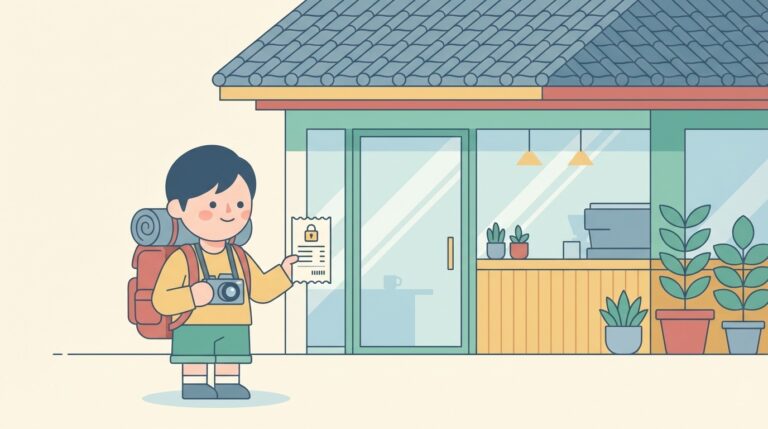
- K-Culture Moment: You order a towering Bingsu (shaved ice). The cashier hands you a long piece of paper. You usually throw it away, right? Stop! In Korea, that receipt is a treasure map. The Wi-Fi and restroom passwords are often printed at the very bottom.
- Editor’s Insight: If you ask for the password, the staff will often point to the receipt and say ‘네, 영수증 밑에 있어요’ (Yes, it’s at the bottom of the receipt). Asking this shows you really know Korean cafe culture!
- Situation Spectrum:
[🚫 Never] ———— [⚠️ Caution] ———— [✅ Freely]
- Close Friends (Casual): 🚫
- Cafe Staff/Strangers (Semi-formal): ✅
- Boss/Elders (Formal): ✅
- 🤔 Think About It: Why do cafes print passwords on receipts? It’s a clever way to ensure that only paying customers use their facilities. Have you seen this system in your country?
Phase 3: Textbook vs. Real Korean
| Situation | 📖 Textbook Korean | 🗣️ Real Korean | 💡 Why is it different? |
|---|---|---|---|
| Asking for the restroom | 화장실은 어디에 있습니까? (Where is the restroom located?) | 저기요, 화장실 어디예요? (Excuse me, restroom where?) | Real Korean drops unnecessary particles (‘은/는’) and uses the softer ‘-해요/예요’ ending instead of the rigid ‘-습니까’. |
| Asking for the password | 화장실의 비밀번호는 무엇입니까? (What is the password of the restroom?) | 비밀번호 뭐예요? (Password what is it?) | Koreans love efficiency! If you are standing near the restroom or holding a receipt, the context is obvious, so we just ask ‘What’s the password?’ |
| Asking for toilet paper | 화장실에 휴지가 비치되어 있습니까? (Is toilet paper provided in the restroom?) | 안에 휴지 있어요? (Is there tissue inside?) | Short, practical, and gets straight to the point before it’s too late! |
Bottom Note: For A1 beginners, don’t worry about speaking in long, perfect sentences. Noun + 어디예요? (Where is [Noun]?) is your ultimate cheat code!
Phase 4: Cultural Context — K-Culture Deep Dive
4-1. Non-Verbal Cues: The Art of Pointing
When you ask ‘화장실이 어디예요?’, the staff might be busy making espresso. They will often answer with their body language—pointing with their chin or gesturing with an open hand toward a specific corner or the exit. In Korea, it’s considered more polite to gesture with an open hand rather than pointing with one index finger!
4-2. The Quirky Reality of Korean Cafe Restrooms
Let’s connect this to your K-Travel experience!
The ‘Out of Building’ Restroom:
Many small cafes in Seoul don’t have a restroom inside. They share a restroom with the rest of the commercial building. When you ask where it is, the staff might say ‘밖에 있어요’ (It’s outside) and point to the building hallway.
The Giant Plushie Keychain:
Here is a hilarious, uniquely Korean phenomenon. If the restroom uses a physical key instead of a digital keypad, the cafe owner will attach the key to a massive object—a giant wooden spoon, a huge Ryan (Kakao Friends) plushie, or a plastic frying pan. Why? So you don’t accidentally put it in your pocket and take it home! Imagine walking through a cafe holding a giant stuffed bear just to go to the toilet. It’s a rite of passage for any traveler in Korea.
Phase 5: Real-Life Roleplay Scenario
Setting: Saturday afternoon. A busy, trendy cafe in Yeonnam-dong. You just ordered your drink, but you really need to use the restroom. The barista looks friendly but busy.
Characters:
– YOU: A traveler exploring Seoul, slightly desperate for the restroom.
– Ji-ah (20s): The friendly cafe barista.
Dialogue:
Ji-ah: 주문하시겠어요? ☕️
(jumunhasigesseoyo?)
[Would you like to order?]
YOU: 아이스 아메리카노 하나 주세요.
(aiseu amerikano hana juseyo.)
[One Iced Americano, please.]
Ji-ah: 네, 영수증 여기 있습니다.
(ne, yeongsujeung yeogi itseumnida.)
[Yes, here is your receipt.]
(🎭 Stage Direction: Ji-ah hands you a long piece of paper. You almost throw it away.)
YOU: 저기요, 화장실이 어디예요?
(jeogiyo, hwajangsiri eodiyeyo?)
[Excuse me, where is the restroom?]
Ji-ah: 가게 밖에 있어요. 오른쪽 건물 입구로 가세요.
(gage bakke isseoyo. oreunjjok geonmul ipguro gaseyo.)
[It’s outside the shop. Go to the building entrance on the right.]
🔀 YOUR TURN! How do you reply?
– A) “감사합니다!” (Runs out without checking the door type)
– B) “비밀번호가 뭐예요?” (Asks for the password smartly)
– C) “휴지 있어요?” (Asks for toilet paper)✅ Best Choice: B — Because it’s an outside building restroom, it is 99% locked! If you pick A, you will run outside, find a locked door, and have to walk all the way back in shame.
(Let’s assume you chose B!)
YOU: 아, 비밀번호가 뭐예요?
(a, bimilbeonhoga mwoyeyo?)
[Ah, what is the password?]
Ji-ah: 비밀번호는 영수증 아래에 써 있어요.
(bimilbeonhoneun yeongsujeung araee sseo isseoyo.)
[The password is written at the bottom of the receipt.]
(🎭 Stage Direction: Ji-ah points to the receipt you are holding.)
YOU: 아! 찾았어요. 감사합니다.
(a! chajasseoyo. gamsahamnida.)
[Ah! I found it. Thank you.]
Ji-ah: 화장실 안에 휴지가 없어요. 카운터 옆에서 가져가세요.
(hwajangsil ane hyujiga eopseoyo. kaunteo yeopeseo gajyeogaseyo.)
[There is no toilet paper inside. Please take some from next to the counter.]
YOU: 네, 알겠습니다!
(ne, algetseumnida!)
[Yes, understood!]
Phase 6: 10-Second Shadowing Drill
Practice speaking like a local! Follow the slashes (/) for pauses and the emotions for intonation.
🥺 Polite & Urgent:
저기요, / 화장실이 / 어~~~디예요?
(jeogiyo, / hwajangsiri / eo~~~diyeyo?)
🧐 Curious:
화장실 / 비밀번호가 / 뭐~~~예요?
(hwajangsil / bimilbeonhoga / mwo~~~yeyo?)
😊 Relieved:
아! / 영수증에 / 있네요!
(a! / yeongsujeunge / inneyo!)
Phase 7: K-Culture Mini Dictionary
| Korean | Romanization | English | Context |
|---|---|---|---|
| 화장실 | hwa-jang-sil | Restroom/Toilet | Literally ‘makeup room’. Used for all toilets. |
| 비밀번호 | bi-mil-beon-ho | Password | Used for restrooms, Wi-Fi, and digital door locks. |
| 영수증 | yeong-su-jeung | Receipt | The magical paper holding Wi-Fi and toilet passwords. |
| 휴지 | hyu-ji | Tissue/Toilet Paper | Always check if you need to bring this before leaving the cafe! |
| 와이파이 | wa-i-pa-i | Wi-Fi | Korea runs on fast Wi-Fi. Passwords are often numeric. |
Phase 8: Traveler’s Survival Kit
Since finding a restroom is the ultimate travel survival skill, here are the top phrases and tips you must know!
🆘 Survival Phrase #1: Finding Toilet Paper
– 🇰🇷 “안에 휴지 있어요?” (ane hyuji isseoyo?)
– 🗣️ Sounds like: ahn-eh hyu-jee ee-so-yo?
– 📍 Where to use: Before you leave the cafe to go to the outside restroom.
– 💡 Pro Tip: Some older buildings do not stock toilet paper inside the stalls. You must grab it from a large dispenser near the cafe counter before you go!🆘 Survival Phrase #2: Wi-Fi Check
– 🇰🇷 “와이파이 비밀번호 뭐예요?” (waipai bimilbeonho mwoyeyo?)
– 🗣️ Sounds like: wai-pai bee-meal-bun-ho mwoh-yeah-yo?
– 📍 Where to use: Any cafe, restaurant, or hotel.
– 💡 Pro Tip: Often written on the cafe counter as “ID: U+Net… / PW: …”📌 Editor’s Travel Note
– Best App: Need a restroom but not in a cafe? Use KakaoMap or Naver Map and search ‘개방 화장실’ (Public Restroom) or just look for subway stations. Korean subway restrooms are free, clean, and amazing!
– The Trash Can Rule: In modern restrooms, flush your toilet paper! But in older buildings, you might see a sign asking you to put it in a small trash bin. Follow the signs!
Phase 9: Critical Thinking Corner — “One Step Deeper”
Space and Trust in Korea (미디어 vs 현실)
Foreigners are often amazed by Korea’s ‘cafe culture trust.’ You can leave a $2,000 MacBook and your wallet on a cafe table to go to the restroom, and nobody will steal it. It’s a famous phenomenon!
But ironically, when you get to the restroom, the door is locked tightly with a digital password, and the toilet paper might be kept at the cafe counter. Why is a laptop safe, but the restroom is heavily guarded?
It comes down to maintenance and hygiene. Korean cafes take pride in offering clean spaces. Locking the shared restroom ensures that only customers use it, keeping it perfectly clean. The trust applies to personal belongings among citizens, but public facility management is strictly controlled to maintain high standards!
💬 Your Turn: In your culture, are public cafe restrooms usually locked with a code, or open to anyone walking in? Tell me in the comments!
Phase 10: FAQ & Avoiding Mistakes
Q: Can I use a cafe’s restroom without buying anything?
A: Generally, no. It’s considered quite rude in Korea, which is exactly why they put the password on the receipt! If it’s a true emergency, you should buy a quick bottled water or an Americano.
Q: What if the password has a symbol like ‘1234‘ on the receipt?
A: You must press the star () on the keypad too! It’s part of the password.*
Q: Can I just ask “Toilet?” in English?
*A: Yes, many Koreans understand “Toilet” or “Restroom,” but saying “화장실어디예요?” will get you a much warmer, appreciative smile!
❌ Common Mistake #1: Pointing at the barista directly with one finger while asking where the restroom is.
✅ Do this instead: Keep your hands neutral or gesture politely with an open palm toward the back of the store.
Phase 11: Summary & Action Items
One-Liner Summary: Never let a locked door stop you—just ask “화장실 비밀번호 뭐예요?” and check your receipt!
Action Mission:
– 🥉 Bronze (Solo): Stand in front of a mirror and ask “화장실이 어디예요?” 3 times with a slightly desperate but polite face.
– 🥈 Silver (Online): Go to a Korean learning forum or our comment section and write “저는 카페 화장실 비밀번호를 알아요!” (I know the cafe restroom password!).
– 🥇 Gold (Real Life): Next time you are in a Korean cafe (or a local Koreatown cafe), find the password on the receipt without asking the staff!
K-Culture Mission:
Next time you watch a K-Drama, pay attention to the cafe scenes. Look closely at the tables—can you spot the little white receipt holding the secret password?
Phase 12: Interactive Quiz!
Let’s test your survival skills.
1. Situational Judgment: You are at a cafe. You walk to the restroom outside, but there is a keypad. What is the FIRST thing you should check before walking back to the barista?
– A) Your wallet
– B) Your cafe receipt
– C) KakaoMap
(Hint: The answer is B! The password is often printed at the bottom!)
2. Fill in the Blank:
“Excuse me, what is the password?”
-> 저기요, _______(이/가) 뭐예요?
(Answer: 비밀번호 – bimilbeonho)
3. True or False – K-Culture Edition:
“In Korea, if a cafe gives you a giant stuffed animal with a key attached, you get to keep the stuffed animal as a gift.”
(Answer: FALSE! Please return the giant Ryan plushie to the barista, or they will be very sad!)
Did you get them all right? Let me know your score in the comments below!
Frequently Asked Questions (FAQ)
Q: What does "화장실이 어디예요?" mean in Korean and how do you pronounce it?
A: In Korean, "화장실이 어디예요?" is pronounced [hwa-jang-siri eo-di-ye-yo?] and means: Where is the restroom? (Literal: Restroom where is it?)
Q: What does "비밀번호가 뭐예요?" mean in Korean and how do you pronounce it?
A: In Korean, "비밀번호가 뭐예요?" is pronounced [bi-mil-beon-hoga mwo-ye-yo?] and means: What is the password? (Literal: Secret number what is it?)
Q: What does "영수증에 있어요?" mean in Korean and how do you pronounce it?
A: In Korean, "영수증에 있어요?" is pronounced [yeong-su-jeung-e i-sseo-yo?] and means: Is it on the receipt?






