

Phase 1: Empathy (Welcome to the Daily Grind)
Hello! This is the Lead Editor of Daily Hangul.
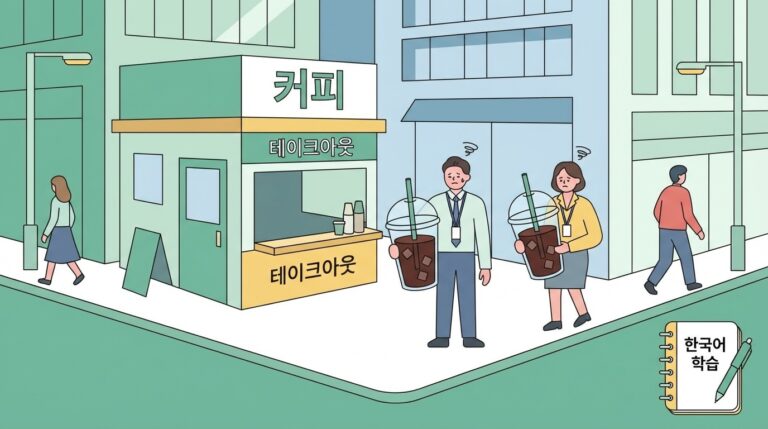
Picture this: It’s 8:30 AM in Yeouido or Gangnam. A sea of office workers, all wearing lanyards, speed-walking from the subway station to their towering office buildings. But look closely at their hands—almost everyone is clutching a massive, 1-liter plastic cup of Iced Americano.
You might be wondering: “How does a coffee shop survive selling a coffee the size of my head for only 1,500 won (about $1.15)?” And why are there literally three of these ultra-cheap, mega-sized coffee franchises right next to each other on a single block?
If you’ve ever lived in or visited Korea, you’ve definitely noticed the explosion of low-cost, high-capacity coffee brands like Mega Coffee, Compose Coffee, and Paik’s Coffee. But as an advanced (C2) Korean learner, ordering an “Americano” is no longer enough for you. To truly understand Korea’s modern corporate hustle and consumer behavior, you need to understand the business and cultural vocabulary behind this caffeine phenomenon.
Today, we aren’t just learning cafe phrases. We are diving deep into the economic survival models of Korean cafes and the socio-linguistic terms that native Koreans use to describe them. Get ready to sound like a true Seoulite!
Phase 2: Core Expressions Deep Dive
To talk about Korea’s giant coffee boom, you need these high-level expressions in your arsenal.
1. 박리다매 (Low margin, high volume)
- Pronunciation: [bang-ni-da-mae] -> Sounds like: “bang-nee-dah-meh” (Note the nasal assimilation: 박리 becomes 방니).
- Meaning: Literal: “Thin profit, many sales.” Real nuance: The business strategy of selling goods at a low profit margin but in massive quantities to generate overall profit.
- K-Culture Moment: This is the exact business model of Korea’s low-cost coffee franchises. When you and your Korean coworkers are discussing how a tiny kiosk pays Seoul’s exorbitant rent while selling $1 coffees, someone will inevitably say, “거긴 완전 박리다매잖아요” (That place is totally running on a low-margin, high-volume model).
- Editor’s Insight: This isn’t just a dry economics term. Koreans use this four-character idiom (Sajaseongeo) casually in everyday conversations to describe anything from a cheap local buffet to a booming online shopping mall.
- Situation Spectrum:
[🚫 절제] ———— [⚠️ 주의] ———— [✅ 자유롭게]
- Casual with friends: ✅
- Business/Semi-formal: ✅ (Highly appropriate)
- Formal/Elders: ✅
- 🤔 Think About It: Why are four-character Chinese idioms (Sajaseongeo) still so prevalent in modern Korean business talk? How does using them elevate your perceived fluency?
2. 회전율 (Turnover rate)
- Pronunciation: [hoe-jeon-nyul] -> Sounds like: “hweh-jeon-nyool”
- Meaning: The rate at which tables or customers turn over in a restaurant or cafe.
- K-Culture Moment: You walk into a cheap franchise cafe, and there are only three tiny, uncomfortable tables. This isn’t poor interior design; it’s a calculated move to maximize 회전율 (turnover rate). They want you to take your coffee and leave so the next customer can order.
- Editor’s Insight: If you sit at a small cafe for 4 hours studying with one cheap coffee, you are hurting their 회전율. In Korea, being mindful of a small business owner’s turnover rate is considered good nunchi (social tact).
- Situation Spectrum:
[🚫 절제] ———— [⚠️ 주의] ———— [✅ 자유롭게]
- Casual with friends: ✅
- Business/Semi-formal: ✅
- Formal/Elders: ✅
- 🤔 Think About It: Korea’s “Ppalli-ppalli” (hurry-hurry) culture is world-famous. How is the concept of ‘회전율’ essentially the economic embodiment of this cultural trait?
3. 카페인 수혈 (Caffeine Blood Transfusion)
- Pronunciation: [ka-pe-in su-hyeol] -> Sounds like: “kah-peh-een soo-hyull”
- Meaning: Literal: “Caffeine blood transfusion.” Real nuance: Desperately needing a coffee to survive the workday; getting your caffeine fix.
- K-Culture Moment: It’s 2:00 PM. The post-lunch food coma hits the office. Your junior colleague walks in with a carrier full of 1-liter Iced Americanos and sighs, “아, 진짜 수혈이 시급했어요” (Ah, I seriously needed a transfusion right now).
- Editor’s Insight: This slang vividly captures the reality of Korean corporate life. Coffee isn’t a leisurely afternoon luxury; it is medical-grade life support required to endure overtime.
- Situation Spectrum:
[🚫 절제] ———— [⚠️ 주의] ———— [✅ 자유롭게]
- Casual with friends: ✅
- Coworkers (same level/junior): ✅
- Boss/Formal: 🚫 (Keep it professional with the boss, unless they have a great sense of humor)
- 🤔 Think About It: Why does modern slang often use extreme medical or survival metaphors (like ‘transfusion’ or ‘resuscitation’) to describe daily habits?
Phase 3: Textbook vs Real Korean
Let’s see how C2-level real-world expressions differ from intermediate textbooks.
| Situation | 📖 Textbook Korean | 🗣️ Real Korean (C2) | 💡 Why the difference? |
|---|---|---|---|
| Explaining a cheap cafe’s survival | “이 카페는 커피를 많이 팔아서 돈을 멉니다.” | “여긴 박리다매로 승부 보는 곳이에요.” | Native speakers use business idioms to summarize complex concepts efficiently. |
| Complaining about lack of seats | “손님이 너무 오래 앉아 있습니다.” | “여긴 회전율이 생명인데 카공족이 너무 많네.” | ‘카공족’ (Cafe study tribe) + ‘회전율’ creates a culturally specific economic critique. |
| Needing a coffee urgently | “저는 너무 피곤해서 커피를 마셔야겠습니다.” | “와, 오늘 야근각이다. 아아 수혈 시급함.” | ‘수혈’ adds dramatic, relatable humor to the sheer exhaustion of office life. |
Bottom Note: At the C2 level, your goal is to integrate these sociological and business terms smoothly into casual banter. It shows you don’t just know Korean words; you know Korean life.
Phase 4: Cultural Context — K-Culture Deep Dive
4-1. The Unspoken Rules of the Kiosk
When ordering at these low-cost franchises, the interaction is almost entirely non-verbal. You will face a giant touchscreen 키오스크 (Kiosk). The nunchi rule here? Speed. If there is a line of office workers behind you during the 12:30 PM lunch rush, do not linger on the menu. Know your order, tap quickly, insert your card, and step aside. Hesitation is the enemy of 회전율!
4-2. The K-Drama Tropes vs. Reality
K-Drama Connection: In Korean dramas, you often see the CEO protagonist sipping a tiny espresso in an empty, luxurious, minimally decorated cafe. But the reality of the Korean workforce? It’s the supporting characters—the exhausted interns and middle managers—hauling plastic carriers of 1-liter “Mega” coffees back to their cubicles.
Critical View: The media often portrays Korean cafe culture as highly aesthetic and romantic (Insta-worthy). While those cafes exist, the true backbone of daily Korean coffee consumption is hyper-utilitarian. It’s about volume, speed, and cost-effectiveness (가성비).
Phase 5: Real-Life Roleplay Scenario
Setting: Tuesday, 12:45 PM. The bustling business district of Gwanghwamun. You and your Korean colleague, Min-su, just finished a spicy Kimchi Jjigae lunch. You offer to buy coffee for the team of five, heading toward a pricey specialty roaster.
Characters:
– YOU: An expat manager who wants to treat the team.
– Min-su (32): Your practical, friendly Korean coworker who knows you’re paying out of pocket.
Dialogue:
YOU: 민수 씨, 제가 커피 쏠게요. 저기 앞 로스터리 카페로 갈까요? ☕
(Min-su ssi, jaega keopi ssolgeyo. Jeogi ap roseuteori kapero galkkayo?)
[Min-su, I’ll treat us to coffee. Shall we go to the roastery cafe over there?]
Min-su: 에이, 팀장님. 팀원도 다섯 명인데 거긴 너무 비싸요. 그냥 저기 테이크아웃 전문점으로 가요!
(Ei, timjangnim. Timwondo daseon myeonginde geogin neomu bissayo. Geunyang jeogi teikeuaut jeonmunjeomeuro gayo!)
[Hey, Manager. There are five of us, that place is too expensive. Let’s just go to the takeout franchise over there!]
YOU: 아, 저렇게 큰 사이즈를 2천 원에 팔면 남는 게 있나요?
(A, jeoreoke keun saijeureul icheon wone palmyeon namneun ge innayo?)
[Ah, if they sell such huge sizes for 2,000 won, do they even make a profit?]
Min-su: 거긴 박리다매로 장사하는 곳이잖아요. 가게도 작아서 월세도 덜 나갈 거고요.
(Geogin bangnidamaero jangsahaneun gosijanayo. Gagedo jagaseo wolsedo deol nagal geogoyo.)
[That place does business on a low-margin, high-volume model. The shop is small too, so rent is probably lower.]
YOU: 아하, 하긴 여긴 앉을 자리도 없어서 회전율은 엄청 빠르겠네요.
(Aha, hagin yeogin anjeul jarido eopseoseo hoejeonnyureun eomcheong ppareugenneyo.)
[Aha, true, there’s no place to sit here, so their turnover rate must be incredibly fast.]
Min-su: 맞아요. 그리고 오늘 오후에 회의 엄청 길잖아요. 다들 대용량으로 카페인 수혈 좀 해야 버틸 수 있어요.
(Majayo. Geurigo oneul ohue hoeui eomcheong giljanayo. Dadeul daeyongnyangeuro kapein suhyeol jom haeya beotil su isseoyo.)
[Exactly. And we have a super long meeting this afternoon. Everyone needs a massive caffeine transfusion to survive it.]
🔀 Your Turn! How do you respond to Min-su at the kiosk?
– A) “그래요. 그럼 제가 여기서 결제할게요. 다들 아이스 아메리카노 맞죠?” (Practical and generous)
– B) “안 돼요! 제가 좋은 거 사주고 싶어서 그래요. 무조건 로스터리로 갑시다!” (Stubbornly generous)
– C) “오, 싸네요. 그럼 민수 씨가 사세요!” (Joking, but potentially awkward)✅ Best Choice: A — Reason: In Korean work culture, when a senior offers to pay, a junior will often suggest a cheaper option out of politeness and consideration for the senior’s wallet. Acknowledging their consideration while still insisting on paying (Choice A) shows excellent leadership and cultural fluency.
⚠️ Choice B Analysis: While your intentions are good, forcing an expensive option when the team genuinely just wants a quick, giant iced coffee to survive a meeting might come off as not reading the room (nunchi).
Phase 6: 10-Second Shadowing Drill
Let’s practice the intonation of a stressed office worker.
😫 아, / 진짜 / 오늘 야근각인데, / 얼른 / 아이스 아메리카노로 / 수혈 좀 / 해야겠어요!
(Ah, / jinjja / oneul yageungaginde, / eolleun / aiseu amerikanoro / suhyeol jom / haeyagesseoyo!)
Pro-Tip: Elongate the “진~짜” and let out a heavy sigh before “수혈”. It makes you sound 100% native!
Phase 7: K-Culture Mini Dictionary
| Korean | Romanization | English | Contextual Meaning |
|---|---|---|---|
| 가성비 | gaseongbi | Cost-effectiveness | “Price-to-performance ratio.” The holy grail of Korean consumerism. Mega coffee is the king of 가성비. |
| 카공족 | kagongjok | Cafe study tribe | People who study or work in cafes for hours. The natural enemy of low-cost cafes relying on high 회전율. |
| 얼죽아 | eoljuga | Iced Americano even if I freeze to death | The cultural stubbornness of Koreans drinking Iced Americanos even in minus 10-degree winter weather. |
| 키오스크 | kioseukeu | Kiosk | The touch-screen ordering machines that have completely taken over Korean food and beverage franchises. |
Phase 8: Traveler’s Survival Kit (Kiosk Edition)
Navigating a Korean cafe kiosk when you want a cheap, giant coffee can be daunting due to the “Options” menu.
🆘 Survival Phrases for Kiosk/Counter Adjustments
– 🇰🇷 “샷 추가해 주세요.” (syat chugahae juseyo) – Add an espresso shot.
– 🇰🇷 “얼음 적게 넣어주세요.” (eoreum jeokge neoeojuseyo) – Less ice, please.
– 🇰🇷 “연하게 타주세요.” (yeonhage tajuseyo) – Make it weak (usually means only 1 shot instead of 2).📌 Editor’s Travel Note:
– No Cash: Most low-cost franchises are “카드 전용” (Card Only).
– Takeout Discount: Many places display a cheaper price on the banner outside, but if you select “매장” (Dine-in) on the kiosk, the price increases by 500~1,000 won!
Phase 9: Critical Thinking Corner — “One Step Deeper”
🧠 Think Deeper: Media vs Reality & The “Pali-Pali” Capitalism
The 1-liter Iced Americano is more than just a beverage; it is a profound reflection of modern Korean society. While the global image of Korea often highlights aesthetic cafes and slow-living vlogs, the reality of the urban workforce is hyper-competitive. The sheer success of the “Low margin, high volume” (박리다매) business model relies on a society that demands cheap, fast, and potent fuel to sustain incredibly long working hours. The coffee is served iced so it can be consumed quickly without burning the tongue—perfect for the “Palli-palli” (hurry up) lifestyle. It is capitalism synthesized into a plastic cup.
💬 Your Turn: Does your culture treat coffee as a relaxing luxury or as a survival tool? Are there giant, low-cost coffee franchises in your country, or do people prefer sitting down for hours? Share your thoughts in the comments!
Phase 10: FAQ & Common Mistakes
❌ Common Mistake #1: Expecting a comfortable seat or a restroom in a cheap franchise cafe.
✅ Do this instead: Understand that these brands operate on maximum 회전율 and minimal square footage. They are strictly grab-and-go!
Q: Can I tell my boss, “부장님, 수혈 좀 하시죠?” (Boss, let’s get a transfusion?)
A: Maybe. It highly depends on your relationship. If your boss is young, trendy, and you have a close relationship, it’s a hilarious and witty thing to say. If your boss is traditional and strict, stick to “커피 한 잔 드시겠습니까?” (Would you like a cup of coffee?).
Q: Why do Koreans drink so much Iced Americano specifically?
A: Several theories exist! 1) The intense spice and heat of Korean food (like Kimchi Jjigae) make people crave cold drinks afterward. 2) High workplace stress causes “Hwabyung” (heat in the chest), so they drink cold things to cool down. 3) You can drink it faster than hot coffee!
Phase 11: Summary & Action Items
☕ One-Liner Summary: The massive cups of cheap Korean coffee aren’t just beverages; they are the high-turnover (회전율), volume-driven (박리다매) fuel for a hyper-competitive society.
Action Mission 3 Steps:
– 🥉 Bronze (Solo): Look at a map of Seoul on Google/Naver Maps, zoom into a busy subway station, and count how many ‘Mega Coffee’ or ‘Compose Coffee’ locations you can spot.
– 🥈 Silver (Online): Write a comment below using the word 박리다매 to describe a business model in your own country.
– 🥇 Gold (Real World): Next time you are in Korea or at a Korean cafe, confidently use the phrase “아아 수혈 시급해요” with your Korean friends!
K-Culture Mission: Watch any modern office K-Drama (like Misaeng or Business Proposal). Count how many times you see employees carrying massive plastic coffee cups instead of actual mugs!
Phase 12: Quiz — Interactive Challenge
1. Situational Judgment: You are opening a tiny takeout cafe in Gangnam. Your rent is incredibly high, so you decide to sell Americanos for 1,500 won but aim to sell 1,000 cups a day. What is this strategy called in Korean?
– A) 가성비 (Gaseongbi)
– B) 박리다매 (Bangnidamae)
– C) 카페인 수혈 (Kapein suhyeol)
2. True or False – K-Culture Edition:
If you buy a 1,500 won coffee at a small franchise, it is totally acceptable and culturally polite to sit at their only table with your laptop for 5 hours.
3. Fill in the Blank:
“식당에 자리가 없지만, 여기는 _____(이/가) 높아서 금방 자리가 날 거예요!”
(There are no seats in the restaurant, but the ________ is high, so a seat will open up soon!)
(Answers: 1. B, 2. False – This ruins their 회전율!, 3. 회전율)
Frequently Asked Questions (FAQ)
Q: What does "박리다매 (Low margin, high volume)" mean in Korean and how do you pronounce it?
A: In Korean, "박리다매 (Low margin, high volume)" is pronounced [bang-ni-da-mae] and means: Literal: "Thin profit, many sales." Real nuance: The business strategy of selling goods at a low profit margin but in massive quantities to generate overall profit.
Q: What does "회전율 (Turnover rate)" mean in Korean and how do you pronounce it?
A: In Korean, "회전율 (Turnover rate)" is pronounced [hoe-jeon-nyul] and means: The rate at which tables or customers turn over in a restaurant or cafe.
Q: What does "카페인 수혈 (Caffeine Blood Transfusion)" mean in Korean and how do you pronounce it?
A: In Korean, "카페인 수혈 (Caffeine Blood Transfusion)" is pronounced [ka-pe-in su-hyeol] and means: Literal: "Caffeine blood transfusion." Real nuance: Desperately needing a coffee to survive the workday; getting your caffeine fix.







