Phase 1: Empathy (Immersive Opening)
Hello! I’m the lead editor of Daily Hangul.
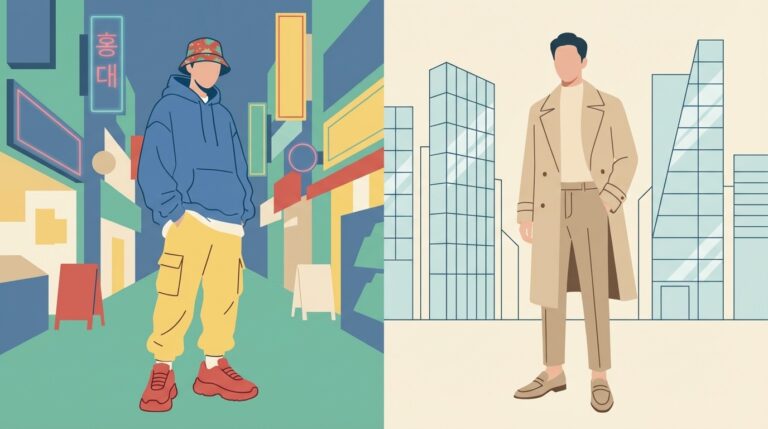
Imagine this: You step out of Hongdae Station Exit 9 on a Friday evening. The streets are a runway of oversized vintage jackets, neon beanies, and chunky boots. It feels like you’ve walked straight into a trendy K-Pop music video. But the next day, you head over to Gangnam Station Exit 10. Suddenly, the vibe shifts completely. You’re surrounded by sleek slacks, tailored coats, neutral tones, and subtle designer bags. It’s the classic wealthy K-Drama protagonist aesthetic.
Have you ever wondered why these two iconic Seoul neighborhoods have such completely different dress codes? In Korea, fashion is more than just clothes; it’s a language. If you don’t understand the vocabulary of Korean fashion trends, you might find yourself feeling either heavily underdressed at a Gangnam cafe or awkwardly formal at a Hongdae indie club.
Today, we are diving deep into the fashion styles of Hongdae and Gangnam. This guide is built from the real experiences of my B2 students who learned the hard way that knowing how to compliment someone’s outfit can make you an instant ‘Insider’ (인싸) in Korea!
Phase 2: Core Expression Deep Dive
Let’s learn the exact words Koreans use to describe these contrasting vibes.
1. 꾸안꾸 (The Gangnam Aesthetic)
- Pronunciation: kku-an-kku [sounds like the quick, staccato clicks of a camera]
- Meaning: Effortlessly chic (Literal: Decorated but not decorated)
- K-Culture Moment: Think of a K-Drama actress arriving at the airport. She’s wearing a “simple” white tee, a beige trench coat, and minimal makeup. It looks like she just rolled out of bed, but that “natural” look actually took two hours and an expensive stylist. That is the essence of kku-an-kku.
- Editor’s Insight: This is an abbreviation for 꾸민 듯 안 꾸민 듯 (As if decorated, but not decorated). It’s the ultimate compliment for Gangnam style, which values sophisticated subtlety over loud brands.
- Situation Spectrum:
[🚫 절대 금지] ———— [⚠️ 주의] ———— [✅ 자유롭게]
- Friends (Casual): ✅
- Close Coworkers (Semi-formal): ✅
- Boss/Elders (Formal): 🚫 (It’s slang, so avoid using it in business meetings!)
- 🤔 Think About It: Why is “looking like you didn’t try” so highly praised in Korea? It reflects a cultural desire for perfection that feels natural and innate, rather than artificial or forced.
2. 힙하다 (The Hongdae Vibe)
- Pronunciation: hip-ha-da [Say “hip” with a sharp P, followed by a soft “hada”]
- Meaning: Trendy, cool, indie, unique (Literal: To be hip)
- K-Culture Moment: You’re scrolling through Instagram and see a Korean rapper wearing baggy cargo pants and retro sunglasses at a dimly lit cafe. The comments are flooded with “우와, 진짜 힙하다!” (Wow, so hip!).
- Editor’s Insight: While borrowed from the English word “hip,” Koreans use it as an adjective. It doesn’t just mean fashionable; it implies a rebellious, individualistic, and artistic coolness that defines Hongdae.
- Situation Spectrum:
[🚫 절대 금지] ———— [⚠️ 주의] ———— [✅ 자유롭게]
- Friends (Casual): ✅
- Close Coworkers (Semi-formal): ⚠️ (Okay for casual Friday, but maybe not in a corporate law firm)
- Boss/Elders (Formal): 🚫
- 🤔 Think About It: Does your native language borrow English words and change their grammar like adding “-hada” (to do/be)?
3. 튀다 / 빡세게 꾸미다 (When you stand out)
- Pronunciation: twi-da / ppak-se-ge kku-mi-da [ppak sounds like a sharp pop!]
- Meaning: To stand out (튀다) / To dress up intensely (빡세게 꾸미다)
- K-Culture Moment: You show up to a casual fried chicken dinner wearing a full suit or a sequin dress. Your Korean friend looks at you with wide eyes and says, “오늘 왜 이렇게 빡세게 꾸몄어?” (Why did you dress up so intensely today?)
- Editor’s Insight: “튀다” (to bounce/stand out) can be negative if you are breaking the social harmony. “빡세게 꾸미다” implies you put a lot of visible effort into your look—the exact opposite of kku-an-kku.
- Situation Spectrum:
[🚫 절대 금지] ———— [⚠️ 주의] ———— [✅ 자유롭게]
- Friends (Casual): ✅
- Close Coworkers (Semi-formal): ⚠️
- Boss/Elders (Formal): 🚫 (Too slangy)
Phase 3: Textbook vs. Real Korean
| Situation | 📖 Textbook Korean | 🗣️ Real Korean | 💡 Why the difference? |
|---|---|---|---|
| Complimenting a unique outfit | 옷이 정말 멋있네요. (Your clothes are very cool.) | 완전 힙한데요! (That’s totally hip!) | Young Koreans prefer borrowed trendy terms to describe street fashion. |
| Describing a natural, chic look | 자연스럽고 예뻐요. (It’s natural and pretty.) | 완전 꾸안꾸 스타일이에요. (It’s totally a kku-an-kku style.) | Slang abbreviations (줄임말) are essential for sounding like a local. |
| Asking why someone dressed up | 왜 이렇게 화려하게 입었어요? (Why are you dressed so colorfully?) | 오늘 무슨 날이에요? 왜 이렇게 빡세게 꾸몄어요? (Is today a special day? Why did you dress so hard?) | “빡세게” humorously acknowledges the physical effort of getting ready. |
Bottom Note for B2 Learners: You don’t need to speak completely in slang. Simply sprinkling in one “힙하다” or “꾸안꾸” during a shopping trip will instantly impress your Korean friends.
Phase 4: Cultural Context — K-Culture Deep Dive
4-1. Non-verbal Cues: The TPO and Nunchi (눈치)
In Korea, fashion is heavily dictated by TPO (Time, Place, Occasion). Going to a wedding? You must not wear white (to avoid upstaging the bride), and you shouldn’t be too 힙하다 (Hongdae style). Instead, a neat Gangnam 꾸안꾸 look is expected. Using your Nunchi (reading the room) to match the vibe of the neighborhood or event is a vital survival skill in Seoul.
4-2. The K-Drama “Makeover” Trope
If you’ve watched enough K-Dramas, you know the classic makeover scene. The female lead, who usually wears oversized hoodies (maybe a bit of a raw Hongdae/street vibe), gets dragged to a luxury boutique in Cheongdam-dong (Gangnam). She emerges in a tailored tweed jacket, minimal jewelry, and soft waves in her hair.
* Critical View: Dramas exaggerate this for effect. In reality, Hongdae fashion isn’t “uncaring”—it actually requires immense thought to curate that perfect vintage streetwear look. Meanwhile, Gangnam fashion isn’t just for chaebols (conglomerate families); it’s the standard office-worker uniform for young professionals in the area.
Phase 5: Real-Life Roleplay Scenario
Setting: Saturday afternoon, 3 PM. An underground vintage shop in Hongdae. The air smells slightly of incense. Racks of colorful, oversized clothes surround you. You are shopping with your Korean friend, Min-ji.
Characters:
– YOU: A foreigner living in Seoul, trying to find a cool jacket for a hip-hop concert.
– Min-ji (28): Your trendy Korean friend who knows all the best shopping spots.
Dialogue:
Min-ji: (Holding up a massive, neon-green retro windbreaker)
야, 이거 진짜 예쁘지 않아? 완전 네 스타일인데!
(Ya, igeo jinjja yeppeuji ana? Wanjeon ne seutairinde!)
Hey, isn’t this really pretty? It’s totally your style!
YOU: 음… 색깔이 좀 너무 화려한 것 같은데.
(Eum… saekkkari jom neomu hwaryeohan geot gateunde.)
Hmm… I think the color is a bit too flashy.
Min-ji: 에이, 홍대에서는 이 정도는 입어줘야지. 한번 입어봐!
(Ei, hongdaeeseoneun i jeongdoneun ibeojwoyaji. Hanbeon ibeobwa!)
Come on, in Hongdae you have to wear at least this much. Try it on!
(🎭 Stage Direction: Min-ji forces the jacket into your hands)
🔀 Your Turn! How will you respond to the mirror?
– A) “너무 이상해요. 벗을래요.” (Too weird. I’ll take it off.)
– B) “오, 생각보다 안 튀고 꾸안꾸 느낌인데요?” (Oh, it doesn’t stand out as much as I thought, kind of a kku-an-kku vibe?)
– C) “대박! 저 오늘 완전 힙하죠? 당장 살게요!” (Daebak! I look totally hip today, right? I’ll buy it right now!)✅ Best Choice: C — Reason: In Hongdae, neon green is the definition of “hip.” Embracing the vibe with enthusiasm makes the shopping trip fun!
⚠️ Choice B Analysis: Calling a neon-green oversized jacket “kku-an-kku” (effortlessly chic) is grammatically correct but culturally contradictory. Neon is definitely NOT kku-an-kku!
Phase 6: 10-Second Shadowing Drill
Practice these sentences to sound like a true Seoulite!
- 😊 오늘 / 옷이 / 완전 힙한데요?
(oneul / osi / wanjeon hip-handeyo?)
Your outfit is totally hip today! -
🥺 이거 / 저한테 / 너무 튀지 않아요?
(igeo / jeohante / neomu twiji anayo?)
Doesn’t this stand out too much on me? -
😎 저는 / 강남역 갈 때 / 항상 빡세게 꾸며요.
(jeo-neun / gangnam-yeok gal ttae / hangsang ppak-se-ge kkumyeoyo.)
I always dress up intensely when I go to Gangnam Station.
Phase 7: K-Culture Mini Dictionary
| Korean | Romanization | English | Context |
|---|---|---|---|
| 보세 | bose | Non-brand/Street boutique clothes | Cheap, trendy clothes often found in underground malls or Hongdae streets. |
| 명품 | myeong-pum | Luxury/Designer brands | The staple of Gangnam style (Chanel, Dior, etc.). |
| 핏 | pit | Fit / Silhouette | Koreans care immensely about how clothes drape on the body (e.g., “오버핏” – oversized fit). |
| 오오티디 | o-o-ti-di | OOTD (Outfit of the Day) | Very popular hashtag (#오오티디) for showing off your kku-an-kku or hip look. |
Phase 8: Traveler Survival Kit
Shopping in Korea can be intimidating, especially in fast-paced areas. Here are the survival phrases you need.
🆘 Survival Phrase #1: Trying things on
– 🇰🇷 “이거 입어봐도 돼요?” (igeo ibeobwado dwaeyo?)
– 🗣️ English: Can I try this on?
– 📍 Where to use: Any clothing store.
– 💡 Pro Tip: In many Korean boutiques (especially bose shops), you are NOT allowed to try on white shirts or knitwear. Why? Because makeup easily transfers onto the collar. Look for signs or ask first!🆘 Survival Phrase #2: Finding your size
– 🇰🇷 “이거 프리사이즈예요?” (igeo peuri-saijeuyeyo?)
– 🗣️ English: Is this “Free Size”?
– 📍 Where to use: Underground shopping malls (Gangnam/Hongdae).
– 💡 Pro Tip: “Free Size” in Korea does NOT mean one-size-fits-all. It usually equates to a Women’s Small or Medium. Always hold it up to yourself to check!🆘 Survival Phrase #3: Getting a discount
– 🇰🇷 “조금만 깎아주세요~” (jogeumman kkakkajuseyo~)
– 🗣️ English: Please give me a little discount~
– 📍 Where to use: Street markets, Dongdaemun, or paying with cash at underground malls.
– 💡 Pro Tip: Do NOT use this at Zara, H&M, or department stores in Gangnam! It only works in traditional markets or small independent vendor stalls.
Phase 9: Critical Thinking Corner — “One Step Deeper”
🧠 Think Deeper: The Paradox of Uniformity vs. Individuality
When you walk through Hongdae, everyone looks incredibly unique and “hip.” But look closer, and you’ll notice they are often wearing variations of the exact same trend (like the recent parachute pants craze). Korean fashion moves incredibly fast, and there is a strong cultural desire not to be left behind (Nunchi culture). Therefore, even in the pursuit of individuality (Hongdae) or effortless elegance (Gangnam), a subtle “uniform” emerges. It’s a fascinating reflection of a society that values group harmony while simultaneously trying to express personal identity.💬 Your Turn: Does your culture have a specific trend that everyone wears to feel “unique”? Share it in the comments!
Phase 10: FAQ & Avoiding Misunderstandings
- Q: Can I tell my boss “과장님, 오늘 완전 힙한데요!” (Manager, you look totally hip today!)?
- A: ⚠️ Proceed with caution. Unless you have a very modern, friendly startup boss, using slang like “힙하다” might sound too informal. It’s safer to say “오늘 옷이 너무 멋지십니다” (Your clothes are very cool today).
- Q: Are Hongdae and Gangnam the only fashion districts?
- A: Not at all! Seongsu-dong is currently the hottest spot, blending Hongdae’s indie vibe with Gangnam’s luxury pop-ups. It’s the ultimate kku-an-kku meets hip neighborhood.
❌ Common Mistake: Buying clothes in a small underground mall (like Gangnam Station Underground) and trying to return them the next day because you changed your mind.
✅ Do This Instead: Most bose (non-brand) shops have a strict No Refund policy, only exchanges within a few days. Always be 100% sure before handing over your credit card!
Phase 11: Summary & Action Items
- One-Liner Summary: To master Korean fashion vocabulary, remember: Gangnam is for the effortlessly chic (꾸안꾸), and Hongdae is for the trendsetting rule-breakers (힙하다).
-
Action Mission 3 Steps:
- 🥉 Bronze (Solo): Look at your outfit right now in the mirror. Are you 꾸안꾸 or 힙하다? Say it out loud!
- 🥈 Silver (Online): Go to Instagram, search the hashtag #오오티디, and leave a comment saying “완전 힙해요!” on a post you like.
- 🥇 Gold (Real Life): Next time you meet your Korean friend or language exchange partner, compliment their outfit using today’s expressions.
- K-Culture Mission:
Open Google Street View (or Kakao Map Road View) and drop the little person directly into Hongdae Exit 9, and then Gangnam Exit 10. Look at what the blurred-out pedestrians are wearing. Can you spot the difference?
Engagement: Which style fits your personal closet better? The polished Gangnam vibe or the artsy Hongdae street style? Let me know below!
Phase 12: Quiz — Interactive Challenge
1. Situational Judgment: You are dressing up for a fancy dinner date at a high-end restaurant in Gangnam. Your friend asks what look you are going for. What is the best answer?
– A) “완전 홍대병 걸린 스타일로 갈 거야.” (I’m going with a total Hongdae-disease style.)
– B) “오늘은 꾸안꾸 스타일로 입을 거야.” (Today, I’ll wear a kku-an-kku style.)
– C) “프리사이즈로 입을 거야.” (I’ll wear free size.)
2. True or False — K-Culture Edition:
In Korean boutique shops, it is perfectly fine to try on a white t-shirt without asking the staff. (T / F)
3. Fill in the Blank:
You spent three hours doing your hair and makeup for a party. Your friend laughs and says:
“너 오늘 완전 _________ 꾸몄네!” (You dressed up so intensely today!)
👀 Click here for answers!
1. B (Gangnam dinner dates call for that elegant, effortless kku-an-kku look. ‘Hongdae disease’ means trying too hard to be indie, which doesn’t fit a fancy dinner.)
2. False (Always ask! Many stores ban trying on white clothes due to makeup stains.)
3. 빡세게 (ppak-se-ge – intensely/with a lot of effort)
Frequently Asked Questions (FAQ)
Q: What does "꾸안꾸 (The Gangnam Aesthetic)" mean in Korean and how do you pronounce it?
A: In Korean, "꾸안꾸 (The Gangnam Aesthetic)" is pronounced [kku-an-kku [sounds like the quick, staccato clicks of a camera] and means: Effortlessly chic (Literal: Decorated but not decorated)
Q: What does "힙하다 (The Hongdae Vibe)" mean in Korean and how do you pronounce it?
A: In Korean, "힙하다 (The Hongdae Vibe)" is pronounced [hip-ha-da [Say "hip" with a sharp P, followed by a soft "hada"] and means: Trendy, cool, indie, unique (Literal: To be hip)
Q: What does "튀다 / 빡세게 꾸미다 (When you stand out)" mean in Korean and how do you pronounce it?
A: In Korean, "튀다 / 빡세게 꾸미다 (When you stand out)" is pronounced [twi-da / ppak-se-ge kku-mi-da [ppak sounds like a sharp pop!] and means: To stand out (튀다) / To dress up intensely (빡세게 꾸미다)