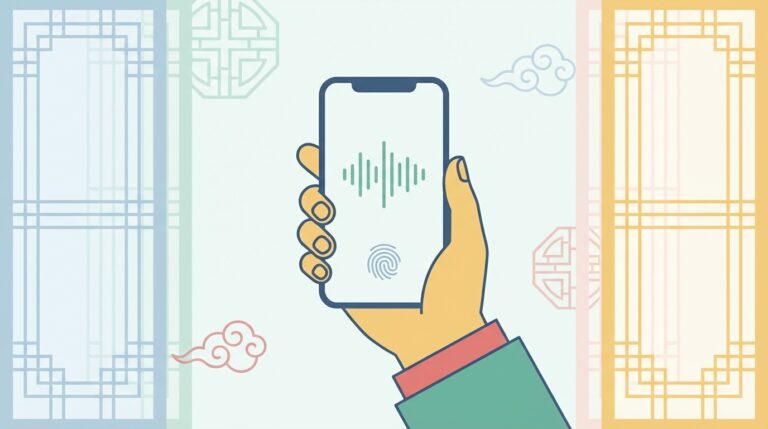
Phase 1: Empathy (The “I Just Want to Pay My Rent” Moment)
Hello! I’m the Lead Editor of Daily Hangul.
Picture this: It’s 11:55 PM, and you need to transfer your rent to your Korean landlord before midnight. You open your banking app (maybe Toss or KakaoBank), but instead of asking for a PIN, it prompts you for 보이스 아이디 (Voice ID). The screen says, “Please read the following sentence aloud: 내 목소리가 비밀번호입니다.” You say it. The app loads… and then rejects you. You try again, this time with a deeper voice. Rejected. You try your best K-Drama announcer voice. Access Granted.
Welcome to hyper-digitalized South Korea! If you’ve watched any recent K-Drama, you’ve seen characters walking into their sleek, chaebol-tier apartments, saying “거실 불 켜” (Turn on the living room lights), or transferring millions of won just by looking at their phones. Korea’s “빨리빨리” (hurry up) culture has made biometrics and voice recognition not just a luxury, but a ubiquitous part of daily life.
But here’s the catch: Korean AI and biometric systems expect a certain rhythm, intonation, and vocabulary. If your phone’s language is set to Korean, or if you’re navigating an automated customer service line, textbook Korean won’t always save you. Today, we’re going to master the advanced, real-world Korean you need to survive and thrive in Korea’s high-tech ecosystem.
Phase 2: Core Expressions Deep Dive
1. 생체 인증을 진행하시겠습니까?
- Pronunciation: [Saengche injeung-eul jinhaenghasigetseumnikka?]
- Meaning: Literal: “Would you like to proceed with biometric authentication?” / Real Nuance: “Do you want to use Face ID/Fingerprint instead of typing a password?”
- K-Culture Moment: You’ll see this pop up constantly when you set up Korean delivery apps like Baedal Minjok (Baemin) or digital wallets. In Korea, taking out your card to type numbers is considered “too slow.”
- Editor’s Insight: “생체” (biometrics) sounds highly clinical, but it’s the standard UX term in Korea. You won’t use this in casual conversation, but you absolutely must recognize it to navigate apps.
- Situation Spectrum:
[🚫 절대 금지] ———— [⚠️ 주의] ———— [✅ 자유롭게]
- Casual Conversation: 🚫 (Too robotic)
- Reading App Menus/Bank Prompts: ✅
- 🤔 Think About It: Why does Korean UX use such formal, Sino-Korean words (Hanja) for technology, rather than simpler native Korean words? Does your native language create new words for tech, or borrow from ancient languages (like Latin/Greek)?
2. 내 목소리가 비밀번호입니다.
- Pronunciation: [Nae moksoriga bimilbeonho-imnida.]
- Meaning: “My voice is my password.”
- K-Culture Moment: When you call a major telecom (like KT or SKT) or a bank, the ARS (automated system) often asks you to register your Voice ID to skip security questions. This is the exact phrase you have to repeat three times to train the AI.
- Editor’s Insight: The tone matters immensely here. If you say it with a rising intonation at the end (like a question), the AI will reject it. You must say it with a flat, confident, descending tone at the end.
- Situation Spectrum:
[🚫 절대 금지] ———— [⚠️ 주의] ———— [✅ 자유롭게]
- Speaking to AI/ARS: ✅
- Speaking to a human: 🚫 (They’ll think you’re joking)
- 🤔 Think About It: Notice the use of “입니다” (formal/polite) even when speaking to a machine. How does this reflect the Korean emphasis on formality in institutional settings?
3. 인식이 잘 안 돼요 / 못 알아듣네요.
- Pronunciation: [Insigi jal an dwaeyo / Mot aradeunneyo.]
- Meaning: Literal: “The recognition isn’t going well / It can’t understand.” / Real Nuance: “Face ID/Siri isn’t working.”
- K-Culture Moment: You’re at an unmanned convenience store (무인 편의점), trying to scan your palm or face to enter, and the door won’t open. You turn to the person waiting behind you and say, “아, 인식이 잘 안 되네요” (Ah, it’s not recognizing me well) to excuse the delay.
- Editor’s Insight: “못 알아듣다” is usually used for humans who fail to comprehend something. Using it for AI shows how much Koreans personify their tech.
- Situation Spectrum:
[🚫 절대 금지] ———— [⚠️ 주의] ———— [✅ 자유롭게]
- Friends (Casual): ✅ (Drop the ‘요’: 인식이 잘 안 돼)
- Strangers/Colleagues (Semi-formal): ✅
- Formal/Boss: ⚠️ (Use “오류가 있는 것 같습니다” – There seems to be an error)
Phase 3: Textbook vs. Real Korean
| Situation | 📖 Textbook Korean | 🗣️ Real Korean | 💡 Why the difference? |
|---|---|---|---|
| AI doesn’t understand | 음성 인식 시스템에 오류가 있습니다. | 아, 시리(빅스비)가 또 못 알아들어. | Koreans treat AI assistants like clumsy friends, using casual blame rather than technical terms. |
| Using Face ID | 얼굴로 잠금을 해제합니다. | 페이스 아이디로 풀게요. / 얼굴로 할게요. | Konglish (페이스 아이디) and simplification (“풀다” = to untie/unlock) are preferred for speed. |
| Fingerprint doesn’t work | 지문이 인식되지 않습니다. | 손에 땀 나서 지문 안 먹혀. | “안 먹힌다” (literally “isn’t being eaten”) is a very common C1-level slang meaning “it’s not working/registering.” |
Phase 4: Cultural Context — K-Culture Deep Dive
4-1. Non-verbal: The “AI Accent”
When Koreans talk to voice assistants (like KT’s GiGA Genie or Samsung’s Bixby), their voice changes. They drop all emotional inflection, speak slightly louder, and articulate every syllable sharply. This is often called the “로봇 말투” (robot speech). If you try to speak to Korean AI with a natural, relaxed, slurred cadence, it will likely fail.
4-2. The Smart Home K-Drama Trope
In almost every modern K-Drama featuring a wealthy character, there is a scene establishing their wealth through voice-activated tech. They walk into their penthouse: “지니야, 커튼 쳐줘” (Genie, close the curtains). But in reality, Voice AI in Korea is deeply integrated into K-Food delivery and domestic life. Families yell from the kitchen, “아리아, 3분 타이머!” (Aria, 3-minute timer!) when their hands are covered in gochujang.
Critical View: While dramas show flawless AI, the reality is that Korean voice recognition heavily favors the standard Seoul dialect (표준어). Users with strong regional dialects (사투리) or foreign accents often find themselves actively having to “code-switch” to standard Seoul Korean just to turn off their alarms!
Phase 5: Interactive Role-Play Scenario
Setting: A Friday afternoon. You’re trying to unlock your account on a Korean banking app over the phone via ARS. The automated voice is polite but unforgiving. Your Korean friend, Min-su, is sitting next to you, watching you struggle.
Characters:
– YOU: An expat trying to pay for a weekend trip.
– AI Assistant: Cold, precise, standard Seoul accent.
– Min-su (32): Your supportive, slightly amused Korean friend.
AI Assistant: 본인 확인을 위해 생체 인증을 진행합니다. 화면의 지문을 터치하거나, 음성 인증을 선택해 주세요.
(Bonin hwagineul wihae saengche injeung-eul jinhaenghamida. Hwamyeon-ui jimuneul teochi-hageona, eumseong injeung-eul seontaekhae juseyo.)
[To verify your identity, we will proceed with biometric authentication. Please touch the fingerprint on the screen or select voice authentication.]
YOU: (Tapping the screen) 아, 손에 물이 묻어서 지문이 안 먹히네. 음성으로 해야겠다.
(A, sone muri mudeoseo jimuni an meokhine. Eumseong-euro haeyagetda.)
[Ah, my hands are wet so the fingerprint isn’t working. I should use voice.]
AI Assistant: ‘내 목소리가 비밀번호입니다’를 정확한 발음으로 읽어주세요.
(‘Nae moksoriga bimilbeonho-imnida’reul jeonghwakhan bareum-euro ilgeojuseyo.)
[Please read ‘My voice is the password’ with accurate pronunciation.]
YOU: 내 목소리가 비밀번호입니다~ 🎵 (Said in a friendly, slightly singing tone)
(Nae moksoriga bimilbeonho-imnida~)
[My voice is the password~]
AI Assistant: 음성이 일치하지 않습니다. 다시 시도해 주세요.
(Eumseong-i ilchihaji anseumnida. Dasi sidohae juseyo.)
[The voice does not match. Please try again.]
Min-su: ㅋㅋㅋ 야, 기계한테 왜 애교를 부려? 아나운서처럼 딱딱하게 해봐.
(ㅋㅋㅋ Ya, gigye-hante wae aegyo-reul buryeo? Anaunseo-cheoreom ttakttakhage haebwa.)
[Hahaha hey, why are you acting cute to a machine? Try doing it stiffly like an announcer.]
🔀 Your Turn! How should you adjust your voice?
– A) Yell it loudly: “내!! 목소리가!! 비밀번호입니다!!!”
– B) Speak in a lower, monotone, flat pitch: “내. 목소리가. 비밀번호입니다.”
– C) Change the phrasing to be more polite: “내 목소리가 비밀번호입니다만…”✅ Best Choice: B — Korean Voice ID systems analyze pitch and cadence. Flat, monotone, and slightly lower pitches without emotional inflection have the highest success rate.
⚠️ Choice A Analysis: Yelling distorts the microphone input. The AI will definitely reject it, and Min-su will laugh harder.
Phase 6: 10-Second Shadowing Drill
Let’s practice the crucial ARS phrase. Pay attention to the pauses and the flat intonation at the end.
😤 단호하게 (Firmly, like an announcer):
내 목소리가 / 비밀번호 / 입니다.
(nae moksoriga / bimilbeonho / imnida.)
😢 답답하게 (Frustrated, to your friend):
아… / 지문이 / 또 안 먹혀.
(a… / jimuni / tto an meokhyeo.)
Phase 7: K-Culture Mini Dictionary
| 한국어 | Romanization | English | Cultural Context |
|---|---|---|---|
| 생체 | saengche | Biometrics | Used in official apps (Kakao, Toss) for Face/Finger ID. |
| 지문 | jimun | Fingerprint | Still the most common authentication method for door locks. |
| 안 먹히다 | an meokhida | Doesn’t work/register | Slang used when tech (touch screens, IDs) fails to respond. |
| 무인 매장 | muin maejang | Unmanned store | Stores requiring QR or biometric entry, very popular in Korea. |
| 공인인증서 | gongin-injeungseo | Public Digital Certificate | The notoriously complex old security system Koreans hated, which sparked the rapid shift to biometrics. |
Phase 8: Traveler’s Survival Kit
Even if you don’t have a Korean bank account, biometrics and voice tech are everywhere in Korea, especially at airports and smart hotels.
🆘 Survival Phrases for the High-Tech Traveler
– 🇰🇷 “얼굴 인식 게이트 어디예요?” (eolgul insik geiteu eodiyeyo?)
– 🗣️ English: Where is the facial recognition gate?
– 📍 Where to use: Incheon Airport (Smart Pass system).
- 🇰🇷 “이거 삼성페이/애플페이 되나요?” (igeo samseong-pei/aepeul-pei doenayo?)
- 🗣️ English: Does this take Samsung Pay / Apple Pay?
- 📍 Where to use: Convenience stores, taxis.
📌 Editor’s Travel Note:
– Smart Pass at Incheon: Download the ‘ICN Smart Pass’ app before your flight. You can register your Face ID to skip massive security lines!
– Digital over Cash: Korea is virtually a cashless society. Even tiny market stalls often prefer digital transfers or cards, making phone biometrics your best friend.
Phase 9: Critical Thinking Corner — “A Step Deeper”
Language & Power: The Standardization of the Korean Voice
🧠 Think Deeper:
As Voice ID and AI become the gatekeepers to banking, housing, and customer service in Korea, a subtle power dynamic emerges. These systems are heavily trained on “표준어” (Standard Seoul Korean). For foreign residents with accents, or elderly Koreans from rural areas with thick “사투리” (dialects), Voice AI can become a digital barrier rather than a convenience. It forces the speaker to assimilate and suppress their natural linguistic identity just to transfer money or turn on a heater. In a way, technology is redefining what “acceptable” Korean sounds like, prioritizing the Seoul accent as the absolute baseline for digital citizenship.💬 Your Turn: Have you ever had to change your accent or tone just to make Siri, Alexa, or a Korean AI understand you? How does this affect your confidence in speaking the language? Share your experience in the comments!
Phase 10: FAQ & Avoiding Misunderstandings
Q: Can I use 반말 (informal language) with smart speakers in Korea?
Yes! In fact, almost everyone does. Saying “시리야, 내일 아침 7시에 깨워줘” (Siri, wake me up at 7 AM) is perfectly normal. Using formal honorifics (“깨워주시겠어요?”) to a machine sounds incredibly awkward to native speakers.
Q: What if the Voice ID fails multiple times?
Don’t panic. Korean systems always have a fallback. If you fail 3 times, you will usually be redirected to a human agent (상담원 연결) or asked to authenticate via an SMS code (문자 인증).
❌ Common Mistake: Pronouncing tech words with a perfect American accent.
✅ Do This Instead: If you are talking to a Korean AI, use the “Konglish” pronunciation. Say “와이파이” (Wa-i-pa-i) instead of “Wi-Fi,” and “앱” (Aeb) instead of “App.” The AI is trained on Korean phonetics!
Phase 11: Summary & Action Items
One-Liner Summary: To survive Korea’s biometric ecosystem, master the flat “announcer tone” and learn to blame the AI when things go wrong (“인식이 안 돼요”).
Your Missions:
– 🥉 Bronze (Solo): Stand in front of a mirror and firmly say “내 목소리가 비밀번호입니다” three times with zero emotion.
– 🥈 Silver (Online): Change your phone’s voice assistant (Siri/Bixby/Google) to Korean for 1 hour and try setting an alarm using voice commands.
– 🥇 Gold (Real World): The next time your phone doesn’t recognize your fingerprint in front of a Korean friend, casually drop the phrase: “아, 지문이 안 먹히네.”
Phase 12: Interactive Challenge Quiz
1. Situational Judgment: You are at a self-checkout kiosk in a Korean supermarket. You try to scan a barcode, but the machine isn’t registering it. What is the most natural Korean thing to mumble to yourself?
– A) “이 기계는 고장 났습니다.”
– B) “인식이 잘 안 먹히네.”
– C) “생체 인증이 필요합니다.”
2. True or False – K-Culture Edition:
In Korea, it is considered rude to use “반말” (casual language) when commanding your AI smart speaker at home. (T / F)
(Answers: 1. B – ‘안 먹히네’ is the perfect natural slang for tech not working. / 2. False – Everyone uses 반말 with smart speakers!)
Frequently Asked Questions (FAQ)
Q: What does "생체 인증을 진행하시겠습니까?" mean in Korean and how do you pronounce it?
A: In Korean, "생체 인증을 진행하시겠습니까?" is pronounced [Saengche injeung-eul jinhaenghasigetseumnikka?] and means: Literal: "Would you like to proceed with biometric authentication?" / Real Nuance: "Do you want to use Face ID/Fingerprint instead of typing a password?"
Q: What does "내 목소리가 비밀번호입니다." mean in Korean and how do you pronounce it?
A: In Korean, "내 목소리가 비밀번호입니다." is pronounced [Nae moksoriga bimilbeonho-imnida.] and means: "My voice is my password."
Q: What does "인식이 잘 안 돼요 / 못 알아듣네요." mean in Korean and how do you pronounce it?
A: In Korean, "인식이 잘 안 돼요 / 못 알아듣네요." is pronounced [Insigi jal an dwaeyo / Mot aradeunneyo.] and means: Literal: "The recognition isn't going well / It can't understand." / Real Nuance: "Face ID/Siri isn't working."