Phase 1: Empathy (The “Wait, Do I Eat This Now?” Moment)
Hello! It’s your Daily Hangul Editor. Grab a seat, because today we’re heading to a Korean restaurant.
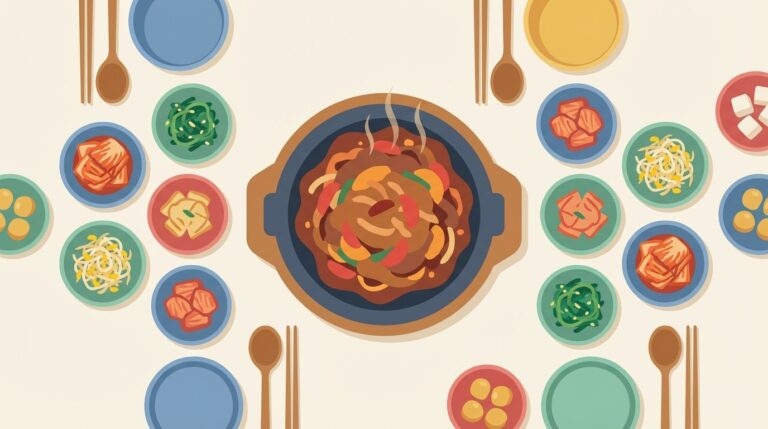
Picture this: You finally visit that famous Korean BBQ or traditional Baekban (thali-style) spot you saw on a travel vlog. You order your main dish. Suddenly, the server starts covering every square inch of your table with tiny, colorful bowls. Kimchi, pickled radishes, seasoned spinach, tiny dried anchovies…
You sit there, chopsticks in hand, wondering: “Wait, are these appetizers? Do I eat them while I wait for the meat? Do I have to pay extra for all this?”
If you’ve ever paniced at a Korean dining table, you’re not alone. I’ve seen countless students nervously nibble on all their Banchan (반찬, side dishes) before the main dish even arrives, only to be too full for the actual meal!
Today, we are diving deep into the beautiful, chaotic, and utterly delicious world of Harmony between the Main Dish and Banchan. Knowing how to navigate these little plates won’t just make your meal taste 100 times better—it will earn you massive respect from the local restaurant owners. Let’s dig in!
Phase 2: Core Expressions Deep Dive
Here are the “cheat codes” you need to master the Korean table.
1. 이거 좀 더 주시겠어요?
- Pronunciation: [igeo jom deo jusigesseoyo?] + [Sounds like: ee-geo johm duh joo-shee-geh-suh-yo?]
- Meaning: (Literal) Would you give me a little more of this? / (Real nuance) “Excuse me, can I get a refill on this side dish?”
- K-Culture Moment: You’re at a Pork Rice Soup (Dwaeji Gukbap) restaurant. You’ve run out of the perfectly fermented radish kimchi (Kkakdugi). In Korea, Banchan refills are almost always FREE. Pointing at the empty dish and saying this will summon a fresh mountain of kimchi.
- Editor’s Insight: The word ‘좀’ (jom – a little) is the magic softening word in Korean. Without it, you sound demanding. With it, you sound polite and natural.
- Situation Spectrum:
[🚫 Never] ———— [⚠️ Be Careful] ———— [✅ Go Ahead]
- Casual (Friends): ✅ (Drop the ‘요’ -> “이거 좀 더 줘”)
- Semi-formal (Restaurant staff): ✅ (Perfectly polite)
- Formal (Strict elders): ⚠️ (Use ‘주십시오’ instead)
- 🤔 Think About It: Why are side dish refills free in a country where inflation is a hot topic? It traces back to the Korean concept of Jeong (정) — affection and generosity. Serving abundant food is how Koreans show they care.
2. 이거랑 같이 먹으면 맛있어요
- Pronunciation: [igeorang gachi meogeumyeon masisseoyo] + [Sounds like: ee-guh-rang ga-chee mo-geu-myun ma-shee-suh-yo]
- Meaning: (Literal) If you eat it together with this, it is delicious. / (Real nuance) “This is the ultimate pairing!”
- K-Culture Moment: You’re eating Korean BBQ. The server or your Korean friend places a pickled sesame leaf (Kkaennip) on your plate, puts a piece of pork belly on it, and tells you this. They are teaching you the secret ‘pairing’ rule of the restaurant!
- Editor’s Insight: Banchan are NOT appetizers. They are co-stars. They are designed to cut the grease of the meat or balance the blandness of the rice.
- Situation Spectrum:
[🚫 Never] ———— [⚠️ Be Careful] ———— [✅ Go Ahead]
- Casual (Friends): ✅
- Semi-formal (Colleagues): ✅
- Formal (Boss): ✅ (A great ice-breaker when dining together!)
- 🤔 Think About It: Does your home country have specific “food pairings” that must go together? How do you explain them to foreigners?
3. 사장님 / 이모님!
- Pronunciation: [sajangnim / imonim] + [Sounds like: sah-jang-neem / ee-mo-neem]
- Meaning: (Literal) Boss / Auntie. / (Real nuance) “Excuse me, server!”
- K-Culture Moment: The restaurant is loud. K-Pop is playing. Meat is sizzling. Raising your hand quietly won’t work. You need to confidently call out to get that Banchan refill.
- Editor’s Insight: ‘사장님’ is safe everywhere. ‘이모님’ is used in older, casual, mom-and-pop style restaurants (like soup joints or BBQ places). NEVER use “아줌마” (Ahjumma) to call a server—it can be considered rude!
- Situation Spectrum:
[🚫 Never] ———— [⚠️ Be Careful] ———— [✅ Go Ahead]
- High-end Fine Dining: 🚫 (Say ‘여기요’ – Yeogiyo instead)
- Casual BBQ / Soup place: ✅
Phase 3: Textbook vs Real Korean
Let’s be real. The textbook is great, but the streets speak differently.
| Situation | 📖 Textbook Korean | 🗣️ Real Street Korean | 💡 Why the difference? |
|---|---|---|---|
| Calling the server | “실례합니다.” (Excuse me) | “사장님!” or “여기요!” (Boss! / Over here!) | ‘Excuse me’ is too formal for a bustling, fast-paced Korean diner. |
| Asking for more kimchi | “김치 조금만 더 주시겠습니까?” | “사장님, 여기 김치 리필이요~” (Boss, Kimchi refill here~) | Adding ‘이요/요’ to English loanwords (‘refill’) is super common in casual dining! |
| Reacting to a great pairing | “이 반찬은 메인 요리와 조화롭군요.” | “와, 이 조합 대박이다!” (Wow, this combo is epic!) | Emphasizing ‘조합’ (combination) is trendy among young foodies. |
Phase 4: Cultural Context — K-Culture Deep Dive
4-1. The Unspoken Rules of the Table (Non-verbal Cues)
- The Two-Hand Rule: When a server hands you a freshly refilled plate of Banchan, slightly lift both hands to receive it, or lightly touch your right elbow with your left hand while receiving it. It shows immense respect.
- Nunchi (눈치) at the Grill: If you notice your friend’s favorite Banchan is empty, call the server and order a refill for them. This high-level Nunchi will make you the star of the dinner.
4-2. The “Mom” Trope in K-Dramas
Have you ever noticed this classic K-Drama scene? The main character is having a tough day, eating a bowl of rice. Suddenly, their mother (or a caring elder) silently uses their chopsticks to place a perfectly torn piece of Kimchi or a braised quail egg right on top of the protagonist’s rice.
Banchan is Love. In Korean culture, feeding someone is the ultimate love language. Since main dishes like rice or soup are somewhat plain, the rich, salty, and spicy Banchan are where the flavor lies. Putting the best piece of Banchan on someone’s spoon is the Korean equivalent of saying, “I love you, you’re doing great.”
Phase 5: Real-Life Roleplay Scenario
Let’s put you in the hot seat.
Setting: Friday night, 7 PM. A smoky, bustling Samgyeopsal (Pork Belly) restaurant in Hongdae. You are with Min-su, your friendly Korean coworker.
Characters:
– YOU: A foreign professional working in Seoul.
– Min-su: (32, Korean coworker) Loves food, loves making sure you experience “Real Korea.”
(The Dialogue)
Min-su: 야, 오늘 고기는 내가 쏜다! 🥩
(ya, oneul gogineun naega ssonda!)
[Hey, the meat is on me today!]
(🎭 Stage Direction: Min-su grabs the tongs and starts grilling the pork belly)
YOU: 우와, 진짜 맛있겠어요! 잘 먹겠습니다.
(uwa, jinjja masigesseoyo! jal meokgetseumnida.)
[Wow, it looks so delicious! I will eat well.]
Min-su: 잠깐만! 고기 그냥 먹지 말고, 이 명이나물에 싸서 먹어봐.
(jamkkanman! gogi geunyang meokji malgo, i myeonginamure ssaseo meogeobwa.)
[Wait! Don’t just eat the meat by itself, try wrapping it in this Myeong-i Namul (pickled garlic leaves).]
YOU: 명이나물요? 이렇게요?
(myeonginamullyo? ireokeyo?)
[Myeong-i Namul? Like this?]
(🎭 Stage Direction: You wrap the meat and take a bite. Your eyes widen.)
YOU: 와… 이거랑 같이 먹으니까 진짜 맛있네요!
(wa… igeorang gachi meogeunikka jinjja masinneyo!)
[Wow… Eating it together with this makes it really delicious!]
Min-su: 거봐, 내가 뭐랬어. 아, 근데 명이나물 다 먹었네.
(geobwa, naega mworaesseo. a, geunde myeonginamul da meogeonne.)
[See, what did I tell you. Oh, but we ate all the Myeong-i Namul.]
🔀 YOUR TURN! How do you handle this?
– A) “명이나물은 비싸니까 그냥 고기만 먹죠.” (Myeong-i Namul is expensive, let’s just eat the meat.)
– B) “제가 더 달라고 할게요. 사장님! 여기 명이나물 좀 더 주시겠어요?” (I’ll ask for more. Boss! Could you give us a bit more Myeong-i Namul here?)
– C) “야, 명이나물 가져와!” (Hey, bring Myeong-i Namul!)✅ Best Choice: B — You show initiative, use the correct polite term for the server, and use ‘좀’ to soften the request.
⚠️ Choice A Analysis: While considerate, Koreans almost always ask for at least one refill. It’s totally fine to ask!
🚫 Choice C Analysis: Strictly forbidden! Speaking casually (Banmal) to restaurant staff is considered extremely rude in modern Korea.
Phase 6: 10-Second Shadowing Drill
Let’s practice your restaurant voice. Speak clearly and don’t be shy!
😊 사장님! / 여기 / 반찬 좀 / 더 주시겠어요?
(sa-jang-nim! / yeo-gi / ban-chan jom / deo ju-si-ge-sseo-yo?)
Flow Tip: Raise your hand boldly on “사장님!” Pause briefly. Then deliver the rest with a warm, polite smile.
Phase 7: K-Culture Mini Dictionary
| Korean | Romanization | English | Cultural Context |
|---|---|---|---|
| 반찬 | banchan | Side dishes | Small plates served with rice. Usually meant to be shared. |
| 쌈 | ssam | Wrap | Wrapping meat/rice in lettuce, sesame leaves, or pickled greens. |
| 백반 | baekban | Korean Thali | A traditional meal centered around rice, soup, and many banchan. |
| 리필 | ri-pil | Refill | Konglish for “refill.” Most banchan can be refilled for free. |
| 눈치 | nunchi | Social tact | The art of reading the room. e.g., Noticing a friend’s empty water cup. |
Phase 8: Traveler Survival Kit 🎒
If you are visiting Korea soon, memorize these three lifesavers for any dining situation!
🆘 Survival Expression #1: “이거 매워요?”
– 🇰🇷 igeo maewoyo?
– 🗣️ Meaning: Is this spicy?
– 💡 Pro Tip: Many red banchan are actually sweet-spicy, but if you have low spice tolerance, always point and ask this first!🆘 Survival Expression #2: “앞접시 좀 주시겠어요?”
– 🇰🇷 apjeopsi jom jusigesseoyo?
– 🗣️ Meaning: Could you give me a small sharing plate?
– 💡 Pro Tip: Because Korean food is highly communal (sharing stews and banchan), asking for a personal plate (‘apjeopsi’) is perfectly normal and hygienic.🆘 Survival Expression #3: “포장해 주시겠어요?”
– 🇰🇷 pojanghae jusigesseoyo?
– 🗣️ Meaning: Could you pack this to go?
– 💡 Pro Tip: You can pack leftover main dishes, but asking to pack leftover Banchan is generally a no-no!
📌 Editor’s Travel Note:
Never leave a tip! Tipping is not a part of Korean culture. If you leave money on the table, the server might chase you down the street thinking you forgot your change!
Phase 9: Critical Thinking — “One Step Deeper”
Food & Identity: The Communal Table
Why do Koreans serve food with so many shared side dishes, rather than individual plating? It stems from the deep-rooted agrarian history of Korea, where village communities (마을) worked the fields together and ate together. Sharing a stew from the same pot and picking from the same Banchan plates breaks down social barriers. It builds “우리가 남이가?” (Are we strangers? No, we are family!). While modern hygiene standards have introduced more individual plates, the psychological core of Korean dining remains: sharing food equals sharing a bond.
💬 Your Turn: Does your culture emphasize individual plating or communal sharing? How does it affect the dining atmosphere? Let us know in the comments!
Phase 10: FAQ & Avoiding Misunderstandings
Q: Is Banchan REALLY infinite and free?
Yes and no. Most basic banchan (kimchi, bean sprouts, pickled radish) are free to refill multiple times. However, premium banchan (like Ganjang Gejang – soy sauce marinated crab, or expensive fish) might incur an extra charge. When in doubt, just ask!
Q: Do I have to finish all the Banchan?
No! It’s perfectly fine to leave some behind. Don’t force yourself to eat the ones you don’t like.
❌ Common Mistake #1: Mixing all the banchan into your rice bowl like a salad.
✅ Do this instead: Unless you are explicitly eating Bibimbap, eat the rice and banchan separately. Take a spoonful of rice, then pick up a piece of banchan to eat with it.❌ Common Mistake #2: Calling a female server “Ahjumma” (아줌마).
✅ Do this instead: Use “사장님” (Sajangnim – Boss) or “이모님” (Imonim – Auntie). Ahjumma can come off as slightly condescending in modern customer service settings.
Phase 11: Summary & Action Items
One-Liner Summary: Banchan are the co-stars of the Korean table, meant to be paired with the main dish and confidently (and politely) refilled when empty!
Your Missions for the Week:
– 🥉 Bronze (Solo): Stand in front of a mirror and boldly practice calling out: “사장님! 여기 반찬 좀 더 주시겠어요?”
– 🥈 Silver (Online): Find a photo of a Korean meal on Instagram. Try to identify at least 3 banchan and leave a comment in Korean!
– 🥇 Gold (Real World): Visit a local Korean restaurant. Order a meal and successfully ask for a Banchan refill in Korean.
🎬 K-Culture Mission:
Watch one episode of Let’s Eat (식샤를 합시다) or any Korean drama dining scene. Count how many times they use the word “대박” (Daebak – awesome) or “맛있다” (Mashitda – delicious) while eating!
Phase 12: Pop Quiz — Interactive Challenge
Let’s see if you’re ready for the Korean dining table!
1. You are at a nice Korean BBQ place with your boss. You want more Kimchi. What do you say?
A) “야, 김치 더 줘!”
B) “아줌마! 김치 리필!”
C) “사장님, 김치 좀 더 주시겠어요?”
2. True or False: You should always eat your Banchan before the main dish arrives, like an appetizer.
3. Fill in the blank: If you wrap meat and side dishes in a lettuce leaf, it is called a [ ______ ].
(Answers: 1: C – Always be polite and use ‘사장님’ or ‘좀 더 주시겠어요?’. 2: False – Banchan are meant to be eaten WITH the main dish! 3: 쌈 / Ssam)
Frequently Asked Questions (FAQ)
Q: What does "이거 좀 더 주시겠어요?" mean in Korean and how do you pronounce it?
A: In Korean, "이거 좀 더 주시겠어요?" is pronounced [igeo jom deo jusigesseoyo?] and means: (Literal) Would you give me a little more of this? / (Real nuance) "Excuse me, can I get a refill on this side dish?"
Q: What does "이거랑 같이 먹으면 맛있어요" mean in Korean and how do you pronounce it?
A: In Korean, "이거랑 같이 먹으면 맛있어요" is pronounced [igeorang gachi meogeumyeon masisseoyo] and means: (Literal) If you eat it together with this, it is delicious. / (Real nuance) "This is the ultimate pairing!"
Q: What does "사장님 / 이모님!" mean in Korean and how do you pronounce it?
A: In Korean, "사장님 / 이모님!" is pronounced [sajangnim / imonim] and means: (Literal) Boss / Auntie. / (Real nuance) "Excuse me, server!"