

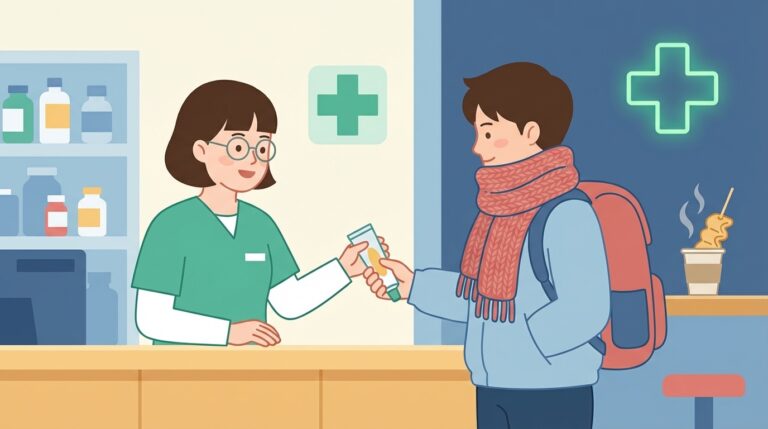
Phase 1: The ‘Ouch’ Moment – K-Culture Cold Open
Hello! This is your lead editor at Daily Hangul.
Picture this: You’re at a bustling K-BBQ restaurant in Sinchon. The samgyeopsal (pork belly) is sizzling beautifully, but suddenly—pop!—a drop of hot oil splatters right onto your hand. Or maybe you’re living out your K-Drama fantasy, walking through the snowy streets of Gangwon-do in January. The “Siberian high-pressure” wind hits you, and after an hour of taking aesthetic photos, your fingers are so numb you can’t feel them.
In textbooks, you might have learned basic phrases like “아파요” (It hurts). But at a C1 (Upper-Intermediate/Advanced) level, and in a real survival situation, that’s simply not enough. You need to accurately describe your symptoms to a Korean pharmacist (yaksa-nim) or a doctor to get the right treatment.
If you don’t know the exact words for “blister,” “frostbite,” or “burn ointment,” a minor accident could ruin your trip. Today, we’re diving deep into the medical Korean you need for Burns & Frostbite First Aid. This guide is based on real frantic messages I’ve received from expat students over the years. Let’s make sure you’re prepared!
Phase 2: Core Expressions Deep Dive
1. 화상을 입었어요 / 데었어요
- Pronunciation: [hwasang-eul ibeosseoyo] / [de-eosseoyo]
- Sound-alike guide: ‘de-eo’ sounds like “day-oh” but spoken quickly.
- Meaning: I suffered a burn / I got burned.
- K-Culture Moment: You’ll hear “데었어요” at a restaurant when someone touches a hot dolsot (stone bowl) of bibimbap. “화상을 입었어요” is what the doctor in a medical K-Drama says while looking at an X-ray with a serious face.
- Editor’s Insight: 화상(burn) is a formal Hanja (Sino-Korean) noun, usually paired with 입다(to wear/suffer). 데다(to get burned) is a native Korean verb used for everyday, minor burns (like touching a hot pan or spilling coffee).
- Situation Spectrum:
[🚫 절대 금지] ———— [⚠️ 주의] ———— [✅ 자유롭게]
- Chatting with friends (Casual: 아, 손 데었어!): ✅
- Explaining to a doctor (Formal: 뜨거운 물에 화상을 입었습니다): ✅
- 🤔 Think About It: Notice how Korean uses the verb “입다” (to wear) for injuries (상처를 입다, 화상을 입다). It frames the injury as something that has “covered” or “clothed” you. Does your native language have a unique verb for sustaining injuries?
2. 물집이 잡혔는데 터뜨려야 되나요?
- Pronunciation: [muljibi japhyeonneunde teotteuryeoya doenayo?]
- Sound-alike guide: ‘japhyeonneunde’ sounds like “jah-pyeon-neun-deh”.
- Meaning: A blister has formed, should I pop it?
- K-Culture Moment: Walking into a local Korean pharmacy (Yakguk). Korean pharmacies are incredibly accessible, and pharmacists often act as primary consultants for minor injuries before you decide to go to a clinic.
- Editor’s Insight: “물집” means blister (literally water-house). Look at the verb 잡히다 (to be caught/formed). We don’t say “I made a blister”; we say “a blister was caught/formed on me.” Also, 터뜨리다 means to intentionally burst or pop something.
- Situation Spectrum:
[🚫 절대 금지] ———— [⚠️ 주의] ———— [✅ 자유롭게]
- Asking a medical professional: ✅
- (Remember, the answer is always NO! Don’t pop it!)
- 🤔 Think About It: The passive voice (잡히다) is heavily used in Korean when describing bodily symptoms. It reflects a cultural mindset that illnesses or injuries are things that happen to a person, rather than actions the person actively owns.
3. 손끝이 얼어서 감각이 없어요. 동상인가요?
- Pronunciation: [sonkkeuchi eoreoseo gamgagi eopseoyo. dongsang-ingayo?]
- Sound-alike guide: ‘gamgak’ sounds like “gahm-gahk”.
- Meaning: My fingertips are frozen and I have no feeling. Is it frostbite?
- K-Culture Moment: Winter in Korea is no joke. The freezing winds can quickly lead to frostnip or frostbite (동상). This is a crucial phrase if you’re skiing in Pyeongchang or waiting for a night bus in Seoul during a cold wave.
- Editor’s Insight: 감각이 없다 literally means “to have no sensation/senses.” It is the perfect C1-level phrase to describe numbness, far better than just saying “안 느껴져요” (I can’t feel it).
Phase 3: Textbook vs. Real Korean
| Situation | 📖 Textbook Korean | 🗣️ Real Korean | 💡 Why is it different? |
|---|---|---|---|
| Minor burn | 저는 뜨거운 물에 화상을 입었습니다. | 앗 뜨거! 나 손 데었어. | Spontaneous reactions use native Korean verbs (데다) rather than formal medical Hanja (화상). |
| Explaining numbness | 손가락에 느낌이 없습니다. | 손끝에 감각이 하나도 없어요. | “감각이 없다” is the natural, idiomatic way adults describe numbness or loss of sensation. |
| Asking for treatment | 화상을 치료할 약을 주십시오. | 약사님, 화상 연고랑 메디폼 주세요. | Koreans rarely ask for generic “medicine”; they specify the type (ointment/연고) or brand (Medifoam). |
Phase 4: Cultural Context — K-Culture Deep Dive
4-1. Non-Verbal Nuances: The Pharmacy Protocol
When you go to a Korean pharmacy for a burn or frostbite, don’t just stand back. The pharmacist will expect you to show the affected area. It is perfectly normal to roll up your sleeve or point directly to the wound. Koreans value quick, accurate assessments.
4-2. K-Food & K-Travel Connections
Korea is famous for its “뜨거운 국물” (hot broth) culture and “빨리빨리” (hurry-hurry) lifestyle. Whether it’s bubbling Kimchi Jjigae served in a boiling stone pot or a street vendor quickly handing you a cup of steaming Odeng broth, minor burns are a common hazard.
In K-Travel, “메디폼” (Medifoam) is a culturally significant item. It’s a brand of hydrocolloid dressing, but like “Band-Aid” in the US, it has become a common noun. If you get a burn, Koreans won’t tell you to use a regular band-aid; they will specifically tell you to go buy Medifoam to prevent scarring. Clear, blemish-free skin is highly valued in K-Beauty, so treating a burn correctly to avoid scars (흉터) is taken very seriously.
Phase 5: Interactive Roleplay Scenario
Setting: A brightly lit pharmacy (약국) in Myeongdong. It’s 8 PM. You accidentally spilled hot street-food tteokbokki sauce on your hand 10 minutes ago. It’s red and stinging.
Characters:
– YOU: A C1 Korean learner, in slight pain but keeping your cool.
– Pharmacist (약사님): A middle-aged, efficient, but caring professional.
Dialogue:
YOU: 약사님, 안녕하세요. 제가 방금 뜨거운 떡볶이 국물에 손을 좀 데었는데요. 화상 연고 있나요?
(yaksa-nim, annyeonghaseyo. jega banggeum tteugeoun tteokbokki gukmure soneul jom de-eonneundeyo. hwasang yeongo innayo?)
[Hello, Pharmacist. I just burned my hand a bit on hot tteokbokki broth. Do you have burn ointment?]
Pharmacist: 아이고, 많이 따갑겠네요. 어디 한 번 보여주세요.
(aigo, mani ttagapgenneyo. eodi han beon boyeojuseyo.)
[Oh my, that must sting a lot. Let me take a look.]
YOU: 네, 여기요. 아직 물집이 잡히진 않았는데, 너무 화끈거려서요.
(ne, yeogiyo. ajik muljibi japhijin ananneunde, neomu hwakkeungeoryeoseoyo.)
[Here. A blister hasn’t formed yet, but it’s really burning/stinging.]
(🎭 Stage Direction: You show the red patch on your hand)
Pharmacist: 다행히 심한 2도 화상은 아니네요. 찬물로 응급처치는 하셨어요?
(dahaenghi simhan ido hwasang-eun anineyo. chanmullo eunggeupcheochineun hasyeosseoyo?)
[Fortunately, it’s not a severe 2nd-degree burn. Did you do first aid with cold water?]
🔀 Your Turn! How should you reply?
– A) “아니요! 편의점에서 얼음을 사서 바로 피부에 문질렀어요!” (No! I bought ice at a convenience store and rubbed it right on the skin!)
– B) “네, 근처 화장실에서 흐르는 미지근한 물에 10분 정도 식혔어요.” (Yes, I cooled it under running lukewarm water for about 10 minutes in a nearby restroom.)
– C) “응급처치가 뭐예요? 그냥 참았어요.” (What’s first aid? I just endured it.)✅ Best Choice: B — Both medically and linguistically! Applying ice directly to a burn (A) can cause tissue damage (and the pharmacist will scold you). Cooling it under water is the standard.
⚠️ Choice A Analysis: The grammar is correct, but the action is dangerous. In Korean, “얼음을 대다” (apply ice) is different from “흐르는 물에 씻다” (wash under running water).
Pharmacist: (If B) 잘하셨네요! 이 화상 연고 하루에 두세 번 얇게 흉터 안 생기게 발라주시고요. 메디폼도 같이 드릴까요?
(jalhasyeonneyo! i hwasang yeongo harue duse beon yalpge hyungteo an saenggige ballajusigoyo. medipomdo gachi deurilkkayo?)
[Good job! Apply this burn ointment thinly 2-3 times a day so it doesn’t scar. Shall I give you Medifoam too?]
YOU: 네, 메디폼도 주세요. 물 닿으면 안 되니까 방수되는 걸로 부탁드려요.
(ne, medipomdo juseyo. mul daeumyeon an doenikka bangsudoeneun geollo butakdeuryeoyo.)
[Yes, Medifoam please. It shouldn’t get wet, so please give me a waterproof one.]
Phase 6: 10-Second Shadowing Drill
Practice this sentence to sound completely natural when you walk into a pharmacy.
🥺 약사님, / 뜨거운 물에 / 손을 데었는데, / 흉터 안 생기는 / 화상 연고 / 있나요?
(yaksa-nim, / tteugeoun mure / soneul de-eonneunde, / hyungteo an saenggineun / hwasang yeongo / innayo?)
[Pharmacist, I burned my hand in hot water, do you have a burn ointment that prevents scarring?]
- Intonation Tip: Raise your pitch slightly at “데었는데” to show the situation is ongoing and you need their help. Emphasize “흉터 안 생기는” (prevents scarring) because that’s the key benefit you want!
Phase 7: K-Culture Mini Dictionary
| 한국어 | Romanization | English | Context/Explanation |
|---|---|---|---|
| 약국 | yakguk | Pharmacy | Look for the glowing green cross. They are everywhere and highly reliable. |
| 화상 연고 | hwasang yeongo | Burn ointment | Essential to ask for specifically; don’t just say “약” (medicine). |
| 흉터 | hyungteo | Scar | K-Beauty highly values preventing these. Pharmacists will often recommend products based on this. |
| 핫팩 | hatpaek | Hot pack | Survival item for Korean winter to prevent 동상 (frostbite). Sold in every convenience store. |
| 메디폼 | medipom | Medifoam | The go-to hydrocolloid bandage brand, used as a generic noun in Korea. |
Phase 8: Traveler’s Survival Kit
🆘 Medical Survival Expressions TOP 3
– 🇰🇷 “제일 가까운 응급실이 어디예요?” (jeil gakkaun eunggeupsiri eodiyeyo?)
– 🗣️ English: Where is the nearest emergency room?
– 📍 Use it at: Hotel front desk, talking to a taxi driver.
- 🇰🇷 “방수 밴드 하나 주세요.” (bangsu baende hana juseyo.)
- 🗣️ English: Please give me one waterproof band-aid.
- 📍 Use it at: Pharmacies, Convenience stores (편의점).
🇰🇷 “피부가 붉어지고 따가워요.” (pibuga bulgeojigo ttagauwoyo.)
- 🗣️ English: My skin is getting red and stinging (good for early frostbite or mild burns).
- 📍 Use it at: Pharmacies, Clinics.
📌 Editor’s Travel Note
– Pharmacy vs. Convenience Store: Convenience stores (CU, GS25) sell basic band-aids and Tylenol, but for burn ointments, you MUST go to a pharmacy (약국).
– Weekend Emergencies: Many pharmacies close on Sundays. Search “휴일지킴이약국” (Holiday Duty Pharmacy) on Naver Maps to find open ones in your area.
Phase 9: Critical Thinking Corner — “One Step Deeper”
🧠 Think Deeper: Language & Medical Accessibility (Media vs. Reality)
In K-Dramas, whenever a character gets a minor cut or burn, the romantic lead dramatically drags them to a hospital emergency room (응급실). However, actual Korean life is deeply intertwined with the neighborhood “동네 약국” (local pharmacy) and “동네 의원” (local clinic). The Korean medical system is highly accessible and affordable. Because of this, the Korean language has developed highly specific vocabulary for everyday medical consultations at the pharmacy counter. You don’t just ask for a “band-aid”; you discuss “흉터” (scars), “물집” (blisters), and “연고” (ointments) directly with the pharmacist. The language reflects a culture that is proactive and detail-oriented about health and aesthetics, without always needing a hospital visit.
💬 Your Turn: In your home country, do you usually go to a doctor, a pharmacist, or just a supermarket for a minor burn or frostbite? Share your culture in the comments!
Phase 10: FAQ & Avoiding Misunderstandings
- Q: Can I use “화상을 입었어요” for a sunburn?
- A: Not usually. Sunburn is formally “일광 화상”, but Koreans typically say “살이 탔어요” (my skin burned/tanned) or “피부가 벗겨졌어요” (my skin is peeling). “화상” usually implies heat from fire, water, or oil.
- Q: Should I address the pharmacist as 의사 선생님 (Doctor)?
- A: No! Call them “약사님” (Pharmacist). Calling a pharmacist a doctor is a common foreigner mistake and can be slightly awkward.
❌ Common Mistake #1: Saying “손이 추워요” (My hands are cold weather) instead of “손이 차가워요” or “손이 시려요” (My hands feel freezing cold/numb).
✅ Do this: Use 춥다 only for the weather/air temperature. Use 차갑다 for an object being cold to the touch, and 시리다 for your body parts feeling chillingly cold (perfect for early frostbite!).
Phase 11: Summary & Action Items
One-Liner Summary: To handle burns and frostbite in Korea like a local, ditch the generic “It hurts” and confidently explain your symptoms (데었어요, 물집, 감각이 없어요) to the “약사님”!
Action Mission 3 Steps:
– 🥉 Bronze: Say “손을 데었어요” and “감각이 없어요” 3 times out loud, practicing the intonation.
– 🥈 Silver: Write a short Korean diary entry about a time you accidentally burned yourself while cooking.
– 🥇 Gold (For travelers): Walk into a Korean pharmacy and successfully buy “메디폼” (Medifoam) entirely in Korean.
K-Culture Mission: Next time you watch a K-Drama where characters are eating hot stew (찌개) or grilling meat, listen closely! See if you can catch someone saying “앗 뜨거!” or warning others with “데지 않게 조심해” (Be careful not to get burned).
Let me know in the comments if you’ve ever had a minor medical emergency in Korea! How did you handle it?
Phase 12: Quiz — Interactive Challenge
1. Situational Judgment: You are at a ski resort in Gangwon-do. Your toes are freezing, and you can’t feel them at all. What is the most natural way to explain this to the medical staff?
– A) 발가락이 안 느껴져요.
– B) 발가락 끝이 얼어서 감각이 없어요.
– C) 발가락이 너무 추워요.
2. Fill in the Blank:
약사님, 프라이팬에 손을 _______. 흉터 안 생기게 바르는 _______ 있나요?
(Pharmacist, I burned my hand on a frying pan. Do you have an ointment to prevent scarring?)
3. True or False – K-Culture Edition:
If you get a mild 1st-degree burn from K-BBQ oil at 11 PM on a Saturday, you can buy “화상 연고” (burn ointment) at the nearest GS25 convenience store.
🚨 Click here for the Answers!
- Answer: B. “감각이 없어요” is the C1-level standard for numbness. A is understandable but unnatural. C is incorrect because ‘춥다’ is for weather, not body parts.
- Answer: 데었는데, (화상) 연고.
- Answer: False. Convenience stores only sell very basic first aid (regular band-aids, painkillers). For specific ointments, you must go to a pharmacy (약국). You would need to search for a late-night pharmacy (심야약국).
Frequently Asked Questions (FAQ)
Q: What does "화상을 입었어요 / 데었어요" mean in Korean and how do you pronounce it?
A: In Korean, "화상을 입었어요 / 데었어요" is pronounced [hwasang-eul ibeosseoyo] and means: I suffered a burn / I got burned.
Q: What does "물집이 잡혔는데 터뜨려야 되나요?" mean in Korean and how do you pronounce it?
A: In Korean, "물집이 잡혔는데 터뜨려야 되나요?" is pronounced [muljibi japhyeonneunde teotteuryeoya doenayo?] and means: A blister has formed, should I pop it?
Q: What does "손끝이 얼어서 감각이 없어요. 동상인가요?" mean in Korean and how do you pronounce it?
A: In Korean, "손끝이 얼어서 감각이 없어요. 동상인가요?" is pronounced [sonkkeuchi eoreoseo gamgagi eopseoyo. dongsang-ingayo?] and means: My fingertips are frozen and I have no feeling. Is it frostbite?







