

Phase 1: Empathy & Immersion (K-Culture Cold Open)
Hello! I’m your Daily Hangul Editor.
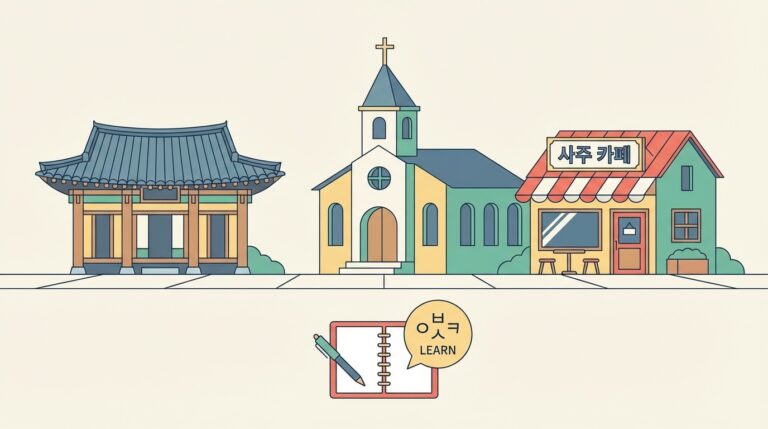
Picture this classic K-Drama scene: The protagonist’s mother goes to a tranquil Buddhist temple at dawn to bow 108 times for her son’s university entrance exam. In the afternoon, she attends a lively Protestant mega-church to sing hymns and pray for his success. And on her way home? She casually drops by a hidden Mudang (Shaman) to get a talisman just in case.
Did she suddenly change religions three times in one day? Not at all!
To a Westerner, religion is often an exclusive identity. But in Korea, spirituality is a fascinating, pragmatic blend of Shamanism, Buddhism, Confucianism, and Christianity. At the C1 level, you aren’t just learning words; you are deciphering the cultural DNA of Korea. If you don’t understand the spiritual undertones hidden in everyday Korean vocabulary, you’re only understanding half of what’s being said. Today, we’re diving deep into the spiritual codes embedded in everyday Korean. This guide is based on the actual ‘aha!’ moments of my advanced students who finally understood why Koreans talk so much about ‘fate’ and ‘duty.’
Phase 2: Deep Dive into Core Expressions
Let’s unpack three high-level expressions rooted in different spiritual traditions.
1. 인연 (Buddhism: The Red Thread of Fate)
- Pronunciation: [in-yeon] + [Sounds like: ‘in’ + ‘yawn’ (but shorter and sharper)]
- Meaning: Literal: Ties/Connection. Real nuance: Destiny, Karma, or a deep, unavoidable bond between people.
- K-Culture Moment: Think of the critically acclaimed movie Past Lives. The entire plot revolves around this concept. In K-Dramas, when lovers meet under impossible circumstances, they sigh, “우린 필연적인 인연인가 봐” (We must be destined In-yeon).
- Editor’s Insight: This isn’t just for romance! In business, Koreans use it to soften a rejection: “이번에는 인연이 닿지 않았지만…” (Our in-yeon didn’t connect this time, but…). It takes the personal sting out of failure by blaming the universe.
- Situation Spectrum:
[🚫 Never] ———— [⚠️ Be Careful] ———— [✅ Freely]
- Close Friends (Casual): ✅
- Colleagues (Semi-formal): ✅
- Boss/Elders (Formal): ✅ (Very polite when discussing professional partnerships)
- 🤔 Think About It: Why do Koreans use a Buddhist concept like In-yeon to reject a business proposal? How does it protect ‘kibun’ (face/mood) compared to a direct Western “No”?
2. 팔자 (Shamanism/Daoism: The Pre-written Script)
- Pronunciation: [pal-ja] + [Sounds like: ‘pal’ (like a friend) + ‘jah’ (like dropping your jaw)]
- Meaning: Literal: The Eight Characters (of one’s birth time). Real nuance: One’s inescapable destiny or lot in life, often used when complaining.
- K-Culture Moment: You’ll see an Ahjumma in a drama wiping tables, wiping away sweat, and muttering to herself, “아이고, 내 팔자야!” (Oh, my poor fate!).
- Editor’s Insight: It sounds pessimistic, but it’s actually a coping mechanism. By saying “It’s my Palja,” you acknowledge that the hardship isn’t entirely your fault, allowing you to let go of the stress and just keep going.
- Situation Spectrum:
[🚫 Never] ———— [⚠️ Be Careful] ———— [✅ Freely]
- Close Friends (Casual): ✅
- Colleagues (Semi-formal): ⚠️ (Only if you are very close, complaining about work together)
- Boss/Elders (Formal): 🚫 (Do not complain about your fate to your boss!)
- 🤔 Think About It: Does attributing hardships to Palja make people passive, or is it a healthy psychological defense mechanism against extreme stress?
3. 도리 (Confucianism: The Invisible Glue)
- Pronunciation: [do-ri] + [Sounds like: ‘dough’ + ‘ree’]
- Meaning: Literal: The right path. Real nuance: Moral duty, proper etiquette, or the fundamental obligations one has as a human being in a specific role.
- K-Culture Moment: In a historical Sageuk drama, the king yells at the rebellious prince, “그게 자식 된 도리이더냐!” (Is that the proper duty of a child?!).
- Editor’s Insight: While Buddhism handles fate and Shamanism handles luck, Confucianism handles relationships. If someone says “사람의 도리가 아니지” (It’s not the do-ri of a human), it is the ultimate moral condemnation in Korean society.
- Situation Spectrum:
[🚫 Never] ———— [⚠️ Be Careful] ———— [✅ Freely]
- Close Friends (Casual): ✅ (Often used playfully: “친구로서 도리는 해야지!”)
- Colleagues (Semi-formal): ⚠️ (Can sound a bit preachy if used seriously)
- Boss/Elders (Formal): ✅ (Shows deep respect for social structure)
- 🤔 Think About It: In your native language, is ‘duty’ driven by personal choice, divine command, or social relationships like Korean Do-ri?
Phase 3: Textbook vs. Real Korean
| Situation | 📖 Textbook Korean | 🗣️ Real Korean | 💡 Why is it different? |
|---|---|---|---|
| Breaking up with someone | 우린 운명이 아닙니다. (We are not destiny.) | 우린 인연이 여기까지인가 봐요. (I guess our in-yeon ends here.) | ‘In-yeon’ implies it was out of our control, softening the blow. |
| Complaining about a hard day | 저는 불행합니다. (I am unhappy.) | 아이고 내 팔자야. (Oh, my fate.) | Koreans prefer attributing minor suffering to the universe rather than a permanent state of unhappiness. |
| Doing a favor for a friend | 책임감 때문에 돕습니다. (I help out of responsibility.) | 친구로서 도리는 해야지. (Gotta do my duty as a friend.) | ‘Responsibility’ sounds legal/cold; ‘Do-ri’ sounds relational and warm. |
Bottom Note: At the C1 level, using ‘인연’ and ‘도리’ naturally will make native speakers see you not just as someone fluent in Korean, but as someone who thinks like a Korean.
Phase 4: Cultural Context — K-Culture Deep Dive
4-1. Non-verbal Cue: The Angle of the Bow (절 – Jeol)
Korea’s religious syncretism is physically visible in how people bow. A casual 15-degree nod is everyday Confucian respect. But during Jesa (Confucian ancestral rites), Koreans do a full prostration to the floor twice. If you go to a Buddhist temple, you might do 108 full prostrations to clear karma. Pro Tip: Never do the deep, two-time prostration to a living person—that is strictly reserved for the dead!
4-2. K-Culture Connection: The ‘Saju’ Cafe Phenomenon
If you’ve watched K-Dramas, you’ve seen characters visit a dimly lit tent or a trendy cafe to consult a fortune teller (Saju). Saju (Four Pillars of Destiny) is rooted in Daoist/Shamanistic astrology. What’s fascinating is that highly educated, modern Koreans—even devout Christians or Catholics—might visit a Saju cafe before a major exam, starting a business, or getting married (to check Gunghap, marital compatibility). It is treated almost like a psychological counseling session rather than strict religious dogma.
Phase 5: Real-Life Roleplay Scenario
Setting: A rainy Friday evening inside a cozy, traditional tea house in Insadong. You are sipping Omija tea with your close Korean coworker, Min-su. You recently had a falling out with a business partner, and you’re feeling down.
Characters:
– YOU: An expat professional living in Seoul, highly fluent but navigating office politics.
– Min-su (32): Your pragmatic, spiritual-but-not-religious Korean friend.
Dialogue:
Min-su: 그 회사랑 계약 깨진 거, 너무 마음에 담아두지 마. 🍵
(geu hoesarang gyeyak kkaejin geo, neomu maeume damaduji ma.)
[Don’t take the broken contract with that company too much to heart.]
(🎭 Stage Direction: Min-su pours you some warm tea.)
YOU: 그래도 제가 뭘 잘못했나 자꾸 생각하게 되네요.
(geuraedo jega mwol jalmothaenna jakku saenggakhage doeneyo.)
[Still, I keep wondering if I did something wrong.]
Min-su: 에이, 비즈니스가 다 그런 거지 뭐. 그냥 그쪽이랑 우리가 인연이 안 닿았던 거야.
(ei, bijeuniseuga da geureon geoji mwo. geunyang geujjogirang uriga inyeoni an daatdeon geoya.)
[Hey, that’s just how business is. We just didn’t have the in-yeon with them.]
YOU: 인연이요? 비즈니스에서도 그런 말을 써요?
(inyeoniyo? bijeuniseuesyeodo geureon mareul sseoyo?)
[In-yeon? You use that word in business too?]
Min-su: 그럼! 억지로 잡으려고 해도 안 되는 건 안 되더라고. 내 팔자려니 해야지.
(geureom! eokjiro jabeuryeogo haedo an doeneun geon an doedeorago. nae paljaryeoni haeyaji.)
[Of course! Even if you try to force it, what’s not meant to be won’t be. I just accept it as my palja.]
🔀 Your Turn! How should you respond?
– A) “맞아요. 다음엔 더 좋은 기회가 오겠죠.” (Textbook, polite, safe)
– B) “진짜 제 팔자가 왜 이럴까요? 사주라도 보러 갈까요?” (Witty, heavily culturally nuanced)
– C) “아니요, 이건 순전히 제 책임입니다.” (Too serious, kills the comforting vibe)✅ Best Choice: B — Why? You are picking up on his cultural cues. Acknowledging palja and joking about getting your saju read perfectly diffuses the tension. Min-su will likely laugh and say, “Let’s go right now!”
⚠️ Choice C Analysis: While noble in a Western context, Min-su is actively trying to take the burden off your shoulders using Korean spiritual concepts. Rejecting that makes the conversation rigid.
Phase 6: 10-Second Shadowing Drill
Master the intonation! Follow the emotion tags and slash marks for pausing.
😤 Sighing heavily
아이고~ / 내 팔자야! / (a-i-go~ / nae pal-ja-ya!)
🥺 Melancholy but accepting
우리는 / 딱 여기까지가 / 인연인가 봐요. / (u-ri-neun / ttak yeogi-kkaji-ga / in-yeon-in-ga bwa-yo.)
😤 Firm and principled
아무리 그래도 / 사람의 도리는 / 지켜야지! / (a-mu-ri geu-rae-do / sa-ram-ui do-ri-neun / ji-kyeo-ya-ji!)
Phase 7: K-Culture Mini Dictionary
| Korean | Romanization | English | Cultural Context |
|---|---|---|---|
| 사주 | saju | Four Pillars of Destiny | Fortune telling based on birth year, month, day, and time. Hugely popular. |
| 궁합 | gunghap | Marital compatibility | Couples often check this before marriage. If it’s bad, parents might actually oppose the wedding! |
| 제사 | jesa | Ancestral rites | Confucian ritual of offering food to deceased ancestors on their death anniversary or holidays like Chuseok. |
| 무당 | mudang | Shaman | A spiritual medium in Korean folk religion. Usually consulted for major life crises. |
| 템플스테이 | tempeulseute-i | Temple Stay | A cultural program where you live in a Buddhist temple for a weekend. Very popular for mental detox. |
Phase 8: Traveler’s Survival Kit
Are you planning to explore Korea’s spiritual side? Whether you’re booking a relaxing Temple Stay in the mountains or visiting a trendy Saju Cafe in Hongdae for fun, you need these phrases.
🆘 Survival Phrases: Spiritual Tourism
– 🇰🇷 “외국인 템플스테이 프로그램 있나요?” (oegugin tempeulseute-i peurogeuraem innayo?)
– 🗣️ English: Do you have a Temple Stay program for foreigners?
– 📍 Where to use: Jogyesa Temple, Bongeunsa Temple websites or info desks.
- 🇰🇷 “연애운 사주 한 번 보는 데 얼마예요?” (yeonae-un saju han beon boneun de eolmayeyo?)
- 🗣️ English: How much is it to read my fortune for romance?
- 📍 Where to use: Saju cafes in Hongdae or Myeongdong.
📌 Editor’s Travel Note
– Manners in Churches/Temples: When visiting historic Buddhist temples, always enter through the side doors, not the main center door (which is for monks). Keep your voice to a whisper.
– Translation Apps won’t help with Saju: Saju tellers use ancient classical Chinese concepts. If you visit one, you must bring a fluent Korean friend to interpret, or find an English-speaking Saju cafe!
Phase 9: Critical Thinking — “One Step Deeper”
🧠 Think Deeper: Spiritual Pragmatism over Dogma
Modern Korea is a hyper-capitalist, tech-forward society, yet it retains a deeply mystical core. How do these coexist? In Korea, spirituality is often highly pragmatic. You go to a state-of-the-art hospital for a complex surgery, but your mother might go to a Buddhist temple to pray for it, and then check with a Shaman to pick the ‘luckiest’ date for the operation. To Westerners, this looks like a contradiction. To Koreans, it is simply utilizing every available resource—science, heaven, and the spirits—to ensure success. This pragmatism explains why religious conflicts are surprisingly low in Korea despite the high diversity of faiths. Religion here is less about rigid identity and more about seeking harmony and blessing.💬 Your Turn: Does your culture blend different spiritual or religious traditions in daily life, or are they kept strictly separate? Share your thoughts in the comments!
Phase 10: FAQ & Avoiding Misunderstandings
Q: If my Korean friend is Christian, will they be offended if I mention ‘In-yeon’ or ‘Palja’?
No! These words have transcended their religious origins and are now just standard Korean vocabulary. A devout Christian will still sigh “아이고 내 팔자야” when they miss the bus.
Q: Can I ask a new Korean friend about their MBTI? Isn’t that like Saju?
Yes! In fact, MBTI is basically the modern, scientific version of Saju for Gen Z and Millennials. Asking “MBTI가 어떻게 되세요?” (What’s your MBTI?) is one of the most common icebreakers in Korea today.
❌ Common Mistake #1: Treating Jesa (Ancestral Rites) as a purely religious act.
✅ Do this instead: Understand that for many Koreans, bowing to the ancestral table isn’t worshipping a ‘false god’—it’s viewed as fulfilling Do-ri (filial piety and respect for one’s roots).
Phase 11: Summary & Action Items
- One-Liner Summary: Korean vocabulary is deeply colored by Buddhist karma (In-yeon), Shamanistic fate (Palja), and Confucian duty (Do-ri), shaping how native speakers view relationships and hardships.
-
Action Mission:
- 🥉 Bronze (Solo): Look in the mirror, sigh deeply, and say “아이고 내 팔자야!” with dramatic flair.
- 🥈 Silver (Online): Go to a K-Drama YouTube clip (like Past Lives) and leave a comment using “인연”.
- 🥇 Gold (Real World): Ask your Korean friend or tutor: “사주 본 적 있어요?” (Have you ever had your fortune read?) and listen to their story!
- K-Culture Mission: Watch episode 1 of any romantic K-Drama and take a shot (of water!) every time the word 운명 (Destiny) or 인연 (Karma/Connection) is mentioned.
Phase 12: Quiz — Interactive Challenge
1. Situational Judgment: You are talking to a business partner. Your company cannot accept their proposal due to budget cuts. What is the most culturally elegant (C1) way to decline?
– A) 당신의 제안은 최악입니다. (Your proposal is the worst.)
– B) 아쉽지만 다음 기회에 인연이 닿기를 바랍니다. (It’s a shame, but I hope our in-yeon connects next time.)
– C) 이것은 제 팔자입니다. (This is my palja.)
2. True or False – K-Culture Edition:
“Only elderly people in Korea visit Saju cafes or read their daily horoscopes.”
3. Fill in the Blank:
When your friend is refusing to help their aging parents out of pure laziness, you scold them by saying: “사람의 _____ 는 해야지!” (You must do your human _____!)
(Answers: 1. B – It perfectly protects their face. / 2. False – Young people love Saju, Tarot, and MBTI! / 3. 도리)
Frequently Asked Questions (FAQ)
Q: What does "인연 (Buddhism: The Red Thread of Fate)" mean in Korean and how do you pronounce it?
A: In Korean, "인연 (Buddhism: The Red Thread of Fate)" is pronounced [in-yeon] and means: Literal: Ties/Connection. Real nuance: Destiny, Karma, or a deep, unavoidable bond between people.
Q: What does "팔자 (Shamanism/Daoism: The Pre-written Script)" mean in Korean and how do you pronounce it?
A: In Korean, "팔자 (Shamanism/Daoism: The Pre-written Script)" is pronounced [pal-ja] and means: Literal: The Eight Characters (of one's birth time). Real nuance: One's inescapable destiny or lot in life, often used when complaining.
Q: What does "도리 (Confucianism: The Invisible Glue)" mean in Korean and how do you pronounce it?
A: In Korean, "도리 (Confucianism: The Invisible Glue)" is pronounced [do-ri] and means: Literal: The right path. Real nuance: Moral duty, proper etiquette, or the fundamental obligations one has as a human being in a specific role.







