

Phase 1: Empathy (The “I’ve Been There” Opening)
Hello! Daily Hangul Editor here.
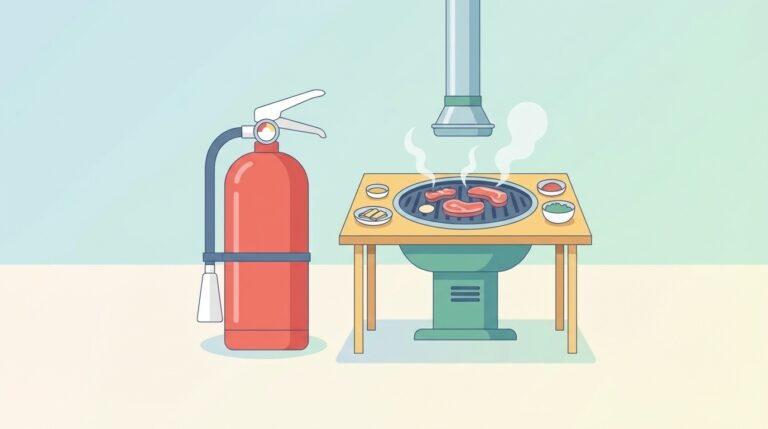
Picture this: It’s Friday night in Seoul. You’re at a bustling K-BBQ restaurant in Hongdae. The pork belly (Samgyeopsal) is sizzling, the K-Pop music is booming, and everyone is having a great time. Suddenly, the grease drips, and WHOOSH! A flame shoots up from your grill.
In a K-Drama, this is the moment the handsome male lead smoothly reaches over and saves the day in slow motion. But in real life? The smoke alarm might go off, and you’re freezing, wondering, “How do I ask for a fire extinguisher in Korean?!”
Emergencies happen. While we hope you never have to use these words, knowing them is like wearing a linguistic seatbelt. Today, we’re going to learn exactly what to say when things get a little too “hot” in Korea. Don’t worry, we’ll keep it simple, practical, and highly survival-focused. Let’s dive in!
Phase 2: Core Expressions Deep Dive
Let’s look at the top 3 lifesavers you need to know.
1. 불이야! (Fire!)
- Pronunciation: bul-i-ya! [Bool-ee-yah!] (The ‘bul’ sounds like ‘bull’, but with an ‘oo’ like in ‘boot’.)
- Meaning: Literal = “It is a fire!” / Real nuance = “FIRE!”
- K-Culture Moment: If you watch Korean news or disaster movies like Exit (엑시트), this is the exact phrase people scream while running down the stairs.
- Editor’s Insight: You might wonder, why not just say “불 (Fire)”? In Korean, adding “~이야” makes it a complete sentence shouting, “It IS a fire!” It grabs much more attention than just yelling the noun.
- Situation Spectrum:
[🚫 절대 금지] ———— [⚠️ 주의] ———— [✅ 자유롭게]
- Casual / Friends: ✅
- Strangers / Public: ✅ (If it’s a real emergency, scream it!)
- Office / Formal: ✅ (Politeness goes out the window in an emergency!)
- 🤔 Think About It: Why do Koreans add “~이야” (It is) even when panicking? It shows how deeply embedded sentence structures are in the Korean mindset. Does your language use a single word or a full sentence for emergencies?
2. 소화기 어디 있어요? (Where is the fire extinguisher?)
- Pronunciation: so-hwa-gi eo-di is-seo-yo? [So-hwa-ghee / uh-dee / ees-uh-yo?]
- Meaning: Literal = “Fire extinguisher where is it?” / Real nuance = “Where’s the fire extinguisher?”
- K-Culture Moment: In every Korean subway station, you will see a bright red box with “소화기” written on it. Korea takes fire safety very seriously!
- Editor’s Insight: “어디 있어요?” (Where is it?) is the most important A1 survival phrase. You can put ANY noun in front of it. Bathroom? (화장실 어디 있어요?) Subway? (지하철 어디 있어요?)
- Situation Spectrum:
[🚫 절대 금지] ———— [⚠️ 주의] ———— [✅ 자유롭게]
- Waiter/Staff: ✅
- Coworkers: ✅
- Strangers: ✅
- 🤔 Think About It: Notice the word order? In Korean, the most important thing (Fire extinguisher) comes first, followed by the question (Where is it?). It’s a highly efficient way to communicate when you’re in a rush!
3. 도와주세요! (Please help me!)
- Pronunciation: do-wa-ju-se-yo! [Doh-wa-joo-seh-yo!]
- Meaning: “Please give me help!”
- K-Culture Moment: You’ll hear this in historical K-Dramas when someone is being chased, or in modern dramas when the heroine is in trouble.
- Editor’s Insight: The ending “~주세요” (ju-se-yo) means “please give.” You’ll use this same ending to order coffee! But when attached to “도와” (help), it becomes a desperate plea for assistance.
- Situation Spectrum:
[🚫 절대 금지] ———— [⚠️ 주의] ———— [✅ 자유롭게]
- Anyone who can hear you: ✅
Phase 3: Textbook vs. Real Korean
When smoke fills the room, nobody uses textbook grammar. Let’s see how language shrinks under pressure.
| Situation | 📖 Textbook Korean | 🗣️ Real Korean | 💡 Why is it different? |
|---|---|---|---|
| Spotting a fire | 화재가 발생했습니다. (A fire has occurred.) | 불이야!! (Fire!!) | Survival instinct! Formal grammar is dropped for speed and volume. |
| Asking for the extinguisher | 소화기를 주십시오. (Please give me the fire extinguisher.) | 저기요, 소화기요!! (Excuse me, extinguisher!) | Dropping verbs and particles. Just saying the noun + “요” (polite marker) is faster. |
| Asking for help | 저를 도와주시겠어요? (Would you please help me?) | 도와주세요!! (Help me!!) | Direct commands with polite endings are standard in urgent situations. |
Bottom Note for A1 Learners: Don’t worry about perfect grammar in an emergency. Just shout the keyword (불! / 소화기!) and point. Koreans will understand instantly.
Phase 4: Cultural Context — K-Culture Deep Dive
4-1. Non-Verbal Cues (The “Nunchi” of Emergencies)
In Korea, action often precedes words. If a grill catches fire, don’t just stand there making eye contact! Point directly at the fire and wave your hands. In normal Korean culture, pointing directly is slightly rude, but in an emergency, it’s necessary.
4-2. The K-Food Connection: The Sizzling Samgyeopsal Incident
Why are we talking about fire extinguishers at a restaurant? Because K-BBQ tables literally have open flames!
When pork belly fat drips onto the charcoal, you might get a “불쇼” (Bul-show / Fire show).
– Reality Check: 99% of the time, the restaurant staff (이모님 / Imo-nim) will calmly walk over with a piece of wet lettuce or a damp towel and casually slap it onto the grill to kill the flame.
– When to panic: Only if the fire spreads outside the grill. If you scream “불이야!!” (FIRE!!) for a normal grill flare-up, the entire restaurant will panic, and you might feel very embarrassed! Instead, just say, “사장님, 불판에 불 났어요!” (Boss, the grill is on fire!)
Phase 5: Real-Life Roleplay Scenario
Setting: Friday evening, 7 PM. A crowded Gangnam K-BBQ restaurant. The room is hazy with delicious meat smoke. You are sitting with Min-su, your friendly Korean coworker.
Characters:
– YOU: A foreigner on a business trip, experiencing your first real K-BBQ.
– Min-su (32): Your Korean coworker. Loves to grill, but maybe put a bit too much meat on at once.
Dialogue:
Min-su: 야, 오늘 고기는 내가 쏜다! 🥩
(Ya, oneul gogineun naega ssonda!)
(Hey, the meat is on me today!)
(🎭 Stage Direction: Min-su confidently puts 5 thick slices of pork belly on the roaring fire.)
YOU: 우와, 진짜 맛있겠어요!
(Uwa, jinjja masitgesseoyo!)
(Wow, it looks really delicious!)
(🎭 Stage Direction: SIZZLE. Suddenly, a huge flame leaps up from the grill, almost touching Min-su’s hair!)
Min-su: 어? 어어?! 불! 불!
(Eo? Eo-eo?! Bul! Bul!)
(Uh? Uh-uh?! Fire! Fire!)
🔀 Your Turn! How should you react?
– A) (Stand up on your chair) “불이야!!! 119!!!” (FIRE!!! Call 911!!!)
– B) (Wave at the staff) “저기요! 소화기 어디 있어요?!” (Excuse me! Where is the fire extinguisher?!)
– C) (Calmly to staff) “사장님, 불판 좀 봐주세요!” (Boss, please look at the grill!)✅ Best Choice: C or B.
Why? Since it’s just the grill, C is the most natural “insider” response. The staff will come fix it. If the table itself catches fire, B is the absolute correct answer. Choice A might cause a stampede for a minor meat incident!
Min-su (wiping sweat): 휴… 고기 다 탈 뻔했네.
(Hyu… gogi da tal ppeonhaenne.)
(Phew… the meat almost burned completely.)
Phase 6: 10-Second Shadowing Drill
Let’s practice your emergency voice. Repeat these aloud, matching the emotion!
- 😱 불 / 이 / 야!!!
(bul / i / ya!!!)
(Loud and urgent!) -
😰 소화기 / 어디 / 있어요?!
(so-hwa-gi / eo-di / is-seo-yo?!)
(Desperate but clear!) -
🥺 제발 / 도와주세요!
(je-bal / do-wa-ju-se-yo!)
(Adding ‘jebal’ makes it ‘Please, I’m begging you!’)
Phase 7: K-Culture Mini Dictionary
| Korean | Romanization | English | Context |
|---|---|---|---|
| 소화기 | so-hwa-gi | Fire Extinguisher | Red, easily found in hallways, subways, and cafes. |
| 불판 | bul-pan | BBQ Grill pan | The literal translation is “fire plate”. The source of deliciousness and occasional panic. |
| 119 | il-il-gu | Emergency Number | Korea’s 911. (119 for Fire/Medical, 112 for Police). |
| 비상구 | bi-sang-gu | Emergency Exit | Look for the green running man sign! |
Phase 8: Traveler’s Survival Kit
If you are traveling in Korea, this is the most important box in this blog post. Take a screenshot!
🆘 Survival Expression #1: Emergency Call
– 🇰🇷 “여기 [장소 이름] 인데, 불이 났어요!”
– 🗣️ [Yeo-gi (Place name) in-de, bul-i nas-seo-yo!]
– 🇬🇧 “I am at [Place name], and there is a fire!”
– 📍 Where to use: Calling 119.
– 💡 Pro Tip: Don’t know where you are? Tell them the name of the nearest big store, or look at a telephone pole—there are unique location codes on them in Korea!📌 Editor’s Travel Note: 119 vs 112
– 119: Fire and Medical Emergencies (Ambulance).
– 112: Police.
– Language Barrier? Don’t panic. If you call 119 and speak English, they have a three-way interpretation service available 24/7. Just stay on the line and say “English, please!”
Phase 9: Critical Thinking Corner — “One Step Deeper”
Media vs Reality: The Illusion of K-Drama Rescues
🧠 Think Deeper:
If you watch K-Dramas, emergencies are often highly romanticized. The building catches fire, and the main character runs into the flames to save someone. In reality, Korea has experienced tragic fires in the past, leading to some of the strictest fire safety laws in the world today. This is why you will see a “소화기” (fire extinguisher) every few meters in subway stations, and why even small cafes have emergency flashlights and smoke masks. The language reflects this practicality: short, sharp, and focused on tools (Where is the extinguisher?) rather than waiting for a hero.💬 Your Turn: How visible are fire extinguishers in your country? Do you know where the closest one is right now? Tell us in the comments!
Phase 10: FAQ & Avoiding Misunderstandings
Q: If I yell “도와주세요” (Help me) to someone older than me, is it rude?
A: Absolutely not! In life-or-death emergencies, the rules of honorifics and age hierarchy are suspended. Your safety comes first.
Q: Can I just yell “FIRE” in English?
A: Yes, many younger Koreans will understand the English word “Fire.” However, screaming “불이야!” guarantees a 100% instant reaction from everyone, including older generations and restaurant owners.
❌ Common Mistake: Trying to dial 911.
✅ Do This Instead: Dial 119. Your foreign phone roaming in Korea will usually redirect 911 to 112 (Police), but dialing 119 directly gets you the fire department faster.
Phase 11: Summary & Action Items
🔥 One-Liner Summary: When things catch fire, yell “불이야!” and ask for the red “소화기”!
Action Mission 3 Steps:
– 🥉 Bronze (Solo): Look around your room right now. Pretend there’s a fire and shout “불이야!” (quietly if it’s late!).
– 🥈 Silver (Online): Write “소화기 어디 있어요?” in your phone’s note app so you can copy-paste it if needed.
– 🥇 Gold (Real Life): Next time you are in a Korean restaurant or subway, play a game: Try to spot the red “소화기” within 10 seconds of entering.
🎥 K-Culture Mission:
Watch one episode of any Korean action drama or movie (like Sweet Home or Squid Game). Keep your ears open for the word “도와주세요!” (Help me!). You’ll be surprised how often you hear it!
Phase 12: Quiz — Interactive Challenge
Let’s test your survival skills!
1. You are at a cafe and the microwave catches on fire. What is the BEST thing to say to the barista?
A) 화재가 발생했습니다. (A fire has occurred.)
B) 소화기 어디 있어요?! (Where is the fire extinguisher?!)
C) 김치찌개 주세요. (Kimchi stew, please.)
2. True or False: In Korea, the emergency number for the fire department is 911.
3. Fill in the blank:
When a fire breaks out, Koreans yell “______이야!”
(Answers below)
Click here for answers!
1. B (A is too formal and slow. C means you are very hungry, but not helpful here!)
2. False (It is 119! 112 is for police.)
3. 불 (Bul-i-ya! = Fire!)
How did you do? Remember, staying calm and knowing just one or two words can make a huge difference. Stay safe, enjoy your K-BBQ responsibly, and see you in the next lesson!
Frequently Asked Questions (FAQ)
Q: What does "불이야! (Fire!)" mean in Korean and how do you pronounce it?
A: In Korean, "불이야! (Fire!)" is pronounced [bul-i-ya! [Bool-ee-yah!] and means: Literal = "It is a fire!" / Real nuance = "FIRE!"
Q: What does "소화기 어디 있어요? (Where is the fire extinguisher?)" mean in Korean and how do you pronounce it?
A: In Korean, "소화기 어디 있어요? (Where is the fire extinguisher?)" is pronounced [so-hwa-gi eo-di is-seo-yo? [So-hwa-ghee / uh-dee / ees-uh-yo?] and means: Literal = "Fire extinguisher where is it?" / Real nuance = "Where's the fire extinguisher?"
Q: What does "도와주세요! (Please help me!)" mean in Korean and how do you pronounce it?
A: In Korean, "도와주세요! (Please help me!)" is pronounced [do-wa-ju-se-yo! [Doh-wa-joo-seh-yo!] and means: "Please give me help!"







