

Phase 1: Empathy (Immersive Opening)
Hello! I’m your Daily Hangul editor.
Picture this: You just finished a sizzling plate of Samgyeopsal (pork belly) with your Korean friends. The mood is fantastic, the soju glasses are empty, and someone suddenly shouts, “2차 가자!” (Let’s go to the 2nd round!). In a K-Drama, this is the exact moment the scene cuts to a neon-lit room with disco balls and tambourines. Yes, it’s time for Noraebang (Karaoke)!
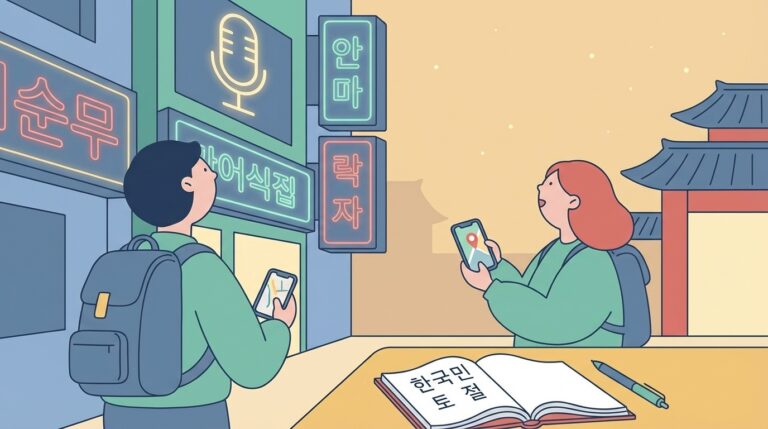
But wait—you step out onto the busy streets of Hongdae, and there are millions of neon signs. Your map app says you’ve arrived, but you don’t see anything. How do you find it? What if you want to practice your favorite K-Pop song alone without spending a fortune?
If you don’t know the right words, you might end up wandering the alleys forever. Don’t worry! This guide is based on real struggles from our students who got lost looking for a place to sing. Let’s learn how to navigate the Korean nightlife like a true insider!
Phase 2: Core Expressions Deep Dive
1. 노래방이 어디에 있어요?
- Pronunciation: [no-rae-bang-i eo-di-e is-seo-yo?]
(Tip: ‘eo’ sounds like the ‘uh’ in ‘uh-oh’, and ‘eu’ sounds like the disgusted sound you make when stepping in gum!)- Meaning: Where is the karaoke? (Literal: Does the karaoke exist where?)
- K-Culture Moment: You are standing in a busy street, looking lost. You tap a convenience store worker’s shoulder and ask this. It’s the ultimate survival phrase!
- Editor’s Insight: Notice we use “있어요” (exists/have) instead of just “where is”. In Korean, we focus on the existence of the place nearby. It sounds much softer.
- Situation Spectrum:
[🚫 절대 금지] ———— [⚠️ 주의] ———— [✅ 자유롭게]
- Casual with friends: ⚠️ (Use ‘어딨어?’ instead)
- Polite to strangers: ✅
- Formal to boss: ✅
- 🤔 Think About It: In English, we ask “Where is [X]?” but Koreans ask “Where does [X] exist?”. How does this subtle shift change the way you view space and locations in a new country?
2. 근처에 코인 노래방 있어요?
- Pronunciation: [geun-cheo-e ko-in no-rae-bang is-seo-yo?]
- Meaning: Is there a coin karaoke nearby?
- K-Culture Moment: You want to sing just three K-Pop songs before heading home. You don’t need a huge room, just a small booth. This is when you look for a Coin Noraebang!
- Editor’s Insight: “근처에” (nearby) is your best friend when traveling. Pair it with anything you need: “근처에 화장실 있어요?” (Is there a restroom nearby?)
- Situation Spectrum:
[🚫 절대 금지] ———— [⚠️ 주의] ———— [✅ 자유롭게]
- Asking strangers politely: ✅
- Asking a store clerk: ✅
- 🤔 Think About It: Why do you think ‘Coin Noraebang’ (tiny booths for 1-2 people) became so insanely popular among Korean youth compared to traditional large karaoke rooms?
3. 저기요, 길 좀 물어볼게요.
- Pronunciation: [jeo-gi-yo, gil jom mu-reo-bol-ge-yo]
- Meaning: Excuse me, let me ask for directions. (Literal: Over there, I will ask a little bit of road.)
- K-Culture Moment: Before asking a stranger anything on the street, you must use this phrase to get their attention politely.
- Editor’s Insight: “저기요” literally means “Over there,” but it functions exactly like “Excuse me” to grab attention. “좀” (a little) softens the request, making you sound extremely polite and naturally Korean.
- Situation Spectrum:
[🚫 절대 금지] ———— [⚠️ 주의] ———— [✅ 자유롭게]
- To strangers on the street: ✅
- To your close friend: 🚫 (They will think you are acting weirdly formal!)
Phase 3: Textbook vs. Real Korean
| Situation | 📖 Textbook Korean | 🗣️ Real Korean | 💡 Why is it different? |
|---|---|---|---|
| Looking for a Coin Karaoke | 코인 노래방이 어디에 있습니까? (Very formal/stiff) | 코노 어딨어요? (Where is Kono?) | Young Koreans love efficiency! They abbreviate ‘Coin Noraebang’ to ‘Ko-No’. |
| Trying to get attention | 실례합니다. (Excuse me – formal) | 저기요! (Over there!) | ‘실례합니다’ sounds like you are interrupting a serious meeting. ‘저기요’ is much more natural for grabbing attention on the street. |
Bottom Note for A2 Learners: You don’t need to use heavy slang, but knowing abbreviations like “코노 (Kono)” will make your Korean friends go, “Whoa, how do you know that?!”
Phase 4: Cultural Context — K-Culture Deep Dive
4-1. Non-Verbal Cues: The Art of “Nunchi” on the Street
When you approach a stranger to ask for a Noraebang, don’t just jump in front of them! Use a little Nunchi (reading the room). Make slight eye contact, give a tiny head bow, say “저기요” (Excuse me), and wait for them to pause before asking “노래방 어딨어요?”.
4-2. K-Travel & K-Drama Connection: Look UP!
Have you noticed in K-Dramas that characters often take elevators or narrow stairs to get to restaurants or cafes?
In many Western countries, businesses are mostly on the ground floor. But in densely packed Korean cities like Seoul, you must look UP or DOWN!
Noraebangs are rarely on the first floor. They are usually located on the 2nd, 3rd, or even basement levels (B1/B2). When you use your map app to find a Noraebang, don’t just look straight ahead. Look for a glowing microphone icon 🎤 or vertical neon signs that say “노래방” high up on the buildings.
Critical View: Drama characters always flawlessly find the perfect empty Noraebang. In reality? On a Friday night in Gangnam, you might have to check three different buildings to find an empty room!
Phase 5: Real-Life Roleplay Scenario
Setting: Friday night, 9 PM. Right outside Hongdae Exit 9. The streets are packed with people, street food vendors, and buskers singing K-Pop. You just finished dinner with your Korean coworker, Min-su.
Characters:
– YOU: A foreign professional working in Korea, ready to experience the famous “2차” (2nd round) culture.
– Min-su (32): Your friendly Korean coworker who loves to sing.
Dialogue:
Min-su: 와, 배부르다! 우리 2차 갈까요? 🍻
(wa, baebureuda! uri icha galkkayo?)
[Wow, I’m full! Should we go to the 2nd round?]
(🎭 Stage Direction: Min-su rubs his belly and smiles.)
YOU: 좋아요! 노래방 어때요? 🎤
(joayo! noraebang eottaeyo?)
[Sounds good! How about karaoke?]
Min-su: 콜! 제가 쏠게요. 근처에 노래방 있나 찾아볼래요?
(kol! jaega ssolgeyo. geuncheoe noraebang inna chajabollaeyo?)
[Deal! I’ll pay. Can you check if there’s a karaoke nearby?]
YOU: 네, 잠깐만요. 지도 앱 켰어요.
(ne, jamkkanmanyo. jido aep kyeosseoyo.)
[Yes, hold on. I turned on the map app.]
Min-su: 코인 노래방으로 가요. 그게 더 싸고 좋아요.
(koin noraebangeuro gayo. geuge deo ssago joayo.)
[Let’s go to a coin karaoke. It’s cheaper and better.]
YOU: 좋은 생각이에요. 근데 지도로는 잘 못 찾겠어요.
(joeun saenggagieyo. geunde jidoroneun jal mot chatgesseoyo.)
[Good idea. But I can’t really find it on the map.]
Min-su: 그럼 지나가는 사람한테 길 좀 물어볼래요? 한국어 연습도 할 겸!
(geureom jinaganeun saramhante gil jom mureobollaeyo? hangugeo yeonseupto hal gyeom!)
[Then do you want to ask a passerby for directions? Good for Korean practice too!]
YOU: 아… 네, 해볼게요!
(a… ne, haebolgeyo!)
[Ah… yes, I’ll try!]
(🎭 Stage Direction: You look at the busy street and choose someone friendly looking.)
🔀 Your Turn! How should you ask the stranger?
– A) “야! 코노 어디야!”
– B) “저기요, 근처에 코인 노래방 있어요?”
– C) “실례합니다. 노래방 주세요.”✅ Best Choice: B — It perfectly grabs attention politely (“저기요”) and asks clearly.
⚠️ Why not the others? A is extremely rude (using “야” to a stranger can start a fight!). C literally means “Give me a karaoke,” which sounds like you want to buy the whole building!
(Continuing with Option B)
YOU: 저기요, 근처에 코인 노래방 있어요?
(jeogiyo, geuncheoe koin noraebang isseoyo?)
[Excuse me, is there a coin karaoke nearby?]
Stranger: 아, 저기 편의점 건물 3층에 있어요. 간판 보이시죠?
(a, jeogi pyeonijeom geonmul samcheung-e isseoyo. ganpan boisijyo?)
[Ah, it’s on the 3rd floor of that convenience store building over there. You see the sign, right?]
YOU: 아! 네, 감사합니다!
(a! ne, gamsahamnida!)
[Ah! Yes, thank you!]
Min-su: 오~ 한국어 진짜 자연스러운데요? 가자! 내 18번 부를 준비 완료!
(o~ hangugeo jinjja jayeonseureoundeyo? gaja! nae sip-pal-beon bureul junbi wallyo!)
[Oh~ Your Korean is really natural! Let’s go! I’m ready to sing my go-to song!]
Phase 6: 10-Second Shadowing Drill
Let’s practice the rhythm and intonation! Follow the emotion tags and pause at the / marks.
😊 저기요! / 이 근처에 / 코~~인 노래방 / 있어요? 🎤
(jeogiyo! / i geuncheoe / ko~~in noraebang / isseoyo?)
(Excuse me! / Near here / Coin karaoke / is there?)
Tip: Drag out the “코 (ko)” slightly to sound incredibly natural and friendly!
Phase 7: K-Culture Mini Dictionary
| 한국어 (Korean) | Romanization | English | Cultural Context |
|---|---|---|---|
| 노래방 | noraebang | Karaoke Room | Literally “Song Room”. Usually rented by the hour for groups. |
| 코인 노래방 (코노) | koin noraebang | Coin Karaoke | Small booths where you pay per song (e.g., 2 songs for 1,000 won). Perfect for solo singing! |
| 회식 | hoesik | Company Dinner | A major part of Korean work culture. Always involves eating, drinking, and usually ends at a Noraebang! |
| 18번 | sip-pal-beon | Go-to Song | Your signature karaoke song. (e.g., “What’s your 18번?”) |
| 2차 | icha | 2nd Round | Changing locations to continue the party after dinner. |
Phase 8: Traveler Survival Kit 🎒
If you are traveling in Korea, you will definitely get lost at least once. Here are your absolute survival phrases for finding places!
🆘 Survival Phrases: Getting Directions
– 🇰🇷 “길 좀 물어볼게요.” (gil jom mureobolgeyo) = Let me ask for directions.
– 🇰🇷 “저쪽이에요?” (jeojjogiyeyo?) = Is it that way? (Point with your whole hand, not just one finger!)
– 🇰🇷 “여기서 멀어요?” (yeogiseo meoreoyo?) = Is it far from here?📌 Editor’s Travel Note
– App Alert: Google Maps does NOT work well for walking directions in Korea due to security laws. You must download Naver Map or KakaoMap. They are lifesavers!
– Card is King: Even small Coin Noraebangs take credit cards now, but keeping a few 1,000 won bills is handy just in case the card reader is broken.
Phase 9: Critical Thinking Corner — “One Step Deeper”
🧠 Think Deeper: Media vs. Reality – The Vertical City
In K-Dramas, characters stroll effortlessly into a beautifully lit café or karaoke room right from the street. However, the reality of Korean geography is quite different. Because South Korea is a mountainous country with limited flat land, cities like Seoul expanded vertically. Businesses stack on top of each other in towering commercial buildings. This changes not only how you navigate (looking up at neon signs instead of street-level windows) but also how the language operates. You’ll often hear Koreans add floor numbers to directions automatically: “3층에 있어요” (It’s on the 3rd floor) instead of just pointing at a building.
💬 Your Turn: Does your home country have “vertical cities” like Seoul, or are businesses mostly spread out on the ground floor? How does that change the way you give directions? Share in the comments!
Phase 10: FAQ & Avoiding Misunderstandings
Q: Can I use “~씨” (Mr./Ms.) to ask a stranger on the street?
No! “~씨” is only for people you already know, usually coworkers of similar rank. Calling a stranger “김씨” or “지민씨” is extremely rude. Always use “저기요” (Excuse me).
Q: What’s the difference between ‘Noraebang’ and ‘Norae Town’?
Be careful! Regular ‘Noraebang’ or ‘Coin Noraebang’ is just for singing and soft drinks. A ‘Norae Town’ (노래타운) is a singing bar where you must order expensive alcohol and food. If you just want to sing, avoid ‘Town’!
❌ Common Mistake #1: Pointing with your index finger when asking “Is the karaoke over there?”
✅ Do This Instead: In Korea, pointing with one finger at a person or even a direction can seem slightly aggressive. Use your open hand, palm facing up, to gesture towards the direction.
Phase 11: Summary & Action Items
🎯 One-Liner Summary: To find a karaoke room like a local, grab attention with “저기요” and simply ask “노래방 있어요?” while remembering to look UP at the buildings!
🚀 Action Mission 3 Steps:
– 🥉 Bronze (Solo): Stand in front of a mirror and say “저기요, 길 좀 물어볼게요” 3 times naturally.
– 🥈 Silver (Online): Go to a map app (like Google Street View or Naver Map) of Hongdae, spot a “노래방” sign, and leave a comment below saying you found one!
– 🥇 Gold (Real Life): Next time you are in Korea (or a Koreatown), use “코노 어딨어요?” to a friend to sound like a true local.
🎤 Special K-Culture Mission:
Think of your ultimate “18번” (go-to karaoke song). Search for the Korean lyrics today and try to memorize just the chorus. Next time you find a Coin Noraebang, you’ll be ready!
Phase 12: Quiz — Interactive Challenge
Test your new survival skills!
1. Situational Judgment: You want to sing two K-Pop songs by yourself after eating dinner. You don’t want to spend much money. What should you ask for?
– A) 노래타운 (Norae Town)
– B) 코인 노래방 (Coin Noraebang)
– C) 식당 (Sikdang)
2. Fill in the Blank: You want to ask a stranger where the karaoke is.
“_________, 근처에 코인 노래방 있어요?”
3. True or False – K-Culture Edition: In Korea, if a map app says you arrived but you don’t see the Noraebang, you should immediately leave because the app is wrong. (T/F)
(Answers below!)
Click to reveal answers!
1. B) 코인 노래방 (Perfect for cheap, solo singing!)
2. 저기요 (Always use this to politely get a stranger’s attention!)
3. False! You probably just need to look UP! Korean businesses are often on higher floors or in the basement.
Frequently Asked Questions (FAQ)
Q: What does "노래방이 어디에 있어요?" mean in Korean and how do you pronounce it?
A: In Korean, "노래방이 어디에 있어요?" is pronounced [no-rae-bang-i eo-di-e is-seo-yo?] and means: Where is the karaoke? (Literal: Does the karaoke exist where?)
Q: What does "근처에 코인 노래방 있어요?" mean in Korean and how do you pronounce it?
A: In Korean, "근처에 코인 노래방 있어요?" is pronounced [geun-cheo-e ko-in no-rae-bang is-seo-yo?] and means: Is there a coin karaoke nearby?
Q: What does "저기요, 길 좀 물어볼게요." mean in Korean and how do you pronounce it?
A: In Korean, "저기요, 길 좀 물어볼게요." is pronounced [jeo-gi-yo, gil jom mu-reo-bol-ge-yo] and means: Excuse me, let me ask for directions. (Literal: Over there, I will ask a little bit of road.)







