

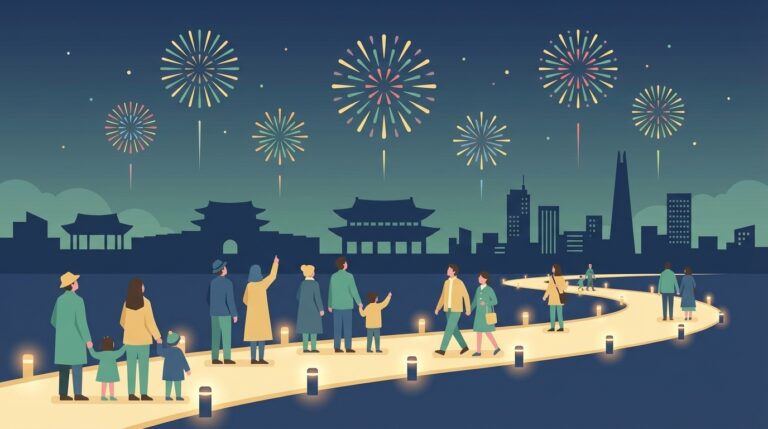
Phase 1: Welcome to the Chaos and Charm of Korean Festivals
Hello there! I’m the Lead Editor at Daily Hangul.
Picture this: It’s Saturday night in October. You are standing by the Han River, the sky is bursting with the colors of the Yeouido International Fireworks Festival, and the energy is absolutely electric. Or maybe you’re at the legendary Waterbomb Festival, surrounded by a sea of cheering K-Pop fans. It’s the peak of K-Culture magic!
But then… the show ends. Suddenly, 100,000 people decide to head to the exact same subway station. The excitement shifts into a tight, shoulder-to-shoulder shuffle. Someone behind you is pressing a little too close, and the crowd feels overwhelming.
In textbooks, you learn how to say “The weather is nice.” But in a massive Korean crowd, you need real survival skills. You need to know how to set boundaries politely, navigate a sea of people without causing offense, and understand the safety instructions shouted by the staff. Today, we are going to dive into the essential Crowd Safety Phrases that will make you feel like a confident local at any Korean festival. Let’s get into it!
Phase 2: Core Expressions Deep Dive
Here are the top three expressions you absolutely must know when navigating a Korean crowd.
1. 잠시만요! 지나갈게요! (Excuse me! Coming through!)
- Pronunciation: Jamsimanyo! Jinagalgeyo! [Jahm-shee-mahn-yo! Jee-nah-gal-geh-yo!]
- Sound-alike guide: Imagine saying “Jam” as in strawberry jam, followed by a smooth “shee-mahn-yo”.
- Meaning: (Literal) Just a moment! I will pass! / (Real nuance) Excuse me, please make way for me to pass through.
- K-Culture Moment: You’ll hear this everywhere—from a crowded subway in Gangnam to a bustling traditional market. It’s the ultimate polite way to part a sea of people without sounding rude.
- Editor’s Insight: If you just say “Excuse me” (실례합니다 – Sillyehamnida), Koreans might think you want to ask a question. To actually get people to move, “잠시만요!” is the magic password.
- Situation Spectrum:
[🚫 절대 금지] ———— [⚠️ 주의] ———— [✅ 자유롭게]
- Casual (Crowd): ✅
- Semi-formal (Coworkers): ✅
- Formal (Elders): ✅
- 🤔 Think About It: Why do Koreans announce “I am passing” instead of just saying “Excuse me”? It reflects a culture that values predictable actions in shared spaces, ensuring you don’t startle anyone.
2. 밀지 마세요! 다쳐요! (Please don’t push! People will get hurt!)
- Pronunciation: Milji maseyo! Dachyeoyo! [Meel-jee mah-seh-yo! Dah-cheo-yo!]
- Meaning: (Literal) Do not push! Get hurt! / (Real nuance) Stop pushing! It’s dangerous!
- K-Culture Moment: If you’re in the standing zone of a K-Pop concert and the crowd surges forward toward the stage, you’ll hear fans collectively chanting this to protect those in the front row.
- Editor’s Insight: This is assertive but still polite because it ends in “~세요” (~seyo). It’s crucial for establishing physical boundaries when you feel unsafe.
- Situation Spectrum:
[🚫 절대 금지] ———— [⚠️ 주의] ———— [✅ 자유롭게]
- Casual (Crowds/Strangers): ✅
- Semi-formal: ⚠️ (Only if they are physically pushing you)
- Formal: ⚠️
- 🤔 Think About It: In your culture, how do you handle someone pushing you in a crowd? Is it usually an angry shout, or a collective warning like in Korea?
3. 천천히 가주세요 / 질서를 지켜주세요 (Please walk slowly / Please keep order)
- Pronunciation: Cheoncheonhi gajuseyo / Jilseoreul jikyeojuseyo [Cheon-cheon-hee gah-joo-seh-yo]
- Meaning: (Literal) Please go slowly / Please keep order.
- K-Culture Moment: You will hear safety personnel (안전요원) screaming this through megaphones at festival exits.
- Editor’s Insight: You might not say this yourself, but you must understand it. Following the flow and maintaining order is a huge part of Korean civic duty in large events.
- Situation Spectrum:
[🚫 절대 금지] ———— [⚠️ 주의] ———— [✅ 자유롭게]
- Used by Staff/Police: ✅
- Used by you to a crowd: ⚠️ (Might sound bossy unless it’s a real emergency)
Phase 3: Textbook vs. Real Korean
How does the textbook differ from the streets of Hongdae on Halloween weekend? Let’s take a look.
| 상황 (Situation) | 📖 교과서 한국어 (Textbook) | 🗣️ 진짜 한국어 (Real Korean) | 💡 왜 다를까? (Why the difference?) |
|---|---|---|---|
| Passing through a crowd | 길을 좀 비켜 주시겠습니까? (Would you please step aside?) | 잠시만요! 지나갈게요~ (Excuse me! Passing by!) | Textbooks focus on formal requests; real life requires quick, rhythmic announcements. |
| Stopping someone from pushing | 저를 밀지 말아 주십시오. (Please refrain from pushing me.) | 아, 밀지 마세요! (Ah, don’t push!) | The “Ah” adds a natural sound of mild distress, which effectively grabs attention in Korea. |
| Telling friends to stay close | 잃어버리지 않게 조심하세요. (Be careful not to get lost.) | 꼭 붙어 다녀! / 손잡아! (Stick together! / Hold hands!) | Friends use short, direct action verbs in high-stress situations. |
Bottom Note for B2 Learners: Notice how real Korean drops the heavy grammar and focuses on short, impactful verbs.
Phase 4: Cultural Context — K-Culture Deep Dive
4-1. The “Moses Parting the Sea” Hand Gesture ✋
Language isn’t just spoken; it’s physical. When you say “잠시만요 (Jamsimanyo)” in a crowd, you must use the hand gesture! Hold your hand vertically in front of you (like a shark fin or a light karate chop motion) and lightly wave it up and down as you walk. This non-verbal cue is instantly recognized by Koreans. It triggers their 눈치 (Nunchi – situational awareness), and they will naturally part like the Red Sea to let you through.
4-2. Safety First: The Post-Itaewon Shift in Crowd Culture
Korea is famous for its vibrant nightlife, massive festivals, and bballi-bballi (hurry up) culture. However, crowd safety has become an incredibly serious and sensitive topic in recent years. Today, you’ll notice a massive increase in police presence and safety staff (안전요원) at any gathering.
If you watch recent festival vlogs or concert footage, you’ll see a beautiful side of K-Culture: fans taking care of each other. If someone drops their phone or falls, people will cross their arms to create a barricade and yell, “앞에 사람 넘어졌어요! 밀지 마세요!” (Someone fell in front! Don’t push!). It’s a powerful display of community.
Phase 5: Real-Life Roleplay Scenario
Setting: It’s 9:30 PM. The Yeouido Fireworks Festival has just ended. You and a million other people are trying to walk toward Yeouinaru Subway Station. The police are using glowing batons to guide the crowd, but it’s a tight squeeze.
Characters:
– YOU: An expat who just wants to get home and eat some fried chicken.
– Minji (28): Your Korean friend, who is holding your backpack strap so she doesn’t lose you.
Dialogue:
Minji: 와, 사람 진짜 많다. 우리 지하철 탈 수 있을까? 😭
(Romanization) Wa, saram jinjja manta. Uri jihacheol tal su isseulkka?
(English) Wow, there are so many people. Do you think we can catch the subway?
YOU: 천천히 가자. 서두르면 다쳐.
(Romanization) Cheoncheonhi gaja. Seodureumyeon dachyeo.
(English) Let’s go slowly. If we rush, we’ll get hurt.
Minji: 어, 야! 뒤에서 자꾸 미는데? 😠
(Romanization) Eo, ya! Dwieseo jakku mineunde?
(English) Uh, hey! They keep pushing from behind?
(🎭 Stage Direction: The crowd suddenly surges forward, and someone bumps hard into Minji’s back.)
🔀 Your Turn! How do you react to the people behind you?
- A) “비켜요!” (Move out of the way!)
- B) “저기요, 밀지 마세요! 다쳐요!” (Excuse me, please don’t push! People will get hurt!)
- C) “아, 진짜 짜증 나네.” (Ah, this is so annoying.)
✅ Best Choice: B — “저기요, 밀지 마세요! 다쳐요!”
Why? It is firm, polite, and highlights the collective danger (“다쳐요” – someone will get hurt).
⚠️ Choice A Analysis: “비켜요” is very aggressive and rude. It might start a fight.
⚠️ Choice C Analysis: Complaining out loud is common, but it doesn’t actually solve the safety issue.
Minji (to the person behind): 네, 조금만 천천히 갈게요!
(Romanization) Ne, jogeumman cheoncheonhi galgeyo!
(English) Yes, we will go a bit slowly!
(🎭 Stage Direction: The crowd stabilizes, and you both safely make it to the main road.)
Phase 6: 10-Second Shadowing Drill
Practice saying these phrases out loud. Pay attention to the pauses (/) and the emotional tags!
- 😤 단호하게 (Firmly):
저기요, / 밀지 마세요! / 다쳐요!
(Jeogiyo, / milji maseyo! / dachyeoyo!) - 🥺 다급하게 (Urgently but politely):
잠시만요! / 앗, / 지나갈게요!
(Jamsimanyo! / at, / jinagalgeyo!) - 😊 친절하게 (Kindly – when you bumped someone):
아이고, / 죄송합니다. / 괜찮으세요?
(Aigo, / joesonghamnida. / gwaenchaneuseyo?)
Phase 7: K-Culture Mini Dictionary
| 한국어 (Korean) | Romanization | English | K-Culture Context |
|---|---|---|---|
| 인파 | inpa | crowd / surge of people | Often used in news: “엄청난 인파가 몰렸습니다” (A massive crowd gathered). |
| 안전요원 | anjeon-yowon | safety staff / security guard | The heroes of Korean festivals wearing neon vests. Listen to them! |
| 떼창 | ttechang | sing-along | When the massive crowd sings along perfectly with the artist. |
| 우측통행 | uchuk-tonghaeng | keep right | The golden rule of walking in Korean subways and streets. |
Phase 8: Traveler’s Survival Kit
Are you traveling to Korea soon for a festival? Keep these expressions in your back pocket!
🆘 Survival Phrases for Crowds
– 🇰🇷 “나가는 곳이 어디예요?” (naganeun gosi eodiyeyo?)
– 🗣️ English: Where is the exit?
– 📍 Where to use: Inside a crowded concert hall or subway station.
– 🇰🇷 “일행이 있어요.” (ilhaengi isseoyo.)
– 🗣️ English: I have a party/friends (I’m with someone).
– 📍 Where to use: When staff tries to separate the crowd, and you need to stay with your friends.📌 Editor’s Travel Note
– App Tip: After a huge festival, Kakao T (taxi) will NOT work due to traffic. Use KakaoMetro to find the fastest subway route.
– Pro Tip: Don’t go to the subway station closest to the festival. Walk 15 minutes to the next station on the line. It will save you an hour of waiting in the crowd!
Phase 9: Critical Thinking — “One Step Deeper”
Language & Power / Civic Duty in Korea
Korean society places a massive emphasis on the collective (우리 – we) over the individual (나 – I). This deeply affects how people behave in crowds. Notice how the phrase “질서를 지켜주세요” (Please keep order) is a common announcement. The word 질서 (order) is a moral and civic expectation. In Western cultures, crowd control often focuses on individual rules (e.g., “Stay behind the line”), but in Korea, the appeal is often made to the collective conscience (e.g., “Let’s be mature citizens and keep order”).
🧠 Think Deeper:
Have you noticed how Koreans use collective language even in emergencies? How does your home country handle massive crowds? Is the responsibility placed more on the police or the citizens themselves?💬 Your Turn: “Share your craziest crowd experience from a concert or festival in the comments below!”
Phase 10: FAQ & Avoiding Misunderstandings
- Q: If someone pushes me really hard, can I just yell in 반말 (informal language) like “밀지 마!”?
- A: Maybe, but be careful. In a split-second emergency to prevent a fall, “밀지 마!” is a natural human reaction. However, if you are just annoyed, using 반말 to a stranger can start a huge argument. Stick to “밀지 마세요!” (with ~요) to be safe.
- Q: Can I tell the security guards “수고하세요” (Good work) as I leave?
- A: YES! This is highly encouraged. Saying “수고하십니다!” (Thank you for your hard work!) as you walk past the safety staff is considered very polite and will earn you a big smile.
❌ Common Mistake #1: Saying “비켜요!” (Move!)
✅ Do This Instead: Always use “잠시만요” (Excuse me). “비켜” implies the person is an obstacle in your way, which is deeply offensive.
Phase 11: Summary & Action Items
- One-Liner Summary: To survive a Korean festival crowd safely, equip yourself with the magic hand gesture and firmly but politely say, “잠시만요, 밀지 마세요!”
-
Action Mission:
- 🥉 Bronze (Solo): Stand in front of a mirror, do the hand-chop gesture, and practice saying “잠시만요! 지나갈게요!” 3 times.
- 🥈 Silver (Online): Go to YouTube, search for “Waterbomb Festival Seoul vlog,” and see if you can hear people saying “잠시만요.”
- 🥇 Gold (Real Life): Next time you are on a crowded bus or subway (even in your home country), mentally practice saying “잠시만요” as you navigate to the door.
Phase 12: Quiz — Interactive Challenge
Test your Crowd Safety Nunchi!
1. You need to get off a crowded subway, but people are blocking the door. What is the BEST thing to say?
A) “비켜요!”
B) “잠시만요, 내릴게요!”
C) “아, 짜증 나.”
2. Fill in the blank: If the crowd pushes you dangerously at a concert, yell: “밀지 _______! 다쳐요!”
3. True or False – K-Culture Edition: When navigating a crowd in Korea, it is polite to tap someone on the shoulder to ask them to move.
(Check your answers by highlighting the invisible text below!)
Click to reveal answers!
1. B (Never say A, it’s rude!)
2. 마세요 (maseyo)
3. FALSE. Physical contact with strangers is generally avoided in Korea. Use your voice (“잠시만요”) instead of tapping shoulders!
Frequently Asked Questions (FAQ)
Q: What does "잠시만요! 지나갈게요! (Excuse me! Coming through!)" mean in Korean and how do you pronounce it?
A: In Korean, "잠시만요! 지나갈게요! (Excuse me! Coming through!)" is pronounced [Jamsimanyo! Jinagalgeyo! [Jahm-shee-mahn-yo! Jee-nah-gal-geh-yo!] and means: a key conversational Korean expression covered in this lesson.
Q: What does "밀지 마세요! 다쳐요! (Please don't push! People will get hurt!)" mean in Korean and how do you pronounce it?
A: In Korean, "밀지 마세요! 다쳐요! (Please don't push! People will get hurt!)" is pronounced [Milji maseyo! Dachyeoyo! [Meel-jee mah-seh-yo! Dah-cheo-yo!] and means: (Literal) Do not push! Get hurt! / (Real nuance) Stop pushing! It's dangerous!
Q: What does "천천히 가주세요 / 질서를 지켜주세요 (Please walk slowly / Please keep order)" mean in Korean and how do you pronounce it?
A: In Korean, "천천히 가주세요 / 질서를 지켜주세요 (Please walk slowly / Please keep order)" is pronounced [Cheoncheonhi gajuseyo / Jilseoreul jikyeojuseyo [Cheon-cheon-hee gah-joo-seh-yo] and means: (Literal) Please go slowly / Please keep order.







