

Hello! I’m your Lead Editor at Daily Hangul.
Picture this: It’s 1:30 AM on a Friday night in Gangnam. You’ve just finished a fantastic 2nd round of drinks (2차) with your Korean friends. The subway gates are already pulled down. You open your Kakao T app, but every taxi around is either engaged or ignoring your call. The dreaded “Late-Night Surcharge” (심야 할증) is ticking up, and your wallet is starting to sweat.
In a K-Drama, this is the perfect moment for the male lead to smoothly pull up in a sports car. But in real-life Seoul? This is when a true insider turns to their friend and says, “야, 올빼미 버스 타자! (Hey, let’s take the Owl Bus!)”
If you want to navigate Seoul’s legendary nightlife like a true local—and save yourself a $30 taxi ride—you need to understand the magic of the “N-Bus” (Night Bus). Let’s dive into the lifesavers of Seoul’s public transit system!
Phase 2: Core Expressions Deep Dive
1. 막차 끊겼어요
- Pronunciation: mak-cha kkeung-yeoss-eo-yo [mak-cha sounds like ‘mock-cha’, kkeung sounds like a sudden stop in your throat]
- Meaning: Literal = The last train/bus is cut off. / Real nuance = I missed the last ride home.
- K-Culture Moment: You’ll hear this constantly around midnight in Hongdae or Itaewon. People frantically checking their phones and shouting this to their friends before sprinting to the subway station.
- Editor’s Insight: Notice how Koreans don’t say “I missed the bus” (내가 놓쳤어) here. They use the passive voice (끊겼다 – it was cut off). It’s a subtle way of shifting the blame from yourself to the merciless schedule of the transit system!
- Situation Spectrum:
[🚫 Never] ———— [⚠️ Be Careful] ———— [✅ Go Ahead]
- Casual with friends: ✅ (막차 끊겼어!)
- Semi-formal (Coworkers): ✅ (막차 끊겼네요.)
- Formal (Boss/Elders): ⚠️ (막차 시간이 지났습니다 is safer)
- 🤔 Think About It: Why does the Korean language favor passive expressions (like things ‘being cut off’ or ‘becoming’ a certain way) rather than direct ‘I did this’ statements? How does this reflect the cultural emphasis on collective harmony over individual fault?
2. N버스 노선 어떻게 돼요?
- Pronunciation: en-beo-seu no-seon eo-tteo-ke dwae-yo?
- Meaning: Literal = How does the N-Bus route become? / Real nuance = What’s the route for the N-Bus?
- K-Culture Moment: Standing shivering at a bus stop, trying to figure out if the N37 or the N61 will get you closer to your Airbnb.
- Editor’s Insight: “어떻게 돼요?” (How does it become?) is a C1-level superpower phrase. Instead of asking a direct, rigid “What is the route?” (노선이 무엇입니까?), this softer approach is the most natural way to ask for information in Korea.
- Situation Spectrum:
[🚫 Never] ———— [⚠️ Be Careful] ———— [✅ Go Ahead]
- Casual: ✅ (노선 어떻게 돼?)
- Strangers/Drivers: ✅ (노선 어떻게 돼요?)
3. 심야 할증 장난 아니야
- Pronunciation: sim-ya hal-jeung jang-nan a-ni-ya
- Meaning: Literal = The late-night surcharge is not a joke. / Real nuance = The late-night taxi fare is insanely expensive!
- K-Culture Moment: The painful realization when you see the taxi meter jump 20-40% faster between 10 PM and 4 AM. This is exactly why the Owl Buses are packed!
- Editor’s Insight: “장난 아니야” (It’s no joke) is the ultimate Korean exaggerator. It can mean something is incredibly good, or incredibly bad. Context is everything.
- Situation Spectrum:
[🚫 Never] ———— [⚠️ Be Careful] ———— [✅ Go Ahead]
- Friends: ✅
- Professional setting: 🚫 (Too slangy)
Phase 3: Textbook vs. Real Korean
| Situation | 📖 Textbook Korean | 🗣️ Real Korean | 💡 Why the difference? |
|---|---|---|---|
| Realizing it’s late | 마지막 버스를 놓쳤습니다. (I missed the last bus.) | 아싸, 막차 끊겼다. N버스 타자. (Oops, last bus is gone. Let’s take the N-bus.) | “막차” (last vehicle) is the universally used abbreviation. |
| Complaining about fares | 밤에는 택시 요금이 비쌉니다. (Taxis are expensive at night.) | 심야 할증 붙어서 택시비 폭탄 맞아. (We’ll get a taxi fare bomb due to the night surcharge.) | “폭탄 맞다” (getting hit by a bomb) vividly describes the financial pain. |
| Deciding to wait | 첫 번째 기차를 기다리겠습니다. (I will wait for the first train.) | 그냥 첫차 뜰 때까지 버티자. (Let’s just hold out until the first bus/train launches.) | “뜨다” (to rise/launch) and “버티다” (to endure) reflect the stamina needed for Seoul nightlife. |
Bottom Note: At a C1 level, you should comfortably drop “마지막 기차” and solely use 막차 (last) and 첫차 (first).
Phase 4: Cultural Context — K-Culture Deep Dive
4-1. The Non-Verbal “Nunchi” at the Bus Stop
When you finally get on an Owl Bus at 2:30 AM, you’ll notice a unique atmosphere. Despite being packed shoulder-to-shoulder, it’s dead silent. Everyone is exhausted. The Nunchi (눈치) rule here is: Keep your voice to a whisper. Loudly chatting about your night out while office workers and designated drivers (대리기사) are trying to catch a 20-minute nap is a major faux pas.
4-2. Media vs. Reality: The Romance of the “Makcha”
If you watch K-Dramas like Something in the Rain or My Liberation Notes, the “막차” (last train/bus) is a crucial plot device. Characters romantically miss the last bus on purpose to spend more time together, walking under the streetlights.
The Reality Check: In reality? Missing the makcha is a frantic, sweaty sprint. If you live in Gyeonggi-do (the province surrounding Seoul), missing the last red bus means you are stranded. The “Owl Buses” (N-Buses) only operate within Seoul city limits. So, before you pull a K-Drama romantic move, make sure you know your zip code!
Phase 5: Real-Life Roleplay Scenario
Setting: 2:15 AM, Friday. A chilly bus stop near Sinnonhyeon Station. You and your Korean coworker have just stumbled out of a company dinner (회식). Taxis are zooming by with “예약” (Reserved) glowing in red.
Characters:
– YOU: An expat who has work at 9 AM tomorrow.
– Minsu (32): Your friendly, slightly tipsy Korean colleague.
Minsu: 아, 택시 진짜 안 잡히네요. 카카오T도 응답이 없어요. 📱
(A, taeksi jinjja an japhineyo. Kakao-ti-do eungdabi eopseoyo.)
[Ah, taxis really aren’t catching. No response on Kakao T either.]
(🎭 Stage Direction: Minsu sighs and aggressively taps his phone screen)
YOU: 심야 할증 시간이라서 그런가 봐요. 그냥 좀 걸을까요?
(Simya haljeung siganiraseo geureonga bwayo. Geunyang jom georeulkkayo?)
[Probably because it’s the late-night surcharge time. Should we just walk a bit?]
Minsu: 걷기엔 너무 멀어요! 아, 맞다. 우리 N버스 탈까요? 마침 저기 N37번 노선 있네요.
(Geotgien neomu meoreoyo! A, matda. Uri en-beoseu talkkayo? Machim jeogi en-sam-chil-beon noseon inneyo.)
[It’s too far to walk! Oh, right. Should we take the N-bus? There’s the N37 route right there.]
🔀 Your Turn! How do you respond?
– A) “N버스요? 그거 밤에 타면 위험하지 않아요?” (N-bus? Isn’t it dangerous to ride at night?)
– B) “오, 좋아요! 배차 간격은 어떻게 돼요?” (Oh, great! What’s the dispatch interval/wait time?)
– C) “아니요, 저는 첫차 뜰 때까지 카페에서 버틸래요.” (No, I’m going to hold out in a cafe until the first train.)✅ Best Choice: B — Using the C1-level vocabulary “배차 간격” (dispatch interval) will impress any native speaker. It shows you know how Korean transit apps work!
⚠️ Choice A Analysis: Korea is incredibly safe at night. Asking if a public bus is dangerous might confuse a local.
Minsu: (Checking the app) 배차 간격이 30분인데… 헉, 3분 뒤에 도착한대요! 뛰어요!!
(Baecha gangeogi samsipbuninde… heok, sambun dwie dochakhandaeyo! Ttwieoyo!!)
[The interval is 30 minutes, but… gasp, it says it’s arriving in 3 minutes! Run!!]
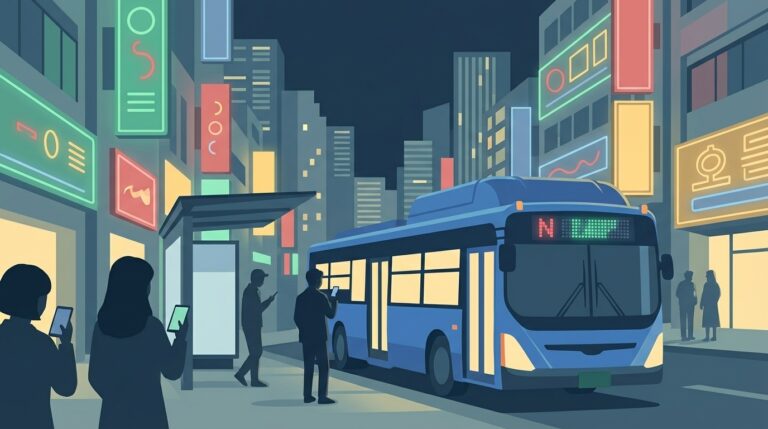
(🎭 Stage Direction: Both of you sprint to the bus stop just as a blue bus with a glowing ‘N37’ pulls up)
Phase 6: 10-Second Shadowing Drill
Let’s practice sounding like a stressed-but-savvy Seoulite!
😤 아, / 택시 진짜 / 안 잡히네. / 우리 그냥 / 올빼미 버스 / 타자!
(a, / taeksi jinjja / an japhine. / uri geunyang / olppaemi beoseu / taja!)
[Ugh, taxis really aren’t catching. Let’s just take the Owl Bus!]
Pro-Tip: Emphasize “진짜” (really) with a deep sigh, and say “타자” (let’s take) with decisive energy.
Phase 7: K-Culture Mini Dictionary
| Korean | Romanization | English | Cultural Context |
|---|---|---|---|
| 올빼미 버스 | olppaemi beoseu | Owl Bus | The affectionate nickname for Seoul’s late-night N-buses. |
| 막차 / 첫차 | makcha / cheotcha | Last train / First train | The alpha and omega of Seoul nightlife planning. |
| 대리기사 | daerigisa | Designated Driver | Professionals you hire to drive your car home after you drink. You’ll see them a lot on N-Buses going to their next job. |
| 심야 할증 | simya haljeung | Late-night surcharge | Taxi fare increases by 20-40% between 10 PM and 4 AM in Seoul. |
| 환승 | hwanseung | Transfer | Yes, the free transfer system works on N-Buses too! |
Phase 8: Traveler Survival Kit
If you are traveling to Seoul and plan to stay out past midnight, the N-Bus is your best friend.
🆘 Survival Expressions for the Night Bus
– 🇰🇷 “기사님, 이거 [이태원] 가요?” (gisanim, igeo [itaewon] gayo?)
– 🗣️ Pronunciation: gi-sa-nim, i-geo [i-tae-won] ga-yo?
– 📍 Where to use: Shouting politely to the driver as you board.
– 💡 Pro Tip: Night buses are mostly “Blue Buses” (Trunk lines). They only stop if you press the bell or if someone is clearly waiting at the stop. Don’t look at your phone when the bus approaches—make eye contact!📌 Editor’s Travel Note
– Essential Apps: KakaoBus or Naver Map. Google Maps will NOT give you accurate live bus times in Korea.
– Payment: Just tap your T-money card or credit card. Cash is no longer accepted on most Seoul buses!
– Fares: N-Buses cost a bit more than regular buses (around 2,500 KRW), but it’s still 1/10th the cost of a night taxi.
Phase 9: Critical Thinking — “One Step Deeper”
Language & Space: The Anatomy of Seoul’s Nightlife
In many Western cities, public transport shutting down means the night is over. In Seoul, the end of the subway (막차) is merely a filter. It divides people into two groups: those who go home, and those who commit to the “N-차” (Nth round) until the first train (첫차) runs at 5 AM. The existence of the “Owl Bus” perfectly encapsulates South Korea’s “24-hour society” (24시간 사회). It serves partygoers, yes, but its primary passengers are often night-shift workers, cleaners, and designated drivers. The Owl Bus isn’t just a transport method; it’s a moving cross-section of Seoul’s relentless work ethic and vibrant nightlife.
💬 Your Turn: Does your city have a 24-hour public transport system? How does transport affect the way people socialize in your culture? Let me know in the comments!
Phase 10: FAQ & Avoiding Mistakes
Q: “Can I use my regular T-money card on the Owl Bus?”
Yes! You use the exact same T-money card or transit-enabled credit card. Just remember to tap out when you exit so you don’t get penalized.
Q: “If the bus is full, can I stand?”
Absolutely. Unlike the red intercity buses (where standing is illegal on highways), N-Buses are city buses. But hold on tight—Korean bus drivers are known for their… “dynamic” driving skills.
❌ Common Mistake #1: Waiting at the wrong side of the road.
✅ How to fix it: N-buses run in both directions. At 3 AM, your brain might be fuzzy. ALWAYS check the direction arrow on Naver Map before sitting at the bus stop.❌ Common Mistake #2: Confusing AM and PM in Korean.
✅ How to fix it: If a friend says “새벽 2시” (Dawn 2 o’clock), they mean 2:00 AM. Koreans use “새벽” (dawn) for times like 1 AM to 5 AM.
Phase 11: Summary & Action Items
One-Liner Summary: When the makcha (last train) is gone and taxis are too expensive, the Owl Bus (N버스) is your ultimate Korean survival tool.
Your Action Missions:
– 🥉 Bronze (Solo): Practice saying “심야 할증 장난 아니야” out loud with proper exasperation.
– 🥈 Silver (Online): Open your favorite map app, find Seoul, and search “N37” to see the actual route it takes across the city.
– 🥇 Gold (Real World): Next time you are in Korea, purposefully stay out past midnight in a safe area and ride an Owl Bus back to your hotel!
K-Culture Mission:
Go on YouTube and search “서울 심야버스 브이로그” (Seoul Night Bus Vlog). Watch the silent, neon-lit streets of Seoul passing by the window. It’s the best ASMR you’ll ever experience.
Phase 12: Quiz — Interactive Challenge
1. Situational Judgment:
You are at a company dinner. It’s 11:45 PM. You need to catch the last subway at midnight. What is the most polite and natural way to excuse yourself to your boss?
A) “보스, 막차 끊겼어요.”
B) “부장님, 죄송하지만 제가 막차 시간이 다 되어서 먼저 일어나보겠습니다.”
C) “나 올빼미 버스 타기 싫어요.”
2. True or False – K-Culture Edition:
T/F: If you miss the N-Bus, you can easily walk onto the highway and hitchhike in Korea.
3. Fill in the Blank:
“택시비 너무 비싸. [ ] 할증이 붙었어!” (Taxi is too expensive. The [ ] surcharge is attached!)
(Answers below)
Click to reveal answers!
- B is correct. It uses the formal title (부장님), an apology, and the polite phrase “먼저 일어나보겠습니다” (I will stand up/leave first). A is too blunt and uses English “boss”. C is just complaining like a toddler!
- False! Hitchhiking is practically non-existent in Korea, and walking on highways is illegal and highly dangerous. Always find a cafe or wait for the first train.
- 심야 (simya – late night).
Frequently Asked Questions (FAQ)
Q: What does "막차 끊겼어요" mean in Korean and how do you pronounce it?
A: In Korean, "막차 끊겼어요" is pronounced [mak-cha kkeung-yeoss-eo-yo [mak-cha sounds like 'mock-cha', kkeung sounds like a sudden stop in your throat] and means: Literal = The last train/bus is cut off. / Real nuance = I missed the last ride home.
Q: What does "N버스 노선 어떻게 돼요?" mean in Korean and how do you pronounce it?
A: In Korean, "N버스 노선 어떻게 돼요?" is pronounced [en-beo-seu no-seon eo-tteo-ke dwae-yo?] and means: Literal = How does the N-Bus route become? / Real nuance = What's the route for the N-Bus?
Q: What does "심야 할증 장난 아니야" mean in Korean and how do you pronounce it?
A: In Korean, "심야 할증 장난 아니야" is pronounced [sim-ya hal-jeung jang-nan a-ni-ya] and means: Literal = The late-night surcharge is not a joke. / Real nuance = The late-night taxi fare is insanely expensive!







