

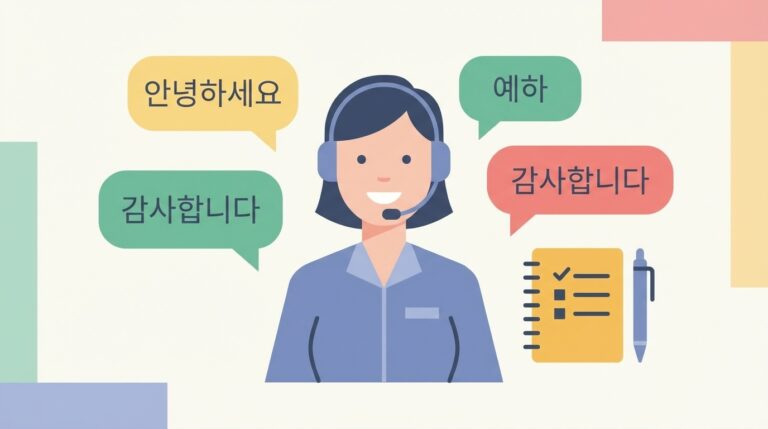
Phase 1: Empathy (Immersive Open)
Hello! I’m the lead editor of Daily Hangul.
Imagine this: You’re watching a K-Drama. The protagonist, struggling to make ends meet, is working at a call center. They put on their headset, take a deep breath, and suddenly, their voice jumps a full octave higher, dripping with an almost musical sweetness. Or perhaps, you’ve experienced this firsthand—you called a Korean airline or a delivery app because your order was wrong. The agent on the phone was so overwhelmingly polite, using grammar structures so complex and apologetic, that even as an advanced (C1) Korean learner, your brain momentarily froze.
Welcome to the apex of Korean emotional labor and linguistic complexity: Customer Service (CS) & Call Center Quality Management (QA).
If you’re working in Korea, doing business with Korean companies, or simply want to understand the pinnacle of Korean honorifics, mastering CS language is non-negotiable. It’s not just about saying “hello” and “sorry.” Korean CS Quality Assurance (QA) teams meticulously grade agents on empathy phrases, tone, and de-escalation techniques. If you don’t know these expressions, you might misinterpret a polite refusal as a green light, or sound too abrupt when trying to resolve an issue.
This guide is built from the real experiences of advanced learners who navigated the rigorous world of Korean corporate culture. Let’s dive into the words behind the headset!
Phase 2: Deep Dive into Core Expressions
1. 불편을 드려 대단히 죄송합니다
- Pronunciation: [bulpyeoneul deuryeo daedanhi joesonghamnida] (bul-pyeon-eul deu-ryeo dae-dan-hi joe-song-ham-ni-da)
- Meaning: (Literal) I am very sorry for giving you inconvenience. / (Real Nuance) The Ultimate Empathy Shield. “I acknowledge your frustration.”
- K-Culture Moment: This is the exact phrase you will read in the opening line of every K-Pop agency’s official apology notice on Weverse when a concert ticketing system crashes. In a call center, QA guidelines mandate this phrase be used before offering any solution.
- Editor’s Insight: It’s not an admission of legal guilt; it’s emotional validation. In Korean CS, skipping the emotional apology and jumping straight to the solution is considered rude and will cost an agent their QA score.
- Situation Spectrum:
[🚫 Casual] ———— [⚠️ Semi-formal] ———— [✅ Formal/CS]
- Casual with friends: 🚫 (Way too robotic!)
- Coworkers: ⚠️ (Only in highly formal emails)
- Customers/Clients: ✅
- 🤔 Think About It: Why does Korean corporate culture prioritize apologizing for the feeling of inconvenience rather than just fixing the technical error? How does this compare to your home country’s CS approach?
2. 양해 부탁드립니다
- Pronunciation: [yanghae butakdeurimnida] (yang-hae boo-tak-deu-rim-ni-da)
- Meaning: (Literal) I ask for your understanding. / (Real Nuance) “We cannot do what you want, and I need you to politely accept this reality.”
- K-Culture Moment: You hear this on the Seoul Subway when a train is delayed. “바쁘신 데 불편을 드려 양해 부탁드립니다.” (We ask for your understanding for the inconvenience during your busy schedule.)
- Editor’s Insight: This is the most elegant, bulletproof way to say “No” in Korean. Direct refusals (안 됩니다 – “You can’t”) trigger anger in K-CS scenarios. Asking for “understanding” shifts the dynamic to mutual respect.
- Situation Spectrum:
[🚫 Casual] ———— [⚠️ Semi-formal] ———— [✅ Formal/CS]3. ~하시는 부분 / ~하신다는 말씀이실까요?
- Pronunciation: [~hasineun bubun / ~hasindaneun malsseumisilkkayo?] (ha-shi-neun boo-boon / ha-shin-da-neun mal-sseum-i-shil-kka-yo?)
- Meaning: (Literal) The part you are doing / Are you saying the words that… / (Real Nuance) “Let me confirm I am actively listening to your complaint.”
- K-Culture Moment: When an angry customer (sometimes referred to as 진상 – ‘Jinsang’ or difficult customer) is ranting, the agent uses this to paraphrase. “고객님, 배송이 지연되어 화가 나셨다는 말씀이실까요?” (Sir, are you saying you are angry because the delivery was delayed?)
- Editor’s Insight: Call center QA evaluators look for “Active Listening” (경청). Adding “부분” (part) or “말씀이실까요” (are you saying) creates psychological distance between the problem and the customer, softening the impact.
- Situation Spectrum:
[🚫 Casual] ———— [⚠️ Semi-formal] ———— [✅ Formal/CS]
Phase 3: Textbook vs. Real Korean
At the C1 level, you must understand Hyper-correction (과잉 교정). Due to the fear of customer complaints, Korean CS workers often use grammatically incorrect, excessive honorifics. QA teams actually try to fix this!
| Situation | 📖 Textbook / Perfect QA Korean | 🗣️ Real Korean (Common Error) | 💡 Why is it different? |
|---|---|---|---|
| Item is out of stock | 품절입니다. (It is sold out.) | 품절이십니다. (The item is honorably sold out.) | Agents are so terrified of offending the customer that they accidentally use honorifics (~시) on inanimate objects (사물 존칭). |
| Explaining a policy | 규정상 안 됩니다. (It is not allowed by policy.) | 규정상 어려우십니다. (It is honorably difficult by policy.) | Direct negatives (안 된다) are avoided. ‘어렵다’ (difficult) is the polite substitute for ‘impossible’. |
| Asking a customer to wait | 잠시 기다려 주세요. (Please wait a moment.) | 잠시 대기 타실게요. (Let’s ride the wait.) | Waiters or junior CS staff often mix casual slang (타다) with honorifics (~시) to sound friendly yet respectful. (QA deducts points for this!) |
Phase 4: Cultural Context — K-Culture Deep Dive
4-1. Non-Verbal Elements: The Infamous “Sol Tone” (솔톤)
If you watch K-Dramas featuring service workers, you’ll notice their voices change entirely when answering the phone. This is called the 솔톤 (Sol Tone). It refers to speaking at the pitch of ‘Sol’ (G) on the musical scale (Do-Re-Mi-Fa-Sol).
In Korean QA management, a low, flat voice is often penalized as “unfriendly” or “lacking energy.” The Sol Tone projects youthfulness, politeness, and extreme willingness to help. However, as an advanced learner, note that using this pitch in a standard corporate boardroom might make you sound unprofessional or too junior. Context is everything.
4-2. K-Drama Connection: “Gapjil” (갑질) and Emotional Labor
Dramas like My Mister (나의 아저씨) or The Glory (더 글로리) often highlight the dark side of the Korean service industry: 갑질 (Gapjil), meaning the abuse of power by someone in a superior position (the customer) over someone in a subordinate position (the worker).
To counter Gapjil, CS Quality Management has evolved. In the past, the motto was “The customer is always right” (고객은 왕이다). Today, automated ARS systems in Korea begin with a mandatory warning: “산업안전보건법에 따라 고객응대 근로자를 보호하고 있습니다…” (Under the Occupational Safety and Health Act, we protect our customer service workers…). Understanding this shift is crucial for comprehending modern Korean corporate ethics.
Phase 5: Real-Life Roleplay Scenario
Setting: It’s 2:00 PM on a Tuesday at the QA (Quality Assurance) monitoring room of a major Korean e-commerce company. You are a foreign QA Manager. You are giving feedback to Minsu, a newly hired call center agent, after listening to his recorded calls.
Characters:
– YOU: The meticulous but supportive QA Manager.
– Minsu (25, Male): A friendly, nervous rookie agent who tries a bit too hard to be polite.
Dialogue:
YOU: 민수 씨, 방금 콜 모니터링 끝났어요. 고객 응대 아주 친절하게 잘하시네요.
(Minsu ssi, banggeum kol moniteoring kkeunnatseoyo. gogaek eungdae aju chinjeolhage jalhasineyo.)
[Minsu, I just finished monitoring your call. You handle customers very kindly.]
Minsu: 아, 감사합니다 매니저님! 제가 진상… 아, 아니, 불만이 있으신 고객님이라서 긴장을 많이 했거든요.
(A, gamsahamnida maenijeonim! Jega jinsang… a, ani, bulmani isseusin gogaengnimiraseo ginjangeul mani haetgeodeunyo.)
[Ah, thank you, Manager! Because it was a ‘Jinsang’ (bad customer)… oh, I mean, a customer with a complaint, I was very nervous.]
YOU: 네, 그 부분은 아주 좋았어요. 그런데 중간에 문법 실수가 하나 있었어요.
(Ne, geu bubuneun aju joasseoyo. Geureonde junggane munbeop silsuga hana isseotseoyo.)
[Yes, that part was very good. However, there was one grammar mistake in the middle.]
Minsu: 헉, 제가 무슨 실수를 했나요?
(Heok, jega museun silsureul haennayo?)
[Gasp, what mistake did I make?]
YOU: “고객님, 주문하신 상품이 품절이십니다”라고 하셨죠?
(Gogaengnim, jumunhasin sangpumi pumjeorisimnida-rago hasyeotjyo?)
[You said, “Customer, the product you ordered is ‘honorably’ sold out,” right?]
Minsu: 네, 최대한 예의 바르게 말씀드리려고 노력했습니다!
(Ne, choedaehan yeui bareuge malsseumdeuriryeogo noryeokaetseumnida!)
[Yes, I tried to speak as politely as possible!]
🔀 Your Turn! As the QA Manager, how should you correct Minsu?
– A) “물건한테 존댓말을 쓰면 안 되죠! 다시 교육받으세요.” (Too harsh, breaks Korean workplace harmony)
– B) “민수 씨 마음은 알겠지만, 사물 존칭은 QA 감점 대상이에요. ‘품절입니다’가 맞습니다.”
– C) “대박! 물건이 왕인가요? ㅋㅋㅋ” (Way too casual for a professional feedback session)✅ Best Choice: B — Reason: It acknowledges his effort (“마음은 알겠지만” – I understand your intention) while professionally pointing out the industry-standard QA deduction for “사물 존칭” (honoring inanimate objects).
Minsu: 아! 사물 존칭이군요. 앞으로는 조심하겠습니다. 피드백 감사합니다.
(A! Samul jonchingigunyo. Apeuroneun josimhagetseumnida. Pideubaek gamsahamnida.)
[Ah! Object honorifics. I will be careful from now on. Thank you for the feedback.]
🎬 Bonus Roleplay: The Traveler’s Rescue
You are calling a Korean airline to change your flight.
Agent (in a high Sol Tone): “전화 주셔서 감사합니다, 무엇을 도와드릴까요?”
You: “안녕하세요, 비행기 표를 변경하고 싶은데, 수수료가 발생한다는 말씀이실까요?”
(Using “말씀이실까요” instantly signals to the agent that you speak high-level, polite Korean, and they will likely treat you with immense professional respect!)
Phase 6: 10-Second Shadowing Drill
Master the pacing and the soft, empathetic intonation of a QA-approved apology.
🥺 고객님, / 이용에 불편을 드려 / 대~단히 / 죄송합니다.
(gogaengnim, / iyonge bulpyeoneul deuryeo / dae~~~danhi / joesonghamnida.)
💡 Tip: Pause slightly at the slashes (/). Elongate the “대” (dae) in 대단히 to sound genuinely remorseful, and lower your voice slightly at the end for sincerity.
Phase 7: K-Culture Mini Dictionary
| Korean | Romanization | English | Context |
|---|---|---|---|
| 솔톤 | sol-ton | Sol Tone | The high-pitched, exceedingly friendly voice (G note) used by Korean service workers to sound polite and energetic. |
| 진상 | jinsang | Unreasonable Customer | A highly derogatory term for a customer who makes impossible demands, yells, or abuses staff. |
| 갑질 | gapjil | Abuse of Power | The systemic or individual abuse of power by someone in a superior position (Gap) over a subordinate (Eul). |
| 사물 존칭 | samul jonching | Object Honorifics | A common grammatical error where honorifics are applied to objects (e.g., “The coffee is honorably hot”) out of extreme fear of offending the customer. |
| 매뉴얼 | maenyueol | Manual | The sacred script of Korean CS. If you ask for something outside the manual, agents will likely say, “매뉴얼상 어렵습니다” (It is difficult according to the manual). |
Phase 8: Traveler Survival Kit
As an advanced learner, you might find yourself navigating complex travel issues like lost baggage or hotel complaints where high-level CS Korean is thrown at you.
🆘 Survival Phrase #1: Confirming the Policy
– 🇰🇷 “혹시 매니저님(또는 책임자분)과 통화 가능할까요?” (hoksi maenijeonim(ttoneun chaegimjabun)gwa tonghwa ganeunghalkkayo?)
– 🗣️ English Guide: Is it possible to speak with the manager (or person in charge)?
– 📍 Where to use: Airline call centers, hotel front desks when an agent is stuck on the “manual.”
– 💡 Pro Tip: Never yell. Say this softly and politely. In Korea, raising your voice makes you a “Jinsang” and people will stop helping you. Staying calm and asking for the “책임자” (Person in charge) gets results.📌 Editor’s Travel Note
– The Magic Opening: When calling any customer service in Korea, start with “수고하십니다” (Thank you for your hard work). It instantly disarms the agent and makes them 10x more willing to help you.
– Chatbots first: Most Korean companies (like Coupang, Baemin, or airlines) prefer CS through KakaoTalk chatbots. You only get to a human (상담원 연결) if the bot fails.
Phase 9: Critical Thinking — “A Step Deeper”
🫠 Think Deeper: Language & Power (갑질 Culture)
Korean CS Quality Management is not just about grammar; it is a profound reflection of the country’s social hierarchy. The extreme honorifics and the emotional labor expected from call center agents stem from a hyper-competitive service industry where the customer was traditionally treated as an untouchable king. However, as the negative impacts of “Gapjil” (power-tripping) became a major societal issue, Korea introduced laws to protect workers. Now, companies actively train agents to politely hang up on verbally abusive customers. The language of Korean CS is currently shifting from “subservient” to “professionally courteous.”
💬 Your Turn: Does your culture’s language change drastically depending on who holds the “power” in a transaction? Have you ever noticed a “customer service voice” in your own language? Share in the comments!
Phase 10: FAQ & Avoiding Misunderstandings
- Q: Can I use “불편을 드려 죄송합니다” with my boss?
- A: No. It sounds too much like a robotic corporate statement. If you made a mistake at work, simply say “죄송합니다. 제가 실수했습니다” (I’m sorry. I made a mistake).
- Q: Do I need to use the “Sol Tone” when speaking Korean?
- A: Only if you work in customer service! In daily life, using the Sol Tone might make you sound like you’re trying to sell something.
- Q: What if an agent says something is “어렵습니다” (difficult)? Does it mean there’s a chance?
- A: No. In Korean CS, “어렵습니다” (It is difficult) is the polite, definitive translation for “Absolutely not.” Do not keep pushing.
❌ Common Mistake #1: Pointing out “Object Honorific” errors to service staff.
✅ Do This Instead: Even if the cafe worker says “커피 나오셨습니다” (The coffee is honorably out), just smile and take it. Correcting their grammar is considered massive “Gapjil” and highly arrogant.
Phase 11: Summary & Action Items
- One-Liner Summary: Mastering advanced Korean CS language means understanding emotional validation, the art of the polite refusal, and navigating the delicate balance of corporate hierarchy.
Action Mission:
– 🥉 Bronze: Say “수고하십니다” (Thank you for your hard work) out loud 3 times in your best, friendly Sol Tone.
– 🥈 Silver: Next time you are at a Korean cafe or restaurant, listen carefully. Can you spot the staff using “사물 존칭” (honoring the food/objects)?
– 🥇 Gold: Call a Korean service center (or use a CS chat), start with a polite greeting, and try to recognize when they use “양해 부탁드립니다” to explain a policy.
K-Culture Mission: Watch episode 1 of a modern Korean office drama. Spot the moment a character answers the phone and their voice pitch instantly changes. That’s the Sol Tone!
Phase 12: Quiz — Interactive Challenge
1. Situational Judgment: You are working as a CS agent in Korea. A customer is complaining about a delayed refund. What is the FIRST thing you must say according to QA standards?
– A) 환불은 3일 걸립니다. (Refunds take 3 days.)
– B) 규정상 지금은 어렵습니다. (It is difficult right now due to policy.)
– C) 불편을 드려 대단히 죄송합니다. (I am very sorry for the inconvenience.)
2. True or False – K-Culture Edition:
In Korean CS, if an agent says “고객님, 그 부분은 처리가 어렵습니다” (Customer, processing that part is difficult), it means if you wait a little longer, they will eventually fix it for you. (T / F)
3. Fill in the Blank:
To show active listening to a frustrated customer, an agent might say: “배송 문제로 화가 나셨다는 _________?” (Are you saying…)
(Answers: 1: C – Always validate emotion first. / 2: False – ‘어렵습니다’ means NO. / 3: 말씀이실까요)
Frequently Asked Questions (FAQ)
Q: What does "불편을 드려 대단히 죄송합니다" mean in Korean and how do you pronounce it?
A: In Korean, "불편을 드려 대단히 죄송합니다" is pronounced [bulpyeoneul deuryeo daedanhi joesonghamnida] and means: (Literal) I am very sorry for giving you inconvenience. / (Real Nuance) The Ultimate Empathy Shield. "I acknowledge your frustration."
Q: What does "양해 부탁드립니다" mean in Korean and how do you pronounce it?
A: In Korean, "양해 부탁드립니다" is pronounced [yanghae butakdeurimnida] and means: (Literal) I ask for your understanding. / (Real Nuance) "We cannot do what you want, and I need you to politely accept this reality."
Q: What does "~하시는 부분 / ~하신다는 말씀이실까요?" mean in Korean and how do you pronounce it?
A: In Korean, "~하시는 부분 / ~하신다는 말씀이실까요?" is pronounced [~hasineun bubun / ~hasindaneun malsseumisilkkayo?] and means: (Literal) The part you are doing / Are you saying the words that... / (Real Nuance) "Let me confirm I am actively listening to your complaint."







