

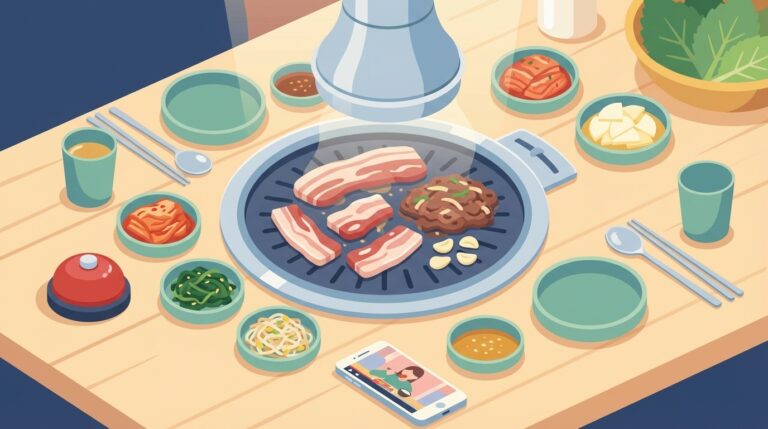
Phase 1: Empathy (Immersive Open)
Hello! I’m your Daily Hangul Editor.
Picture this: It’s 11 PM. You’re lying in bed watching your favorite Korean Mukbang YouTuber demolish a sizzling, spicy mountain of Tteokbokki or grilling thick cuts of Samgyeopsal (pork belly). The way they wrap the meat, garlic, and ssamjang in a lettuce leaf makes your mouth water. You tell yourself, “When I go to Korea, I am definitely eating there!”
Fast forward to your Seoul trip. You finally find the restaurant tucked away in an alleyway. You walk in, the smell is incredible… but there’s no English menu, the place is incredibly loud, and the staff is rushing around like it’s an Olympic sport. Panic sets in. How do you order exactly what you saw in the video?
If you only rely on your textbook Korean, you might end up with plain rice and a polite but confused waiter. Don’t worry! This guide is built from the real experiences of my students who successfully conquered Korea’s most intimidating, authentic eateries. Let’s learn how to order like a true K-Food Insider!
Phase 2: Core Expressions Deep Dive
1. [유튜버 쯔양] 님이 먹은 걸로 주세요.
- Pronunciation: [yu-tyu-beo jjeu-yang]-ni-mi / meo-geun geol-lo / ju-se-yo.
(Sound-alike guide: ‘meo-geun’ sounds like ‘mug-un’, and ‘geol-lo’ sounds like ‘gull-lo’.)- Meaning:
- Literal: Please give me what YouTuber [Tzuyang] ate.
- Real Nuance: I’m here because of the video, please give me that exact combo!
- K-Culture Moment: You’ll often see signs outside Korean restaurants bragging, “Featured on [YouTuber’s Name] Channel!” If you say this phrase, the owner will instantly smile. They know exactly what menu combination you’re talking about.
- Editor’s Insight: This is the ultimate cheat code. You don’t even need to know the name of the dish. By adding ‘님 (nim)’ after the YouTuber’s name, you sound incredibly natural and respectful.
- Situation Spectrum:
[🚫 Never] ———— [⚠️ Caution] ———— [✅ Freely]
- To friends (Casual): 🚫 (Use this to staff, not friends)
- To restaurant owners/staff (Formal/Polite): ✅
- 🤔 Think About It: Why do Koreans love watching Mukbang so much? Could it be related to Korea’s strong culture of “eating together” being a remedy for modern loneliness?
2. 이거 많이 매워요? / 덜 맵게 해 주세요.
- Pronunciation: i-geo / ma-ni / mae-wo-yo? / deol / maep-ge / hae ju-se-yo.
(Sound-alike guide: ‘mae-wo-yo’ sounds like ‘may-woah-yo’, ‘deol’ rhymes with ‘dull’.)- Meaning:
- Literal: Is this a lot spicy? / Make it less spicy, please.
- Real Nuance: I want to survive this meal, please don’t burn my tongue off.
- K-Culture Moment: In K-Dramas, you often see characters sweating and panting over spicy chicken feet (닭발) while drinking Soju to relieve stress. But in reality, not all Koreans love spicy food! Those who can’t handle spice are affectionately called ‘맵찔이’ (Maep-jjiri).
- Editor’s Insight: Never trust a Korean who says “에이~ 하나도 안 매워요!” (Hey~ It’s not spicy at all!). Their baseline for “not spicy” might be your “call an ambulance.” Always ask this question to be safe!
- Situation Spectrum:
[🚫 Never] ———— [⚠️ Caution] ———— [✅ Freely]
- To restaurant owners/staff (Polite): ✅
- 🤔 Think About It: Spicy food (매운맛) in Korea is often marketed as “stress-relieving.” How does your culture use food to relieve stress?
3. 볶음밥 하나 볶아 주세요.
- Pronunciation: bo-kkeum-bap / ha-na / bo-kka ju-se-yo.
(Sound-alike guide: ‘bo-kka’ sounds like ‘bo-kah’.)- Meaning:
- Literal: Please fry one fried rice.
- Real Nuance: We are finished with the main dish, now it’s time for the grand finale: the fried rice!
- K-Culture Moment: Whether you eat Dakgalbi (spicy stir-fried chicken), Gopchang (intestines), or Shabu-shabu, the meal is never over until they mix rice into the leftover sauce on the grill.
- Editor’s Insight: Koreans joke that “Fried rice is the traditional Korean dessert.” Knowing when and how to ask for “K-Dessert” proves you are a true K-Food veteran.
- Situation Spectrum:
[🚫 Never] ———— [⚠️ Caution] ———— [✅ Freely]
- To restaurant staff (Polite): ✅
- 🤔 Think About It: Frying rice in the leftover sauce ensures no food or flavor goes to waste. Do you have a similar “save the best for last” culinary tradition in your country?
Phase 3: Textbook vs. Real Korean
| Situation | 📖 Textbook Korean | 🗣️ Real Korean | 💡 Why is it different? |
|---|---|---|---|
| Calling the Waiter | 실례합니다. (Excuse me.) | 사장님~! (Boss!) or 이모님~! (Auntie!) | Shouting “Excuse me” sounds too formal and distant. Koreans treat local staff like extended family! |
| Ordering Food | 저는 비빔밥 하나 주십시오. (Please give me one Bibimbap.) | 여기 비빔밥 하나요! (One Bibimbap here!) | Bbali-bbali (hurry up) culture! Dropping verbs makes ordering faster and more energetic. |
| Asking for Water | 물 한 잔 주시겠어요? (Could I have a glass of water?) | 물 좀 주세요~ (Please give some water~) | The word ‘좀’ (a little/some) softens the command perfectly without needing long, formal grammar. |
Bottom Note for B1 Learners: You don’t need to use complex honorifics (주시겠습니까?) at a noisy BBQ joint. Keep it simple, polite (-요), and say it with a smile!
Phase 4: Cultural Context — K-Culture Deep Dive
4-1. Non-Verbal Communication: The Magic Table Bell 🛎️
In many Western countries, calling out to a waiter is considered rude; you are supposed to make eye contact and wait. In Korea, waiting for eye contact might mean you’ll starve! Many tables have a call bell (호출벨). Press it once. Do not spam it. If there is no bell, confidently raise your hand and call out “사장님!” (Sajangnim). Also, don’t look them dead in the eye for too long when ordering—a polite glance and pointing at the menu is perfectly natural. Use your Nunchi (social sense); if the waiter is carrying a boiling pot, wait until they drop it off before calling them.
4-2. K-Food Connection: The “Service” (서비스) Culture
If you watch Mukbangs, you’ll see YouTubers getting free plates of steamed egg (계란찜) or soda. The owner will proudly say, “이건 서비스예요!” (This is service!). In Korea, “Service” doesn’t mean the act of serving; it means “on the house” or “free of charge.” This is an extension of Jeong (정), the Korean concept of warmth, connection, and generosity.
Critical Viewpoint: While foreign visitors might think “Korean food is so cheap and generous!” remember that this culture stems from a history of sharing scarce resources. Today, with rising inflation, expecting free “service” at every restaurant can put a lot of pressure on small business owners. Be grateful when you get it, but don’t demand it!
Phase 5: Real-Life Roleplay Scenario
Setting: Friday 7:30 PM, a famous Dakgalbi (Spicy Chicken) restaurant in Myeongdong that was recently featured on a mega-hit Mukbang channel. The place is packed, K-Pop is blasting, and every table has a huge iron pan sizzling with red sauce. You are here with your Korean friend, Min-su.
Characters:
– YOU: An adventurous foodie who really wants to try the “K-Dessert” (Fried Rice).
– Min-su (30): Your Korean friend who always wants to make sure you’re enjoying the food.
– Sajangnim (Restaurant Owner): Busy but extremely friendly.
Dialogue:
Min-su: 어때요? 입에 맞아요?
(eo-ttae-yo? i-be ma-ja-yo?)
(How is it? Does it suit your taste?)
(🎭 Stage Direction: Min-su hands you a piece of chicken wrapped in a perilla leaf.)
YOU: 네, 진짜 맛있어요! 근데 조금 맵네요.
(ne, jin-jja ma-si-sseo-yo! geun-de jo-geum maem-ne-yo.)
(Yes, it’s really delicious! But it’s a little spicy.)
Min-su: 하하, 맵찔이네요! 물 더 줄까요?
(ha-ha, maep-jji-ri-ne-yo! mul deo jul-kka-yo?)
(Haha, you’re a spice-beginner! Shall I give you more water?)
YOU: 괜찮아요. 우리 이제 그거 먹어요! 볶음밥!
(gwaen-cha-na-yo. u-ri i-je geu-geo meo-geo-yo! bo-kkeum-bap!)
(It’s okay. Let’s eat that now! Fried rice!)
Min-su: 오~ 역시 먹을 줄 아네요! 사장님 부를게요.
(o~ yeok-si meo-geul jul a-ne-yo! sa-jang-nim bu-reul-ge-yo.)
(Oh~ You really know how to eat! I’ll call the owner.)
🔀 Your Turn! How do you help Min-su call the owner to order the fried rice?
- A) Wait quietly until the owner walks by, make eye contact, and whisper “Excuse me.”
- B) Press the bell on the table, and when the owner comes over, say “사장님, 여기 볶음밥 하나 볶아 주세요!”
- C) Yell across the room: “야! 볶음밥 줘!” (Hey! Give me fried rice!)
✅ Best Choice: B — Reason: Pressing the bell is the most efficient and polite way in a busy Korean restaurant.
⚠️ Choice C Analysis: “야” and “줘” is extremely rude casual language (반말). It would sound like a villain in a K-Drama looking for a fight!
(Owner arrives at the table)
Sajangnim: 네~ 주문하시겠어요?
(ne~ ju-mun-ha-si-ge-sseo-yo?)
(Yes~ Would you like to order?)
YOU: 사장님, 유튜버 OOO 님이 먹은 치즈 볶음밥으로 해 주세요!
(sa-jang-nim, yu-tyu-beo OOO ni-mi meo-geun chi-jeu bo-kkeum-ba-beu-ro hae ju-se-yo!)
(Boss, please make it the cheese fried rice that YouTuber OOO ate!)
Sajangnim: 아이고~ 그거 봤구나! 맛있게 해 줄게요!
(a-i-go~ geu-geo bwat-gu-na! ma-sit-ge hae jul-ge-yo!)
(Oh my~ You saw that! I’ll make it delicious for you!)
Phase 6: 10-Second Shadowing Drill
Read these out loud to practice your rhythm and intonation. Follow the slashes for pauses!
- 😊 밝게 (Brightly):
사장님~ / 여기 / 볶음밥 하나 / 볶아 주세요! (sa-jang-nim~ / yeo-gi / bo-kkeum-bap ha-na / bo-kka ju-se-yo!) -
🥺 조금 걱정하며 (Slightly worried):
이거 / 많이 매워요? / 덜 맵게 / 해 주세요. (i-geo / ma-ni mae-wo-yo? / deol maep-ge / hae ju-se-yo.) -
😤 자신감 있게 (Confidently):
유튜버 / 쯔양 님이 먹은 걸로 / 주세요! (yu-tyu-beo / jjeu-yang ni-mi meo-geun geol-lo / ju-se-yo!)
Phase 7: K-Culture Mini Dictionary
| 한국어 (Korean) | Romanization | English | Cultural Context |
|---|---|---|---|
| 웨이팅 | we-i-ting | Waiting in line | Famous Mukbang spots always have “waiting.” You usually register your phone number on a tablet at the door. |
| 맵찔이 | maep-jji-ri | Spice-beginner | A cute slang word for someone who has a low tolerance for spicy food. |
| 앞접시 | ap-jeop-si | Personal small plate | Since Koreans share large stews or grill meat together, you must ask for an “ap-jeop-si” to scoop your portion. |
| 서비스 | seo-bi-seu | On the house (Free) | Complimentary food given by the restaurant owner to show appreciation (Jeong). |
Phase 8: Traveler Survival Kit 🎒
Going to a famous local spot? Keep these survival phrases handy!
🆘 Survival Phrase #1: Ordering safely
– 🇰🇷 “이거 2인분 주세요.” (i-geo i-in-bun ju-se-yo.)
– 🗣️ Meaning: Please give me 2 portions of this.
– 📍 Where to use: K-BBQ or Stew restaurants. (Note: Many restaurants require a minimum of 2 portions for the main dish!)🆘 Survival Phrase #2: Surviving the heat
– 🇰🇷 “앞치마 좀 주세요.” (ap-chi-ma jom ju-se-yo.)
– 🗣️ Meaning: Please give me an apron.
– 📍 Where to use: Slurping Jjamppong (spicy seafood noodle) or eating Tteokbokki. Protect your white shirt!🆘 Survival Phrase #3: Wrapping up
– 🇰🇷 “남은 거 포장해 주세요.” (na-meun geo po-jang-hae ju-se-yo.)
– 🗣️ Meaning: Please pack the leftovers to-go.
– 📍 Where to use: When your eyes were bigger than your stomach after watching that Mukbang.📌 Editor’s Travel Note
– Table Bells: Look under the table! Sometimes the call bell, napkins, and utensils are hidden in a slide-out drawer.
– Paying the Bill: Unlike in the West, the waiter won’t bring the check to your table. You usually bring the small receipt on your table to the counter (카운터) near the exit to pay.
– Tipping: Do not tip! Korea has a strict no-tipping culture. Trying to leave money on the table will just make the staff chase you down the street thinking you forgot your change!
Phase 9: Critical Thinking Corner — “One Step Deeper”
Food & Identity: The Culture of the Shared Pot
If you visit a Korean restaurant, you’ll notice a massive pot boiling in the middle of the table, and everyone dipping their spoons into the same communal stews (jjigae), or sharing dozens of side dishes (banchan). This isn’t just about culinary efficiency; it’s a profound reflection of Korean community identity. Sharing food from a single source builds Jeong (정) and breaks down social barriers. Historically, Korea was an agrarian society where village survival depended on shared labor and shared meals.
🧠 Think Deeper:
As Korea becomes more globalized and individualistic, “dining alone” (혼밥 – Honbap) is becoming a huge trend, and younger generations prefer using separate serving spoons. How does your culture balance communal sharing versus individual hygiene?💬 Your Turn: Does your culture have a tradition of sharing food from a central dish, or is everything strictly plated individually? Share your thoughts in the comments!
Phase 10: FAQ & Avoiding Common Mistakes
Q: “Is it rude if I don’t finish all the side dishes (Banchan)?”
No, it’s completely fine! You are actually welcome to ask for free refills of the ones you do like by saying “반찬 좀 더 주세요” (Please give me more side dishes).
Q: “Can I call a male waiter ‘이모님’ (Auntie)?”
Definitely not! ‘이모님’ is exclusively for middle-aged female staff. For male staff, stick to ‘사장님’ (Sajangnim – Boss) or ‘저기요’ (Jeo-gi-yo – Excuse me).
❌ Common Mistake #1: Leaving a tip on the table.
✅ Do this instead: Give them a bright smile and say “잘 먹었습니다!” (Jal meo-geot-seum-ni-da! – I ate well/Thank you for the meal) on your way out. It’s worth more than a tip!❌ Common Mistake #2: Waiting at the table for the bill.
✅ Do this instead: Grab the bill from your table (or just walk to the front door if there isn’t one) and pay at the counter.
Phase 11: Summary & Action Items
One-Liner Summary: Skip the formal textbook ordering—use the magic table bell, call “Sajangnim!”, and order your “YouTuber’s pick” and “K-Dessert” (Fried Rice) with confidence!
Your Action Missions:
– 🥉 Bronze (Solo): Stand in front of a mirror and practice saying 사장님, 여기 볶음밥 하나요! with a confident smile 3 times.
– 🥈 Silver (Online): Find your favorite Mukbang video on YouTube and write a comment in Korean: 나도 이거 먹고 싶다! (I want to eat this too!)
– 🥇 Gold (Real Life): Visit a local Korean restaurant (or a K-BBQ spot in your city) and successfully ask to make a dish less spicy: 조금 덜 맵게 해 주세요.
🎬 K-Culture Special Mission:
Open Google Maps or KakaoMap and search for a famous restaurant in Seoul (e.g., “명동 교자” Myeongdong Kyoja). Look at the photo reviews to find where the “call bell” is located on the tables!
Phase 12: Interactive Quiz
Let’s test your K-Food survival skills!
1. Situational Judgment: You want to order the exact same spicy noodles that BTS Jin ate in a recent video. What is the best way to say this to the waiter?
– A) 진 먹어. (Jin eats.)
– B) 진 님이 먹은 걸로 주세요. (Give me what Jin-nim ate.)
– C) 실례합니다, 메뉴판 주시겠습니까? (Excuse me, could you give me the menu?)
2. True or False – K-Culture Edition:
“If the service is excellent at a Korean restaurant, you should leave a 15% tip on the table before leaving.”
– True / False
3. Fill in the blank:
You are full, but you must respect the K-Culture tradition. You look at the leftover sauce in the pan and call the boss: “사장님, 여기
하나 볶아 주세요!”
(Scroll down for answers!)
👀 Click here to see the answers!
- Answer: B. Adding “님” and saying “먹은 걸로 주세요” is polite and perfectly communicates that you want the celebrity’s exact order.
- Answer: False. Korea does not have a tipping culture. Leave with a polite “잘 먹었습니다!” instead.
- Answer: 볶음밥 (Fried Rice). The mandatory K-Dessert!
Frequently Asked Questions (FAQ)
Q: What does "[유튜버 쯔양] 님이 먹은 걸로 주세요." mean in Korean and how do you pronounce it?
A: In Korean, "[유튜버 쯔양] 님이 먹은 걸로 주세요." is pronounced [yu-tyu-beo jjeu-yang] and means: Literal: Please give me what YouTuber [Tzuyang] ate.
Q: What does "이거 많이 매워요? / 덜 맵게 해 주세요." mean in Korean and how do you pronounce it?
A: In Korean, "이거 많이 매워요? / 덜 맵게 해 주세요." is pronounced [i-geo / ma-ni / mae-wo-yo? / deol / maep-ge / hae ju-se-yo.] and means: Literal: Is this a lot spicy? / Make it less spicy, please.
Q: What does "볶음밥 하나 볶아 주세요." mean in Korean and how do you pronounce it?
A: In Korean, "볶음밥 하나 볶아 주세요." is pronounced [bo-kkeum-bap / ha-na / bo-kka ju-se-yo.] and means: Literal: Please fry one fried rice.







