

Phase 1: Empathy (Welcome to the Real Korean Summer!)
Hello! I’m the lead editor of Daily Hangul.
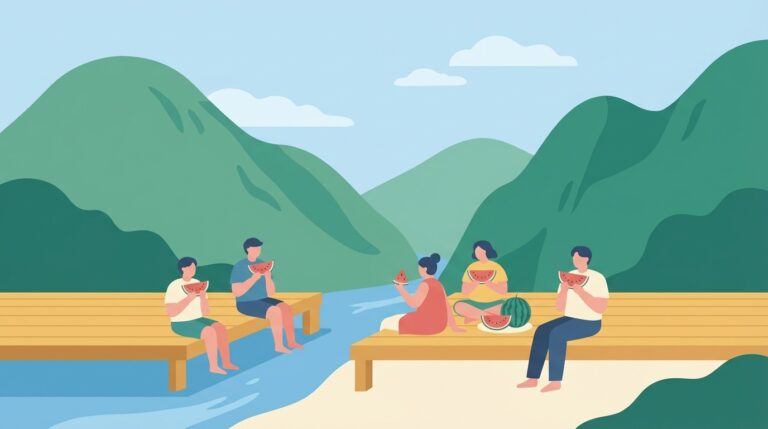
Have you ever watched a K-Drama or a K-Pop idol reality show (like Run BTS or Going Seventeen) where the cast goes on a summer retreat? They don’t go to the beach. Instead, they drive up into the lush green mountains, sit on massive wooden platforms next to a freezing stream, eat a giant watermelon, and splash each other with water.
In Korea, this is called going to the Gyegok (계곡, mountain valley). It’s the ultimate, authentic Korean summer vibe!
If you translate “Let’s go swimming” using a textbook, you might end up at a boring indoor pool. But if you want to experience the lively, food-filled, and refreshing Korean summer like a true local, you need to know the ‘Gyegok’ vocabulary.
This guide is based on real questions from my foreign students who were shocked when their Korean friends invited them to a mountain stream to eat hot chicken soup on a 35°C day! Let’s dive in.
Phase 2: Core Expressions Deep Dive
Here are the top 3 expressions you absolutely need at a Gyegok.
1. 물놀이 가요 (Let’s go play in the water)
- Pronunciation: mul-no-ri ga-yo
- Sound-alike guide: ‘물’ (mul) sounds like ‘mool’ but shorter. ‘놀’ (nol) sounds like ‘knoll’.
- Meaning: Literal = Let’s go to water-play. / Real nuance = Let’s go splash around and have fun in the water!
- K-Culture Moment: In K-Dramas, university students going on an MT (Membership Training) always shout this before throwing their friends into the valley stream.
- Editor’s Insight: Koreans rarely say “수영하러 가요” (Let’s go swimming) when going to the valley, because you don’t really swim laps there. You float on tubes, splash, and play. “물놀이” captures that playful vibe perfectly!
- Situation Spectrum:
[🚫 절대 금지] ———— [⚠️ 주의] ———— [✅ 자유롭게]
- Friends (Casual): ✅ (물놀이 가자!)
- Coworkers (Semi-formal): ✅ (물놀이 가요)
- Boss/Elders (Formal): ⚠️ (Not usually said to elders unless suggesting it for kids)
- 🤔 Think About It: Why does Korean have a specific word for “water-play” (물놀이) instead of just “swimming”? Does your language distinguish between serious swimming and just playing in the water?
2. 자리 있어요? (Is there a seat? / Is this spot taken?)
- Pronunciation: ja-ri i-sseo-yo?
- Sound-alike guide: ‘자’ (ja) like ‘jar’ without the r.
- Meaning: Literal = Is there a seat? / Real nuance = Do you have any wooden platforms (Pyeongsang) available for rent?
- K-Culture Moment: Gyegok spots are highly competitive. You’ll see Korean dads wandering around crowded restaurants by the water, nervously asking the owners this exact phrase to secure a spot for their family.
- Editor’s Insight: At a valley, a “자리” (seat) usually means a ‘평상’ (Pyeongsang), a large flat wooden platform where your whole group sits, eats, and naps.
- Situation Spectrum:
[🚫 절대 금지] ———— [⚠️ 주의] ———— [✅ 자유롭게]
- Friends (Casual): ✅
- Restaurant Owners (Polite): ✅
- 🤔 Think About It: Koreans love securing a “basecamp” before relaxing. In your culture, do people claim a specific spot for the whole day when outdoors?
3. 으아! 물이 너무 차가워요! (Whoa! The water is so cold!)
- Pronunciation: eu-a! mu-ri neo-mu cha-ga-wo-yo!
- Sound-alike guide: ‘으’ (eu) sounds like the disgusted sound you make when stepping in gum.
- Meaning: Literal = The water is very cold! / Real nuance = It’s freezing but awesome!
- K-Culture Moment: Variety show stars always scream this the second their foot touches the valley water. Gyegok water comes from the deep mountains, so it’s freezing even in August!
- Editor’s Insight: It’s almost a cultural rule to act dramatically shocked by how cold the water is. Exaggerating your reaction makes it more fun!
- Situation Spectrum:
[🚫 절대 금지] ———— [⚠️ 주의] ———— [✅ 자유롭게]
- Anyone: ✅ (It’s a common reaction!)
- 🤔 Think About It: Does your language have specific exclamation words like “으아!” (eua) to express a sudden physical sensation?
Phase 3: Textbook vs. Real Korean
| Situation | 📖 Textbook Korean | 🗣️ Real Korean | 💡 Why is it different? |
|---|---|---|---|
| Suggesting to go to the water | 수영하러 갑시다. (Let’s go swimming.) | 물놀이 가요! (Let’s play in the water!) | Valley water is shallow; it’s about playing, not sports. |
| Asking if a spot is open | 빈 좌석이 있습니까? (Are there empty seats?) | 여기 자리 있어요? (Is there a spot here?) | ‘좌석’ sounds like a movie theater seat. ‘자리’ is natural for spaces. |
| Reacting to cold water | 수온이 낮습니다. (The water temperature is low.) | 물 진짜 차가워요! / 시원해요! (The water is really cold/refreshing!) | Koreans often use ‘시원하다’ (refreshing) even when things are freezing or hot! |
Bottom Note: For A2 learners, using ‘물놀이’ instead of ‘수영’ will instantly make you sound like you’ve lived in Korea for years!
Phase 4: Cultural Context — K-Culture Deep Dive
4-1. Non-Verbal Elements: The ‘Pyeongsang’ Etiquette
When you go to a Gyegok, you will likely rent a 평상 (Pyeongsang). This is a large, low wooden platform.
* Rule #1: NEVER wear your shoes on it! You must take off your sandals before stepping up.
* Rule #2: It’s a shared space. You sit cross-legged, eat, play card games, and even lie down to take a nap.
4-2. K-Food Connection: Why Hot Chicken Soup?
If you go to a valley in Korea, you must eat 백숙 (Baeksuk). It’s a whole chicken boiled with healthy herbs like ginseng and garlic.
Wait, eating boiling hot soup on a 35°C summer day? Yes! This is based on the traditional Korean philosophy of 이열치열 (Iyeolchiyeol)—”fighting heat with heat.” By sweating out the heat while eating hot food, and then dipping your feet in the freezing valley water, Koreans believe you restore your body’s energy. It’s an essential part of the Korean summer experience!
Phase 5: Interactive Roleplay Scenario
Setting: It’s a blazing hot Saturday afternoon at Gapyeong Valley near Seoul. The sound of cicadas and splashing water fills the air. You are here with your Korean friend, Minho, and a few others.
Characters:
– YOU: A foreigner experiencing a Korean valley for the first time.
– Minho (32): Your friendly Korean coworker who planned this trip.
Dialogue:
Minho: 와, 사람 진짜 많다! 평상 자리 있을까?
(Wa, saram jinjja manta! pyeongsang jari isseulkka?)
[Wow, there are so many people! Will there be a Pyeongsang spot?]
YOU: 저기 빈 자리 있어요! 빨리 가요!
(Jeogi bin jari isseoyo! ppalli gayo!)
[There’s an empty spot over there! Let’s go quickly!]
Minho: 오, 나이스! 우리 밥 먹기 전에 먼저 물놀이 할까?
(O, naiseu! uri bap meokgi jeone neonjeo mullori halkka?)
[Oh, nice! Should we go play in the water before eating?]
YOU: 좋아요! 제가 튜브 빌려올게요.
(Joayo! jega tyubeu billyeoolgeyo.)
[Sounds good! I’ll go rent a tube.]
(🎭 Stage Direction: 10 minutes later, you step into the valley stream.)
Minho: 으아! 물 진짜 차가워! 들어올 수 있겠어?
(Eua! mul jinjja chagawo! deureool su itgesseo?)
[Whoa! The water is really cold! Can you come in?]
🔀 Your Turn! How will you answer?
– A) “너무 추워요. 저는 집에 갈래요.” (Too cold. I want to go home.)
– B) “진짜 시원해요! 빨리 들어와요!” (It’s really refreshing! Come in quickly!)
– C) “물 온도가 낮습니다.” (The water temperature is low.)✅ Best Choice: B — Korean summers are about embracing the cold water! Saying “시원해요” (refreshing) instead of just “추워요” (cold) shows you truly understand the vibe.
⚠️ Choice A & C Analysis: A is a bit of a party pooper. C sounds like a weather report!
(🎭 Stage Direction: After playing, you go back to the platform. A giant pot of hot chicken soup arrives.)
Minho: 자, 백숙 나왔다! 많이 먹어.
(Ja, baeksuk nawatda! mani meogeo.)
[Alright, the Baeksuk is here! Eat a lot.]
YOU: 와, 여름에 뜨거운 국물요?
(Wa, yeoreume tteugeoun gungmuryo?)
[Wow, hot soup in the summer?]
Minho: 한국은 이열치열이지! 먹으면 힘이 날 거야.
(Hangugeun iyeolchiyeoriji! meogeumyeon himi nal geoya.)
[In Korea, we fight heat with heat! You’ll get energy if you eat it.]
YOU: 잘 먹겠습니다! 국물이 진짜 끝내줘요!
(Jal meokgetseumnida! gungmuri jinjja kkeunnaejwoyo!)
[I will eat well! The broth is really amazing!]
Phase 6: 10-Second Shadowing Drill
Time to practice your acting! Speak this sentence out loud with feeling.
😆 아~! / 물이 / 너~~~무 / 시원해요!
(Ah~! / mu-ri / neo~~~mu / si-won-hae-yo!)
[Ah~! The water is soooo refreshing!]
- Pausing: Pause slightly at the slashes (
/). - Intonation: Drag out the “너” (neo) to emphasize how great it feels. Smile brightly while saying it!
Phase 7: K-Culture Mini Dictionary
| Korean | Romanization | English | Cultural Context |
|---|---|---|---|
| 계곡 | gyegok | Mountain valley | The ultimate Korean summer getaway destination, often featuring rocky streams. |
| 평상 | pyeongsang | Wooden platform | Large, flat outdoor tables where families sit cross-legged, eat, and rest at the valley. |
| 백숙 | baeksuk | Boiled chicken soup | A healthy dish eaten to regain stamina during the hot summer. |
| 래쉬가드 | raeswigadeu | Rash guard | Long-sleeved swimwear. Koreans heavily prefer this over bikinis at valleys to prevent sunburn and scratches. |
Phase 8: Traveler Survival Kit (Gyegok Edition)
Heading to a valley this summer? Bring these expressions with you!
🆘 Survival Expression #1: Renting Equipment
– 🇰🇷 “여기 튜브 빌려주세요.” (yeogi tyubeu billyeojuseyo.)
– 🗣️ English: Please rent me a tube here.
– 📍 Where to use: Small stalls next to the water.
– 💡 Pro Tip: They usually ask for a deposit (보증금 – bojeunggeum) in cash, which you get back when you return the tube.🆘 Survival Expression #2: Asking for the Bathroom
– 🇰🇷 “화장실이 어디예요?” (hwajangsiri eodiyeyo?)
– 🗣️ English: Where is the restroom?
– 📍 Where to use: Asking the restaurant owner.📌 Editor’s Travel Note
– What to wear: Wear water shoes (아쿠아슈즈). Valley rocks are slippery and sharp!
– Sun protection: Bikinis are rare at valleys. Opt for a rash guard and a hat.
– Booking: Many good Pyeongsang spots require you to order expensive food (like Baeksuk) to use the spot for the day. It’s essentially “paying for the seat” through food.
Phase 9: Think Deeper — “Food & Identity”
🧠 Think Deeper: Sharing a Pot, Sharing ‘Jeong’ (정)
Have you noticed that Koreans rarely order individual portions of Baeksuk at the valley? It’s always one massive pot placed in the middle of the Pyeongsang. Everyone scoops from the same pot, passing chicken legs to the youngest or oldest members first.
This communal eating isn’t just about efficiency; it’s a physical manifestation of Jeong (정)—the deep feeling of affection and community. By sweating together over a boiling pot and sharing the same meal by the cool water, the boundaries between ‘you’ and ‘I’ melt away, becoming ‘us’ (우리).💬 Your Turn: In your culture, is there a specific food that brings everyone together during the summer? Share it in the comments!
Phase 10: FAQ & Avoiding Common Mistakes
Q: Can I wear a bikini to the valley?
A: Technically yes, but you will stand out a lot. Most Koreans wear rash guards and board shorts. Plus, valleys have lots of bugs and sharp rocks, so covering up is practical!
Q: Do I have to pay to enter the valley?
A: The water itself is usually public property, but the convenient flat areas next to it are often owned by restaurants. You usually have to order food to use their tables/Pyeongsang.
❌ Common Mistake #1: Leaving your trash behind.
✅ Do this instead: Valleys are deep in nature. Always bring a trash bag and take your garbage with you (분리수거 – recycling is serious in Korea!).❌ Common Mistake #2: Wearing regular sneakers into the water.
✅ Do this instead: They will get ruined and take days to dry. Bring crocs, water shoes, or sandals with straps.
Phase 11: Summary & Action Items
One-Liner Summary: To survive a Korean summer, head to a Gyegok, secure a Pyeongsang, and enjoy some Baeksuk after a freezing Mullori!
Action Mission:
– 🥉 Bronze: Say “아! 물이 너무 시원해요!” (Ah! The water is so refreshing!) out loud 3 times right now.
– 🥈 Silver: Search “Korean Gyegok Baeksuk” on YouTube and watch a vlog to see the vibe!
– 🥇 Gold: Plan a trip to a valley (like Gapyeong or Bukhansan) this summer and use “여기 자리 있어요?” to the restaurant owner!
Special K-Culture Mission: Watch an episode of a K-Drama or idol reality show where they go to a summer MT. Can you spot them eating a giant watermelon on a wooden platform?
Phase 12: Quiz — Interactive Challenge
Q1. You arrive at a crowded valley restaurant and want to find a wooden platform to sit on. What is the most natural thing to say to the owner?
1) 빈 좌석이 있습니까? (Are there empty seats?)
2) 수영장 어디예요? (Where is the swimming pool?)
3) 여기 자리 있어요? (Is there a spot/seat here?)
4) 평상 주세요. (Give me a platform.)
Q2. True or False: In Korea, it is considered strange to eat boiling hot chicken soup on the hottest day of summer.
Q3. Fill in the blank: Instead of saying “Let’s go swimming” at a valley, Koreans say “___ 가요!”
👀 Click here for Answers!
Q1 Answer: 3) 여기 자리 있어요? (Using ‘자리’ is the most natural way to ask for a spot in a busy place! Option 1 is too textbook, Option 4 sounds a bit rude.)
Q2 Answer: False! It is a massive tradition called Iyeolchiyeol (fighting heat with heat).
Q3 Answer: 물놀이 (mul-no-ri / water play)
Frequently Asked Questions (FAQ)
Q: What does "물놀이 가요 (Let's go play in the water)" mean in Korean and how do you pronounce it?
A: In Korean, "물놀이 가요 (Let's go play in the water)" is pronounced [mul-no-ri ga-yo] and means: Literal = Let's go to water-play. / Real nuance = Let's go splash around and have fun in the water!
Q: What does "자리 있어요? (Is there a seat? / Is this spot taken?)" mean in Korean and how do you pronounce it?
A: In Korean, "자리 있어요? (Is there a seat? / Is this spot taken?)" is pronounced [ja-ri i-sseo-yo?] and means: Literal = Is there a seat? / Real nuance = Do you have any wooden platforms (Pyeongsang) available for rent?
Q: What does "으아! 물이 너무 차가워요! (Whoa! The water is so cold!)" mean in Korean and how do you pronounce it?
A: In Korean, "으아! 물이 너무 차가워요! (Whoa! The water is so cold!)" is pronounced [eu-a! mu-ri neo-mu cha-ga-wo-yo!] and means: Literal = The water is very cold! / Real nuance = It's freezing but awesome!







