

Phase 1: The ‘Convenience Store Freeze’ 🥶
안녕하세요! 매일한글(Daily Hangul) 수석 에디터입니다.
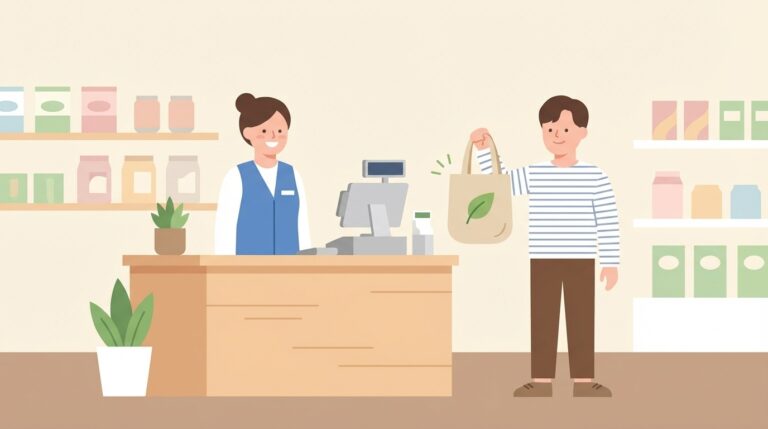
Picture this: You are visiting Seoul. It’s 11 PM, and you just recreated a classic K-Drama scene by grabbing spicy Ramyeon and banana milk from a local GS25 or CU convenience store. You walk up to the counter, feeling confident. The cashier scans your items, looks at you, and mumbles something incredibly fast:
“Bongtu-hasigesseoyo?”
You freeze. Wait, what did they just say? Was that a greeting? A question about your credit card? In many Korean dramas, you just see the main character grab their black plastic bag and walk out. But in reality? That cashier is asking you one of the most common, yet stress-inducing questions for travelers: “Do you need a bag?”
Since Korea implemented strict environmental laws to reduce single-use plastics, getting a free plastic bag is a thing of the past. If you don’t know how to answer, you might end up awkwardly carrying a pyramid of snacks in your bare hands, or holding up the fast-paced ppalli-ppalli (hurry up) line.
This guide is based on real moments of panic my B2 students have shared with me. Today, we’re going to master the art of the Korean checkout counter, learn how to proudly use your eco-bag (장바구니), and understand the cultural shift towards going green in Korea. Let’s dive in!
Phase 2: Core Expressions Deep Dive
Let’s break down the essential phrases you need to survive and thrive at the checkout counter.
1. 봉투 필요하세요? (Do you need a bag?)
- Pronunciation: [Bongtu piryohaseyo?] + [Sounds like: Bong-too pee-ryo-ha-se-yo?]
- Meaning: Literal: Do you need an envelope/bag? / Real nuance: Do you want to buy a plastic/paper bag for 50-100 won?
- K-Culture Moment: You’ll hear this everywhere—from Olive Young (K-Beauty mecca) to the local bakery. In Korea, ‘봉투 (bongtu)’ originally meant an envelope, but in retail, it means a shopping bag (plastic or paper).
- Editor’s Insight: The cashier isn’t offering a gift; they are asking if you’re willing to pay the environmental fee for a bag. If you look confused, they might just stare at you, waiting. It’s all about speed!
- Situation Spectrum:
[🚫 절대 금지] ———— [⚠️ 주의] ———— [✅ 자유롭게]
- Cashier to Customer: ✅ (Very common)
- You asking a cashier (봉투 주세요): ✅
- 🤔 Think About It: Korea charges for bags everywhere now. How does your home country handle the reduction of single-use plastics? Is it enforced by the government or driven by consumer choice?
2. 아니요, 장바구니 챙겨왔어요. (No, I brought a reusable bag.)
- Pronunciation: [Aniyo, jangbaguni chaenggyeowasseoyo.] + [Sounds like: Ah-nee-yo, jang-ba-goo-nee chaeng-gyeo-wa-sseo-yo]
- Meaning: Literal: No, I packed/brought a market basket. / Real nuance: I’m good, I brought my eco-bag.
- K-Culture Moment: Picture a trendy K-Pop idol at the airport carrying a stylish canvas ‘eco-bag’ (에코백). While younger people use ‘에코백’, the traditional and universally understood term for a grocery bag is ‘장바구니’ (jangbaguni).
- Editor’s Insight: Using the verb ‘챙기다’ (to pack/bring something you shouldn’t forget) makes you sound incredibly fluent. It shows you were prepared!
- Situation Spectrum:
[🚫 절대 금지] ———— [⚠️ 주의] ———— [✅ 자유롭게]
- To a cashier: ✅
- To a friend asking where you put the groceries: ✅
- 🤔 Think About It: Why do Koreans use specific verbs like ‘챙기다’ (to take care of / pack) instead of just ‘가지고 오다’ (to bring)? It reflects a culture that values preparation and attentiveness.
3. 영수증은 버려주세요 / 괜찮아요. (Please throw away the receipt / It’s fine.)
- Pronunciation: [Yeongsujeung-eun beoryeojuseyo / Gwaenchanayo.] + [Sounds like: Yeong-soo-jeung-eun buh-ryuh-joo-se-yo / Gwaen-cha-na-yo]
- Meaning: Literal: Please throw away the receipt / It’s okay. / Real nuance: I don’t need the receipt, please dispose of it for me.
- K-Culture Moment: To save paper, many stores ask “영수증 드릴까요?” (Shall I give you the receipt?). A quick “괜찮아요” (It’s okay) is the ultimate native-sounding refusal.
- Editor’s Insight: In English, “It’s okay” can mean “Yes, that’s fine.” In Korean, “괜찮아요” when offered something almost always means “No, thank you.” This is a crucial B2 level nuance!
Phase 3: Textbook vs Real Korean
How does textbook Korean differ from the battlefield of a Seoul supermarket?
| 상황 | 📖 교과서 한국어 | 🗣️ 진짜 한국어 | 💡 왜 다를까? (Why the difference?) |
|---|---|---|---|
| Cashier asking if you need a bag | 비닐봉투가 필요하십니까? (Do you need a plastic bag?) | 봉투 하세요? / 봉투 100원인데 드릴까요? | Extreme efficiency. Ppalli-ppalli (hurry) culture turns “Do you need…” into “Are you doing a bag?” |
| Declining the bag | 아니요, 필요하지 않습니다. (No, I do not need it.) | 아, 괜찮아요. (Ah, it’s okay.) | Korean communication values softness. A direct “No” feels cold; “It’s okay” is polite and warm. |
| Telling them you have a bag | 저는 제 가방을 가져왔습니다. (I brought my bag.) | 담아 갈게요. / 가방에 넣을게요. (I’ll put it in here.) | Action-oriented. You announce what you are going to do rather than what you did. |
Bottom Note: As a B2 learner, try transitioning from the robotic “아니요” to the softer, more natural “괜찮아요” or “그냥 들고 갈게요” (I’ll just carry it).
Phase 4: Cultural Context — K-Culture Deep Dive
4-1. Non-Verbal Cues: The Checkout Nunchi (눈치)
When you bring your reusable bag (장바구니) to a busy Korean supermarket like E-Mart or Lotte Mart, Nunchi (the art of reading the room) is critical.
Unlike in some Western countries where the cashier bags your groceries while making small talk, Korean cashiers just scan and slide. It is your job to rapidly pack your own items into your bag. If you dawdle, you’ll feel the intense, burning gaze of the Ahjumma (middle-aged lady) waiting behind you. The rule is: Scan, swipe card, pack fast, bow slightly, and run!
4-2. K-Food & Travel Connection: The “Jongnyangje” (종량제) Secret
If you really need a bag at a big supermarket, do not just ask for a plastic bag (비닐봉투). By law, large supermarkets cannot sell normal single-use plastic bags.
Instead, you must ask for a 종량제 봉투 (Jongnyangje bongtu)—a government-mandated garbage bag.
Yes, you read that right! Koreans buy their groceries, pack them into a municipal trash bag, take them home, and then use that exact bag to throw away their house trash. It’s a brilliant recycling loop!
Pro Tip for Travelers: If you’re staying at an Airbnb, you will need these specific trash bags anyway, so buy one at the checkout!
Phase 5: Real-Life Roleplay Scenario
Scenario A: The Friday Night Supermarket Rush
- Setting: Friday, 7 PM. A bustling Homeplus supermarket in Seoul. The lines are long. Carts are overflowing with Samgyeopsal (pork belly) and Soju.
- Characters:
- YOU: An expat living in Korea for 6 months, buying ingredients for a weekend dinner. You have your trusty canvas bag in your pocket.
- Cashier (점원): 50s, wearing a uniform vest, scanning items at lightning speed.
점원: (Scanning items quickly) 포인트 카드 있으세요? 💳
(Pointeu kadeu isseuseyo?)
(Do you have a point card?)
YOU: 아니요, 없어요.
(Aniyo, eopseoyo.)
(No, I don’t.)
점원: 네, 5만 3천 원입니다. 봉투 필요하세요? 🛍️
(Ne, oman samcheon wonimnida. Bongtu piryohaseyo?)
(Okay, that’s 53,000 won. Do you need a bag?)
🔀 당신의 차례! 어떻게 대답할까요? (Your Turn! How will you answer?)
- A) “아니요, 비닐봉투 주지 마세요.” (Robot-mode)
- B) “아, 괜찮아요. 장바구니 챙겨왔어요!” (Pro-level)
- C) “공짜 봉투 없어요?” (Dangerous territory!)
✅ Best Choice: B — “아, 괜찮아요. 장바구니 챙겨왔어요!” This is the gold standard. It’s polite, natural, and tells the cashier exactly why you don’t need one.
⚠️ Choice A Analysis: Grammatically correct, but “주지 마세요” (Don’t give it to me) sounds like an order. It’s too aggressive for a simple checkout.
🚫 Choice C Analysis: Asking for a “공짜” (free) plastic bag will get you a stern look, as providing them for free is illegal and can result in massive fines for the store.
(🎭 Stage Direction: You pull out your canvas bag and start packing like a pro.)
점원: 영수증 버려드릴까요?
(Yeongsujeung beoryeodeurilkkayo?)
(Shall I throw away the receipt for you?)
YOU: 네, 버려주세요. 수고하세요!
(Ne, beoryeojuseyo. Sugohaseyo!)
(Yes, please throw it away. Keep up the good work!)
Scenario B: K-Culture Bonus Roleplay — The Traditional Market (전통시장)
Unlike modern supermarkets, at traditional markets (like Gwangjang Market), vendors love to hand out black plastic bags. If you want to be eco-friendly here, you have to be fast!
할머니 (Vendor): 떡볶이 1인분 포장이요~ (Puts the food in a plastic bag)
YOU: 앗, 할머니! 저 여기 통 가져왔어요. 여기에 담아주세요! (Ah, Grandma! I brought my own container here. Please put it in here!)
할머니: 아이고, 예쁜 학생이 환경 생각하네~ 덤으로 튀김 하나 더 줄게! (Oh my, this pretty student cares about the environment. I’ll give you an extra piece of fried food as a bonus!)
Phase 6: 10-Second Shadowing Drill
Let’s practice the flow. Pay attention to the pauses (/) and intonation!
😊 아, / 괜찮아요. / 장바구니 / 챙겨왔어요! (Ah, / gwaenchanayo. / jangbaguni / chaenggyeowasseoyo!)
😤 (To yourself when packing fast) 빨리 / 넣어야 돼! / 눈치 보여! (Ppalli / neoeoya dwae! / nunchi boyeo!)
😊 영수증은 / 괜찮습니다. / 버려주세요~ (Yeongsujeung-eun / gwaenchansseumnida. / beoryeojuseyo~)
Phase 7: K-Culture Mini Dictionary
| 한국어 | Romanization | English | Context / Meaning |
|---|---|---|---|
| 장바구니 | jangbaguni | Reusable grocery bag | Originally meant a traditional woven market basket, now refers to any reusable eco-bag. |
| 종량제 봉투 | jongnyangje bongtu | Standardized trash bag | The government-issued trash bags you must buy. Used instead of plastic bags at big marts. |
| 일회용품 | ilhoeyongpum | Single-use items | “일(One) 회(Time) 용(Use) 품(Item)”. Korea has strict campaigns to reduce these. |
| 눈치 | nunchi | Social awareness / Tact | The unspoken Korean art of sensing the mood. Essential when packing groceries quickly so you don’t hold up the line. |
| 에코백 | ekobaek | Eco-bag (Canvas tote) | A fashion staple in Korea, often used as an everyday bag, not just for groceries. |
Phase 8: Traveler’s Survival Kit
If you are traveling to Korea, the checkout counter is your daily battlefield. Memorize these!
🆘 서바이벌 표현 TOP 3 (Top 3 Survival Phrases)
- “봉투 하나 주세요.” (Bongtu hana juseyo.)
- 🗣️ Please give me a bag. (Be prepared to pay 50-100 won).
- “그냥 들고 갈게요.” (Geunyang deulgo galgeyo.)
- 🗣️ I will just carry it. (Perfect when you buy just 1-2 items like a drink and a snack).
- “영수증 괜찮아요.” (Yeongsujeung gwaenchanayo.)
- 🗣️ I don’t need the receipt (Literally: The receipt is fine).
📌 Editor’s Travel Note: The Eco-Friendly Korea
– Coffee Shops: If you drink coffee inside a cafe (like Starbucks Korea), you must use a mug/glass by law. If you want a plastic cup, you have to say “테이크아웃 할게요” (I will take it out).
– Hotels: Since 2024, large hotels in Korea are banned from providing free single-use toothbrushes and razors. Bring your own, or buy them at the convenience store downstairs!
Phase 9: Critical Thinking Corner — “A Step Deeper”
Media vs Reality: The Plastic Paradox in Korea
🧠 Think Deeper:
If you watch older K-Dramas or even some modern ones, you might notice a paradox. Characters are constantly drinking iced Americanos from plastic cups or bringing home late-night snacks wrapped in layers of black plastic bags. Yet, actual life in Korea involves some of the strictest recycling (분리수거 – bullisugeo) and plastic reduction policies in the world.This gap between media and reality highlights the transition Korea is currently undergoing. The Ppalli-ppalli (convenience and speed) culture heavily relied on disposable items. Now, the government is clashing with this convenience culture to enforce sustainability. When you proudly use your ‘장바구니’ (reusable bag), you are actively participating in modern Korea’s cultural shift!
💬 Your Turn: How is recycling and plastic use portrayed in the media of your home country compared to reality? Share your thoughts in the comments!
Phase 10: FAQ & Avoiding Misunderstandings
Q: Is it rude to just hold out my reusable bag to the cashier without saying anything?
A: Yes, it can seem a bit abrupt or demanding. It’s much better to say “여기에 담을게요” (I will put it in here) or simply “장바구니 있어요” (I have a bag). A little verbal communication goes a long way in showing politeness!
Q: What if I bought too much and my eco-bag is full?
A: You can always ask for a paper bag (종이 쇼핑백) or a standardized trash bag (종량제 봉투) for the rest. Just say: “종량제 봉투 하나만 더 주세요” (Please give me one more trash bag).
❌ 흔한 실수 #1 (Common Mistake): Expecting bags to be free.
Never argue with a cashier about a 50 won bag fee. It’s the law, not a store policy. Arguing will just make you the villain of the convenience store!❌ 흔한 실수 #2: Using “아니요 (No)” too bluntly.
Just saying a flat “아니요” when offered a bag or receipt sounds angry. Always soften it with “아, 괜찮아요” (Ah, it’s okay) or add your reason: “가방에 넣을게요” (I’ll put it in my bag).
Phase 11: Summary & Action Items
💡 One-Liner Summary: When asked “봉투 필요하세요?” at a Korean store, pull out your eco-bag and confidently say, “괜찮아요, 장바구니 있어요!” to sound like a true local.
🎯 Action Mission 3 Steps:
– 🥉 Bronze (Solo): Stand in front of a mirror with any bag and practice saying “괜찮아요, 장바구니 챙겨왔어요!” three times naturally.
– 🥈 Silver (Online): Post a picture of your favorite reusable bag on a Korean language learning forum or your social media with the caption: “제 장바구니입니다!”
– 🥇 Gold (Real Life): Next time you visit a Korean mart or H-Mart in your country, decline the plastic bag using Korean: “그냥 들고 갈게요!”
🎬 K-Culture Mission: Watch an episode of a slice-of-life K-Drama (like Hospital Playlist or Reply 1988). Spot a scene where someone goes to a convenience store or market. Notice if they get a plastic bag or bring their own!
Phase 12: Quiz — Interactive Challenge
Test your new B2 survival skills!
1. Situational Judgment: You buy just one bottle of water at CU. The cashier asks, “봉투 필요하세요?” What is the most natural, native-sounding response?
– A) 아니요, 필요하지 않습니다.
– B) 아, 그냥 들고 갈게요.
– C) 비닐봉투 주지 마세요.
2. Fill in the Blank:
Cashier: “영수증 드릴까요?” (Would you like the receipt?)
You: “아, _____________. 버려주세요.”
– A) 미안해요 (I’m sorry)
– B) 좋아요 (I like it)
– C) 괜찮아요 (It’s okay)
3. True or False – K-Culture Edition:
– In large supermarkets like E-Mart, you can easily buy cheap, single-use plastic bags for your groceries if you forget your eco-bag. (T / F)
(Answers below!)
👀 정답 보기 (Click to see answers)
1. B – “I’ll just carry it.” is the most natural phrase for 1-2 items. A is too robotic, C is too aggressive.
2. C – “괜찮아요” is the polite way to say “No, thank you” in Korean.
3. False – Large supermarkets are legally banned from selling single-use plastic bags. You must buy a reusable bag or a ‘종량제 봉투’ (municipal trash bag)!
Did you enjoy today’s guide? Pack your eco-bag and conquer those checkout lines! Let us know in the comments what K-Culture moment you want us to decode next!
Frequently Asked Questions (FAQ)
Q: What does "봉투 필요하세요? (Do you need a bag?)" mean in Korean and how do you pronounce it?
A: In Korean, "봉투 필요하세요? (Do you need a bag?)" is pronounced [Bongtu piryohaseyo?] and means: Literal: Do you need an envelope/bag? / Real nuance: Do you want to buy a plastic/paper bag for 50-100 won?
Q: What does "아니요, 장바구니 챙겨왔어요. (No, I brought a reusable bag.)" mean in Korean and how do you pronounce it?
A: In Korean, "아니요, 장바구니 챙겨왔어요. (No, I brought a reusable bag.)" is pronounced [Aniyo, jangbaguni chaenggyeowasseoyo.] and means: Literal: No, I packed/brought a market basket. / Real nuance: I'm good, I brought my eco-bag.
Q: What does "영수증은 버려주세요 / 괜찮아요. (Please throw away the receipt / It's fine.)" mean in Korean and how do you pronounce it?
A: In Korean, "영수증은 버려주세요 / 괜찮아요. (Please throw away the receipt / It's fine.)" is pronounced [Yeongsujeung-eun beoryeojuseyo / Gwaenchanayo.] and means: Literal: Please throw away the receipt / It's okay. / Real nuance: I don't need the receipt, please dispose of it for me.







