

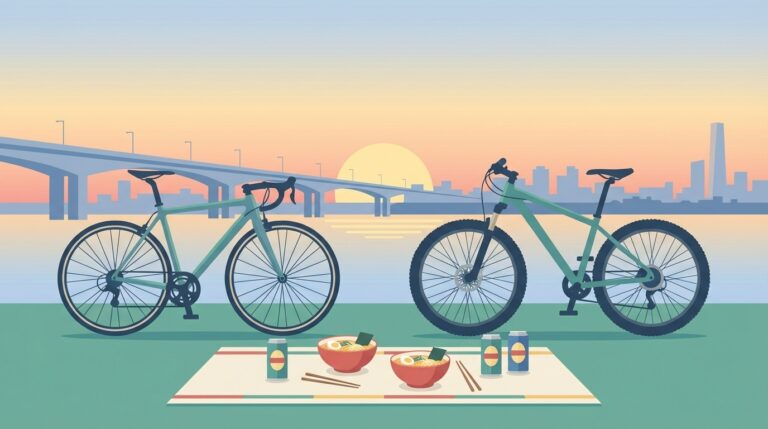
Phase 1: Empathy & The K-Culture Cold Open
Hello, language enthusiasts! This is your lead editor at Daily Hangul.
Picture this: It’s a breezy Friday evening. The golden hour hits the Han River just right, reflecting off the water like a scene straight out of Hospital Playlist or Twenty-Five Twenty-One. You’ve finally decided to join the quintessential Seoulite experience—Han River biking. You confidently walk into a sleek bike shop in Seongsu-dong, or perhaps you’re joining a local riding Donghohoe (동호회, hobby club).
But suddenly, you’re hit with a barrage of questions: “Are you team Road or team MTB? Are you riding for ‘speed’ or ‘ride comfort’? How’s your gear?”
If your Korean biking vocabulary is limited to just “자전거 (bicycle),” you might find yourself slightly overwhelmed. In Korea, leisure isn’t just a pastime; it’s a lifestyle, a community, and sometimes, a fiercely passionate subculture. Knowing the nuances between a sleek Road bike (로드) and a sturdy Mountain bike (MTB/엠티비) won’t just help you buy a bike—it will grant you instant “Insider (인싸)” status among Korean riders.
This guide is crafted from real questions my advanced students have asked when trying to integrate into Korean hobby communities. Let’s gear up and dive in!
Phase 2: Core Expressions Deep Dive
Let’s unpack the essential vocabulary used by Korean cycling aficionados. At the C1 level, we are moving past basic nouns and diving into descriptive, native-level phrasing.
1. 속도감을 즐기려면 무조건 로드죠. (If you want to enjoy the sense of speed, it’s definitely a Road bike.)
- Pronunciation: [sok-do-gam-eul jeul-gi-ryeo-myeon mu-jo-geon ro-deu-jyo] / ‘무조건’ sounds like ‘moo-jo-gun’—say it with absolute conviction!
- Meaning: Literal: To enjoy a sense of speed, unconditionally Road. / Real nuance: There’s no debate; if speed is your goal, you MUST choose a Road bike.
- K-Culture Moment: You’ll hear this at any bike shop or cafe along the Han River when experienced riders are giving advice to newbies. The word ‘무조건’ (unconditionally/absolutely) is a staple in Korean persuasion.
- Editor’s Insight: This isn’t just about speed; it’s about the Korean conversational habit of making strong, confident recommendations to show care and expertise.
- Situation Spectrum:
[🚫 Never] ———— [⚠️ Be Careful] ———— [✅ Freely]
- Close friends (Casual): ✅
- Colleagues (Semi-formal): ✅
- Superiors/Elders (Formal): ⚠️ (A bit too assertive; soften it with “로드도 좋은 선택입니다” – Road is also a good choice.)
- 🤔 Think About It: Why do Koreans use absolute terms like ‘무조건’ (unconditionally) or ‘절대’ (absolutely) so often in casual advice? How does this reflect the cultural desire to provide ‘the best’ solution to a friend?
2. 거친 길도 거뜬하게 주파하죠. (It effortlessly conquers rough terrain.)
- Pronunciation: [geo-chin gil-do geo-tteun-ha-ge ju-pa-ha-jyo] / ‘거뜬’ sounds like a light, bouncy hop.
- Meaning: Literal: It breaks through rough roads lightly. / Real nuance: MTBs can handle any bumpy, unpaved road without breaking a sweat.
- K-Culture Moment: Used by MTB loyalists who prefer off-roading in Korea’s mountainous terrains (like Bukhansan or local trails) rather than the paved paths of the Han River.
- Editor’s Insight: ‘거뜬하다’ is a fantastic C1 vocabulary word. It means doing something with unexpected ease. It gives the listener a feeling of unwavering reliability—perfect for describing an MTB.
- Situation Spectrum:
[🚫 Never] ———— [⚠️ Be Careful] ———— [✅ Freely]
- Close friends (Casual): ✅
- Colleagues (Semi-formal): ✅
- Superiors/Elders (Formal): ✅ (It’s a very polite and descriptive phrasing!)
- 🤔 Think About It: Does your native language have a specific word like ‘거뜬하다’ that describes both physical lightness and situational ease?
3. 자전거는 역시 장비빨이죠! (When it comes to bikes, it’s all about the gear!)
- Pronunciation: [ja-jeon-geo-neun yeok-si jang-bi-ppal-i-jyo] / ‘빨’ is a strong, explosive ‘ppal’—like popping a balloon!
- Meaning: Literal: Bicycles are expectedly gear-power. / Real nuance: A hobby is only as good as the expensive equipment you buy for it.
- K-Culture Moment: You show up to a casual weekend ride, and your Korean friend is dressed head-to-toe in aerodynamic spandex, carbon-fiber shoes, and polarized Oakley sunglasses. They jokingly say this to justify their $5,000 setup.
- Editor’s Insight: The suffix ‘-빨’ (effect/power derived from something) is crucial slang. ‘화장빨’ (makeup effect), ‘조명빨’ (lighting effect). It’s self-deprecating yet proud.
- Situation Spectrum:
[🚫 Never] ———— [⚠️ Be Careful] ———— [✅ Freely]
- Close friends (Casual): ✅
- Colleagues (Semi-formal): ✅ (Great for breaking the ice!)
- Superiors/Elders (Formal): 🚫 (Too slangy for a boss you aren’t close to.)
- 🤔 Think About It: Why is “Gear Illness” (장비병) such a massive phenomenon in Korean hobby culture?
Phase 3: Textbook vs. Real Korean
Let’s upgrade your textbook vocabulary to what actual riders say at the convenience store halfway through their route.
| Situation | 📖 Textbook Korean | 🗣️ Real Korean | 💡 Why the difference? |
|---|---|---|---|
| Naming the bikes | 산악자전거 / 도로용 자전거 | 엠티비(또는 므틉) / 로드 | Koreans love abbreviating and adopting English terms for modern hobbies. “므틉” is a fun, phonetic typing slang for MTB. |
| Asking to go riding | 자전거 타러 갈래요? | 라딩(라이딩) 갈래? / 한강 뛸래? | “뛰다” (to run) is often used metaphorically for engaging in an active hobby or going to a location. |
| Complimenting a bike | 자전거가 아주 좋네요. | 와, 승차감 대박이겠는데요? | Focusing on specific technical merits (승차감 – ride comfort) shows you are an insider. |
Bottom Note: As an advanced learner, dropping “므틉” or “승차감” in a conversation instantly shifts how native speakers perceive your fluency.
Phase 4: Cultural Context — K-Culture Deep Dive
4-1. Non-Verbal Cues: The Art of Passing
When you ride a Road bike on the Han River, you’ll inevitably need to pass pedestrians or slower Ttareungi (city bike) riders.
The Nunchi Rule: In many Western countries, ringing your bike bell is the polite way to say “Excuse me.” In Korea? Aggressively ringing your bell can be perceived as rude or demanding (“Get out of my way!”). Instead, the polite and expected etiquette is to use your voice. As you approach, you say: “지나가겠습니다~” (I am passing by~), slightly elongating the end to sound friendly.
4-2. K-Food Connection: The Post-Ride Ritual
Riding a bike in Korea is practically an excuse to eat. Whether you ride a lightning-fast Road bike or a heavy-duty MTB, all rides culminate in one thing: 한강 라면 (Han River Ramen) and 치맥 (Chimaek – Chicken & Beer).
You’ll often hear riders say, “라면 먹으려고 자전거 타는 거지” (We’re just riding bikes so we can eat ramen). The culture of shared meals after physical exertion is a cornerstone of Korean community bonding (정 – Jeong).
Phase 5: Real-Life Roleplay Scenario
Setting: A trendy, high-end bicycle shop in Mapo-gu. The walls are lined with sleek carbon frames and rugged mountain tires. You are looking to buy your first serious bike in Korea to join your company’s weekend riding club.
Characters:
– YOU: An expat working in Seoul, eager to fit in but unsure which bike suits the local culture.
– Min-su (32): The shop owner and a hardcore cycling enthusiast. Friendly, highly energetic, and very opinionated.
Dialogue:
Min-su: 어서 오세요! 혹시 찾으시는 모델 있으신가요? (Welcome! Are you looking for a specific model?)
YOU: 아, 제가 이번에 회사 동호회에 들어가게 돼서요. 자전거를 하나 장만하려고요. (Ah, I recently joined my company’s hobby club. I’m looking to get a bicycle.)
Min-su: 아하! 동호회 가입 축하드립니다! 주로 한강에서 타시나요, 아니면 산이나 험로 위주로 가시나요? (Aha! Congratulations on joining the club! Will you mostly ride on the Han River, or on mountains and rough terrain?)
YOU: 거의 한강 자전거 도로에서 탈 것 같아요. (I think I’ll mostly ride on the Han River bike paths.)
Min-su: 그럼 무조건 로드죠! 한강에서 속도감 즐기기엔 로드만한 게 없거든요. MTB는 승차감은 좋은데, 포장도로에서는 좀 무거워요. (Then it’s absolutely a Road bike! There’s nothing like a Road bike to enjoy the speed on the Han River. MTBs have great ride comfort, but they’re a bit heavy on paved roads.)
YOU: 아, 그렇군요. 그런데 로드는 바퀴가 얇아서 펑크가 잘 나지 않나요? (Oh, I see. But don’t Road bikes get flat tires easily because the wheels are so thin?)
Min-su: 에이, 요즘 기술이 얼마나 좋은데요. 거뜬합니다! 게다가 동호회 나가시면 다들 장비빨이 장난 아닐 텐데, 멋진 로드 하나 뽑으셔야죠! (Hey, technology is so good these days. It’s totally fine! Besides, when you go to the club, everyone will have crazy gear, so you should pick up a cool Road bike!)
🔀 Your Turn! How do you respond?
– A) “장비빨이요? 전 그냥 싼 거 살래요.” (Gear? I’ll just buy a cheap one.)
– B) “맞아요, 자전거는 역시 장비빨이죠! 입문용으로 괜찮은 로드 추천해 주세요.” (That’s right, it’s all about the gear! Please recommend a good entry-level Road bike.)
– C) “산악자전거(MTB)가 더 안전해 보이는데, 그걸로 주세요.” (An MTB looks safer, I’ll take that.)✅ Best Choice: B — Why? You acknowledge the cultural joke about “장비빨” (gear effect) while keeping the conversation moving toward a practical “입문용” (entry-level) recommendation. You’ve instantly bonded with the shop owner!
⚠️ Choice A Analysis: While honest, shutting down the “gear” joke so bluntly might kill the fun, enthusiastic vibe Min-su is trying to build.
Phase 6: 10-Second Shadowing Drill
Master the rhythm and intonation to sound like a native!
😤 단호하게 (Firmly/Confidently)
한강에서 / 속도감을 즐기려면 / 무·조·건 / 로드죠!
(Han-gang-e-seo / sok-do-gam-eul jeul-gi-ryeo-myeon / mu-jo-geon / ro-deu-jyo!)
Tip: Emphasize each syllable of “무.조.건” (Un.con.di.tion.al.ly) to show your absolute certainty, and raise the pitch slightly at “로드죠” to keep it conversational and friendly.
Phase 7: K-Culture Mini Dictionary
| Korean | Romanization | English | Contextual Explanation |
|---|---|---|---|
| 장비병 | jang-bi-byeong | Gear Illness | A humorous term for the obsession with buying expensive, professional-grade equipment for a casual hobby. |
| 동호회 | dong-ho-hoe | Hobby Club | A social club based on shared interests. Extremely important for networking and socializing in adult Korean life. |
| 따릉이 | tta-reung-i | Ttareungi | Seoul’s public bicycle sharing system. The name comes from the “ring-ring” sound of a bike bell. |
| 승차감 | seung-cha-gam | Ride Comfort | Often used to compare the smooth, shock-absorbing ride of an MTB versus the stiff, bumpy ride of a Road bike. |
| 펑크 나다 | peong-keu na-da | To get a flat tire | Derived from the English word “puncture.” |
Phase 8: Traveler Survival Kit 🆘
Even if you aren’t buying a $3,000 Road bike, you can still experience the Han River on a public bike!
🆘 Survival Phrases for Seoul Biking
– 🇰🇷 “따릉이 대여소가 어디예요?” (tta-reung-i dae-yeo-so-ga eo-di-ye-yo?)
– 🗣️ Meaning: Where is the Ttareungi rental station?
– 📍 Where to use: Exiting a subway station near the Han River (like Yeouinaru or Ttukseom).
- 🇰🇷 “자전거 전용 도로가 어느 쪽인가요?” (ja-jeon-geo jeon-yong do-ro-ga eo-neu jjog-in-ga-yo?)
- 🗣️ Meaning: Which way is the bicycle-only path?
- 💡 Pro Tip: Never ride on the pedestrian-only paths at the Han River park. The bike paths are strictly color-coded (usually red/dark red).
📌 Editor’s Travel Note
– Useful Apps: Download the ‘Seoul Public Bike (따릉이)’ app before your trip. You can rent a bike for just 1,000 KRW (less than $1) an hour!
– Safety Etiquette: Koreans take bike lane directions seriously. Always keep to the right, and remember to shout “지나가겠습니다~” instead of ringing your bell aggressively when passing.
Phase 9: Critical Thinking Corner — “One Step Deeper”
Hobby & Identity: Why Do Koreans Dress Like Pro Cyclists?
If you visit the Han River, you might be surprised to see casual weekend riders dressed in aerodynamic, branded cycling kits that look suited for the Tour de France. This phenomenon ties deeply into the Korean concept of collective identity and “장비병” (Gear Illness). In Korea, joining a community (동호회) often means assimilating into its visual culture. Having the “right” gear—whether it’s a sleek Road bike, professional cleats, or specific brands—signals respect for the hobby and readiness to belong to the group. It’s less about showing off wealth and more about showing commitment to the tribe.
🧠 Think Deeper: Does the concept of “dressing the part” exist in your culture’s hobbies to this extent? Or is leisure wear generally more relaxed and individualistic?
💬 Your Turn: How would you feel showing up to a Korean cycling club in jeans and a t-shirt while everyone else is in full spandex? Share your thoughts in the comments!
Phase 10: FAQ & Avoiding Misunderstandings
Q: If my boss is in the riding club, can I use slang like ‘장비빨’ with them?
– Maybe, but be careful. While hobby clubs break down some corporate hierarchy, age and status still matter. Wait until your boss uses informal slang first. Until then, stick to “자전거가 정말 멋지네요!” (Your bicycle is really cool!).
Q: I rented an MTB. Can I ride it on the street instead of the bike path?
– No! In Korea, bicycles are legally classified as vehicles. You must use the designated bike paths or the right edge of the main road. Riding on the sidewalk is technically illegal and heavily frowned upon.
❌ Common Mistake #1: Aggressively ringing the bike bell at pedestrians.
✅ Do this instead: Slow down and politely say, “지나가겠습니다~” (I’m passing by). It shows you understand Korean Nunchi and social grace.
Phase 11: Summary & Action Items
- One-Liner Summary: Whether you’re chasing ‘속도감’ (speed) on a Road bike or ‘승차감’ (comfort) on an MTB, knowing the gear-obsessed, community-driven language of Korean cycling will make your Han River experience unforgettable.
-
Action Mission 3 Steps:
- 🥉 Bronze (Solo): Stand in front of a mirror and practice saying “지나가겠습니다~” with a friendly, non-aggressive tone.
- 🥈 Silver (Online): Go to a Korean YouTube video about “로드 vs MTB 차이” and leave a comment using “장비빨” or “승차감.”
- 🥇 Gold (Real World): Rent a Ttareungi at the Han River, safely pass someone using your new phrase, and reward yourself with Han River Ramen!
- K-Culture Mission:
Watch an episode of Hospital Playlist (슬기로운 의사생활) and spot the scenes where the doctors are riding their bikes with full professional gear. Notice how they interact on the bike paths!
Phase 12: Interactive Quiz
1. Situational Judgment: You are riding your bike on the Han River path and a group of people is walking slightly in your lane. What is the most culturally appropriate way to pass?
– A) Ring your bell repeatedly until they move.
– B) Say “비켜주세요!” (Move out of the way!)
– C) Say “지나가겠습니다~” (I’m passing by~) as you approach.
2. Fill in the Blank:
“친구가 자전거 휠을 200만 원 주고 바꿨대. 역시 자전거는 _________이지!”
(My friend spent 2 million won upgrading their bike wheels. As expected, biking is all about _________!)
3. True or False:
“In Korea, it is considered perfectly normal and expected to wear professional, full-body cycling gear even for a casual 10km ride along the Han River.”
(Answers: 1. C – A is aggressive, B is rude. / 2. 장비빨 / 3. True – Welcome to the culture of 장비병!)
Frequently Asked Questions (FAQ)
Q: What does "속도감을 즐기려면 무조건 로드죠. (If you want to enjoy the sense of speed, it's definitely a Road bike.)" mean in Korean and how do you pronounce it?
A: In Korean, "속도감을 즐기려면 무조건 로드죠. (If you want to enjoy the sense of speed, it's definitely a Road bike.)" is pronounced [sok-do-gam-eul jeul-gi-ryeo-myeon mu-jo-geon ro-deu-jyo] and means: Literal: To enjoy a sense of speed, unconditionally Road. / Real nuance: There's no debate; if speed is your goal, you MUST choose a Road bike.
Q: What does "거친 길도 거뜬하게 주파하죠. (It effortlessly conquers rough terrain.)" mean in Korean and how do you pronounce it?
A: In Korean, "거친 길도 거뜬하게 주파하죠. (It effortlessly conquers rough terrain.)" is pronounced [geo-chin gil-do geo-tteun-ha-ge ju-pa-ha-jyo] and means: Literal: It breaks through rough roads lightly. / Real nuance: MTBs can handle any bumpy, unpaved road without breaking a sweat.
Q: What does "자전거는 역시 장비빨이죠! (When it comes to bikes, it's all about the gear!)" mean in Korean and how do you pronounce it?
A: In Korean, "자전거는 역시 장비빨이죠! (When it comes to bikes, it's all about the gear!)" is pronounced [ja-jeon-geo-neun yeok-si jang-bi-ppal-i-jyo] and means: Literal: Bicycles are expectedly gear-power. / Real nuance: A hobby is only as good as the expensive equipment you buy for it.







