

Phase 1: Empathy (Immersive Open)
Hello! This is the Lead Editor of Daily Hangul.
Picture this: You are watching a deeply emotional K-Drama like Move to Heaven or My Mister. A beloved character passes away. The scene shifts to a hospital funeral hall (장례식장). You see people dressed in stark black suits, wearing small white armbands. The air is heavy, yet surprisingly, it is filled with the clinking of soju glasses and the smell of spicy beef soup.
If you have a Korean friend or colleague who experiences a loss, your instinct might be to translate “I’m sorry for your loss” into Korean. But if you say “미안합니다 (I’m sorry),” they might look at you in confusion. Why are you apologizing? You didn’t cause this.
Navigating grief (애도) in a foreign language is one of the most profound challenges for any advanced learner. At the C2 level, fluency isn’t just about flawless grammar; it’s about holding space for someone’s pain using the cultural and emotional frameworks of their world. This guide is built on real experiences of expats who wanted to offer true comfort in Korea but didn’t know how. Let’s learn how to heal and comfort like a true local.
Phase 2: In-Depth Analysis of Core Expressions
When dealing with grief, silence is often better than the wrong words. But when you must speak, these are the phrases that carry true weight.
1. 삼가 고인의 명복을 빕니다
- Pronunciation: [sam-ga go-in-ui myeong-bog-eul bim-ni-da] + Sound-alike: sahm-gah go-een-wee myung-bohg-eul beem-nee-dah
- Meaning: (Literal) I respectfully pray for the deceased’s bliss in the underworld. / (Real Nuance) May they rest in peace.
- K-Culture Moment: This is the most standard, formal condolence phrase. You will see this written on white envelopes containing condolence money (조의금) or text banners at the funeral hall.
- Editor’s Insight: The word ‘명복’ (冥福) comes from Hanja, meaning “blessings in the dark/afterlife.” It’s a heavy, formal phrase. You don’t usually say this casually over coffee; it is reserved for the funeral setting, written messages, or formal announcements.
- Situation Spectrum:
[🚫 절대 금지] ———— [⚠️ 주의] ———— [✅ 자유롭게]
- Casual (Close friends): ⚠️ (A bit too formal for a private text, but acceptable in a funeral hall)
- Semi-formal (Colleagues): ✅
- Formal (Boss/Elders): ✅
- 🤔 Think About It: In English, we say “Rest in peace,” focusing on the state of the body and soul. Korean focuses on “blessings in the next world.” What does this tell us about the traditional Korean view of the afterlife?
2. 얼마나 상심이 크십니까 (크시겠어요)
- Pronunciation: [eol-ma-na sang-sim-i keu-sim-ni-kka] + Sound-alike: ull-mah-nah sahng-sheem-ee keu-shim-nee-kkah
- Meaning: (Literal) How great must your heartbreak be? / (Real Nuance) I am so deeply sorry for your profound loss.
- K-Culture Moment: When you enter the mourning room, after bowing to the portrait, you turn to the chief mourner (상주). You hold their hands gently and whisper this phrase with a slight bow of your head.
- Editor’s Insight: ‘상심’ (傷心) literally means “wounded heart.” This phrase is pure empathy. Instead of talking about your own feelings (I am sorry), you are acknowledging the vastness of their pain.
- Situation Spectrum:
[🚫 절대 금지] ———— [⚠️ 주의] ———— [✅ 자유롭게]
- Casual (Close friends): ✅ (Usually softened to “얼마나 상심이 크니” or “얼마나 힘들겠어”)
- Semi-formal (Colleagues): ✅
- Formal (Boss/Elders): ✅
- 🤔 Think About It: Korean condolences often take the form of empathetic questions (“How hard must this be for you?”) rather than statements (“I feel bad for you”). Why do you think indirect empathy is preferred in Korean culture?
3. 마음을 잘 추스르길 바라요
- Pronunciation: [ma-eum-eul jal chu-seu-reu-gil ba-ra-yo] + Sound-alike: mah-eum-eul jahl choo-seu-reu-geel bah-rah-yoh
- Meaning: (Literal) I hope you gather your heart well. / (Real Nuance) Take the time you need to heal and recover emotionally.
- K-Culture Moment: You say this after the funeral, when a colleague returns to the office, or when texting a friend a few weeks after their loss.
- Editor’s Insight: The verb ‘추스르다’ is beautiful. It means to lift up and gather something that is falling apart or scattered. It paints a picture of gently putting the pieces of a broken heart back together.
- Situation Spectrum:
[🚫 절대 금지] ———— [⚠️ 주의] ———— [✅ 자유롭게]
- Casual (Close friends): ✅ (마음 잘 추슬러)
- Semi-formal (Colleagues): ✅
- Formal (Boss/Elders): ⚠️ (Better to use: “건강 잘 챙기십시오” for elders)
- 🤔 Think About It: The concept of the “heart” (마음) being a physical entity that can be scattered and gathered is common in Korean. Does your native language treat emotions as physical objects in this way?
Phase 3: Textbook vs. Real Korean
Let’s look at why direct translations of English condolence phrases fail in Korean.
| Situation | 📖 Textbook / Literal Translation | 🗣️ Real Korean | 💡 Why is it different? |
|---|---|---|---|
| Expressing sorrow | 유감입니다 (I feel regret) | 얼마나 상심이 크십니까 / 좋은 곳으로 가셨을 거예요 | “유감입니다” sounds like a diplomatic statement from a politician. It lacks warmth and Jeong (정). |
| Apologizing for the loss | 미안합니다 (I’m sorry) | (Silence and a gentle squeeze of the hand) | In Korean, apologizing means admitting fault. You don’t apologize unless you caused the death! |
| Telling them to be strong | 강해지세요 (Be strong) | 기운 내세요 / 마음 잘 추스르세요 | “강해지세요” sounds like an order for a workout. “기운 내세요” (Gather your energy) is the natural idiom. |
Bottom Note: At the C2 level, knowing what not to say is as important as knowing what to say. In Korean mourning, your physical presence (staying late at the funeral hall) speaks much louder than any perfectly crafted sentence.
Phase 4: Cultural Context — K-Culture Deep Dive
4-1. Non-Verbal Elements (The Etiquette of Grief)
In a Korean funeral, how you act is scrutinized far more than what you say. This is the ultimate test of your Nunchi (눈치).
– The Bow (절): You must bow to the deceased’s portrait two and a half times. (Two full bows to the floor, followed by a slight standing bow). Bowing only once is for the living; doing it at a funeral is a massive faux pas.
– The Hands: When pouring alcohol for the deceased’s spirit, or when handing over your condolence envelope, you must always use two hands.
4-2. K-Food Connection: The Healing Power of Yukgaejang
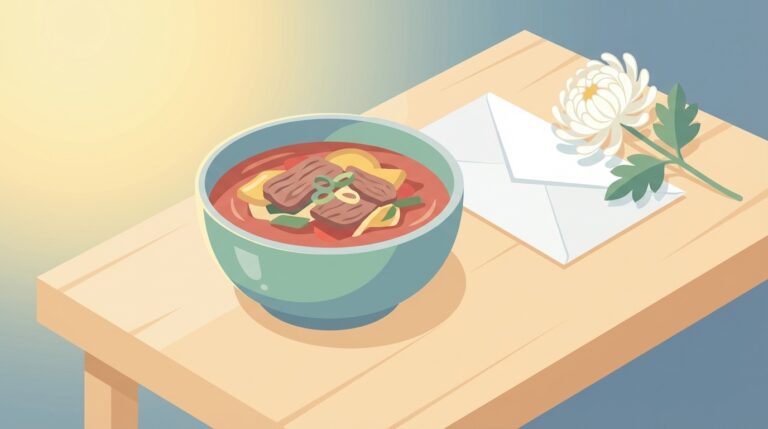
If you’ve seen a K-Drama funeral scene, you’ve seen the food. Why do Koreans serve Yukgaejang (육개장 – Spicy Beef Soup) at funerals?
Historically, the red color of the chili oil was believed to ward off evil spirits (액운을 쫓다) who might wander into the funeral hall. More importantly, mourning in Korea is a communal endurance test. The family stays awake for three days and nights. Serving a hearty, hot, spicy soup to the guests who come to share this burden is the ultimate expression of gratitude and Jeong. Eating together in the presence of death is how Koreans affirm life and community.
Phase 5: Real-Life Roleplay Scenario
Setting: Thursday evening, 8:00 PM. A hospital funeral hall in Seoul. The smell of incense and chrysanthemums fills the air. You are wearing a dark suit. You have come to pay respects to your Korean colleague, Minsu, whose father just passed away.
Characters:
– YOU: An expat professional living in Seoul for 5 years. You want to show deep respect.
– Minsu (35): Your colleague. He is wearing a black suit with a dual black-stripe armband (indicating he is the chief mourner). He looks exhausted.
Dialogue:
Minsu: 아… 와주셨군요. 바쁘실 텐데 정말 감사합니다.
(a… wajusyeotgunyo. bappeusil tende jeongmal gamsahamnida.)
[Ah… You came. Thank you so much, you must be busy.]
(🎭 Stage Direction: Minsu bows slightly, his voice hoarse from crying and greeting guests.)
YOU: 당연히 와야죠. …
(dangyeonhi wayajyo. …)
[Of course I had to come. …]
🔀 Your Turn! How should you continue this sentence?
– A) “아버님이 돌아가셔서 제가 다 미안합니다.” (I’m sorry your father passed away.)
– B) “얼마나 상심이 크십니까. 좋은 곳으로 가셨을 거예요.” (How great your heartbreak must be. He must have gone to a good place.)
– C) “유감입니다. 빨리 강해지시길 바랍니다.” (It is a regret. I hope you get strong quickly.)✅ Best Choice: B — Reason: It uses the culturally appropriate phrase for acknowledging profound pain (상심이 크다) and offers a comforting, gentle thought about the afterlife.
⚠️ Choice A & C Analysis: ‘A’ incorrectly uses “미안하다” (taking the blame). ‘C’ sounds like a translated English textbook and lacks empathy.
(Continuing with the best choice)
Minsu: 네, 다행히 주무시듯 편안하게 가셨어요. 위로해 주셔서 감사합니다.
(ne, dahaenghi jumusideut pyeonanage gasyeosseoyo. wirohae jusyeoseo gamsahamnida.)
[Yes, thankfully he went peacefully as if he were sleeping. Thank you for consoling me.]
YOU: 아버님께서 평소에 민수 씨 칭찬을 많이 하셨잖아요. 자랑스러워하셨을 겁니다.
(abeonimkkeseo pyeongsoe minsu ssi chingchaneul mani hasyeotjanayo. jarangseureowohasyeosseul geomnida.)
[Your father used to praise you a lot. He must have been very proud of you.]
Minsu: 그렇게 말씀해 주시니 위안이 되네요. 저쪽 테이블에 가서 식사라도 좀 하고 가세요. 육개장 따뜻할 때 드세요.
(geureoke malsseumhae jusini wiani doeneyo. jeojjok teibeure gaseo siksarado jom hago gaseyo. yukgaejang ttatteutal ttae deuseyo.)
[Hearing you say that brings me comfort. Please go to that table and have a meal before you go. Eat the Yukgaejang while it’s warm.]
YOU: 네, 너무 무리하지 마시고, 마음 잘 추스르세요.
(ne, neomu murihaji masigo, maeum jal chuseureuseyo.)
[I will. Don’t push yourself too hard, and take your time to heal.]
🎬 K-Culture Bonus Roleplay: The Envelope Handover
You are at the reception desk outside the mourning room. You need to hand in your condolence money (조의금).
Receptionist (Minsu’s Cousin): 방명록에 이름 적어주시겠어요?
(bangmyeongnoge ireum jeogeojusigesseoyo?)
[Could you write your name in the guestbook?]
YOU: 네, 여기 있습니다. (Handing the white envelope with two hands). 삼가 고인의 명복을 빕니다.
(ne, yeogi itseumnida. samga goinui myeongbogeul bimnida.)
[Yes, here it is. May he rest in peace.]
Phase 6: 10-Second Shadowing Drill
Let’s practice the rhythm and heavy emotion of comforting a chief mourner. Speak slowly and softly.
🥺 얼마나 / 상심이 / 크십니까... / 좋은 곳으로 / 가셨을 거예요.
(eol-ma-na / sang-sim-i / keu-sim-ni-kka… / jo-eun gos-eu-ro / ga-syeoss-eul geo-ye-yo.)
Pro Tip: Do not make eye contact too intensely when saying this. Look slightly downward with a solemn expression. In Korea, direct eye contact during a deeply sad moment can feel invasive.
Phase 7: K-Culture Mini Dictionary
| Korean | Romanization | English | Contextual Meaning |
|---|---|---|---|
| 장례식장 | jangnyesikjang | Funeral Hall | Usually located in the basements of major hospitals in Korea. |
| 상주 | sangju | Chief Mourner | The primary family member (traditionally the eldest son) hosting the funeral. |
| 조의금 | joeuigeum | Condolence Money | Cash given in a white envelope. Amounts are typically 50k, 100k, or 150k KRW (odd numbers). |
| 육개장 | yukgaejang | Spicy Beef Soup | The staple comfort food served to all funeral guests. |
| 발인 | barin | Carrying out the coffin | The final step on the 3rd day when the casket leaves the funeral hall for the cemetery/crematorium. |
Phase 8: Traveler Survival Kit
Even as an expat or a long-term traveler, you might be invited to a funeral hall by a local friend. It’s a sign they consider you deeply close.
🆘 Survival Phrases for the Funeral Hall
– 🇰🇷 “조의금 봉투는 어디에 있나요?” (joeuigeum bongtuneun eodie innayo?)
– 🗣️ English: Where are the condolence envelopes?
– 📍 Where to use: At the entrance. Usually, white envelopes with Chinese characters printed on them are provided for free.
- 🇰🇷 “어떻게 절을 해야 하는지 알려주시겠어요?” (eotteoke jeoreul haeya haneunji allyeojusigesseoyo?)
- 🗣️ English: Could you tell me how to bow?
- 📍 Where to use: Asking a friend before entering the mourning room. It’s totally fine to ask for help!
📌 Editor’s Culture Note
– What to wear: A black suit and black tie for men. Black dress/suit for women. If you don’t have black, very dark navy or grey is acceptable. Avoid flashy jewelry or bright colors.
– The Money Rule: Always give crisp, new bills if possible. The amount should start with an odd number (3, 5, 7) or 10 (considered a complete number). 50,000 KRW is standard for an acquaintance; 100,000 KRW for a close friend.
Phase 9: Critical Thinking Corner — “One Step Deeper”
🧠 Think Deeper: Food & Identity in Korean Mourning
In many Western cultures, funerals are brief ceremonies followed by a small wake. In Korea, a funeral (장례식) is a 3-day marathon. The family practically lives in the hospital basement, and guests arrive at all hours of the day and night.
The centerpiece of this marathon is the communal dining area. Feeding guests hot Yukgaejang and pouring them soju is not just hospitality; it is the physical manifestation of Jeong (정 – deep communal bonding). By eating the spicy soup, sweating, and talking loudly, the community brings the warmth of ‘life’ into a space of ‘death’. It prevents the grieving family from being consumed by Han (한 – unresolved sorrow). The burden of grief is literally eaten and digested collectively.💬 Your Turn: How does your culture handle the physical space of grief? Do you have specific mourning foods? Share your thoughts in the comments!
Phase 10: FAQ & Avoiding Misunderstandings
Q: “Is it okay to hug the grieving person?”
Maybe. Traditionally, Koreans do not hug to comfort. Physical touch is limited to holding hands or gently patting the back/shoulder. However, younger generations or friends who know you are a foreigner might welcome a hug. Read the room (Nunchi!).
Q: “If I’m not Korean, do I still have to do the full bows on the floor?”
No, it’s not strictly required. If you are uncomfortable with bowing for religious or personal reasons, you can stand in front of the portrait, bow your head deeply (a standing bow), and take a moment of silent prayer. Koreans deeply respect this.
❌ Common Mistake #1: Saying “미안해요” (I’m sorry).
✅ Do this instead: Say “얼마나 상심이 크십니까” or simply hold their hand in silence.❌ Common Mistake #2: Clinking glasses (건배) while drinking soju at a funeral.
✅ Do this instead: You never clink glasses at a funeral. You pour for others, but you drink silently.
Phase 11: Summary & Action Items
- One-Liner Summary: In Korean culture, grief is processed communally through profound empathetic phrases, silent presence, and sharing warm food, rather than direct apologies.
-
Action Mission 3 Steps:
- 🥉 Bronze (Solo): Practice the 10-second shadowing phrase out loud, focusing on a gentle, solemn tone.
- 🥈 Silver (Online): Write a mock condolence message in your journal or a language community using “삼가 고인의 명복을 빕니다.”
- 🥇 Gold (Real-world): If you watch a K-Drama featuring a funeral, try to spot the white envelopes, listen for the phrase “상심이 크시겠어요,” and notice how the characters pour drinks.
- K-Culture Mission: Go on YouTube and search for “한국 장례식 예절” (Korean Funeral Etiquette). Watch a short video to visually familiarize yourself with the bowing process. Seeing it once will give you massive confidence!
Engagement: Have you ever experienced a moment where a direct translation failed you during an emotional time? Let’s talk about it in the comments below.
Phase 12: Quiz — Interactive Challenge
1. Situational Judgment: Your Korean boss’s mother has passed away. You walk into the funeral hall. Which is the MOST appropriate phrase to say to your boss?
– A) 부장님, 어머니가 돌아가셔서 미안합니다.
– B) 부장님, 얼마나 상심이 크십니까.
– C) 부장님, 화이팅! 강해지세요.
2. True or False — K-Culture Edition:
– At a Korean funeral, it is customary to loudly say “Cheers!” (건배) to celebrate the life of the deceased when drinking soju. (T/F)
3. Fill in the Blank:
– You are leaving a condolence message on an online memorial board. You write: “삼가 고인의 ( ____ )을 빕니다.”
(Toggle for Answers)
Answers:
1. B (Acknowledging the depth of their pain is the standard polite protocol. ‘A’ takes unnecessary blame. ‘C’ is wildly inappropriate).
2. False (You never clink glasses or toast at a funeral in Korea. It is a somber occasion).
3. 명복 (myeong-bok – bliss in the underworld).
Frequently Asked Questions (FAQ)
Q: What does "삼가 고인의 명복을 빕니다" mean in Korean and how do you pronounce it?
A: In Korean, "삼가 고인의 명복을 빕니다" is pronounced [sam-ga go-in-ui myeong-bog-eul bim-ni-da] and means: (Literal) I respectfully pray for the deceased's bliss in the underworld. / (Real Nuance) May they rest in peace.
Q: What does "얼마나 상심이 크십니까 (크시겠어요)" mean in Korean and how do you pronounce it?
A: In Korean, "얼마나 상심이 크십니까 (크시겠어요)" is pronounced [eol-ma-na sang-sim-i keu-sim-ni-kka] and means: (Literal) How great must your heartbreak be? / (Real Nuance) I am so deeply sorry for your profound loss.
Q: What does "마음을 잘 추스르길 바라요" mean in Korean and how do you pronounce it?
A: In Korean, "마음을 잘 추스르길 바라요" is pronounced [ma-eum-eul jal chu-seu-reu-gil ba-ra-yo] and means: (Literal) I hope you gather your heart well. / (Real Nuance) Take the time you need to heal and recover emotionally.







