

Phase 1: Empathy (The “I Need to Go NOW” Moment)
Hello! I’m your Daily Hangul Editor, your friendly local guide and veteran Korean tutor. 👋
Picture this: You are exploring the vibrant streets of Hongdae. You just finished a giant iced Americano at a trendy cafe, or maybe you had a bit too much Somaek (Soju + Beer) at a Korean BBQ place. Suddenly, nature calls. You look around… no signs. No doors. You need to ask the busy staff, but your mind goes blank.
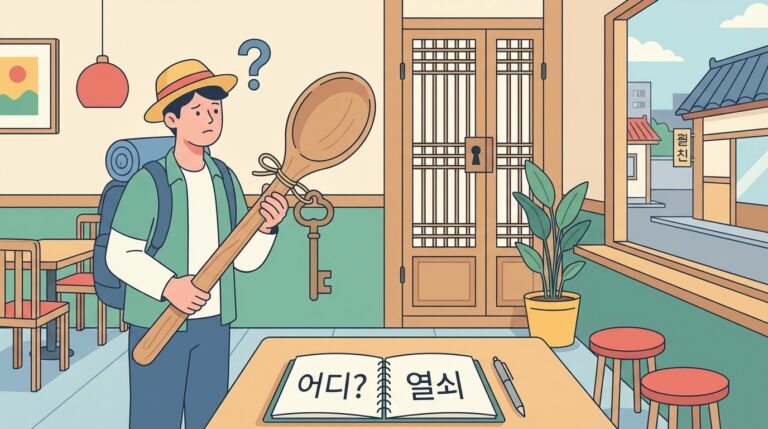
In K-Dramas, the main characters never seem to need the restroom, or they magically find it with perfect background music. But in reality? Korean restrooms, especially in older buildings or busy cafes, can be a bit like an escape room. You might need a physical key attached to a giant teddy bear, a 4-digit passcode, or even a roll of toilet paper from the counter!
If you don’t know how to navigate this situation, things can get very uncomfortable, very fast. This guide is built from the real “panic moments” of my students. Let’s learn how to ask for the restroom confidently and decode Korea’s unique bathroom culture!
Phase 2: Deep Dive into Core Expressions
Let’s look at the survival phrases you absolutely need.
1. 화장실이 어디예요?
- Pronunciation: hwajangsiri eodiyeyo? [hwa-jang-shil-ee uh-dee-ye-yo?]
- Meaning: Where is the restroom? (Literal & Real meaning)
- K-Culture Moment: You are at a crowded restaurant. The music is loud. You catch the waiter’s eye, point vaguely, and ask this phrase. It’s the ultimate survival question!
- Editor’s Insight: Hwajangsil literally means “makeup room.” If you say it with a slightly desperate but polite tone, Koreans will immediately point you in the right direction.
- Situation Spectrum:
[🚫 Never] ———— [⚠️ Caution] ———— [✅ Freely]
- Close Friends (Casual): ⚠️ (Use ‘어디야?’ instead)
- Staff/Strangers (Polite): ✅
- Boss/Elders (Formal): ✅ (Safe and polite enough)
- 🤔 Think About It: In English, we often soften it by saying “Could you tell me where the restroom is?” In Korean, the direct “Restroom where is it?” (with the polite ‘yo’ ending) is perfectly polite. Why do you think Korean values this directness in certain service situations?
2. 화장실 비밀번호가 뭐예요?
- Pronunciation: hwajangsil bimilbeonhoga mwoyeyo? [bee-meel-bun-ho-ga mwo-ye-yo?]
- Meaning: What is the restroom password?
- K-Culture Moment: You find the bathroom door in the building hallway, but there’s a glowing digital keypad. You must do the “walk of shame” back to the cafe to ask this question.
- Editor’s Insight: Bimil means secret, beonho means number. “Secret number!” Many cafes share a restroom with the rest of the building, so they lock it to keep it clean for paying customers only.
- Situation Spectrum:
[🚫 Never] ———— [⚠️ Caution] ———— [✅ Freely]
- Close Friends (Casual): ⚠️
- Cafe Staff (Polite): ✅
3. 휴지 있어요?
- Pronunciation: hyuji isseoyo? [hyoo-jee ees-suh-yo?]
- Meaning: Is there tissue/toilet paper?
- K-Culture Moment: The restaurant owner hands you the bathroom key and points to a roll of toilet paper sitting on the counter. Yes, you have to take it with you!
- Editor’s Insight: In older buildings, public restrooms might not stock toilet paper. It’s totally normal to see people walking through a restaurant holding a roll of tissue.
- Situation Spectrum:
[🚫 Never] ———— [⚠️ Caution] ———— [✅ Freely]
- Restaurant Staff (Polite): ✅
Phase 3: Textbook vs Real Korean
| Situation | 📖 Textbook Korean | 🗣️ Real Korean | 💡 Why the difference? |
|---|---|---|---|
| Asking a stranger | 화장실이 어디에 있습니까? | 저기요, 화장실 어디예요? | The “-습니까” ending is too stiff for daily life. “저기요(Excuse me)” gets attention first. |
| Asking a friend | 화장실이 어디에 있어? | 화장실 어디야? / 나 화장실 좀. | Friends drop particles completely for speed. “나 화장실 좀 (I need the restroom a bit)” leaves the verb out entirely! |
| Code on the receipt | 영수증 하단에 비밀번호가 있습니다. | 영수증 밑에 비밀번호 있어요. | Spoken Korean prefers native Korean words (밑 – bottom) over Sino-Korean words (하단). |
Phase 4: Cultural Context — K-Culture Deep Dive
4-1. Non-Verbal Nunchi (눈치)
When you ask the staff for the restroom, watch their hands. If they point toward the door, it’s inside. If they reach under the counter and hand you a giant wooden spoon, a plush toy, or a spatula with a single key attached to it… don’t be alarmed!
Because restrooms are often outside the restaurant in shared hallways, owners attach the tiny key to massive, funny objects so customers won’t accidentally put it in their pockets and steal it. Taking the “Giant Spoon of Bathroom Destiny” is a rite of passage for foreigners in Korea!
4-2. The “Cafe Password” Culture
If you order at a franchise cafe (like Mega Coffee, Ediya, or Compose Coffee), look closely at your printed receipt. At the very bottom, you will often see:
**[화장실 비밀번호] 남자: 1234* 여자: 5678***
You don’t even need to ask! The password is right there. This reflects Korea’s fast-paced Pali-pali (hurry up) culture—saving both you and the barista the time of talking.
Phase 5: Real-Life Roleplay Scenario
Setting: A rainy Saturday afternoon. You are at a cozy but crowded cafe in Seongsu-dong. You’ve had a lot of water, and you urgently need the restroom. You approach the busy barista.
Characters:
– YOU: A traveler trying to be polite but in a bit of a rush.
– Barista (Min-ji): Friendly, but multitasking making 3 lattes at once.
Dialogue:
YOU: 저기요, 화장실 어디예요? 🚻
(jeogiyo, hwajangsil eodiyeyo?)
[Excuse me, where is the restroom?]
Min-ji: 아, 화장실은 밖으로 나가서 오른쪽 건물 안에 있어요.
(a, hwajangsireun bakkeuro nagaseo oreunjjok geonmul ane isseoyo.)
[Ah, the restroom is outside, inside the building on the right.]
YOU: 아… 밖에 있어요?
(a… bakke isseoyo?)
[Ah… it’s outside?]
Min-ji: 네, 비밀번호 치고 들어가셔야 돼요.
(ne, bimilbeonho chigo deureogasyeoya dwaeyo.)
[Yes, you have to type the password to enter.]
YOU: 비밀번호가 뭐예요?
(bimilbeonhoga mwoyeyo?)
[What is the password?]
Min-ji: 영일이삼 별표예요. 휴지는 여기 카운터에서 챙겨가세요!
(yeong-il-i-sam byeolpyoyeyo. hyujineun yeogi kaunteoeseo chaenggyeogaseyo!)
[It’s 0-1-2-3-star. Please take tissue from the counter here!]
🔀 Your Turn! How do you react to the numbers?
– A) Just nod and walk away, hoping you remember “yeong-il-i-sam”.
– B) Confirm it: “공일이삼 별표 맞아요?” (0-1-2-3 star, right?)
– C) Hand over your phone: “여기에 적어주세요!” (Please write it here!)✅ Best Choice: B or C. Numbers can be tricky! Repeating it back (B) shows great Korean skills. If you are totally lost, handing them your phone to type it (C) is a very smart, practical survival move!
⚠️ Note on A: If you forget, you have to walk all the way back in the rain!
(🎭 Stage Direction: You grab a handful of tissues, type 0123* on the glowing keypad, and the door clicks open. Victory!)
Phase 6: 10-Second Shadowing Drill
Repeat after me to get the natural rhythm!
- 😊 Polite & clear:
저기요, / 화장실 / 어디예요?
(jeo-gi-yo, / hwa-jang-sil / eo-di-ye-yo?) -
🥺 A bit urgent & confused:
화장실 / 비밀번호가 / 뭐예요?
(hwa-jang-sil / bi-mil-beon-ho-ga / mwo-ye-yo?) -
🤔 Checking for supplies:
안에 / 휴지 / 있어요?
(an-e / hyu-ji / is-seo-yo?)
Phase 7: K-Culture Mini Dictionary
| Korean | Romanization | English | Context |
|---|---|---|---|
| 비밀번호 | bimilbeonho | Password | Usually a 4-digit code followed by an asterisk (* 별표). |
| 영수증 | yeongsujeung | Receipt | Often holds the key to the restroom password at the bottom. |
| 남녀 공용 | namnyeo gong-yong | Unisex | A shared bathroom for all genders. Common in older/smaller bars. |
| 도어락 | do-eo-rak | Door lock | The digital keypad on the door. Very common in Korea! |
| 별표 (*) | byeol-pyo | Star / Asterisk | Most Korean door locks require you to press * after the numbers. |
Phase 8: Traveler Survival Kit 🆘
When navigating locations in Korea, these are your lifesavers!
🆘 Survival Phrases TOP 3
1. 🇰🇷 “여기서 멀어요?” (yeogiseo meoreoyo?) – Is it far from here?
2. 🇰🇷 “지하철역이 어디예요?” (jihacheollyeogi eodiyeyo?) – Where is the subway station?
3. 🇰🇷 “영수증 버려주세요.” (yeongsujeung beoryeo-juseyo) – Please throw away the receipt. (Wait! If you need the restroom, keep it!)📌 Editor’s Travel Note
– Subway Restrooms: In Seoul, most subway stations have excellent, clean public restrooms. However, they are often located outside the ticket turnstiles. If you tapped in and realize you need to go, you can usually press the “Help” button near the gate to ask the staff to let you out and back in without paying twice!
– Public Restroom Apps: Naver Map and KakaoMap both have “화장실” (restroom) search features that will show you the nearest free public toilet.
Phase 9: Critical Thinking — “One Step Deeper”
🧠 Think Deeper: Media vs Reality (K-Drama vs Real Life)
If you watch K-Dramas, you might think every location in Korea is flawlessly designed, with spotless, perfectly integrated restrooms right next to the aesthetic cafe seating.
Reality is more complex. Because Seoul developed incredibly fast over a few decades, many trendy new businesses are housed in older buildings from the 1980s or 90s. The “aesthetic” cafe is just renting one room, while the plumbing is shared by the whole floor. This creates a fascinating contrast: you drink a beautifully crafted $6 latte, then take a physical key tied to a plastic spoon to a slightly worn-out staircase to use the restroom. It’s the true charm of Seoul—a city where hyper-modernity and older, practical infrastructure exist side by side.
💬 Your Turn: Does your country have public restrooms everywhere, or do you have to buy something at a cafe to use them? Share your culture in the comments!
Phase 10: FAQ & Avoiding Mistakes
Q: Can I just ask “어디야?” (eodiya) to be friendly?
No! Unless the person is your close friend of the same age or younger, dropping the “요 (yo)” sounds rude to strangers. Always stick to “어디예요?”
Q: What if I don’t know how to read Korean numbers for the password?
Don’t panic! You can politely hand them a piece of paper or your phone, or just point to the receipt and ask “비밀번호… (bimilbeonho…)”. They will write or point it out for you.
❌ Common Mistake #1: Leaving the cafe without checking if you need the key.
✅ Do this instead: Look at the counter near the door. If there’s a big, funny object with a key, grab it! Or simply ask: “열쇠가 필요해요?” (Do I need a key?)
Phase 11: Summary & Action Items
One-Liner Summary: To find the restroom like a local, ask “화장실 어디예요?” and don’t forget to check for the 비밀번호 (password) or the giant key!
Action Mission 3 Steps:
– 🥉 Bronze (Solo): Stand in your room, point to your door, and say “화장실 어디예요?” 3 times naturally.
– 🥈 Silver (Online): Go to Google Images, search “한국 영수증” (Korean receipt), and see if you can spot the word “비밀번호”.
– 🥇 Gold (Real Life): Next time you are at a Korean restaurant or cafe, find the restroom on your own using these phrases!
Phase 12: Quiz — Interactive Challenge
1. You find a restroom door in a Korean building, but it won’t open. There is a digital number pad. What should you ask the staff?
A) 화장실 어디예요?
B) 화장실 비밀번호가 뭐예요?
C) 영수증 있어요?
2. True or False: In Korea, it’s considered very rude to take toilet paper from the restaurant counter into the bathroom.
– (T / F)
3. Fill in the blank: Excuse me, where is the restroom?
– ________, 화장실 어디예요?
(Answers below!)
Click to see answers!
1. B (You need the password!)
2. False (It is completely normal and often required in older buildings!)
3. 저기요 (Jeogiyo)
Frequently Asked Questions (FAQ)
Q: What does "화장실이 어디예요?" mean in Korean and how do you pronounce it?
A: In Korean, "화장실이 어디예요?" is pronounced [hwajangsiri eodiyeyo? [hwa-jang-shil-ee uh-dee-ye-yo?] and means: Where is the restroom? (Literal & Real meaning)
Q: What does "화장실 비밀번호가 뭐예요?" mean in Korean and how do you pronounce it?
A: In Korean, "화장실 비밀번호가 뭐예요?" is pronounced [hwajangsil bimilbeonhoga mwoyeyo? [bee-meel-bun-ho-ga mwo-ye-yo?] and means: What is the restroom password?
Q: What does "휴지 있어요?" mean in Korean and how do you pronounce it?
A: In Korean, "휴지 있어요?" is pronounced [hyuji isseoyo? [hyoo-jee ees-suh-yo?] and means: Is there tissue/toilet paper?







