

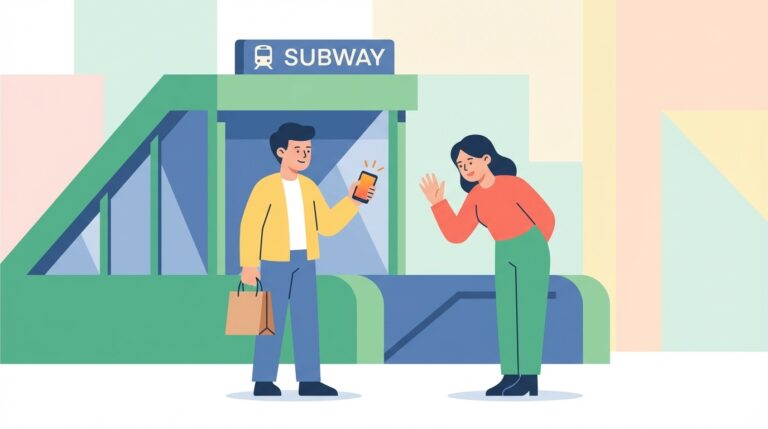
Phase 1: Empathy (The Awkward Subway Encounter)
Hello! I’m the Senior Editor at Daily Hangul, your personal cultural navigator.
Imagine this: You are standing at Exit 3 of Gangnam Station. The street is bustling, but you are completely still, awkwardly making eye contact with every passing stranger who happens to be holding a small paper bag. It feels exactly like a secret agent drop-off scene from a K-Drama. You step forward, your heart beats faster, and you wonder: “Is that the person who is selling me the BTS photocard? What do I even say?”
If you live in or visit Korea, using second-hand apps like Karrot Market (당근마켓 – Danggeun Market) is a rite of passage. But meeting a complete stranger for an in-person transaction (직거래) can be terrifying if you don’t know the secret “passcode.”
Don’t worry! This guide is built from the real experiences of my beginner students who once panicked at subway exits. Today, we’ll learn the magic phrases that will make you look like a confident, trusted local buyer.
Phase 2: Core Expressions Deep Dive
Let’s look at the top 3 survival phrases you need for an in-person trade.
1. 혹시 당근이세요?
- Pronunciation: hok-shi dang-geun-i-se-yo? (Sound trick: ‘으/eu’ sounds like the disgusted noise you make when you step in chewing gum! Dang-gEUn!)
- Meaning: (Literal) Are you a carrot by any chance? vs (Real) Are you the seller/buyer from the Karrot app?
- K-Culture Moment: Picture a quiet neighborhood park. Two people tentatively walk toward each other, looking at their phones. One finally breaks the silence with a soft bow: “Hokshi… Danggeun?” It’s the ultimate icebreaker.
- Editor’s Insight: You only use this for the app “Danggeun Market” (which means carrot). It feels like a secret password between locals. It’s polite, a bit shy, and very friendly.
- Situation Spectrum:
[🚫 Never] ———— [⚠️ Caution] ———— [✅ Freely]
- Strangers on the app (All ages): ✅
- In a regular store: 🚫 (They will be very confused!)
- 🤔 Think About It: Why do Koreans use the app’s name instead of just saying “Are you here to trade?” Does your country have an app that became a verb or a daily phrase?
2. 이거 맞아요?
- Pronunciation: i-geo ma-ja-yo?
- Meaning: (Literal) Is this correct? vs (Real) Is this the right item/amount?
- K-Culture Moment: When the seller hands you the K-Pop album, or when you hand them the cash. You say this to double-check. It shows you are careful but polite.
- Editor’s Insight: This is a super-versatile survival phrase! You can use it anywhere in Korea—at a cafe, buying a ticket, or trading goods.
- Situation Spectrum:
[🚫 Never] ———— [⚠️ Caution] ———— [✅ Freely]
- Second-hand trader (Stranger): ✅
- Cashier at a mart: ✅
3. 여기 있어요.
- Pronunciation: yeo-gi i-sseo-yo.
- Meaning: (Literal/Real) Here it is. / Here you go.
- K-Culture Moment: You say this right as you are handing the cash or the item over. In K-Dramas, you’ll see characters handing over a mysterious USB drive saying this.
- Editor’s Insight: Handing things over in silence can feel a bit rude in Korea. Adding this short phrase fills the gap nicely.
- Situation Spectrum:
[🚫 Never] ———— [⚠️ Caution] ———— [✅ Freely]
- Anyone you are giving something to: ✅
Phase 3: Textbook vs. Real Korean
| Situation | 📖 Textbook Korean | 🗣️ Real Korean | 💡 Why is it different? |
|---|---|---|---|
| Meeting the person | 중고 거래 하러 오셨나요? (Did you come for the second-hand trade?) | 혹시 당근이세요? (Are you Karrot?) | Efficiency! Naming the app instantly confirms you both are at the right place. |
| Handing over cash | 제 돈을 받으세요. (Please accept my money.) | 현금 여기 있어요. (Here is the cash.) | Textbook phrases are often too dramatic. Real Korean is short and practical. |
| Saying Goodbye | 안녕히 계십시오. (Farewell.) | 감사합니다~ 안녕히 가세요! (Thanks~ Bye!) | Casual politeness is preferred over rigid, formal endings in street encounters. |
Phase 4: Cultural Context — K-Culture Deep Dive
4-1. The “Karrot Market Bow” (Non-verbal Magic)
In Korea, body language speaks volumes. When you meet your trading partner, do not go in for a handshake or a hug! Instead, perform the “Karrot Bow”—a slight 15-degree nod of the head while saying “Hokshi Danggeun…?” Also, always use two hands when receiving the item or handing over the cash. It shows respect and good Nunchi (social awareness).
4-2. The Spy Movie Trope in Reality
If you watch K-Dramas like Crash Landing on You or action thrillers, secret exchanges always happen in underground parking lots. Interestingly, real-life second-hand trades feel like mini spy missions! You get a location pin, a time, and a brief description (“I am wearing a black padded jacket”).
Critical View: While K-Dramas make strangers seem dangerous, Korea is incredibly safe. In fact, people often trade high-value items like laptops in broad daylight with zero fear of theft.
Phase 5: Interactive Roleplay Scenario
Setting: Friday, 7 PM. Exit 10 of Gangnam Station. It’s crowded. You are holding a 10,000 won bill. You are here to buy a rare photocards of your favorite K-Pop idol.
Characters:
– YOU: A foreign K-Pop fan who just started learning Korean.
– Minji (20s): The local seller. She looks like a university student and is holding a small envelope.
Dialogue:
YOU: (Approaching cautiously with a slight bow) 🙋♂️ 혹시 당근이세요?
(hok-shi dang-geun-i-se-yo?)
[By any chance, are you Karrot?]
Minji: 아, 네! 맞아요. 앨범 사시는 분?
(a, ne! ma-ja-yo. ael-beom sa-si-neun bun?)
[Ah, yes! That’s right. The person buying the album?]
YOU: 네, 맞아요!
(ne, ma-ja-yo!)
[Yes, that’s right!]
(🎭 Stage Direction: Minji hands you the envelope with two hands.)
Minji: 여기 있어요. 확인해 보세요.
(yeo-gi i-sseo-yo. hwa-gin-hae bo-se-yo.)
[Here it is. Please check it.]
🔀 YOUR TURN! How do you respond?
– A) (Without looking inside) “감사합니다! 안녕히 가세요!” (Thanks, bye!)
– B) (Quickly checking the card) “아, 맞아요. 현금 여기 있어요.” (Ah, it’s correct. Here is the cash.)
– C) “오 마이 갓! 대박! 사랑해요!” (Oh my god! Daebak! I love you!)✅ Best Choice: B — Always quickly verify the item! It’s totally expected and not rude at all. Then politely hand over the cash.
⚠️ Choice A Analysis: It’s okay, but if the item is wrong, you can’t refund it later!
⚠️ Choice C Analysis: Save the “I love you” for the idol, not the Karrot seller! You might scare Minji away.
YOU: (After picking B) 현금 여기 있어요.
(hyeon-geum yeo-gi i-sseo-yo.)
[Here is the cash.]
Minji: 네, 감사합니다. 좋은 하루 보내세요~
(ne, gam-sa-ham-ni-da. jo-eun ha-ru bo-nae-se-yo~)
[Yes, thank you. Have a good day~]
YOU: 감사합니다! 안녕히 가세요.
(gam-sa-ham-ni-da! an-nyeong-hi ga-se-yo.)
[Thank you! Goodbye.]
Phase 6: 10-Second Shadowing Drill
Practice these lines out loud. Pay attention to the pauses (/) and the emotion tags!
- 🥺 (Slightly shy) 혹시 / 당근이세요?
(hok-shi / dang-geun-i-se-yo?) - 😊 (Brightly) 아, 네! / 맞아요.
(a, ne! / ma-ja-yo.) - 🤝 (Polite & Grateful) 감사합니다 / 안녕히 가세요!
(gam-sa-ham-ni-da / an-nyeong-hi ga-se-yo!)
Phase 7: K-Culture Mini Dictionary
| Korean | Romanization | English | Context |
|---|---|---|---|
| 직거래 | jik-geo-rae | In-person trade | Meeting face-to-face to exchange money and goods without a delivery service. |
| 당근마켓 | dang-geun-ma-ket | Karrot Market | Korea’s #1 hyper-local second-hand trading app. |
| 쿨거래 | kul-geo-rae | Cool trade | A fast, no-nonsense transaction without endless questions or bargaining. Koreans LOVE this. |
| 매너온도 | mae-neo-on-do | Manner temperature | A rating system in the Karrot app starting at 36.5°C. Good trades increase your temperature! |
Phase 8: Traveler Survival Kit
Even if you are just traveling and not using the Karrot app, “in-person trading” skills are exactly what you need when shopping at Korean street markets (like Gwangjang Market or Namdaemun)!
🆘 Survival Phrases for Street Markets
– 🇰🇷 “이거 얼마예요?” (i-geo eol-ma-ye-yo?)
– [How much is this?]
– 🇰🇷 “현금만 되나요?” (hyeon-geum-man doe-na-yo?)
– [Do you only take cash?]
– 🇰🇷 “조금만 깎아 주세요~” (jo-geum-man kka-kka ju-se-yo~)
– [Please give me a small discount~]📌 Editor’s Travel Note
– Payment: Korea is a cashless society, BUT for street markets, food stalls, and second-hand trades, cash is king. Always carry around 20,000~30,000 won in physical bills.
– Haggling: Do not haggle in department stores or convenience stores. Haggling is only acceptable at traditional markets or on second-hand apps (and only if the app listing allows it!).
Phase 9: Critical Thinking — A Step Deeper
Language & Power: The “High-Trust” Society
Have you ever wondered why Koreans are so comfortable meeting complete strangers on a street corner to exchange cash for a used smartphone? It reflects Korea’s status as a High-Trust Society (고신뢰 사회).
Because of the extensive CCTV network and cultural emphasis on collective harmony, crime rates like mugging are incredibly low. This safety creates a unique cultural phenomenon where a community app can thrive purely on mutual trust. The polite language we use during these trades (“Is this correct?”, “Thank you”) acts as a social glue to maintain that peace.
💬 Your Turn: Would you feel safe doing an in-person cash trade with a stranger in your hometown? How do people usually trade used items in your culture? Tell us in the comments!
Phase 10: FAQ & Avoiding Mistakes
Q: Can I ask for a discount when we meet face-to-face?
A: No! In Korean Danggeun culture, all negotiations (Nego / 네고) should be done inside the app chat before you meet. Asking for a discount at the meeting spot is considered very bad manners (it drops your Manner Temperature!).
Q: Should I shake hands after the trade?
A: No, physical contact is generally avoided with strangers. A simple bow and “Thank you” is perfect.
❌ Common Mistake #1: Using casual language (Banmal / 반말) just because the seller looks young or you are doing a casual trade.
✅ Do this instead: ALWAYS use polite language (존댓말) with strangers, even if they are selling a $2 sticker. “고마워 (Thanks)” 🚫 -> “감사합니다 (Thank you)” ✅
Phase 11: Summary & Action Items
One-Liner Summary: When trading in person, remember the secret password: “Hokshi Danggeun-iseyo?” and always double-check the item!
Your Action Missions:
– 🥉 Bronze (Solo): Stand in front of a mirror, bow slightly, and practice saying “혹시 당근이세요?” 3 times.
– 🥈 Silver (Online): Comment below with what you would want to buy on a Korean second-hand app!
– 🥇 Gold (Real World): Next time you hand cash to a cashier or a friend, try saying “여기 있어요 (Here it is).”
K-Culture Mission: Go to YouTube and search “당근마켓 직거래 브이로그” (Karrot Market Trade Vlog). Watch just one minute to see how real Koreans act and sound during these meetings!
Phase 12: Interactive Quiz
1. Fill in the Blank:
You are handing 10,000 won to the seller. What should you say?
“현금 _______.”
(Hint: It means ‘Here it is’)
2. True or False – K-Culture Edition:
It is completely normal to hug the seller if they give you a free extra item (an “덤 / service”) during the trade. (T / F)
3. Situational Judgment:
You meet the seller, but you are not 100% sure it’s them. What is the most natural Korean icebreaker?
A) “이름이 뭐예요?” (What is your name?)
B) “당근마켓에서 왔습니까?” (Did you come from Karrot Market?)
C) “혹시 당근이세요?” (Are you Karrot by any chance?)
👉 Click to see the answers!
- 여기 있어요 (yeo-gi i-sseo-yo)
- False! Personal space is very important. Even if you are thrilled, just give a deeper bow and express your thanks verbally: “와, 진짜 감사합니다!” (Wow, really thank you!)
- C! It’s the most natural, native-sounding icebreaker for this exact situation.
Frequently Asked Questions (FAQ)
Q: What does "혹시 당근이세요?" mean in Korean and how do you pronounce it?
A: In Korean, "혹시 당근이세요?" is pronounced [hok-shi dang-geun-i-se-yo? (Sound trick: '으/eu' sounds like the disgusted noise you make when you step in chewing gum! Dang-gEUn!] and means: (Literal) Are you a carrot by any chance? vs (Real) Are you the seller/buyer from the Karrot app?
Q: What does "이거 맞아요?" mean in Korean and how do you pronounce it?
A: In Korean, "이거 맞아요?" is pronounced [i-geo ma-ja-yo?] and means: (Literal) Is this correct? vs (Real) Is this the right item/amount?
Q: What does "여기 있어요." mean in Korean and how do you pronounce it?
A: In Korean, "여기 있어요." is pronounced [yeo-gi i-sseo-yo.] and means: (Literal/Real) Here it is. / Here you go.






