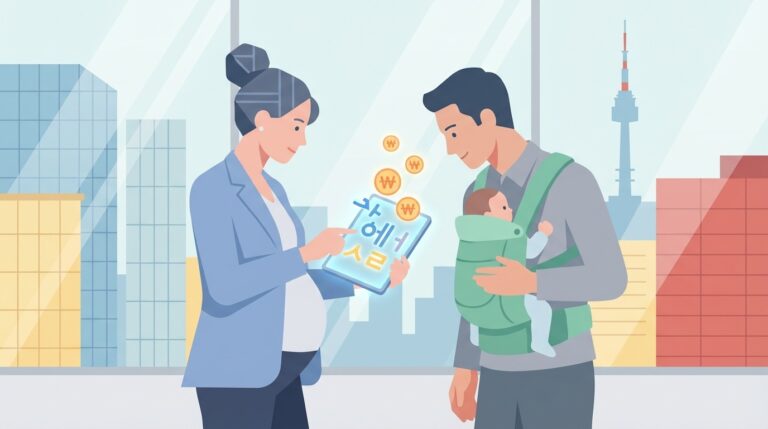
Phase 1: Empathy (Welcome to the K-Office Reality)
Hello! This is your Daily Hangul Editor.
Picture this K-Drama scene: The protagonist, a dedicated employee, nervously approaches the HR department (인사팀). The upbeat background music stops. They hand over a document, and the manager sighs deeply. The subtitles might just say, “I’m taking a leave,” but anyone working in Korea knows the sheer amount of nunchi (눈치, reading the room) required for that exact moment.
If you’re building a life in Korea at a C2 level, you’ve likely moved past ordering coffee and are now tackling ‘adulting’—like family planning. Navigating Parental Leave (육아휴직) and the uniquely Korean Post-Payment System (사후지급금) isn’t just about language; it’s about understanding Korea’s corporate culture and government policies designed to keep people in the workforce.
Let’s dive into the vocabulary that will ensure you don’t lose out on millions of won just because of a bureaucratic misunderstanding!
Phase 2: Core Expressions Deep Dive
1. 육아휴직 (Parental Leave)
- Pronunciation: [yuga-hyujik] (‘yoo-gah’ sounds like yoga with a U, ‘hyoo-jik’ has a sharp J sound at the end)
- Meaning: Literal: Childcare leave of absence. Real nuance: A legally protected leave for parents, though historically laden with workplace pressure.
- K-Culture Moment: Think of dramas like Misaeng. When a female employee gets pregnant, there’s often a whispered conversation in the pantry. Nowadays, the culture is shifting, and you’ll even hear about 아빠 육아휴직 (Paternity Leave), which is highly encouraged by the government but still takes some courage to use in conservative companies.
- Editor’s Insight: You don’t just ‘take’ this; you ‘enter’ it (들어간다) or ‘apply’ for it (신청한다).
- Situation Spectrum:
[🚫 절대 금지] ———— [⚠️ 주의] ———— [✅ 자유롭게]
- Casual with friends: ✅ “나 내년부터 육아휴직 하려고.” (I’m planning to take parental leave next year.)
- Semi-formal (Co-workers): ✅ “저 다음 달에 육아휴직 들어갑니다.” (I’m going on parental leave next month.)
- Formal (Boss): ⚠️ “팀장님, 육아휴직 신청 관련해서 면담 부탁드립니다.” (Boss, I’d like to request a meeting regarding my parental leave application.) Always ask for a private meeting first!
- 🤔 Think About It: Why do Koreans use the word “휴직” (pausing work) instead of a word that focuses on the family aspect? It highlights the strong corporate-centric mindset of traditional Korean society.
2. 사후지급금 (Post-Payment / Retention Bonus)
- Pronunciation: [sahu-jigeup-geum] (‘sah-hoo’ meaning after, ‘jee-geup’ meaning payment, ‘geum’ meaning money)
- Meaning: Literal: After-payment money. Real nuance: The 25% of your government parental leave allowance that is deliberately withheld. You only receive it in a lump sum six months after you return to work.
- K-Culture Moment: This is the ultimate “golden handcuffs” of Korean family planning. In mom cafes (맘카페) and expat forums alike, this is the #1 topic of confusion. People constantly ask, “Wait, why is my allowance less than expected?”
- Editor’s Insight: This word feels very bureaucratic. You won’t use it at a BBQ joint, but you must know it when looking at your bank account.
- Situation Spectrum:
[🚫 절대 금지] ———— [⚠️ 주의] ———— [✅ 자유롭게]
- Used exclusively in administrative contexts, HR discussions, and government portals. ✅
- 🤔 Think About It: Does your home country withhold benefits to ensure you return to your employer? This system reflects the Korean government’s aggressive strategy to prevent women from dropping out of the workforce entirely after childbirth (a phenomenon known as 경력단절 – career interruption).
3. 복직하다 (To Return to Work)
- Pronunciation: [bok-jik-hada] (‘bok’ rhymes with poke, ‘jik’ rhymes with peek but shorter)
- Meaning: Literal: Restore job. Real nuance: Officially returning to your position after a leave.
- K-Culture Moment: When K-Pop idols return from military service, we say they are ‘discharged’ (제대하다). But when an office worker returns from parental leave, they ‘복직하다’. Your colleagues will constantly ask, “언제 복직하세요?” (When are you coming back?)
- Editor’s Insight: It’s a heavy word that carries the expectation of resuming your full workload seamlessly.
Phase 3: Textbook vs. Real Korean
| Situation | 📖 Textbook Korean | 🗣️ Real Korean | 💡 Why the Difference? |
|---|---|---|---|
| Telling a friend you’re on leave | 저는 육아휴직 중입니다. (I am on childcare leave.) | 나 지금 육휴 중이야. (I’m on yuk-hyu right now.) | Koreans love abbreviating 4-syllable words. ‘육휴’ (yuk-hyu) is the ultimate office slang for parental leave. |
| Asking about the withheld money | 남은 지원금은 언제 받을 수 있나요? (When can I receive the remaining support funds?) | 사후지급금 언제 들어와요? (When does the post-payment hit my account?) | ‘들어오다’ (to come in) is the standard native way to talk about money being deposited. |
| Planning to return | 6개월 뒤에 다시 회사로 돌아갑니다. (I am returning to the company in 6 months.) | 6개월 뒤에 복직해요. (I’m reinstating in 6 months.) | Using the exact Sino-Korean HR term (복직) sounds much more professional and natural for adults. |
Phase 4: Cultural Context — K-Culture Deep Dive
4-1. The Non-Verbal ‘Nunchi’ of Taking Leave
Applying for leave in Korea isn’t just about clicking a button on an HR portal. It requires a highly choreographed sequence of Nunchi (눈치). You must first casually mention your family plans to a trusted senior, then formally request a 1-on-1 meeting (면담) with your department head. Only after getting verbal blessing do you submit the paperwork. Bypassing this unspoken hierarchy is considered a major faux pas.
4-2. The ‘Latte’ Bosses vs. The MZ Generation
In many modern K-Dramas like Work Later, Drink Now, you’ll see a clash of generations. Older bosses (often mocked with the phrase “라떼는 말이야” – ‘Latte is a horse’, a pun on ‘Back in my day’) might expect employees to prioritize the company over family. However, the MZ generation fiercely protects their work-life balance (워라밸). The rise of ‘아빠 육아휴직’ (Dad’s parental leave) is a direct result of this cultural shift. While older dramas showed moms quitting, newer media celebrates dual-income (맞벌이) couples successfully navigating the system.
Phase 5: Real-Life Roleplay Scenario
Setting: A quiet corner of your company’s breakroom. You’re holding a paper cup of instant Maxim coffee. You need to figure out the HR system, so you ask your trusted Korean colleague, Min-su, for advice.
Characters:
– YOU: A C2-level expat who is expecting a child soon and wants to maximize benefits without angering the boss.
– Min-su (34): Your friendly senior colleague who just returned from his own paternity leave last year.
Dialogue:
Min-su: 요즘 안색이 피곤해 보이네요. 무슨 일 있어요? ☕
(yojeum ansaegi pigonhae boineyo. museun il isseoyo?)
[You look tired lately. Is everything okay?]
YOU: 아, 실은 아내가 곧 출산이라서요. 저도 육아휴직을 쓸까 고민 중입니다.
(a, sireun anaega got chulsaniraseoyo. jeodo yugahyujigeul sseulkka gomin jung-imnida.)
[Ah, actually my wife is due soon. I’m thinking about taking parental leave too.]
Min-su: 오, 축하해요! 당연히 써야죠. 요새는 아빠들도 다 쓰는 추세잖아요. 기간은 얼마나 생각하고 있어요?
(o, chukahaeyo! dangyeonhi sseoyajyo. yosaeneun appadeuldo da sseuneun chusejanayo. giganeun eolmana saenggakhago isseoyo?)
[Oh, congratulations! Of course you should take it. It’s the trend for dads to take it these days. How long are you thinking?]
YOU: 한 6개월 정도 생각하고 있는데, 팀장님께 언제 말씀드리는 게 좋을까요?
(han yuk-gaewol jeongdo saenggakhago inneunde, timjangnimkke eonje malsseumdeurineun ge joeulkkayo?)
[I’m thinking about 6 months, but when should I tell the manager?]
(🎭 Stage Direction: Min-su looks around to make sure no one is listening)
Min-su: 음, 적어도 3개월 전에는 면담을 잡는 게 좋아요. 그래야 인수인계 준비를 하니까요. 아, 그리고 급여 신청할 때 사후지급금 있는 거 알죠?
(eum, jeogeodo sam-gaewol jeoneneun myeondameul jamneun ge joayo. geuraeya insuingye junbireul hanikkayo. a, geurigo geubyeo sincheonghal ttae sahujigeupgeum inneun geo aljyo?)
[Well, you should schedule a meeting at least 3 months in advance. That way they can prepare for the handover. Oh, and you know about the post-payment when you apply for the allowance, right?]
🔀 Your Turn! How do you respond?
– A) “사후지급금이요? 그게 뭐예요? 회사가 돈을 안 준다는 건가요?” (Post-payment? What’s that? The company isn’t paying me?)
– B) “네, 복직하고 6개월 뒤에 남은 25%를 한 번에 받는 제도 맞죠?” (Yes, that’s the system where I get the remaining 25% in a lump sum 6 months after reinstating, right?)
– C) “대박! 돈을 뺏어가는 거예요? 완전 어이없네!” (Awesome/Crazy! They steal my money? That’s ridiculous!)✅ Best Choice: B — Reason: As a C2 speaker in a corporate setting, showing you’ve done your research using the exact terms (복직, 25%) earns massive respect. Min-su will see you as a fully adapted local.
⚠️ Choice A & C Analysis: ‘A’ shows a common misunderstanding (the government pays this, not the company). ‘C’ is way too casual and emotional for an office setting, even with a friendly colleague.
Min-su: 맞아요! 복직하고 6개월 버티면 꽤 큰 목돈이 들어오니까, 꼭 챙기세요!
(majayo! bokjikhago yuk-gaewol beotimyeon kkwae keun mokdoni deureoonikka, kkok chaenggiseyo!)
[Exactly! If you endure 6 months after returning, a pretty big lump sum comes in, so make sure to claim it!]
Phase 6: 10-Second Shadowing Drill
Master the natural intonation to sound like a native Korean professional!
😤 단호하게 (Firmly but politely)
팀장님, / 저 / 다음 달부터 / 육아휴직에 / 들어가고자 합니다.
(timjangnim, / jeo / da-eum dal-buteo / yuga-hyujige / deureogagoja hamnida.)
🤔 궁금하게 (Curiously)
사후지급금은 / 복직 후 / 언제쯤 / 입금되나요?
(sahu-jigeup-geumeun / bokjik hu / eonjejjeum / ipgeumdoenayo?)
Phase 7: K-Culture Mini Dictionary
| Korean | Romanization | English | Contextual Meaning |
|---|---|---|---|
| 눈치 | nunchi | Reading the room | The unspoken social sense required to know when to submit your leave form without upsetting your team. |
| 인수인계 | insu-ingye | Handover | Transferring your duties to a colleague before your leave. Crucial for good office karma. |
| 복직 | bokjik | Reinstatement | Returning to your exact job position after your leave ends. |
| 워라밸 | worabael | Work-Life Balance | Konglish abbreviation of Work-Life Balance. The core philosophy of younger Korean workers. |
| 고용보험 | goyong-boheom | Employment Insurance | The government entity that actually pays your parental leave allowance, NOT your company. |
Phase 8: Bureaucratic Survival Kit (Gov App Edition)
Even if you aren’t traveling, navigating the Korean bureaucratic web is a journey in itself. Here are the survival phrases for dealing with the Employment Insurance Center (고용센터).
🆘 Survival Phrases for the Gov Hotline (1350)
– 🇰🇷 “육아휴직 급여 신청하려는데요, 사후지급금 조건이 어떻게 되나요?”
– 🗣️ (yugahyujik geubyeo sincheongharyeoneundeyo, sahujigeupgeum jogeoni eotteoke doenayo?)
– 📍 Where to use: Calling the Ministry of Employment and Labor (MoEL).
– 💡 Pro Tip: When you call Korean government hotlines, press ‘9’ or listen for “외국어 서비스” (Foreign Language Service) if you want to double-check complex terms in English, though using Korean will often get you faster results.📌 Editor’s Administrative Note
– Useful Apps: 고용보험 (Employment Insurance Mobile App) and 정부24 (Gov24).
– Digital ID: You absolutely need a 공동인증서 (Public Certificate) or a PASS app set up on your phone to apply for these benefits online.
– Fact Check: Your company must process the ‘Confirmation of Leave’ (육아휴직 확인서) first before you can apply for the allowance on the app!
Phase 9: Critical Thinking Corner — “One Step Deeper”
Language & Power: The Bureaucracy of Motherhood and Fatherhood
Why does a concept like 사후지급금 (Post-payment) even exist? It’s deeply tied to Korea’s critical socio-economic issue: 저출산 (Low Birth Rate). In the past, many women experienced 경력단절 (career interruption) due to immense corporate pressure. They would take leave and never return. The government introduced the 25% post-payment system as an incentive—a financial hook—to ensure mothers (and increasingly fathers) return to their desks. The language used in these policies—allowances, reinstatements, withholdings—reveals a society desperately trying to mathematically balance capitalist productivity with human reproduction.
💬 Your Turn: Does your home country have financial mechanisms designed to force employees back to work after having a child? Or is the burden placed entirely on the company? Share your thoughts in the comments!
Phase 10: FAQ & Mistake Prevention
❌ Common Mistake #1: Asking your boss, “회사가 육아휴직 급여를 언제 주나요?” (When is the company giving me the leave pay?)
✅ Correction: The government (Employment Insurance) pays it! Your company just submits the confirmation. Say: “고용센터에 신청서 언제 낼 수 있나요?” (When can I submit the application to the employment center?)
K-Culture FAQ:
Q: “Is it true that taking paternity leave (아빠 육아휴직) will ruin my chances of promotion?”
A: Five years ago, maybe. Today? Major conglomerates (대기업) actively force male employees to take it to improve their ESG scores! However, in smaller SMEs (중소기업), nunchi is still very much required.
Q: “If I quit 5 months after returning, do I get a prorated post-payment?”
A: No. It’s strictly 6 months. If you quit at 5 months and 29 days, you lose the entire 25% lump sum. Welcome to Korean bureaucracy!
Phase 11: Summary & Action Items
- One-Liner Summary: To successfully navigate family planning in Korea, master the bureaucratic vocabulary like 육아휴직 (Parental Leave) and properly claim your withheld 사후지급금 (Post-payment) after 6 months of 복직 (reinstatement).
-
Action Mission:
- 🥉 Bronze (Solo): Read the shadowing drill out loud 3 times, focusing on the professional, firm tone.
- 🥈 Silver (Online): Go to a Korean expat forum or a Mom cafe and search the keyword “사후지급금”. Read one post to see native speakers panicking about it just like expats do!
- 🥇 Gold (Real World): If you or a colleague are expecting, casually use the slang “육휴” in a congratulatory sentence: “육휴 언제부터 들어가세요?” (When are you starting your yuk-hyu?)
Phase 12: Quiz — Interactive Challenge
1. Situational Judgment:
You have just returned to work after 1 year of parental leave. You want to know when your remaining 25% money will arrive. Who do you ask, and what do you say?
– A) Ask the CEO: “제 사후지급금 주실 때가 되지 않았나요?”
– B) Call the Employment Center: “복직한 지 6개월이 지났는데, 사후지급금 신청은 어떻게 하나요?”
– C) Ask HR: “저 육휴 들어갑니다.”
2. True or False — K-Culture Edition:
– In Korea, your monthly salary is paid in full by your employer while you are on parental leave. (T/F)
3. Fill in the Blank:
“나 다음 달에 회사로 돌아가. 드디어 _____ 하네.”
(I’m going back to the company next month. Finally _____.)
🚨 Click here for the answers!
- B is correct. The government (Employment Center) handles the post-payment (사후지급금), and you must apply for it after completing 6 months of reinstatement (복직). A is wrong because the CEO doesn’t pay it. C means “I am starting my leave.”
- False. Your employer stops paying your salary. You receive a capped allowance from the government’s Employment Insurance (고용보험).
- 복직 (bokjik – reinstatement).
Frequently Asked Questions (FAQ)
Q: What does "육아휴직 (Parental Leave)" mean in Korean and how do you pronounce it?
A: In Korean, "육아휴직 (Parental Leave)" is pronounced [yuga-hyujik] and means: Literal: Childcare leave of absence. Real nuance: A legally protected leave for parents, though historically laden with workplace pressure.
Q: What does "사후지급금 (Post-Payment / Retention Bonus)" mean in Korean and how do you pronounce it?
A: In Korean, "사후지급금 (Post-Payment / Retention Bonus)" is pronounced [sahu-jigeup-geum] and means: Literal: After-payment money. Real nuance: The 25% of your government parental leave allowance that is deliberately withheld. You only receive it in a lump sum six months after you return to work.
Q: What does "복직하다 (To Return to Work)" mean in Korean and how do you pronounce it?
A: In Korean, "복직하다 (To Return to Work)" is pronounced [bok-jik-hada] and means: Literal: Restore job. Real nuance: Officially returning to your position after a leave.