

Phase 1: Empathy (The K-Culture Cold Open)
Hello! I’m your Daily Hangul Editor, your veteran tutor and local culture navigator.
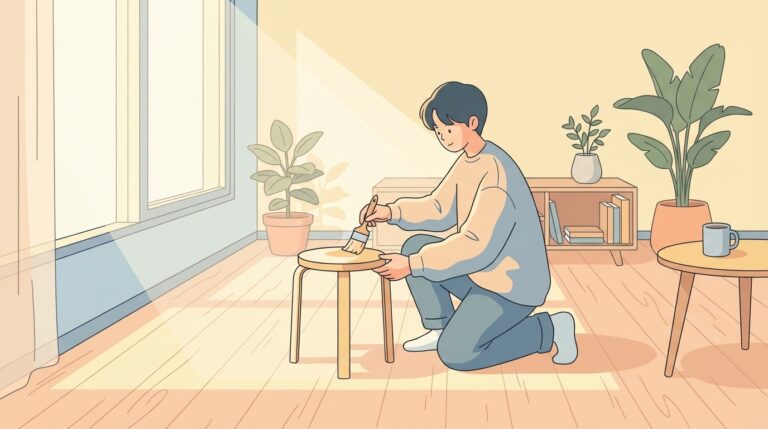
Imagine this: You are watching a K-vlog on YouTube. Your favorite idol or a trendy Korean influencer is standing in a tiny, slightly outdated studio apartment. They roll up their sleeves, tie their hair back, and start transforming a discarded wooden stool into a vintage masterpiece. Or maybe you remember that classic K-Drama scene where the leads playfully splash paint on each other while decorating their new newlywed home.
As a C1 learner, you probably already know how to say “I like this color” (이 색깔이 좋아요). But what if you decide to visit one of the trendy one-day woodworking classes in Seongsu-dong? If the instructor tells you, “결을 살려서 덧칠해 주세요,” would you know what to do?
In Korea, the “Self-Interior” (셀프 인테리어) trend is massive. Young Koreans love customizing their spaces, and furniture DIY is a huge part of it. Today, we’re moving past textbook vocabulary and diving into the real, hands-on Korean expressions used in woodworking, painting, and varnishing. Trust me, knowing these will instantly upgrade your Korean from ‘classroom student’ to ‘local workshop artisan.’ Let’s dive in!
Phase 2: Core Expressions Deep Dive
Here are the top advanced expressions you absolutely need when handling paint and varnish in a Korean workshop.
1. 얇게 덧칠하다
- Pronunciation: [yal-ge deot-chil-ha-da] (Think of yal like ‘y’ + ‘al’ in ‘Al’ and deot sounding like ‘dot’ but with an ‘uh’ vowel).
- Meaning: (Literal) To paint over thinly. (Real nuance) To apply multiple thin coats/layers.
- K-Culture Moment: If you watch a Korean DIY YouTube channel, you will hear this non-stop. Koreans are famous for their “Bbali-bbali” (hurry-hurry) culture, but when it comes to painting, rushing ruins the furniture. Instructors will constantly remind you: “급하게 하지 말고 얇게 덧칠하세요!” (Don’t rush, apply thin layers!)
- Editor’s Insight: The prefix 덧- means ‘adding on top of’. It’s a brilliant C1-level prefix. You can use it in words like 덧신 (overshoes) or 덧바르다 (to reapply sunscreen/makeup).
- Situation Spectrum:
[🚫 Never] ———— [⚠️ Be Careful] ———— [✅ Freely]
- Close Friends (Casual): ✅ “야, 이거 한 번 더 덧칠하자.”
- Co-workers (Semi-formal): ✅ “대리님, 여기 한 번 더 덧칠할까요?”
- Superiors/Elders (Formal): ✅ “선생님, 이 부분 덧칠하겠습니다.”
- 🤔 Think About It: Why does Korean use specific verbs for applying things? We use 바르다 for lotion/varnish, 칠하다 for paint, and 그리다 for art. Does your language distinguish between painting a wall and painting a portrait?
2. 나무의 결을 살리다
- Pronunciation: [na-mu-ui gyeol-eul sal-li-da] (Sound-alike: gyeol sounds like ‘gy’ + ‘all’ without the ‘l’ at the end, clipped).
- Meaning: (Literal) To save the wood’s grain. (Real nuance) To bring out or enhance the natural wood grain.
- K-Culture Moment: Have you noticed the aesthetic of modern Korean cafes? The “wood and white” interior is a staple. To achieve this, carpenters don’t cover the wood with opaque paint; they use a light stain or varnish to 결을 살립니다 (enhance the grain).
- Editor’s Insight: 결 (Gyeol) is a magical word in Korean. It refers to the natural texture or flow of a material. We say 피부결 (skin texture) in K-Beauty, and 머릿결 (hair texture) in haircare. When you say you want to “결을 살리다” in a woodworking class, the instructor will look at you with deep respect.
- Situation Spectrum:
[🚫 Never] ———— [⚠️ Be Careful] ———— [✅ Freely]
- Casual: ✅
- Semi-formal: ✅
- Formal: ✅
- 🤔 Think About It: “살리다” literally means “to save a life” or “to revive.” Why do you think Koreans use a life-giving verb to describe enhancing a texture or flavor (맛을 살리다)?
3. 바짝 마르다 / 떡지다 (Slang)
- Pronunciation: [ba-jjak ma-reu-da] / [tteok-ji-da]
- Meaning: To dry completely (bone dry) / To get clumpy or cakey.
- K-Culture Moment: You applied too much varnish because you were impatient. The instructor sighs and says, “페인트가 다 떡졌네요. 바짝 마를 때까지 기다렸어야죠.” (The paint got all clumpy. You should have waited until it was completely dry.)
- Editor’s Insight: 바짝 is an emphasizing adverb for dryness or tension. But the real star here is 떡지다. Derived from Tteok (sticky rice cake), it means something has clumped together unattractively. Women use this daily to describe greasy, unwashed hair (머리가 떡졌어) or clumpy mascara.
- Situation Spectrum (for 떡지다):
[🚫 Never] ———— [⚠️ Be Careful] ———— [✅ Freely]
- Casual: ✅
- Workshop Instructor (Semi-formal): ⚠️ (Okay if the vibe is friendly, but it’s informal slang)
- Formal/Business: 🚫 (Use “뭉쳤습니다” instead)
Phase 3: Textbook vs. Real Korean
Let’s see how these concepts evolve from the textbook to the dusty, creative air of a real Korean workshop.
| Situation | 📖 Textbook Korean | 🗣️ Real Korean | 💡 Why the difference? |
|---|---|---|---|
| Telling someone not to touch wet paint | 페인트가 마를 때까지 만지지 마십시오. | 바짝 마를 때까지 건들지 마세요. | ‘건들다’ is the colloquial form of 건드리다 (to touch/bother). ‘바짝’ adds strong emphasis. |
| Complaining about clumpy varnish | 바니쉬가 한 곳에 너무 많이 발라졌습니다. | 아, 바니쉬 다 떡졌어 / 뭉쳤어. | Visual metaphors (Tteok/rice cakes) are highly favored in everyday Korean slang. |
| Applying Primer | 기초 페인트를 칠하세요. | 젯소(Gesso) 먼저 바르고 시작할게요. | Workshop jargon! Koreans commonly use the loanword ‘젯소’ for primer in DIY contexts. |
Bottom Note for C1 Learners: Using “떡지다” will make you sound incredibly fluent and natural, but remember its casual nature. If you are in a formal furniture design company meeting, stick to “도료가 뭉쳤습니다” (The coating has clumped).
Phase 4: Cultural Context — K-Culture Deep Dive
4-1. Non-Verbal Communication: The “Touch and Nod”
In a Korean woodworking shop, words aren’t enough. When discussing 결 (wood grain), Koreans will gently sweep their bare fingertips across the wood. When checking if the paint is dry, they don’t just poke it; they use the back of their hand (손등) to lightly tap the surface. Doing this while saying, “아직 덜 말랐네요” (It’s not fully dry yet) will make you look like a true craftsman.
4-2. The “Self-Interior” and “Oneul-ui Jip” Phenomenon
If you want to understand furniture DIY in Korea, you must understand the app ‘오늘의집’ (Today’s House). Due to the high cost of real estate in Seoul, many young adults live in small rented studios (원룸) on a Jeonse (large lump-sum deposit) or Wolse (monthly rent) contract.
Because they don’t own the house, they cannot make major renovations or even hammer nails into the wall (못질 금지). Their solution? DIY Furniture and Paint! They buy cheap wooden furniture, use a premium varnish to 결을 살리고 (enhance the grain), and create an aesthetic cafe vibe in their 10-pyeong room. When you talk about painting furniture with a Korean friend, mentioning “오늘의집 감성” (Today’s House aesthetic) will earn you an instant high-five.
Phase 5: Real-Life Roleplay Scenario
Setting: Saturday afternoon. A trendy woodworking studio (목공방) tucked away in an alley in Seongsu-dong. The smell of sawdust and fresh coffee fills the air. You are attending a one-day class to make a bedside table.
Characters:
– YOU: An expat living in Seoul, trying to upgrade your apartment’s aesthetic.
– Hyun-woo (현우, 30s): The workshop instructor. Passionate, wears a denim apron, loves aesthetic details.
Dialogue:
현우: 자, 이제 조립은 끝났고 마감재를 바를 차례입니다.
(Ja, ije jorib-eun kkeut-nat-go ma-gam-jae-reul ba-reul cha-rye-im-ni-da.)
[Alright, the assembly is done, and it’s time to apply the finish.]
YOU: 바니쉬 칠하는 거 맞죠? 그냥 쓱쓱 바르면 되나요?
(Ba-ni-swi chil-ha-neun geo mat-jyo? Geu-nyang sseuk-sseuk ba-reu-myeon doe-na-yo?)
[We’re painting the varnish, right? Can I just brush it on casually?]
(🎭 Stage Direction: You hold up the brush enthusiastically)
현우: 아유, 그렇게 한 번에 많이 바르면 다 떡져요!
(A-yu, geu-reo-ke han beon-e man-i ba-reu-myeon da tteok-jyeo-yo!)
[Oh no, if you apply too much at once, it’ll get all clumpy!]
YOU: 아, 그럼 어떻게 해야 예쁘게 나와요?
(A, geu-reom eo-tteo-ke hae-ya ye-ppeu-ge na-wa-yo?)
[Ah, then how should I do it so it comes out pretty?]
현우: 스펀지에 조금만 묻혀서, 나무 결을 따라서 얇게 덧칠해 주세요.
(Seu-peon-ji-e jo-geum-man mu-chyeo-seo, na-mu gyeol-eul tta-ra-seo yal-ge deot-chil-hae ju-se-yo.)
[Put just a little on the sponge, and apply thin layers following the wood grain.]
🔀 Your Turn! It’s your first try, and you made a mistake. How do you respond?
– A) “선생님, 바니쉬가 너무 두껍습니다.” (Teacher, the varnish is too thick.)
– B) “헐, 선생님! 저 이거 떡진 것 같은데요? 망했어요!” (Omg, teacher! I think it got clumpy! I’m ruined!)
– C) “제가 나무 결을 죽였습니다. 죄송합니다.” (I killed the wood grain. I am sorry.)✅ Best Choice: B — Reason: In a friendly, modern workshop setting, expressing mild, exaggerated panic using “망했어요” (I’m ruined/It’s ruined) and “떡지다” is incredibly natural and will make the instructor laugh and help you immediately.
⚠️ Choice A Analysis: Grammatically perfect, but sounds like a robot or a military report.
⚠️ Choice C Analysis: A hilarious literal translation of the opposite of “결을 살리다”, but Koreans don’t usually say “결을 죽이다” in this context.
현우: (Laughs) 괜찮아요! 굳기 전에 사포(sandpaper)로 살짝 밀어내면 돼요.
(Gwaen-chan-a-yo! Gut-gi jeon-e sa-po-ro sal-jjak mil-eo-nae-myeon dwae-yo.)
[It’s okay! We can just sand it off lightly before it hardens.]
Phase 6: 10-Second Shadowing Drill
Let’s practice the rhythm and pausing. At the C1 level, how you pause is just as important as your pronunciation.
😤 Firmly, like an expert giving advice:
페인트는 / 한 번에 칠하려고 하지 마시고요, / 얇게, / 여러 번 / 덧칠하는 게 / 핵심입니다.
(pe-in-teu-neun / han beon-e chil-ha-ryeo-go ha-ji ma-si-go-yo, / yal-ge, / yeo-reo beon / deot-chil-ha-neun ge / haek-sim-im-ni-da.)
Phase 7: K-Culture Mini Dictionary
Expand your DIY & Interior vocabulary with these cultural keywords:
| 한국어 | Romanization | English | Contextual Meaning |
|---|---|---|---|
| 금손 | geum-son | Golden hands | Slang for someone who is exceptionally good at making things or DIY. |
| 똥손 | ttong-son | Poop hands | Slang for someone who is terrible at DIY or ruins everything they touch. |
| 공방 | gong-bang | Workshop / Studio | A small studio where you can learn crafts like woodworking, pottery, or leatherwork. Extremely popular for dates. |
| 젯소 | jet-so | Gesso / Primer | Used universally in Korean DIY to refer to the primer applied before the main paint color. |
Phase 8: Traveler’s Survival Kit
What if you decide to buy your own varnish or sandpaper instead of going to a class? You’ll need to visit a 철물점 (Cheol-mul-jeom), a traditional Korean hardware store, often run by older, experienced locals.
🆘 Survival Phrases for the Hardware Store
– 🇰🇷 “사장님, 이거 바니쉬 칠할 건데 붓 말고 스펀지 있나요?”
(sa-jang-nim, i-geo ba-ni-swi chil-hal geon-de but mal-go seu-peon-ji in-na-yo?)
– “Boss, I’m going to apply varnish to this. Do you have a sponge instead of a brush?”
– 🇰🇷 “나무 결 다듬을 사포 좀 얇은 걸로 주세요.”
(na-mu gyeol da-deum-eul sa-po jom yal-beun geol-lo ju-se-yo.)
– “Please give me some fine-grit sandpaper to smooth out the wood grain.”📌 Editor’s Travel Note
Local hardware stores (철물점) rarely have price tags on items. Don’t panic! Just pick what you need and ask “사장님, 이거 다 해서 얼마예요?” (How much is all of this together?). While big stores like Daiso or HomePlus sell basic DIY gear, real Cheol-mul-jeom owners give the best free advice on which varnish to use!
Phase 9: Critical Thinking Corner — “One Step Deeper”
Space and Identity (공간과 정체성)
🧠 Think Deeper:
Why has the “Self-Interior” and DIY culture exploded among Korean millennials and Gen Z? It goes beyond just a hobby; it’s a reflection of the housing reality. In a densely populated city like Seoul, owning a home is a distant dream for many young people. Living in small, identical rented apartments (원룸) can feel alienating. Therefore, carefully sanding a cheap desk, painting it with a trendy color, and applying varnish is a way to reclaim their personal space. It is an act of saying, “Even if I don’t own these walls, this space is uniquely mine.” The language of DIY in Korea is deeply tied to the desire for personal identity within a highly standardized society.💬 Your Turn: How is DIY culture viewed in your country? Is it mostly for homeowners doing major renovations, or do renters also actively paint and customize their furniture? Let me know in the comments!
Phase 10: FAQ & Avoiding Mistakes
Q: Can I use “바르다” (to apply) and “칠하다” (to paint) interchangeably?
Yes and no!
– 페인트를 칠하다 (O) / 페인트를 바르다 (O): Both work, though 칠하다 is standard.
– 바니쉬/마감재를 바르다 (O) / 칠하다 (O): Both work.
– 로션을 칠하다 (X): Never! You 바르다 (apply) lotion, you don’t paint your face!
❌ Common Mistake #1: Saying “가구에 그림을 그렸어요” when you mean “I painted the furniture.”
✅ Do this instead: 그리다 is for drawing pictures or art. If you changed the color of a table, you must use 칠하다. “가구에 페인트를 칠했어요.”❌ Common Mistake #2: Pronouncing 바니쉬 exactly like “Varnish.”
✅ Do this instead: Korean doesn’t have a ‘V’ sound. You must pronounce it as a hard ‘B’: 바니쉬 (Ba-ni-swi) or use the older Japanese-derived term still used by older carpenters: 니스 (Ni-seu).
Phase 11: Summary & Action Items
- One-Liner Summary: To master Korean DIY talk, remember to apply multiple thin coats (얇게 덧칠하다) and respect the wood grain (결을 살리다) so it doesn’t get clumpy (떡지다).
Action Mission 3-Step:
– 🥉 Bronze: Say “결을 살려서 덧칠해 주세요” out loud 3 times right now.
– 🥈 Silver: Search the hashtag #셀프인테리어 on Instagram or TikTok and leave a comment on a video: “우와 금손이시네요!” (Wow, you have golden hands!)
– 🥇 Gold: Visit a hardware store (철물점) or a Daiso in Korea and try asking for a brush or varnish using today’s phrases!
K-Culture Mission:
Download the app ‘오늘의집’ (Today’s House) or browse their website. Look at the “집들이” (Housewarming) photo section and see how young Koreans transform their spaces. Spot any varnished wood furniture?
Phase 12: Quiz — Interactive Challenge
1. Situational Judgment: You are at a woodworking class. You accidentally put way too much paint on your brush. What is the instructor most likely to say to warn you?
– A) “페인트가 떡질 수 있으니 얇게 바르세요.”
– B) “페인트가 바짝 마를 수 있으니 조심하세요.”
– C) “페인트가 결을 살릴 수 있습니다.”
2. Fill in the Blank:
“급하게 한 번에 끝내려 하지 말고, 여러 번 _____ 하는 게 중요해요.”
(Don’t try to finish it all at once in a rush; it’s important to ____ multiple times.)
3. True or False – K-Culture Edition:
“In Korea, it is completely fine to paint the walls of a rented apartment (Jeonse/Wolse) without asking the landlord.”
👀 Click here for Answers!
- A – Applying too much paint causes it to clump (떡지다), so you must apply it thinly (얇게 바르다).
- 덧칠 (deot-chil) – Meaning to apply additional coats.
- False – Because of the ‘원상복구’ (restoration to original state) clause in most Korean rental contracts, you cannot paint walls or hammer nails without the landlord’s explicit permission. This is why painting furniture instead of walls is so popular!
Frequently Asked Questions (FAQ)
Q: What does "얇게 덧칠하다" mean in Korean and how do you pronounce it?
A: In Korean, "얇게 덧칠하다" is pronounced [yal-ge deot-chil-ha-da] and means: (Literal) To paint over thinly. (Real nuance) To apply multiple thin coats/layers.
Q: What does "나무의 결을 살리다" mean in Korean and how do you pronounce it?
A: In Korean, "나무의 결을 살리다" is pronounced [na-mu-ui gyeol-eul sal-li-da] and means: (Literal) To save the wood's grain. (Real nuance) To bring out or enhance the natural wood grain.
Q: What does "바짝 마르다 / 떡지다 (Slang)" mean in Korean and how do you pronounce it?
A: In Korean, "바짝 마르다 / 떡지다 (Slang)" is pronounced [ba-jjak ma-reu-da] and means: To dry completely (bone dry) / To get clumpy or cakey.






