

Phase 1: Empathy
Hello! Daily Hangul Editor here.
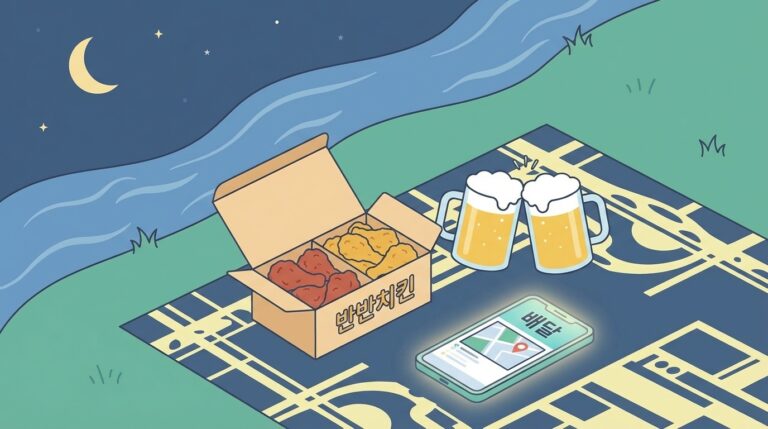
Picture this: It’s Friday night, 8 PM. You’re sitting on a picnic mat by the Han River, the city lights are reflecting on the water, and your Korean friend pulls out their phone. In a K-Drama, this is the exact moment the main character sighs after a long day at work and says a magical phrase. The English subtitles might just say, “Let’s get chicken and beer,” but… is that really all they said?
If you’ve lived in Korea or watched enough K-Dramas, you know that Yashik (야식, late-night snack culture) is practically a national sport. And the reigning champion of Yashik? Chimaek (치맥 – Chicken and Beer).
But ordering and eating fried chicken in Korea isn’t just about food; it’s a deeply cultural bonding experience with its own vocabulary, etiquette, and unwritten rules. If you only know textbook Korean, you might end up awkwardly asking, “Shall we consume chicken?” while your friends are already shouting slang.
This guide is based on real struggles my advanced students faced—like accidentally eating their boss’s favorite chicken wing! Let’s dive into the real, unfiltered Korean of late-night Chimaek.
Phase 2: In-Depth Expression Analysis
1. 오늘 치맥 땡기는데? (Craving Chimaek today?)
- Pronunciation: [oneul chimaek ttaenggineunde?] (ttaeng sounds like a tight ‘teng’ with a strong ‘tt’)
- Meaning: Literal: “Is Chimaek pulling (me) today?” / Real nuance: “I’m really craving chicken and beer today, wanna join?”
- K-Culture Moment: You’ll hear this at 5:30 PM in the office as coworkers start packing up. It’s a casual, irresistible invitation that instantly builds camaraderie after a stressful day.
- Editor’s Insight: The verb ‘땡기다’ (standard form: 당기다) is an absolute must-know C1 slang. It means you have a strong, sudden appetite or desire for something. Adding ‘~는데?’ at the end softens the phrase, turning a statement into a suggestive question.
- Situation Spectrum:
[🚫 절대 금지] ———— [⚠️ 주의] ———— [✅ 자유롭게]
- Casual (Friends): ✅
- Semi-formal (Close Coworkers): ✅
- Formal (Boss/Elders): 🚫 (Use “오늘 치맥 어떠세요?” instead)
- 🤔 Think About It: Why do Koreans often suggest plans with a trailing sentence ending like “~는데” (which technically means ‘but…’) rather than a direct “Let’s go”? How does this reflect the cultural preference for indirectness and protecting the other person’s feelings if they want to decline?
2. 겉바속촉 (Crispy outside, soft inside)
- Pronunciation: [geot-ba-sok-chok] (Short, punchy syllables)
- Meaning: Literal: Outside crispy, inside moist / Real nuance: The highest compliment you can give to fried food in Korea.
- K-Culture Moment: Watching a Mukbang (먹방) YouTuber take their first bite of fried chicken, widening their eyes, and whispering this exact four-syllable word into an ASMR microphone.
- Editor’s Insight: This is an acronym for 겉은 바삭하고 속은 촉촉하다. Koreans love abbreviating phrases into four syllables, almost like modern-day Hanja (Chinese character) idioms!
- Situation Spectrum:
[🚫 절대 금지] ———— [⚠️ 주의] ———— [✅ 자유롭게]
- Casual (Friends): ✅
- Semi-formal (Close Coworkers): ✅
- Formal (Boss/Elders): ⚠️ (They might not understand the slang if they are older!)
- 🤔 Think About It: Korean food culture is obsessed with texture (식감). Does your native language have specific slang words just to describe how food feels in your mouth?
3. 너 퍽퍽살파야, 야들살파야? (Are you team white meat or team dark meat?)
- Pronunciation: [neo peok-peok-sal-pa-ya, ya-deul-sal-pa-ya?]
- Meaning: Literal: Are you dry-meat faction, or tender-meat faction? / Real nuance: Do you prefer chicken breasts or chicken thighs/drumsticks?
- K-Culture Moment: The tense moment right after the chicken box is opened. Before anyone grabs a piece, you must establish alliances. If you and your friend both want the drumsticks (야들살), it’s a competition. If one likes breast meat (퍽퍽살) and the other likes drumsticks, you are soulmates.
- Editor’s Insight: The suffix ‘-파’ (faction/team) is heavily used in Korean pop culture to categorize preferences (e.g., 민초파 – Mint choco team). ‘퍽퍽하다’ means dry/choking, and ‘야들야들하다’ means soft/tender.
- Situation Spectrum:
[🚫 절대 금지] ———— [⚠️ 주의] ———— [✅ 자유롭게]
- Casual (Friends): ✅
- Semi-formal (Close Coworkers): ✅
- Formal (Boss/Elders): ⚠️
- 🤔 Think About It: Asking about food preferences before eating is a major way Koreans show care. What is the ultimate ‘deal-breaker’ food preference in your culture?
Phase 3: Textbook vs. Real Korean
| Situation | 📖 Textbook Korean | 🗣️ Real Korean | 💡 Why the difference? |
|---|---|---|---|
| Suggesting dinner | 치킨과 맥주를 먹을까요? (Shall we eat chicken and beer?) | 오늘 불금인데 치맥 콜? (It’s Fire Friday, Chimaek call?) | “콜” (Call) is adopted from poker/gaming culture meaning “I’m in!” |
| Ordering half and half | 양념 반, 후라이드 반 주세요. (Half seasoned, half fried, please.) | 반반 무 많이요! (Half-and-half, lots of radish!) | Efficiency! It’s a legendary, universally understood delivery phrase. |
| Describing the taste | 치킨이 정말 맛있습니다. (The chicken is very delicious.) | 와, 미쳤다. 완전 겉바속촉! (Wow, this is crazy. Totally crispy/moist!) | Slang like ‘미쳤다’ (crazy) is the ultimate casual praise among younger generations. |
Phase 4: Cultural Context — K-Culture Deep Dive
4-1. Non-verbal Nunchi (눈치) at the Chicken Table
Korean communal dining requires serious Nunchi (social radar). When there is only one piece of chicken left on the plate, do not take it immediately. In Korea, taking the last piece without asking is a faux pas. You should hover your chopsticks, look around, and ask, “이거 누구 드실 분?” (Anyone want this?). Usually, everyone will politely decline, and then you can eat it!
4-2. K-Drama & K-Food Connection: The Healing Power of Chimaek
Why do K-Drama characters always eat Chimaek when they are heartbroken, stressed about a presentation, or celebrating a small victory?
In Korea, Chimaek is more than food; it’s a psychological buffer. The combination of carbonated, cold beer cutting through the rich, oily crunch of fried chicken represents washing away the fatigue of the day.
Critical View: Dramas show perfectly styled actors delicately eating a chicken leg. In reality? You’re wearing plastic gloves (비닐장갑), you have sweet chili sauce (양념) on your cheek, and you’re passionately debating office politics with a mouth full of pickled radish!
Phase 5: Real-Life Roleplay Scenario
Setting: Friday night, 8:00 PM. The famous Yeouido Hangang Park. You and your Korean coworker, Min-su, are sitting on a rented picnic mat. The cool river breeze is blowing, and buskers are singing K-Pop in the distance.
Characters:
– YOU: An expat working in Seoul, proud of your advanced Korean skills.
– Min-su (32): Your friendly, slightly overworked Korean coworker who loves a good drink.
Dialogue:
Min-su: 아… 이번 주 진짜 힘들었다. 그쵸? 🍺
(A… ibeon ju jinjja himdeureotda. Geuchyo?)
[Ah… this week was really tough. Right?]
YOU: 맞아요. 팀장님 때문에 스트레스가… 장난 아니었어요.
(Majayo. Timjangnim ttaemune seuteureseuga… jangnan anieosseoyo.)
[Right. The stress from the team leader… was no joke.]
Min-su: (Sighs) 오늘 스트레스도 받는데, 치맥 땡기지 않아요? 내가 쏠게요!
(Oneul seuteureseudo banneunde, chimaek ttaenggiji anayo? Naega ssolgeyo!)
[With all this stress today, aren’t you craving Chimaek? It’s my treat!]
🔀 Your Turn! How do you respond?
– A) “아니요, 제가 살게요!” (No, I will buy it!)
– B) “진짜요? 콜! 그럼 제가 맥주 쏠게요!” (Really? Call! Then I’ll treat us to the beer!)
– C) “치킨과 맥주 아주 좋습니다.” (Chicken and beer is very good.)✅ Best Choice: B — Reason: In Korea, a “Treat Exchange” is the best way to build a relationship. If an older coworker offers to buy the main dish (chicken), offering to buy the drinks (beer) or the next round of coffee shows impeccable Nunchi and manners!
⚠️ Choice A Analysis: Refusing too aggressively can make them feel awkward.
⚠️ Choice C Analysis: Too robotic and textbook for a Han River hangout.
YOU: 진짜요? 콜! 그럼 제가 편의점 가서 맥주 사 올게요!
(Jinjjayo? Kol! Geureom jega pyeonijeom gaseo maekju sa olgeyo!)
[Really? Call! Then I’ll go to the convenience store and buy beer!]
Min-su: 오, 센스 대박. 치킨은 뭐 시킬까요? 후라이드? 양념?
(O, senseu daebak. Chikineun mwo sikilkkayo? Huraideu? Yangnyeom?)
[Oh, great sense. What chicken should we order? Fried? Seasoned?]
YOU: 에이, 당연히 반반이죠. 아, 그리고 저 야들살파니까 다리는 다 민수 씨 드셔도 돼요!
(Ei, dangyeonhi banbanijyo. A, geurigo jeo yadeulsalpanikka darineun da Minsu ssi deushyeodo dwaeyo!)
[Hey, half-and-half of course. Oh, and I’m team tender meat, so you can eat all the legs, Min-su!]
Min-su: 헉… 다리를 양보하다니… 당신은 천사입니까?
(Heok… darireul yangbohadani… dangsineun cheonsaimnikka?)
[Gasp… yielding the chicken legs… are you an angel?]
(🎭 Stage Direction: Min-su looks genuinely touched and opens the Baemin app)
Phase 6: 10-Second Shadowing Drill
Practice your natural rhythm! Pay attention to the pauses (/).
😤 아~ / 이번 주 / 진짜 스트레스 / 장난 아니었는데,
(Ah~ / ibeon ju / jinjja seuteureseu / jangnan anieonneunde,)
😊 오늘 / 퇴근하고 / 치맥 / 콜?!
(Oneul / toegeunhago / chimaek / kol?!)
Phase 7: K-Culture Mini Dictionary
| Korean | Romanization | English | Cultural Context |
|---|---|---|---|
| 야식 | yashik | Late-night snack | Eating heavily after 9 PM. A cornerstone of Korean socializing and delivery app culture. |
| 불금 | bulgeum | Fire Friday | TGIF! The abbreviation for 불타는 금요일 (Burning Friday), when everyone goes out to drink. |
| 순살 | sunsal | Boneless | Pure meat. Essential keyword on delivery apps if you don’t want to deal with chicken bones at a park! |
| 1인 1닭 | il-in il-dak | 1 chicken per person | The humorous, ambitious mantra that every person should be able to finish a whole chicken themselves. |
| 배달존 | baedal-zone | Delivery Zone | Designated pick-up spots at Hangang Parks where riders and customers meet. |
Phase 8: Traveler Survival Kit (Hangang Park Edition)
If you’re traveling to Seoul, ordering chicken to the Han River is a bucket-list experience. But meeting the delivery rider in a crowded park can be stressful!
🆘 Survival Phrases for Delivery
– 🇰🇷 “기사님, 배달존 2번(이번)에 있어요.” (Gisanim, baedal-jon ibeone isseoyo.)
– 🗣️ Meaning: “Driver, I am at Delivery Zone number 2.”
– 📍 Where to use: On a phone call with the delivery rider.
- 🇰🇷 “순살 반반, 치킨무 하나 더 추가해 주세요.” (Sunsal banban, chikin-mu hana deo chugahae juseyo.)
- 🗣️ Meaning: “Boneless half-and-half, please add one more pickled radish.”
- 📍 Where to use: Ordering on the phone or leaving a note on the app.
📌 Editor’s Travel Note
– Apps: ‘배달의민족’ (Baedal Minjok) or ‘요기요’ (Yogiyo).
– Payment: If you don’t have a Korean bank card, select “만나서 카드결제” (Meet and pay by card) on the app to pay the rider directly with your physical foreign credit card!
– Tip Culture: There is ZERO tip culture in Korea, even for food delivery! Do not try to tip the rider; just say “수고하세요!” (Take care/Good work!).
Phase 9: Critical Thinking Corner — “A Step Deeper”
Food & Identity: The Communal Chicken Box
In many Western cultures, dining is highly individualized—you order your own meal on your own plate. However, Korean Chimaek culture is deeply rooted in the concept of Jeong (정, emotional connection) and Woori (우리, us/we). A whole chicken is served in the center of the table, and everyone shares from the same box. You pour beer for each other, never for yourself. This shared physical space and the negotiation of pieces (who gets the legs? who gets the wings?) acts as a social lubricant that breaks down hierarchical walls faster than any textbook conversation.
💬 Your Turn: Does your culture have a specific food that is strictly “meant for sharing” to build bonds? How would people react in your country if someone poured a drink for themselves instead of waiting for someone else to do it? Let us know in the comments!
Phase 10: FAQ & Mistake Prevention
Q: Can I eat chicken with my hands in a nice restaurant?
Yes! Most Korean chicken pubs (호프집) will provide you with small tongs (집게) and a fork. You hold the chicken with the tongs and tear the meat with the fork. Or, they will give you disposable plastic gloves (비닐장갑). Dig in with your hands!
Q: What if I don’t drink alcohol? Can I still join Chimaek?
Absolutely! You can order Chicol (치콜 – Chicken and Cola) or Chisa (치사 – Chicken and Cider/Sprite). No one will pressure you to drink beer if you don’t want to.
❌ Common Mistake: Throwing chicken bones into the regular trash.
✅ Do this instead: In Korea’s strict recycling system, chicken bones belong in the General Waste (일반쓰레기), NOT the Food Waste (음식물쓰레기), because animals cannot safely digest the hard bones.
Phase 11: Summary & Action Items
- One-Liner Summary: Master the art of Chimaek by knowing your chicken preferences (퍽퍽살 vs 야들살) and using casual slang like “치맥 땡기는데?” to bond with locals!
-
Action Mission:
- 🥉 Bronze (Solo): Stand in front of a mirror and enthusiastically say, “오늘 치맥 콜?!”
- 🥈 Silver (Online): Go to a K-Drama YouTube clip featuring food and comment: “저도 오늘 치맥 완전 땡겨요!” (I’m totally craving Chimaek today too!)
- 🥇 Gold (Real Life): Message a Korean friend or language partner right now and ask: “혹시 퍽퍽살파예요, 야들살파예요?”
- K-Culture Mission: Open Google Maps or Naver Map, search for “여의도 한강공원 배달존” (Yeouido Hangang Park Delivery Zone), and imagine waiting there for your Banban chicken!
Phase 12: Quiz — Interactive Challenge
1. Situational Judgment: Your boss (Team Leader) says they are hungry after working overtime. What is the most appropriate way to suggest Chimaek?
– A) 팀장님, 완전 겉바속촉 치맥 콜?
– B) 팀장님, 오늘 야식으로 치맥 어떠세요?
– C) 팀장님, 배달앱 켤까요?
2. Fill in the Blank:
– You are ordering chicken over the phone. You want half fried, half spicy, and extra pickled radish.
– “사장님, 여기 _______ 무 많이 가져다주세요!”
3. True or False — K-Culture Edition:
– When the delivery rider arrives at the Hangang Park delivery zone, you should give them a 10% tip for finding you. (T/F)
(Answers: 1: B (A is too informal, C is a bit direct to a boss) / 2: 반반 (Banban) / 3: False – Tipping is not practiced in Korea!)
Frequently Asked Questions (FAQ)
Q: What does "오늘 치맥 땡기는데? (Craving Chimaek today?)" mean in Korean and how do you pronounce it?
A: In Korean, "오늘 치맥 땡기는데? (Craving Chimaek today?)" is pronounced [oneul chimaek ttaenggineunde?] and means: Literal: "Is Chimaek pulling (me) today?" / Real nuance: "I'm really craving chicken and beer today, wanna join?"
Q: What does "겉바속촉 (Crispy outside, soft inside)" mean in Korean and how do you pronounce it?
A: In Korean, "겉바속촉 (Crispy outside, soft inside)" is pronounced [geot-ba-sok-chok] and means: Literal: Outside crispy, inside moist / Real nuance: The highest compliment you can give to fried food in Korea.
Q: What does "너 퍽퍽살파야, 야들살파야? (Are you team white meat or team dark meat?)" mean in Korean and how do you pronounce it?
A: In Korean, "너 퍽퍽살파야, 야들살파야? (Are you team white meat or team dark meat?)" is pronounced [neo peok-peok-sal-pa-ya, ya-deul-sal-pa-ya?] and means: Literal: Are you dry-meat faction, or tender-meat faction? / Real nuance: Do you prefer chicken breasts or chicken thighs/drumsticks?







