

Phase 1: Empathy (Immersive Open)
Hello! Daily Hangul Editor here. 👋
Have you ever watched a K-Drama and noticed that whenever a wealthy CEO or a powerful chairman needs to make a life-altering decision, they are always sitting silently by a misty lake, holding a fishing rod? Or perhaps you’ve seen K-Pop idols on variety shows (or listened to BTS Jin’s “Super Tuna” 🐟) screaming with joy on a boat in the middle of the ocean.
Fishing in Korea isn’t just a hobby; it’s a reflection of the culture itself. But did you know there is a massive cultural and linguistic divide between 민물낚시 (Minmul-naksi / Freshwater fishing) and 바다낚시 (Bada-naksi / Sea fishing)?
If you use the loud, energetic slang of the sea at a quiet freshwater spot, you might get some serious side-eyes. Don’t worry! This guide is built from the real experiences of our students. We’ll give you the ultimate insider vocabulary so you can navigate Korean fishing spots like a true local!
Phase 2: Core Expressions Deep Dive
1. 입질이 오다 (Ipjiri oda)
- Pronunciation: ip-jil-i o-da [Sounds like: eep-jeel-ee oh-dah]
- Meaning: (Literal) The bite is coming. / (Real nuance) The fish is biting! OR Someone is showing interest/taking the bait.
- K-Culture Moment: On fishing variety shows like City Fisherman (도시어부), you’ll hear the cast yell “입질 왔다! (It’s biting!)” when the float bobs. In daily K-Culture, we also use this as slang when someone is showing romantic interest, or a customer is about to buy something!
- Editor’s Insight: This isn’t just about fish. It’s about the anticipation. When you say this, you should sound excited but trying to keep your voice down so you don’t scare the fish (or jinx the deal).
- Situation Spectrum:
[🚫 절대 금지] ———— [⚠️ 주의] ———— [✅ 자유롭게]
- Casual (Friends): ✅ (Used for both fishing and dating gossip!)
- Semi-formal (Coworkers): ✅ (Great for team-building fishing trips)
- Formal (Bosses/Elders): ⚠️ (Stick to literal fishing meaning only)
- 🤔 Think About It: Why do Koreans use fishing metaphors for human relationships (like “taking the bait”)? Does your native language do the same when someone is flirting?
2. 손맛 (Sonmat)
- Pronunciation: son-mat [Sounds like: sohn-maht]
- Meaning: (Literal) Hand taste. / (Real nuance) The physical thrill and heavy resistance you feel in your hands when a fish is caught.
- K-Culture Moment: If you go sea fishing (바다낚시) in Jeju or Busan, the captain will constantly ask, “손맛 좀 봤어요? (Did you feel the ‘hand taste’?)”. It’s the ultimate measure of a successful trip.
- Editor’s Insight: Koreans love adding the word 맛 (taste) to non-food items to describe a “feeling” or “vibe” (e.g., 돈맛 – the taste of money). Sonmat is the holy grail of Korean fishing.
- Situation Spectrum:
[🚫 절대 금지] ———— [⚠️ 주의] ———— [✅ 자유롭게]
- Casual: ✅
- Semi-formal: ✅
- Formal: ✅ (Perfectly polite to ask an elder if they had good sonmat!)
- 🤔 Think About It: “Taste” is highly sensory. How does mapping a physical sensation to “taste” change the way we experience hobbies in Korea?
3. 꽝 쳤다 (Kkwang chyeot-da)
- Pronunciation: kkwang chyut-dah [Sounds like: kwahng-chut-dah]
- Meaning: (Literal) Hit a ‘boom’ (blank). / (Real nuance) I caught absolutely nothing. I struck out.
- K-Culture Moment: This is the universal sound of defeat. Whether you are freshwater fishing for hours in silence or casting lines into the sea, coming back with an empty cooler is called Kkwang.
- Editor’s Insight: It’s a very self-deprecating, slightly humorous way to admit failure. Say it with a sigh and a bitter smile.
- Situation Spectrum:
[🚫 절대 금지] ———— [⚠️ 주의] ———— [✅ 자유롭게]
- Casual: ✅
- Semi-formal: ✅
- Formal: ⚠️ (Slightly too slangy for a very strict formal setting)
- 🤔 Think About It: Why use an onomatopoeia (Kkwang/Boom) for catching nothing? It emphasizes the dramatic feeling of emptiness!
Phase 3: Textbook vs Real Korean
| Situation | 📖 Textbook Korean | 🗣️ Real Korean | 💡 Why the Difference? |
|---|---|---|---|
| When a fish bites | 물고기가 미끼를 물었어요 (The fish bit the bait) | 입질 온다! (Ipjil onda!) | Efficiency and action-oriented slang favored by hobbyists. |
| Catching a huge fish | 아주 큰 물고기를 잡았습니다 (I caught a very big fish) | 와, 대물이다! / 월척이다! (Daemurida! / Wolcheogida!) | Use of traditional Hanja-based slang to add dramatic flair. |
| Catching nothing | 한 마리도 못 잡았어요 (I didn’t catch a single one) | 오늘 완전 꽝 쳤어 (Oneul wanjeon kkwang chyeosseo) | Self-deprecating humor eases the disappointment. |
Bottom Note for B2 Learners: You don’t need to use aggressive fishing slang, but knowing Ipjil and Kkwang will immediately make Koreans see you as someone who “gets” the culture!
Phase 4: Cultural Context — K-Culture Deep Dive
4-1. The Non-Verbal “Nunchi” of the Waters
In Korea, the fishing spot dictates your behavior.
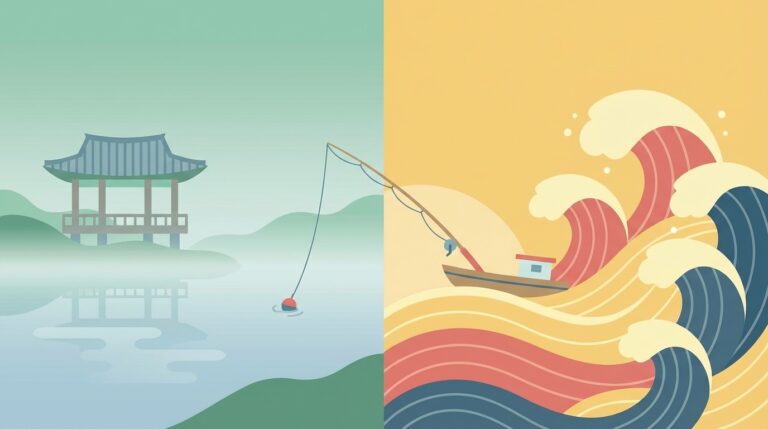
– Freshwater Fishing (민물낚시): This is the domain of K-Drama chairmen. It’s about meditation, patience, and absolute silence. If you are at a reservoir (저수지), using Nunchi (reading the room) is vital. Do not talk loudly. Move slowly.
– Sea Fishing (바다낚시): This is K-Pop energy! It’s dynamic, loud, and communal. You are battling the waves. High-fives, yelling over the engine noise, and immediate celebrations are expected.
4-2. The K-Food Connection: From Sea to Soju
The true climax of Korean sea fishing isn’t just catching the fish; it’s eating it immediately on the boat. The captain will often slice the fish right there (선상 회 – Seonsang Hoe). But here’s the catch: Koreans almost never eat sashimi with soy sauce on a boat; they dip it in 초장 (Chojang – sweet and spicy vinegar gochujang). If you know how to wrap fresh fish in a perilla leaf with garlic and Chojang while the boat rocks, you are essentially a Korean citizen.
Phase 5: Real-life Roleplay Scenario
Scenario A: The Ocean Battle
Setting: Saturday morning, 6:00 AM. A rocking boat off the coast of Incheon. The salty wind is blowing. You are sea fishing with your Korean coworker, Minsu.
Characters:
– YOU: An expat who has never been sea fishing before, trying to survive the waves.
– Minsu (32): Your friendly, slightly overly-enthusiastic Korean coworker who takes fishing very seriously.
Dialogue:
Minsu: 야, 오늘 파도 좋은데? 대물 하나 낚아보자! 🌊
(Ya, oneul pado joeunde? Daemul hana nakaboja!)
[Hey, the waves are good today! Let’s catch a monster!]
YOU: 저 낚시 처음이라… 잘할 수 있을지 모르겠어요.
(Jeo naksi cheoeumira… jalhal su isseulji moreugesseoyo.)
[It’s my first time fishing… I’m not sure if I’ll do well.]
Minsu: 걱정 마! 바다낚시는 타이밍이야. 어? 야! 너 낚싯대!
(Geokjeong ma! Bada-naksineun taiming-iya. Eo? Ya! Neo naksitdae!)
[Don’t worry! Sea fishing is all about timing. Oh? Hey! Your rod!]
YOU: 네? 왜요? (Suddenly the rod bends heavily)
(Ne? Waeyo?)
[What? Why?]
Minsu: 입질 왔다! 빨리 감아! 안 그러면 도망가!
(Ipjil watda! Ppalli gama! An geureomyeon domangga!)
[It’s biting! Reel it in fast! Or it’ll get away!]
(🎭 Stage Direction: You struggle to reel it in. The fish is fighting hard!)
YOU: 으아, 이거 너무 무거워요! 진짜 월척인가 봐요!
(Eua, igeo neomu mugeowoyo! Jinjja wolcheoginga bwayo!)
[Whoa, this is too heavy! It must really be a prize catch!]
Minsu: (Grabbing the net) 오케이, 내가 뜰채로 뜰게! 와… 참돔이다!!
(Okei, naega tteulchaero tteulge! Wa… chamdomida!!)
[Okay, I’ll scoop it with the net! Wow… it’s a red sea bream!!]
YOU: 우와… 방금 손맛 장난 아니었어요!
(Uwa… banggeum sonmat jangnan anieosseoyo!)
[Wow… the ‘hand taste’ just now was no joke!]
Minsu: 하하, 너 이제 낚시 중독되겠다. 선장님! 여기 회 좀 쳐주세요!
(Haha, neo ije naksi jungdokdoegetda. Seonjangnim! Yeogi hoe jom chyeojuseyo!)
[Haha, you’re gonna be addicted to fishing now. Captain! Please slice some sashimi for us here!]
🔀 Your Turn! How do you respond to the fresh sashimi offer?
– A) “아, 저는 날생선은 좀… 익혀 먹으면 안 될까요?” (Uh, raw fish is a bit… can we cook it?)
– B) “대박! 선상에서 먹는 회가 진짜죠. 초장 있어요?” (Awesome! Sashimi on the boat is the real deal. Do you have Chojang?)
– C) “집에 가져가서 내일 먹을게요.” (I’ll take it home and eat it tomorrow.)✅ Best Choice: B — Reason: In K-Fishing culture, eating the catch immediately on the boat is the highest form of celebration. Asking for Chojang proves you know Korean food culture!
⚠️ Choice A Analysis: While okay if you have allergies, refusing boat sashimi breaks the enthusiastic vibe. If you must refuse, blame seasickness!
Scenario B: The Silent Reservoir (Freshwater Bonus)
Setting: A quiet lake at dawn. You accidentally drop your metal thermos with a loud CLANG.
– Elderly Fisher (Next tent): 쯧쯧… 고기 다 도망가겠네.
(Tteut-tteut… gogi da domanggagenne. / Tsk tsk… the fish are all going to run away.)
– YOU: 앗, 죄송합니다. 제가 민물낚시 예절을 잘 몰라서요.
(At, joesonghamnida. Jega minmul-naksi yejeoreul jal mollaseoyo. / Ah, I’m sorry. I didn’t know the etiquette for freshwater fishing well.)
– Elderly Fisher: (Softening) 여기서는 발소리도 죽여야 해. 커피 한 잔 할 텐가?
(Yeogiseoneun balsorido jugyeoya hae. Keopi han jan hal tenga? / Here, you have to kill even the sound of your footsteps. Care for a cup of coffee?)
Phase 6: 10-Second Shadowing Drill
Practice this sentence to sound like a seasoned Korean angler. Follow the pacing and emotion!
😤 (With determination)
오늘은 / 기필코 / 월척을 낚아서 / 찐한 손맛을 / 볼 겁니다!
(o-neul-eun / gi-pil-ko / wol-cheok-eul nak-a-seo / jjin-han son-mat-eul / bol geom-ni-da!)
Today / at all costs / I will catch a huge one / and feel the deep ‘hand taste’!
Phase 7: K-Culture Mini Dictionary
| Korean | Romanization | English | Context |
|---|---|---|---|
| 민물 | minmul | Freshwater | Rivers, lakes, reservoirs. Requires patience, silence, and Nunchi. |
| 갯바위 | gaetbawi | Seaside Rocks | A dangerous but popular spot for sea fishing. Very K-Variety show style. |
| 매운탕 | maeuntang | Spicy Fish Stew | Made from the leftover head/bones of the fish you just ate as sashimi. Essential finale. |
| 방생 | bangsaeng | Catch and Release | Releasing small fish back into the water. Highly respected etiquette. |
| 선상 회 | seonsang hoe | Boat Sashimi | Eating the fish raw immediately on the boat. Peak K-Food experience. |
Phase 8: Traveler Survival Kit
Planning to try fishing in Jeju or Gangneung? Here are your survival tools!
🆘 Survival Expression #1
– 🇰🇷 “초보자용 낚싯대 대여 되나요?” (choboja-yong naksitdae daeyeo doenayo?)
– 🗣️ Sound-alike: [cho-bo-jah-yong nak-sheet-dae dae-yuh dwe-nah-yo?]
– 📍 Where to use: Tackle shops near ports.
– 💡 Meaning: Can I rent a fishing rod for beginners?🆘 Survival Expression #2
– 🇰🇷 “이거 무슨 고기예요? 먹어도 돼요?” (igeo museun gogiyeyo? meogeodo dwaeyo?)
– 🗣️ Sound-alike: [ee-guh moo-seun go-gee-yeh-yo? mug-uh-do dwe-yo?]
– 📍 Where to use: When you catch something weird.
– 💡 Meaning: What kind of fish is this? Is it edible?📌 Editor’s Travel Note
– Useful Apps: Use Naver Map and search “배낚시” (Boat fishing) to find chartered boat rentals. Many offer “experience packages” (체험 낚시) where rods and bait are provided.
– Seasickness (멀미): Korean pharmacies sell excellent liquid motion sickness medicine (마시는 멀미약). Drink it 30 minutes before boarding. Trust me, the Yellow Sea is choppy!
Phase 9: Critical Thinking Corner — “One Step Deeper”
🧠 Think Deeper: Food & Identity (음식과 정체성)
Have you noticed how Korean fishing isn’t considered complete until the fish is eaten together? In Western cultures, fishing is often a solitary sport of “catch and release” or keeping a trophy. In Korea, catching a Wolcheok (big fish) immediately triggers the thought: “How many people can I feed with this?” The fish is sliced for Hoe (sashimi) to share with everyone on the boat, and the remains are boiled into a communal Maeuntang (spicy stew) where everyone dips their spoons into the same pot. Fishing here isn’t just man vs. nature; it’s a mechanism for reinforcing the Korean community spirit (Jeong/정).💬 Your Turn: In your culture, what is the ultimate goal of fishing? Is it relaxation, sport, or food? Let us know in the comments!
Phase 10: FAQ & Avoiding Misunderstandings
Q: Can I use “손맛 (Sonmat)” when I’m not fishing?
Yes! Gamers use it constantly. When a mechanical keyboard feels great to type on, or a combat game has great impact feedback, Koreans say “키보드 손맛이 좋다” or “타격 손맛이 최고다.”
Q: What if I hate raw fish? Will the captain be offended?
Not offended, but maybe a bit confused. Just politely say, “제가 장이 안 좋아서요” (My stomach isn’t doing well). It’s the polite Korean excuse for avoiding raw or spicy food!
❌ Common Mistake #1: Shouting “입질 왔다!” (It’s biting!) at a silent freshwater reservoir.
✅ Do this instead: At a freshwater spot (민물낚시), just silently raise your hand or whisper to your friend. Keep the K-Pop energy for the ocean (바다낚시)!
Phase 11: Summary & Action Items
- One-Liner Summary: Remember that freshwater fishing (민물낚시) is for silent Nunchi, while sea fishing (바다낚시) is for loud Sonmat and spicy Maeuntang!
-
Action Mission:
- 🥉 Bronze (Solo): Look at your hands and passionately whisper, “오늘 손맛 장난 아니다” 3 times.
- 🥈 Silver (Online): Find a YouTube video of Korean sea fishing (search 배낚시) and leave a comment: “우와 대물이다! 손맛이 궁금해요!”
- 🥇 Gold (Real World): Visit a Korean seafood restaurant (횟집) and ask the waiter, “오늘 회는 무슨 고기가 좋아요?” (What fish is good for sashimi today?)
- K-Culture Mission: Watch an episode of the variety show City Fisherman (도시어부) or any K-Drama featuring a wealthy CEO fishing. Spot the difference in noise levels!
Phase 12: Quiz — Interactive Challenge
1. Situational Judgment: You are at a quiet lake (민물낚시) with your boss. You feel a tug on the line. What is the BEST reaction?
– A) Scream “입질 왔다!!!” and jump up.
– B) Quietly start reeling it in, whispering “어, 뭅니다 (It’s biting).”
– C) Throw your rod into the water.
(Answer: B. Maintain the silent etiquette of freshwater fishing and use polite language with your boss.)
2. Fill in the Blank:
You fished for 5 hours on a boat but caught nothing. You sigh and say: “오늘 완전 ( ___ ) 쳤어.”
(Answer: 꽝 – Kkwang)
3. True or False – K-Culture Edition:
If you catch a fish on a Korean charter boat, you must take it home to cook it; eating it on the boat is illegal. (T/F)
(Answer: False. Eating it raw on the boat with Chojang is the highlight of the trip!)
Frequently Asked Questions (FAQ)
Q: What does "입질이 오다 (Ipjiri oda)" mean in Korean and how do you pronounce it?
A: In Korean, "입질이 오다 (Ipjiri oda)" is pronounced [ip-jil-i o-da [Sounds like: eep-jeel-ee oh-dah] and means: (Literal) The bite is coming. / (Real nuance) The fish is biting! OR Someone is showing interest/taking the bait.
Q: What does "손맛 (Sonmat)" mean in Korean and how do you pronounce it?
A: In Korean, "손맛 (Sonmat)" is pronounced [son-mat [Sounds like: sohn-maht] and means: (Literal) Hand taste. / (Real nuance) The physical thrill and heavy resistance you feel in your hands when a fish is caught.
Q: What does "꽝 쳤다 (Kkwang chyeot-da)" mean in Korean and how do you pronounce it?
A: In Korean, "꽝 쳤다 (Kkwang chyeot-da)" is pronounced [kkwang chyut-dah [Sounds like: kwahng-chut-dah] and means: (Literal) Hit a 'boom' (blank). / (Real nuance) I caught absolutely nothing. I struck out.







