

Hello! I’m the Lead Editor of Daily Hangul. 👋
Picture this: You are watching a K-Drama, and the lead couple is on a late-night video call. The girl is hiding under her blanket, squealing, “No! I haven’t washed my face yet!” Or maybe, you finally won that K-Pop Yeong-tong (video call fan signing) you’ve been dreaming of, but right when your ultimate bias smiles at you, the screen freezes! 😱
In Korea, where internet speeds are lightning-fast and the KakaoTalk “FaceTalk” ringtone is the soundtrack of daily life, video calls are a massive part of the culture. But did you know there are unspoken rules about when to call, how to ask someone to show their face, and the exact slang to use when the Wi-Fi acts up?
If you just use textbook phrases like “Please turn on your camera,” you might sound like a strict boss! Today, I’m going to share real-life, B1-level video call expressions based on my years of living in Seoul and helping expats navigate KakaoTalk like a true insider.
Phase 2: Deep Dive into Core Expressions 🔎
Here are the top three phrases you need for your next Korean video call!
1. 얼굴 좀 보여줘~
- Pronunciation: Eolgul jom boyeojwo~ [ohl-gool johm bo-yuh-jwoh]
- Sound-alike guide: ‘ohl’ sounds like ‘old’ without the ‘d’. ‘jom’ is like ‘John’ with an ‘m’.
- Meaning: (Literal) Show me your face a little. / (Real Nuance) Turn on your camera! / Let me see you!
- K-Culture Moment: You’ll hear this in every romantic K-Drama. When a couple misses each other, they don’t say “Activate video mode.” They whine adorably, “Eolgul jom boyeojwo~”
- Editor’s Insight: The magic word here is 좀 (a little). It softens the request. Without it, “얼굴 보여줘” sounds like a police interrogation. With it, it sounds affectionate and casual.
- Situation Spectrum:
[🚫 Formal] ———— [⚠️ Semi-formal] ———— [✅ Casual]
- Close Friends (Casual): ✅ (Perfect!)
- Coworkers (Semi-formal): ⚠️ (Only if you are very close work besties.)
- Boss/Elders (Formal): 🚫 (Never. It’s too intimate.)
- 🤔 Think About It: Why does Korean rely so heavily on words like ‘좀 (a little)’ to soften requests? Does your native language have a similar “cushion” word?
2. 나 지금 쌩얼이야.
- Pronunciation: Na jigeum ssaeng-eoriya. [nah ji-geum ssang-uhl-ee-ya]
- Sound-alike guide: ‘ssang’ is a sharp sound, like the ‘sang’ in ‘sang a song’, but said with tension in your throat.
- Meaning: (Literal) I am bare-faced right now. / (Real Nuance) I don’t have makeup on, so I’m not turning on the camera!
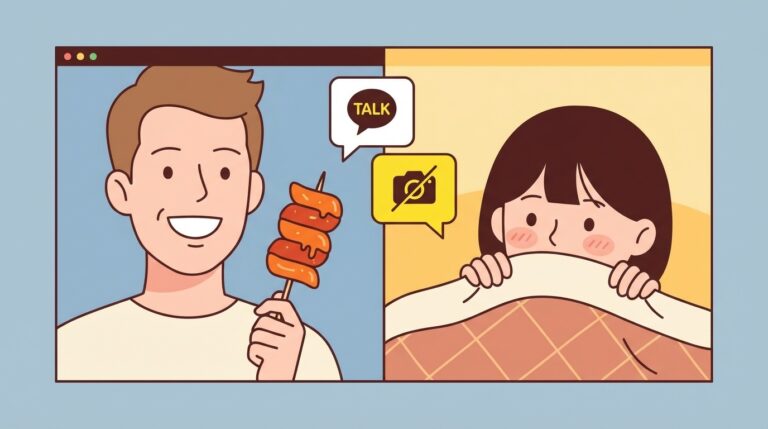
- K-Culture Moment: You call your Korean friend unannounced on FaceTalk. They answer, but the screen is just their default Kakao Friends profile picture. Why? Because they are ssaeng-eol. In Korea’s appearance-conscious society, showing a bare face is reserved for very close friends or family!
- Editor’s Insight: 쌩 (ssaeng) is slang for ‘raw’ or ‘natural’, and 얼 (eol) is short for eolgul (face). It’s the ultimate excuse to decline a video call.
- Situation Spectrum:
[🚫 Formal] ———— [🚫 Semi-formal] ———— [✅ Casual]
- Close Friends (Casual): ✅
- Coworkers/Boss (Formal): 🚫 (Too informal and TMI for work!)
- 🤔 Think About It: Is there pressure to look presentable even for casual calls in your culture?
3. 화면이 자꾸 끊겨요.
- Pronunciation: Hwamyeoni jakku kkeungyeoyo. [hwa-myuhn-ee jah-kkoo kkeun-gyuh-yo]
- Sound-alike guide: ‘kkeun’ sounds like the start of ‘kin’, but with a sharp ‘K’ catch in your throat.
- Meaning: (Literal) The screen keeps getting cut off. / (Real Nuance) The video is lagging/freezing!
- K-Culture Moment: The absolute nightmare phrase of any K-Pop fan during a video call event! If you finally get 2 minutes to talk to your idol and the hotel Wi-Fi fails, you need to shout this quickly!
- Editor’s Insight: The verb 끊기다 means “to be disconnected” or “choppy.” It’s the most natural way to describe bad reception for both voice and video calls.
- Situation Spectrum:
[✅ Formal] ———— [✅ Semi-formal] ———— [✅ Casual](Use ‘끊겨’ without ‘요’ for casual).
Phase 3: Textbook vs. Real Korean 📚
Let’s see how real Koreans speak compared to textbooks!
| Situation | 📖 Textbook Korean | 🗣️ Real Korean | 💡 Why is it different? |
|---|---|---|---|
| Suggesting a video call | 화상 통화 할까요? (Shall we do a video call?) | 페톡 할래? / 영통 할까? | Koreans love abbreviations! ‘페톡’ (FaceTalk) and ‘영통’ (Yeongsang-tonghwa) are everyday slang. |
| Telling someone their video is lagging | 연결 상태가 좋지 않습니다. (The connection condition is not good.) | 화면 멈췄어! / 렉 걸렸어! | “렉 걸리다” (to lag) comes from gaming culture (lag) and is universally used for tech glitches! |
| Asking them to turn on the camera | 비디오를 켜 주십시오. (Please turn on the video.) | 카메라 켜 봐~ | “-아/어 봐” (try doing) makes it a soft, friendly suggestion rather than a rigid command. |
Phase 4: Cultural Context — K-Culture Deep Dive 🌊
4-1. The “Nunchi” of Video Calls
In Korea, calling someone via video without texting first is considered a slight lack of 눈치 (Nunchi – social awareness). Because Koreans value looking neat and presentable, suddenly projecting their unstyled hair or messy living room onto your screen can make them panic. Always text: “지금 페톡 괜찮아?” (Is FaceTalk okay right now?) before hitting that camera button!
4-2. The Idol “Yeong-Tong” Phenomenon
If you’re a K-Pop fan, you know the word 영통팬싸 (Yeong-tong fan-sign). During the pandemic, in-person fan meetings moved online, creating a massive culture of 1-on-1 video calls.
– The Reality: Fans rent out special hotel rooms with ring lights, ethernet cables, and scripts just for a 2-minute call.
– The Language: Idols often use super affectionate, semi-casual Korean to make fans feel like close friends. If you say “화면이 끊겨요,” they might adorably reply, “진짜? 이제 잘 보여?” (Really? Can you see me well now?)
Phase 5: Interactive Roleplay Scenario 🎬
Setting: It’s 9 PM on a Friday. You are at a bustling night market in Myeongdong, eating incredibly spicy Tteokbokki. You want to show your Korean friend, Min-su, the delicious chaos, so you start a Kakao FaceTalk.
Characters:
– YOU: A food-loving traveler trying to survive the spice.
– Min-su (32): Your friendly Korean language exchange partner. He is chilling at home.
(Kakao FaceTalk Ringtone plays… Min-su answers, but his camera is off!)
Min-su: 여보세요? 어, 페톡이네?
(Yeoboseyo? Eo, petogine?)
[Hello? Oh, it’s FaceTalk?]
YOU: 민수 씨! 저 지금 명동이에요! 떡볶이 먹고 있어요. 🌶️
(Minsu ssi! Jeo jigeum Myeongdong-ieyo! Tteokbokki meokgo isseoyo.)
[Min-su! I’m in Myeongdong right now! I’m eating Tteokbokki.]
Min-su: 진짜요? 맛있겠다! 근데 저 지금 완전 쌩얼이라…
(Jinjjayo? Masitgetda! Geunde jeo jigeum wanjeon ssaeng-eorira…)
[Really? Sounds delicious! But I’m completely bare-faced right now so…]
🔀 YOUR TURN! How do you reply?
– A) 비디오를 켜 주십시오!
– B) 에이, 얼굴 좀 보여줘요~ 쌩얼도 괜찮아요!
– C) 아, 그래요? 그럼 끊을게요.✅ Best Choice: B!
Why? Option A sounds like a robot. Option C is a bit cold. Option B (“Hey, show me your face~ Bare face is fine too!”) is the perfect B1-level friendly response. It shows you understand his hesitation but warmly encourage him.
(You chose B!)
YOU: 에이, 얼굴 좀 보여줘요~ 쌩얼도 괜찮아요!
(Ei, eolgul jom boyeojwoyo~ Ssaeng-eoldo gwaenchanayo!)
[Hey, let me see your face~ Bare face is fine!]
(🎭 Stage Direction: Min-su laughs and turns on his camera. He’s wearing a giant oversized t-shirt and messy hair.)
Min-su: 아 ㅋㅋㅋ 알았어요. 어? 근데 화면이 자꾸 끊겨요. 사람 많아요?
(A hhh arasseoyo. Eo? Geunde hwamyeoni jakku kkeungyeoyo. Saram manayo?)
[Ah lol okay. Huh? But the screen keeps freezing. Are there a lot of people?]
YOU: 네, 사람 너무 많아서 와이파이가 약해요. 내 목소리 들려요?
(Ne, saram neomu manaseo waipaiga yakaeyo. Nae moksori deullyeoyo?)
[Yeah, there are so many people so the Wi-Fi is weak. Can you hear my voice?]
Min-su: 목소리는 잘 들려요! 떡볶이 안 매워요?
(Moksorineun jal deullyeoyo! Tteokbokki an maewoyo?)
[I can hear your voice well! Isn’t the Tteokbokki spicy?]
YOU: 엄청 매워요! 눈물 나요 😭
(Eomcheong maewoyo! Nunmul nayo.)
[It’s super spicy! I have tears in my eyes.]
Phase 6: 10-Second Shadowing Drill ⏱️
Let’s practice the flow and intonation like a native speaker!
🥺 에이~ / 얼굴 좀 / 보여줘요! / 쌩얼도 / 괜찮아요~
(Ei~ / eolgul jom / boyeojwoyo! / ssaeng-eoldo / gwaenchanayo~)
Emotion Tag: Playful and warmly encouraging.
Focus: Drag out the “Ei~” a little bit. It’s a classic Korean sound of playful dismissal!
Phase 7: K-Culture Mini Dictionary 📖
| Korean | Romanization | English | Contextual Meaning |
|---|---|---|---|
| 페톡 | pe-tok | FaceTalk | Abbreviation for KakaoTalk’s video call feature. |
| 영통 | yeong-tong | Video call | Abbreviation for 영상 통화. Used for both everyday calls and K-Pop fan events. |
| 쌩얼 | ssaeng-eol | Bare face | A face with zero makeup. Often used as an excuse to avoid video calls! |
| 렉 걸리다 | rek geollida | To lag | Originally gamer slang, now the standard way to say your video/phone is lagging. |
| 캡처하다 | kaepcheohada | To screenshot | From the English “capture.” Always ask before taking one on a video call! |
Phase 8: Traveler Survival Kit 🎒
Even if you aren’t calling an idol, video calls are lifesavers when traveling in Korea!
🆘 Survival Phrase #1: Showing your location
– 🇰🇷 “기사님, 제 위치 이거 보이세요?”
– 🗣️ gisanim, je wichi igeo bo-ee-se-yo?
– 📍 Where to use: Video calling a taxi driver or a Korean friend when you are completely lost.
– 💡 Pro Tip: If you can’t read the street signs, just switch your camera to the rear view and say “이거 보이세요?” (Can you see this?).📌 Editor’s Travel Note:
– Public Wi-Fi: Korea has amazing free Wi-Fi (Public WiFi Free) on buses and subways. However, if you are moving underground, FaceTalk might drop. If someone says “렉 걸려요” (It’s lagging), switch to a voice call!
– Apps: Don’t use WhatsApp or FaceTime if you want to reach a Korean local quickly. Download KakaoTalk. It is the absolute standard for all communication in Korea.
Phase 9: Critical Thinking — “One Step Deeper” 🧠
Media vs. Reality: The “Presentable” Culture
In K-Dramas, actors wake up with perfect hair and “no-makeup makeup” looks, taking video calls instantly. But in reality, Korean society places a high value on 꾸밈 노동 (grooming labor)—the effort put into looking neat and socially acceptable. A video call pierces the boundary between public presentation and private relaxation. When a Korean friend says “I’m ssaeng-eol,” it’s not just about vanity; it’s about not being mentally prepared to host you in their private visual space. The screen is essentially their living room!
💬 Your Turn:
How do people in your culture treat surprise video calls? Do people care if they are wearing pajamas or have messy hair? Let me know in the comments!
Phase 10: FAQ & Mistake Prevention 🛡️
Q: Can I use “얼굴 좀 보여줘 (Show me your face)” to my boss?
NO! 🚫 This phrase implies intimacy. If you are on a Zoom meeting with your boss, politely say, “부장님, 카메라 켜 주실 수 있나요?” (Manager, could you please turn on your camera?).
Q: If an idol is lagging during a fan-call, can I use informal language?
Yes and No. Depending on your fan persona, you can use casual language (반말) if you’ve established that vibe. But in a panic, it’s safer to use polite form: “화면이 끊겨요!” (The screen is freezing!).
❌ Common Mistake #1: Calling FaceTalk out of the blue.
✅ Do this instead: Always send a quick text first: “지금 통화 가능해?” (Are you available to talk right now?)
Phase 11: Summary & Action Items 🎯
One-Liner Summary: Soften your video call requests with “좀” and always respect the “Ssaeng-eol” boundary!
Your 3-Step Action Mission:
– 🥉 Bronze (Solo): Stand in front of a mirror and say “나 지금 쌩얼이야!” with dramatic K-Drama flair.
– 🥈 Silver (Online): Drop a comment below sharing a time your video call lagged at the worst possible moment.
– 🥇 Gold (Real Life): Next time you call your Korean language partner, successfully use “화면이 끊겨요” if the internet drops!
🌟 K-Culture Mission: Open KakaoTalk, go to a friend’s chatroom, and find the “FaceTalk (페이스톡)” icon. Notice how it’s right next to VoiceTalk. It’s built for daily use!
Phase 12: Interactive Challenge Quiz 🏆
1. Situational Judgment: You want to casually ask your close Korean friend to turn on their video. What is the most natural B1-level phrase?
– A) 카메라를 켜 주십시오.
– B) 얼굴 좀 보여줘~
– C) 비디오 시작!
(Answer: B. ‘A’ is too formal, and ‘C’ sounds like a machine command.)
2. Fill in the Blank:
“The Wi-Fi is bad, so the screen keeps freezing!” -> 와이파이가 안 좋아서 화면이 자꾸 (______).
(Answer: 끊겨요 / kkeungyeoyo)
3. True or False (K-Culture Edition):
“It is considered totally polite to FaceTime a Korean coworker unannounced at 9 PM.”
(Answer: False! Nunchi dictates you always text first, especially to coworkers outside of work hours!)
Frequently Asked Questions (FAQ)
Q: What does "얼굴 좀 보여줘~" mean in Korean and how do you pronounce it?
A: In Korean, "얼굴 좀 보여줘~" is pronounced [Eolgul jom boyeojwo~ [ohl-gool johm bo-yuh-jwoh] and means: (Literal) Show me your face a little. / (Real Nuance) Turn on your camera! / Let me see you!
Q: What does "나 지금 쌩얼이야." mean in Korean and how do you pronounce it?
A: In Korean, "나 지금 쌩얼이야." is pronounced [Na jigeum ssaeng-eoriya. [nah ji-geum ssang-uhl-ee-ya] and means: (Literal) I am bare-faced right now. / (Real Nuance) I don't have makeup on, so I'm not turning on the camera!
Q: What does "화면이 자꾸 끊겨요." mean in Korean and how do you pronounce it?
A: In Korean, "화면이 자꾸 끊겨요." is pronounced [Hwamyeoni jakku kkeungyeoyo. [hwa-myuhn-ee jah-kkoo kkeun-gyuh-yo] and means: (Literal) The screen keeps getting cut off. / (Real Nuance) The video is lagging/freezing!







