

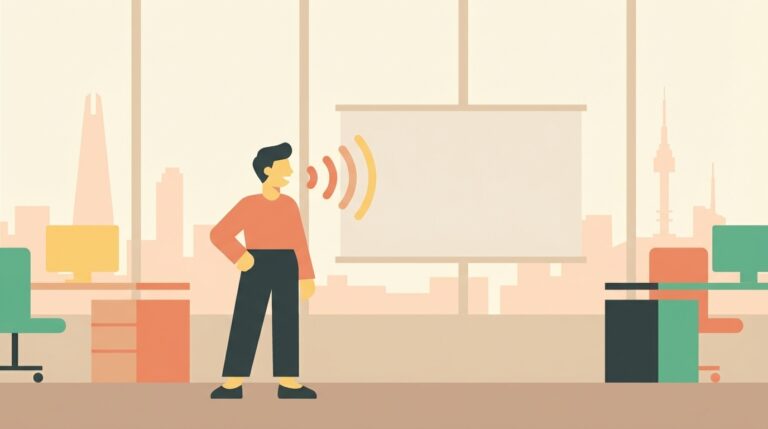
Phase 1: Empathy (The “Korean Voice” Illusion)
Hello! I’m the Lead Editor at Daily Hangul.
Imagine this K-Drama scene: The protagonist walks into a cafe, and the part-timer behind the counter greets them with an incredibly cheerful, high-pitched “어~서오세~요!” (Welcome!). But the moment the customer leaves, the part-timer turns to their coworker and speaks in a completely normal, deeper voice.
What just happened? Did they suddenly change personalities? Not at all. You’ve just witnessed the magic—and necessity—of Korean vocal modulation.
When you reach the C1 level in Korean, knowing the right words is only half the battle. The other half is how you say them. If you use your normal, flat tone in a formal or service setting in Korea, you might unintentionally sound angry or indifferent. On the flip side, if you speak too loudly in the wrong setting, you’ll immediately stand out as a tourist.
Today, we aren’t just looking at pronunciation rules. We are going to master the “Korean Voice”—the subtle art of pitch, breath, and pausing that will make you sound less like a textbook and more like a true Seoulite.
Phase 2: Core Expressions & Vocal Techniques Deep Dive
Let’s break down the three fundamental vocalization techniques that dictate social interactions in Korea.
1. 솔톤 (Sol Tone)
- Pronunciation: [sol-ton] (Sounds like the musical note ‘Sol’ + ‘tone’)
- Meaning: The “Customer Service Voice” or the “Friendly Pitch.”
- K-Culture Moment: Have you ever noticed how your Korean friend’s voice goes up two octaves when they answer a call from their boss or a senior? That’s the Sol Tone. It’s a slightly elevated, bright pitch used to project warmth, politeness, and readiness.
- Editor’s Insight: Think of it as an auditory smile. You don’t use this with your best friends, but if you’re meeting your partner’s parents for the first time, hitting that ‘Sol’ note is crucial for a good first impression.
- Situation Spectrum:
[🚫 절대 금지] ———— [⚠️ 주의] ———— [✅ 자유롭게]
- 친구 사이 (Casual): 🚫 (They will ask why you are acting weird)
- 서비스/첫만남 (Service/First Meetings): ✅
- 진지한 회의 (Serious Business Meetings): ⚠️ (Too high can sound unprofessional; you need a more grounded tone here)
- 🤔 Think About It: Why does a higher pitch equate to politeness in Korean society? How does your native culture signal “I am friendly and mean no harm” through voice?
2. 공기 반 소리 반 (Half Air, Half Sound)
- Pronunciation: [gong-gi ban sori ban]
- Meaning: Speaking with a breathy, softened voice to show empathy or mitigate harshness.
- K-Culture Moment: Originally popularized by K-Pop producer J.Y. Park as singing advice, this applies perfectly to everyday speaking. When a K-Drama character is apologizing sincerely or comforting someone, they don’t project their voice from the chest. They let a lot of air out with their words.
- Editor’s Insight: In Western cultures, speaking clearly and projecting your voice is a sign of confidence. In Korea, if you need to soften a blow (like rejecting an offer or giving bad news), adding “air” to your voice shows that you are treading carefully around the other person’s feelings.
- Situation Spectrum:
[🚫 절대 금지] ———— [⚠️ 주의] ———— [✅ 자유롭게]
- 위로/사과 (Comforting/Apologizing): ✅
- 거절할 때 (Refusing politely): ✅
- 발표할 때 (Public Speaking): 🚫 (You need resonance and clarity here!)
- 🤔 Think About It: How does the physical act of “softening” your voice correlate with the Korean cultural emphasis on preserving Kibun (기분 – mood/feelings) of others?
3. 말끝 흐리기 (Trailing Off)
- Pronunciation: [mal-kkeut heu-ri-gi]
- Meaning: Fading out the volume at the end of a sentence.
- K-Culture Moment: In a corporate meeting, a junior employee disagrees with the boss. Instead of saying “That is wrong” loudly and clearly, they say, “그건 좀 아닌 것 같은데요…” (I think that might not be right…) while letting their voice trail off into silence.
- Editor’s Insight: This isn’t a sign of weakness or a lack of confidence. In a high-context culture like Korea, trailing off leaves room for the listener to infer your meaning without forcing a direct confrontation. It’s a highly advanced conversational buffer.
- Situation Spectrum:
[🚫 절대 금지] ———— [⚠️ 주의] ———— [✅ 자유롭게]
- 반대의견 제시 (Disagreeing with seniors): ✅
- 보고할 때 (Giving factual reports): 🚫 (Facts need clear, crisp endings)
- 🤔 Think About It: Why is absolute certainty sometimes viewed as aggressive in Korean conversation?
Phase 3: Textbook vs. Real Korean Delivery
| 상황 (Situation) | 📖 Textbook Delivery | 🗣️ Real Korean Delivery | 💡 Why the difference? |
|---|---|---|---|
| Apologizing to a senior | 죄.송.합.니.다. (Flat, robotic, clear consonants) | 아, 죄송합니다아… (Breathy, elongated ending) | Clear, sharp consonants can sound defiant. Softening the sound shows humility. |
| Disagreeing | 저는 동의하지 않습니다. (Loud, firm ending) | 제 생각은 조금 다른데요… (Trailing off volume at the end) | Direct disagreement disrupts group harmony. Trailing off allows for graceful retreat. |
| Answering the phone (Business) | 여보세요? (Flat pitch) | 네~ 감사합니다, Daily Hangul입니다~ (Sol tone, upward inflection) | The ‘Sol Tone’ instantly establishes a polite, welcoming professional persona. |
Bottom Note for C1 Learners: You already know the grammar. Now, focus on how you deliver it. A perfectly grammatical sentence delivered with the wrong pitch can completely alter your intended message.
Phase 4: Cultural Context — K-Culture Deep Dive
4-1. Non-Verbal Elements: The Art of Staring (or Not)
When you are modulating your voice, your body language must match. In Western public speaking, maintaining strong eye contact is key. In Korea, if you are using a softened voice to apologize or disagree with someone older, holding intense, unbroken eye contact is considered aggressive.
Pro Tip: Aim your gaze around their nose or chin, and occasionally look down to show you are “listening with your whole body.”
4-2. The K-Drama Workplace Trope
If you watch K-Dramas set in offices (like Misaeng or Start-Up), pay attention to the vocal contrast. The strict Team Leader speaks in a low, resonant, chest voice (often dropping honorifics). The eager new recruit speaks in a higher pitch, speaks faster, and uses highly structured honorifics.
Critical View: While dramas exaggerate this for effect, the reality is that your social rank in a Korean room often dictates your acceptable vocal pitch and volume. The higher your rank, the lower and slower you can afford to speak.
Phase 5: Real-Life Roleplay Scenario
Setting: Tuesday afternoon, 2:00 PM. A glass-walled meeting room in a Gangnam tech company. You are reviewing a project proposal with your Korean team. The atmosphere is somewhat tense.
Characters:
– YOU: A foreign manager (C1 Korean speaker). You need to point out a flaw in the plan without offending anyone.
– Team Leader Kim (45): Proud of his project, but open to feedback if delivered respectfully.
Dialogue:
Team Leader Kim: 자, 이번 마케팅 플랜은 이대로 진행하면 될 것 같습니다. 다들 동의하시죠?
(Ja, ibeon maketing peullaeneun idaero jinhaenghamyeon doel geot gatseumnida. Dadeul dong-uihasijyo?)
(Alright, I think we should proceed with the marketing plan as is. Everyone agrees, right?)
(🎭 Stage Direction: He looks around the room with confidence, expecting nods.)
YOU: (Taking a gentle breath in) 팀장님, 준비하신 플랜 정말 좋은데요…
(Timjangnim, junbihasin peullaen jeongmal joeundeyo…)
(Team Leader, the plan you prepared is really great, but…)
Team Leader Kim: 네, 의견 있어요?
(Ne, uigyeon isseoyo?)
(Yes, do you have an opinion?)
🔀 Your Turn! How should you deliver your disagreement?
- A) (Loudly, clear voice) “예산 부분이 완전히 틀렸습니다! 수정해야 합니다!” (The budget part is completely wrong! We must fix it!)
- B) (Slightly breathy voice, trailing off) “예산 부분에서 조금 무리가 있지 않을까… 싶습니다만…” (I’m wondering if there might be a slight overreach in the budget part…)
- C) (High-pitched Sol Tone) “예산이 너무 비싸요~!” (The budget is too expensive~!)
✅ Best Choice: B — Reason: This is the ultimate C1 power move. By using “공기 반 소리 반” (breathy voice) and “말끝 흐리기” (trailing off with 싶습니다만…), you preserve Team Leader Kim’s Kibun (pride) in front of the team while clearly stating that the budget is an issue.
⚠️ Choice A & C Analysis: A is grammatically perfect but culturally disastrous; it sounds like an attack. C uses the ‘Sol Tone’ which is entirely inappropriate for serious business analysis.
Phase 6: 10-Second Shadowing Drill
Let’s practice your vocal modulation. Follow the emotional tags and pauses!
1. The Polite Rejection (Breathy & Trailing off)
🥺 아… / 제안은 정말 감사한데요… / 제가 오늘은 좀… (a… / jeaneun jeongmal gamsahandeyo… / jaega oneureun jom…)
Tip: Let your voice fade away completely on the last “jom.”
2. The Cheerful Service Greeting (Sol Tone)
😊 네~! / 감사합니다! / 데일리 한글입니다~! (ne~! / gamsahamnida! / deilli hangeurimnida~!)
Tip: Start on a high pitch and keep the melody bouncy!
3. The Confident Presentation (Firm, Grounded Pitch)
😤 이번 프로젝트의 / 핵심 목표는 / 다음과 같습니다. (ibeon peurojekteu-ui / haeksim mokpyoneun / daeumgwa gatseumnida.)
Tip: Drop your pitch slightly, pause exactly where the slashes are, and enunciate the final ‘다’ clearly.
Phase 7: K-Culture Mini Dictionary
| 한국어 | Romanization | English | Contextual Explanation |
|---|---|---|---|
| 솔톤 | sol-ton | Sol Tone | A high-pitched, friendly tone of voice used in customer service or when being extremely polite to strangers. |
| 말끝 흐리기 | mal-kkeut heu-ri-gi | Trailing off | Fading out the end of a sentence to soften a statement, avoid direct confrontation, or show humility. |
| 공기 반 소리 반 | gong-gi ban sori ban | Half air, half sound | Speaking (or singing) with a breathy quality to convey deep empathy, softness, or apology. |
| 억양 | eog-yang | Intonation / Pitch | The rise and fall of the voice. Crucial in Korean as it changes the nuance from a statement to a question to a suggestion. |
| 목소리를 깔다 | moksorireul kkalda | Lowering one’s voice | Literally “laying down the voice.” Speaking in a deep, serious tone to assert authority or show extreme seriousness. |
Phase 8: Traveler’s Survival Kit
Even if your vocabulary is advanced, knowing how to project your voice is a survival skill in Korea!
🆘 Survival Expression: The Restaurant Call
– 🇰🇷 “저기요~!” (jeogiyo~!)
– 🗣️ Vocal Guide: Project from your diaphragm. The pitch should start mid and go UP on “요”. It needs to cut through the noise of a busy BBQ restaurant.
– 📍 Where to use: Any non-fine-dining restaurant, cafe, or bar to get attention.
– 💡 Pro Tip: Don’t use a breathy voice here. If you use “공기 반 소리 반” to call a waiter in a loud Gangnam pub, you will starve. Volume and confidence are key!
📌 Editor’s Travel Note: Voice Volume in Korea
– Subways & Buses: Keep your voice incredibly low. Koreans are very sensitive to loud talking on public transport.
– Cafes: A normal conversational volume is fine, but avoid loud, booming laughs that fill the room.
– Markets (e.g., Gwangjang Market): Be loud! The vendors will shout to get your attention, and you need to project your voice to ask “이거 얼마예요?” (How much is this?).
Phase 9: Critical Thinking — “One Step Deeper”
🧠 Think Deeper: Language & Power (언어와 권력)
In Korean society, vocal modulation is a profound reflection of social hierarchy. Have you noticed who is allowed to speak loudly? Usually, it’s the older person, the boss, or the customer. They can use a firm, chest-driven voice and end their sentences abruptly. Conversely, the junior person, the employee, or the service provider is culturally expected to raise their pitch (Sol tone) to show willingness, or soften their voice (breathy tone) to show humility. As a C1 speaker, mastering these vocal shifts means you are no longer just speaking Korean—you are successfully navigating the invisible web of Korean social dynamics.
💬 Your Turn: In your culture, does speaking softly indicate respect, or does it indicate a lack of confidence? Share your thoughts in the comments!
Phase 10: FAQ & Avoiding Misunderstandings
Q: Should I always use the ‘Sol Tone’ to sound polite?
A: No! This is a common pitfall. If you use the ‘Sol Tone’ during a serious business negotiation or a somber situation, you will sound frivolous or insincere. Match the pitch to the gravity of the room.
Q: I feel like I sound fake when I use these tones. Is that normal?
A: Absolutely. It feels like acting at first. But think of it as switching “social personas” rather than being fake. It’s a linguistic tool for social harmony.
❌ Common Mistake #1: Apologizing with a loud, firm voice.
✅ Do This Instead: Lower your volume, add a little breathiness, and slightly bow your head. “정말 죄송합니다” said softly is 100x more effective than said loudly.❌ Common Mistake #2: Staring directly into a senior’s eyes without blinking while explaining yourself.
✅ Do This Instead: Soften your gaze. Look at their face, but don’t lock eyes aggressively. Let your voice trail off slightly at the end of your explanation.
Phase 11: Summary & Action Items
One-Liner Summary: At the C1 level, mastering Korean isn’t just about the words you choose, but controlling your pitch, breath, and sentence endings to navigate complex social hierarchies gracefully.
Action Mission:
– 🥉 Bronze (Solo): Stand in front of a mirror. Say “감사합니다” three times: once in a flat tone, once in a high ‘Sol Tone’, and once in a soft, breathy tone.
– 🥈 Silver (Online): Find a scene in a K-Drama where an employee is talking to a boss. Listen specifically to the pitch difference between the two actors.
– 🥇 Gold (Real World): Next time you enter a Korean store or cafe, try ordering your coffee using a slight ‘Sol Tone’. Notice if the barista’s reaction is warmer!
K-Culture Mission: Watch an interview of your favorite K-Pop idol or actor. Notice how their voice changes when they are joking with their members (chest voice, loud) versus when they are directly addressing their fans or the MC (higher pitch, more breathy/polite).
Have you ever accidentally used the wrong tone of voice in Korean? Tell me your funny stories in the comments below!👇
Phase 12: Quiz — Interactive Challenge
1. Situational Judgment: You are at a company dinner (회식). You accidentally spilled a little bit of water on your senior manager’s sleeve. How should you deliver your apology?
– A) Loudly and clearly: “죄!송!합!니!다!” so everyone hears you taking responsibility.
– B) Softly, with a breathy voice: “아, 부장님… 죄송합니다…” (Ah, manager… I’m so sorry…)
– C) In a high-pitched Sol Tone: “어머! 죄송해요~!”
2. Fill in the Blank (Vocal delivery): When you want to softly disagree with a friend’s movie choice without hurting their feelings, you should use the ______________ technique.
– A) 목소리 깔기 (Lowering voice)
– B) 말끝 흐리기 (Trailing off)
– C) 솔톤 (Sol Tone)
3. True or False – K-Culture Edition:
“Speaking loudly and clearly with crisp endings is always the best way to show confidence and respect in any Korean business setting.”
🚨 Click here for the answers!
1. Answer: B. A soft, breathy voice shows genuine remorse. ‘A’ sounds robotic or sarcastic, and ‘C’ sounds too lighthearted for a mistake made to a senior.
2. Answer: B. Trailing off (e.g., “아, 그 영화는 좀 별로일 것 같은데…”) is the perfect way to disagree gently.
3. Answer: False. While confidence is good, crisp and loud endings in a situation where you are the junior person can be interpreted as defiant or lacking humility. Knowing when to soften your tone is crucial.
Frequently Asked Questions (FAQ)
Q: What does "솔톤 (Sol Tone)" mean in Korean and how do you pronounce it?
A: In Korean, "솔톤 (Sol Tone)" is pronounced [sol-ton] and means: The "Customer Service Voice" or the "Friendly Pitch."
Q: What does "공기 반 소리 반 (Half Air, Half Sound)" mean in Korean and how do you pronounce it?
A: In Korean, "공기 반 소리 반 (Half Air, Half Sound)" is pronounced [gong-gi ban sori ban] and means: Speaking with a breathy, softened voice to show empathy or mitigate harshness.
Q: What does "말끝 흐리기 (Trailing Off)" mean in Korean and how do you pronounce it?
A: In Korean, "말끝 흐리기 (Trailing Off)" is pronounced [mal-kkeut heu-ri-gi] and means: Fading out the volume at the end of a sentence.







