

Hello! I am the Lead Editor of Daily Hangul.
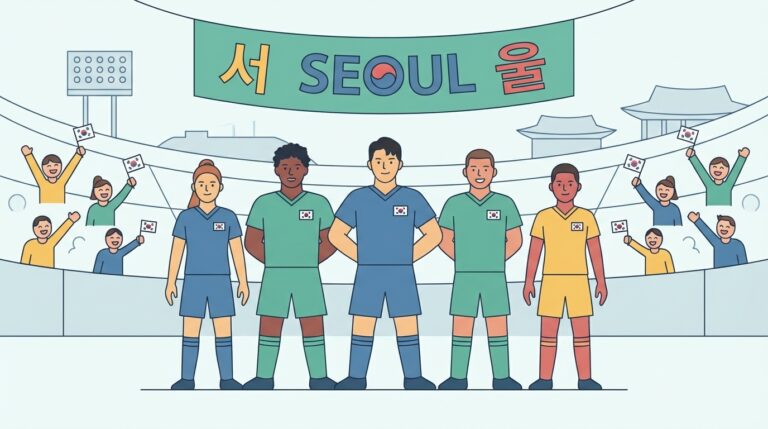
Picture this: You are at a packed Chimaek (Chicken and Beer) pub in Hongdae on a Friday night. The screens are blaring the FIBA Asia Cup or a World Cup qualifier. Suddenly, an athlete who doesn’t look traditionally “Korean” sinks a buzzer-beater or scores a stunning goal. The entire pub erupts. The crowd isn’t shouting his foreign birth name; they are chanting his adopted Korean name.
You might pause with your beer halfway to your mouth and think: Wait, I thought Korea was famously proud of being a ‘single-ethnicity’ nation (단일민족)? How does this work?
If you are a C2-level learner, you already know the grammar, the honorifics, and how to order a decent Americano. But to truly master Korean, you need to read the room—specifically, the complex, shifting landscape of Korean social identity. Today, we are diving deep into the national sentiment surrounding naturalized athletes (귀화 선수).
Understanding this won’t just help you read the sports section of Naver News; it will give you the ultimate “Insider” key to discussing Korean nationalism, identity, and K-Culture like a true local.
Phase 2: Core Expressions Deep Dive
At the C2 level, we move beyond basic vocabulary and look at expressions that carry historical and emotional weight.
1. 태극마크를 달다 (taegeuk-makeu-reul dalda)
- Pronunciation: [tae-geuk-ma-keu-reul dal-da] (The ‘tae’ sounds like the ‘ta’ in ‘tap’, ‘geuk’ is a short, sharp ‘gook’).
- Meaning: Literal: To attach the Taegeuk mark. Real: To be selected for the South Korean national team.
- K-Culture Moment: Think of the hit K-Drama Twenty-Five Twenty-One. When the fencer Na Hee-do finally makes the national team, she doesn’t just say “I made the team.” She cries over the uniform because wearing the national flag (Taegeuk) is the ultimate climax of blood, sweat, and tears.
- Editor’s Insight: This expression is heavy. It implies an immense burden of responsibility. You aren’t just playing a sport; you are carrying the pride of 50 million people on your chest.
- Situation Spectrum:
[🚫 Absolute Ban] ———— [⚠️ Caution] ———— [✅ Use Freely]
- Casual with friends: ✅
- Formal/News Media: ✅ (Highly versatile)
- 🤔 Think About It: Why “attach the mark” rather than simply “join”? In Korea, sports have historically been a vehicle for national survival and pride (especially post-war). How does your native language express joining a national team? Does it carry the same patriotic weight?
2. 순혈주의를 극복하다 (sunhyeoljuui-reul geukbokhada)
- Pronunciation: [sun-hyul-ju-ui-reul geuk-bo-ka-da]
- Meaning: Literal/Real: To overcome pure-blood nationalism/ethnocentrism.
- K-Culture Moment: You will hear this in serious talk shows or read it in editorial columns when discussing how K-Pop groups (with members from Japan, Thailand, etc.) have successfully globalized, while traditional sports have been slower to adapt.
- Editor’s Insight: Sunhyeol (Pure blood) is a concept deeply embedded in Korean history to maintain unity against countless foreign invasions. Using this word shows you deeply grasp the sociological friction in modern Korea.
- Situation Spectrum:
[🚫 Absolute Ban] ———— [⚠️ Caution] ———— [✅ Use Freely]
- Casual (Drinking with friends): ⚠️ (A bit too academic unless deep in a debate)
- Formal/Workplace/Debate: ✅
- 🤔 Think About It: Is “blood” the prerequisite for nationality? As Korea faces a demographic cliff, this word is becoming the center of social evolution.
3. 찐 한국인 다 됐네 (jjin hangugin da dwaenne)
- Pronunciation: [jjin han-gu-gin da dwen-ne]
- Meaning: Literal: You’ve become a real Korean. Real: You are officially one of us now.
- K-Culture Moment: A foreign-born athlete posts a picture on Instagram eating wildly spicy Kimchi Jjigae or complains about Korea’s humid summer using perfect slang. Korean netizens will flood the comments with this phrase.
- Editor’s Insight: Jjin (Real/Authentic) is slang, but this phrase reflects “conditional acceptance.” If a naturalized citizen shows Jeong (정, emotional bond) and adopts local habits, the public embraces them warmly.
- Situation Spectrum:
- Social Media / Close Friends: ✅
- News Articles / Formal: 🚫
Phase 3: Textbook vs. Real Korean
Let’s see how the news portrays this vs. how netizens actually talk.
| Situation | 📖 Textbook / News | 🗣️ Real Korean (Netizens) | 💡 Why the Difference? |
|---|---|---|---|
| An athlete gets naturalized | 귀화 선수가 발탁되었습니다. | 드디어 우리 형 됐네! (He finally became ‘our older brother!’) | Netizens use familial terms (“우리 형” – Our Bro) to instantly bridge the ethnic gap through emotional intimacy. |
| Praising their loyalty | 국가에 대한 헌신이 돋보입니다. | 마인드는 이미 토종 한국인임 ㅋㅋ | “토종” (Native/Indigenous) is used affectionately here to validate their “Korean-ness” based on attitude, not genetics. |
| Overcoming prejudice | 편견을 깨고 활약하고 있습니다. | 폼 미쳤다, 까방권 획득! | “까방권” (Immunity from criticism) is earned when an athlete performs so well they become universally loved. |
Phase 4: Cultural Context — K-Culture Deep Dive
4-1. The Non-Verbal Proof: The National Anthem (애국가)
When a naturalized athlete lines up before a match, the camera always zooms in on them during the Aegukga (National Anthem). Are they lip-syncing? Are their eyes closed in passion? Do they have their right hand firmly over their heart? In Korean Nunchi culture, this 1-minute non-verbal performance is a public audition of their loyalty. Nailing the anthem emotionally earns them instant respect.
4-2. The K-Pop Parallel
Let’s connect this to K-Pop. Think about multinational groups like SEVENTEEN or TWICE. Fans seamlessly accept foreign members because the goal is global domination. However, sports are traditionally tied to 국위 선양 (Enhancing National Prestige). For decades, the narrative was “Koreans beating the world.” When a naturalized athlete wears the Taegeuk mark, it forces society to ask: “Are we cheering for the flag, or the bloodline?” Today, the flag is winning.
Phase 5: Real-Life Roleplay Scenario
Setting: Friday night. You are at a bustling sports pub near Gangnam Station. The air smells of fried chicken and spilled beer. You and your Korean coworkers are watching an intense international basketball game. A naturalized player, Ra Gun-ah, just blocked a massive shot.
Characters:
– YOU: A foreign professional working in Seoul, highly fluent in Korean.
– Min-su (32): Your friendly, slightly loud Korean coworker who is very passionate about sports.
Min-su: 와!! 봤어요? 저 피지컬! 진짜 우리 국가대표의 보물이다 보물! 🍻
(Wa!! Bwasseoyo? Jeo pijikeol! Jinjja uri gukgadaepyoeui bomurida bomul!)
Wow!! Did you see that? That physicality! He is truly a treasure of our national team!
YOU: 완전요! 저 선수 귀화하고 나서 한국 팀 전력이 확 올라간 것 같아요.
(Wanjeonyo! Jeo seonsu gwihwahago naseo hanguk tim jeollyeogi hwak ollagan geot gatayo.)
Absolutely! Our team’s power level shot up after he got naturalized.
Min-su: 맞아요. 옛날에는 순혈주의 어쩌고 하면서 말 많았는데, 요즘은 다들 실력과 열정만 봐요. 애국가 부를 때 뭉클하더라니까요.
(Majayo. Yennareneun sunhyeoljuui eojjeogo hamyeonseo mal mananneunde, yojeumeun dadeul sillyeokgwa yeoljeongman bwayo. Aegukga bureul ttae mungkeulhadeoranikkayo.)
Right. In the past, there was a lot of talk about pure-blood lines, but nowadays, everyone just looks at skill and passion. It touches my heart when he sings the national anthem.
🔀 Your Turn! How do you respond?
– A) “그래도 아직 차별이 조금 있지 않나요?” (Isn’t there still a little discrimination?)
– B) “맞아요, 핏줄보다 가슴에 단 태극마크가 더 중요한 거죠! 짠 할까요?” (Exactly, the Taegeuk mark on the chest is more important than bloodline! Shall we toast?)
– C) “저도 귀화하면 국가대표 될 수 있을까요? ㅋㅋ” (Could I become a national athlete if I naturalize? lol)✅ Best Choice: B.
Why? It perfectly echoes Korean sentiment with a highly advanced, emotionally resonant phrase. It validates Min-su’s patriotism while smoothly pivoting to a celebratory toast (짠 할까요?).
Analysis of A: While analytically true, it might kill the celebratory mood of a sports pub.
Analysis of C: A great, witty joke for close friends, but B shows off your C2-level cultural fluency.
Phase 6: 10-Second Shadowing Drill
Master the cadence of a thoughtful, advanced Korean speaker.
😌 이제는 / 핏줄보다 / 가슴에 단 태극마크가 / 더 중요한 것 같아요.
(ijeneun / pitjulboda / gaseume dan taegeukmakeuga / deo jungyohan geot gatayo.)
“Now, / rather than bloodline, / the Taegeuk mark on the chest / seems more important.”
Tip: Pause slightly after ‘핏줄보다’ to emphasize the contrast. Deliver it with a warm, approving smile.
Phase 7: K-Culture Mini Dictionary
| Korean | Romanization | English | Context |
|---|---|---|---|
| 단일민족 | danilminjok | Homogeneous nation | The historical myth/belief that Koreans share a single bloodline. |
| 군면제 | gunmyeonje | Military exemption | A highly sensitive topic. Male athletes can earn this by winning Asian Games Gold or Olympic medals. |
| 토종 | tojong | Native/Indigenous | Usually used for local animals/plants, but affectionately used for foreigners who act extremely Korean. |
| 혼혈 | honhyeol | Mixed-race | An increasingly common demographic in Korea, reshaping the future of sports teams. |
Phase 8: Traveler’s Survival Kit
Even if you are just visiting Korea, you might end up at a Baseball Stadium (Jamsil) or a sports pub. Korean sports cheering culture is legendary. Here are your survival tools:
🆘 Survival Expressions for Sports Matches
– 🇰🇷 “우리 팀 응원석이 어디예요?” (uri tim eungwonseogi eodiyeyo?) – Where is our team’s cheering section?
– 🇰🇷 “여기 생맥주 두 잔이요!” (yeogi saengmaekju du janiyo!) – Two draft beers here, please!
– 🇰🇷 “역전승 가자!” (yeokjeonseung gaja!) – Let’s go for a come-from-behind victory!📌 Editor’s Travel Note
– The Vibe: Korean baseball games are half sports match, half K-Pop concert. Every player has their own theme song. Learn the songs, and you’ll make friends instantly.
– Food: You don’t need to bring food. You can order delivery (like fried chicken) directly to your seat via apps, or buy incredible street food right outside the stadium.
Phase 9: Critical Thinking — “One Step Deeper”
Language & Identity: The Conditional “Us”
Notice how the language shifts around naturalized athletes. When they first arrive in the local league, they are called Yongbyeong (용병 – mercenaries). They are hired hands expected to score points. However, the moment they naturalize and wear the national flag, the media language drastically transforms. They become “우리 선수” (Our player) or “대한민국의 아들” (Son of South Korea).
This reveals a fascinating aspect of Korean society: identity is often treated as a “shared destiny” rather than just legal citizenship. The public demands emotional proof—singing the anthem, crying when they lose, eating Korean food—to fully bridge the gap from outsider to insider.
💬 Your Turn: How does your culture view naturalized athletes? Are they instantly accepted as “one of us” through a passport, or is there an emotional test they must pass? Let us know in the comments!
Phase 10: FAQ & Avoiding Misunderstandings
Q: Can I openly discuss the “pure-blood” (단일민족) concept with Korean friends?
Yes, especially with younger generations. Millennials and Gen Z are very open to discussing the demographic changes in Korea. However, treat it as a sociological observation rather than a criticism.
Q: Do Korean fans get angry if a naturalized player makes a mistake?
No more than they would with a native player! In fact, if a naturalized player shows immense effort and cries out of frustration, Korean fans (who value “투혼” – fighting spirit) will fiercely protect them from criticism.
❌ Common Mistake: Confusing 용병 (mercenary/foreign import in local leagues) with 귀화 선수 (naturalized national team player).
✅ Do This: Never call someone wearing the Taegeuk mark a “용병”. It undermines their citizenship and dedication to the national team. They are “국가대표” (National Representative).
Phase 11: Summary & Action Items
One-Liner Summary: In Korean sports, the Taegeuk mark on the chest is slowly but surely overriding the history of the bloodline, driven by passion, skill, and Jeong.
Your Action Mission:
– 🥉 Bronze (Solo): Read the expression “핏줄보다 가슴에 단 태극마크” out loud 3 times with a dramatic, proud tone.
– 🥈 Silver (Online): Find a YouTube video of a Korean national team match featuring a naturalized player (like Ra Gun-ah) and read the Korean comments. Can you spot “우리 형”?
– 🥇 Gold (Real-world): Next time you watch a game with Korean friends, use the word “국위 선양” (enhancing national prestige) and watch their jaws drop at your advanced vocabulary!
K-Culture Mission: Watch an episode of The Gentlemen’s League (뭉쳐야 찬다) on Netflix. It features Korean sporting legends trying to play soccer, offering a hilarious, deep look into Korea’s athletic hierarchy and camaraderie.
Phase 12: Quiz — Interactive Challenge
1. Situational Judgment: You are watching the Olympics with a Korean boss. A naturalized Korean athlete wins a gold medal and cries during the anthem. What is the most C2-appropriate remark?
– A) “저 사람은 진짜 한국인 아니잖아요.”
– B) “오, 세금 낸 보람이 있네요.”
– C) “정말 감동적이네요. 이제는 완벽히 태극마크의 무게를 이겨낸 토종 한국인 같아요.”
2. Fill in the Blank:
한국 스포츠계도 점차 ( )주의를 극복하고 다양성을 받아들이고 있습니다.
(The Korean sports world is gradually overcoming _________-ism and embracing diversity.)
3. True or False – Culture Edition:
(T / F) If you want to drink beer at a Korean baseball stadium, you must sneak it in because alcohol is strictly prohibited.
🚨 Click here for the answers!
- Answer: C. It shows empathy, advanced vocabulary (태극마크의 무게), and cultural understanding. A is deeply offensive, and B is too cynical for this emotional moment.
- Answer: 순혈 (sunhyeol – pure blood).
- Answer: False. Korean stadiums famously sell massive cups of draft beer, and chicken-and-beer is a stadium staple!
Frequently Asked Questions (FAQ)
Q: What does "태극마크를 달다 (taegeuk-makeu-reul dalda)" mean in Korean and how do you pronounce it?
A: In Korean, "태극마크를 달다 (taegeuk-makeu-reul dalda)" is pronounced [tae-geuk-ma-keu-reul dal-da] and means: Literal: To attach the Taegeuk mark. Real: To be selected for the South Korean national team.
Q: What does "순혈주의를 극복하다 (sunhyeoljuui-reul geukbokhada)" mean in Korean and how do you pronounce it?
A: In Korean, "순혈주의를 극복하다 (sunhyeoljuui-reul geukbokhada)" is pronounced [sun-hyul-ju-ui-reul geuk-bo-ka-da] and means: Literal/Real: To overcome pure-blood nationalism/ethnocentrism.
Q: What does "찐 한국인 다 됐네 (jjin hangugin da dwaenne)" mean in Korean and how do you pronounce it?
A: In Korean, "찐 한국인 다 됐네 (jjin hangugin da dwaenne)" is pronounced [jjin han-gu-gin da dwen-ne] and means: Literal: You've become a real Korean. Real: You are officially one of us now.






