

Phase 1: Empathy (Immersive Open)
Hello! I’m your Daily Hangul Editor.
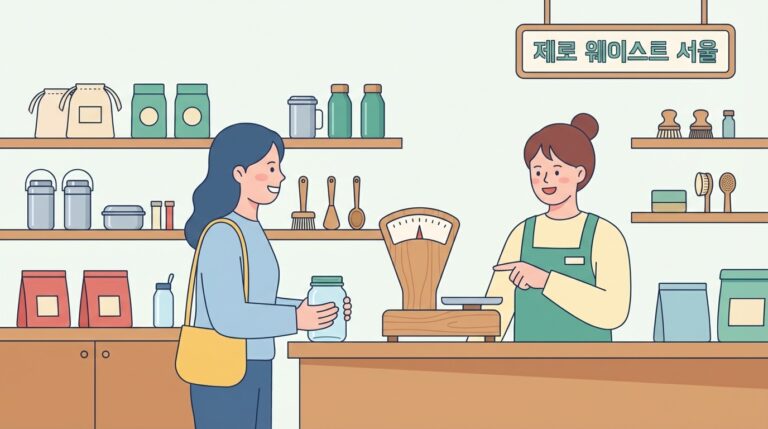
Picture this: You are walking down the trendy streets of Seongsu-dong. You step into a beautiful, minimalist store that looks exactly like the set of a K-Drama where the chic female lead works. It’s a zero-waste K-Beauty refill station. You pick up a beautiful glass bottle to buy some vegan body wash, but as you approach the counter, the staff smiles and asks:
“손님, 혹시 용기 있으세요?” (Son-nim, hoksi yonggi isseuseyo?)
You freeze. You’ve studied Korean up to an intermediate level. You know the word 용기 (yonggi) means ‘courage’.
“Do I need courage to buy soap?!” you think, panicking.
Don’t worry! In the context of environment and recycling, 용기 (yonggi) means ‘container’. Today, we’re diving into the eco-friendly side of modern K-Culture. Knowing how to navigate a zero-waste shop (제로 웨이스트 샵) will not only save the planet but also make you look like an absolute Seoul local. Let’s learn the phrases that will give you the courage to use your container!
Phase 2: Core Expressions Deep Dive
1. 용기 챙겨 왔어요. (I brought my own container.)
- Pronunciation: [Yonggi chaeng-gyeo wasseoyo.] + (‘Yong’ sounds like ‘young’ with an ‘o’, and ‘gi’ sounds like the ‘gee’ in geese)
- Meaning: I brought my own container. (Literal: I packed and brought a container.)
- K-Culture Moment: You’ll see K-Pop idols holding their own tumblers or eco-bags at the airport to promote ‘가치소비’ (value-based consumption). Say this proudly at the refill station!
- Editor’s Insight: Using 챙기다 (to pack/make sure to bring) instead of just 가져오다 (to bring) adds a nuance of care and preparation. It sounds incredibly natural and mature.
- Situation Spectrum:
[🚫 절대 금지] ———— [⚠️ 주의] ———— [✅ 자유롭게]
- Casual with staff: ✅
- Formal business: ⚠️ (Use ‘지참했습니다’ for highly formal settings, but ‘챙겨 왔어요’ is perfect for shops)
- 🤔 Think About It: Why does Korean have so many words with double meanings (like 용기)? How does context play a heavier role in Korean than in English?
2. 이거 소분해서 살 수 있나요? (Can I buy this in small portions?)
- Pronunciation: [Igeo sobunhaeseo sal su innayo?] + (‘So’ like in ‘so’, ‘bun’ like ‘boon’)
- Meaning: Can I buy this subdivided/in small portions?
- K-Culture Moment: In a typical Korean supermarket, everything is sold in massive bulk (1+1 or 2+1 deals). But zero-waste shops allow you to buy just the 10 grams of baking soda you actually need.
- Editor’s Insight: The word 소분하다 (to subdivide/portion out) is a B2-level gem. If you use this word instead of “조금만 주세요” (Please give me a little), the staff will be seriously impressed by your vocabulary.
- Situation Spectrum:
[🚫 절대 금지] ———— [⚠️ 주의] ———— [✅ 자유롭게]
- Zero waste shops / Markets: ✅
- Normal convenience stores: 🚫 (They don’t do this!)
- 🤔 Think About It: Korea has a strong “sharing” culture (like giant pots of stew). Do you think the rise of ‘소분하다’ reflects the increase in single-person households in Seoul?
3. 영수증은 모바일로 주세요. (Please give me a mobile receipt.)
- Pronunciation: [Yeongsujeung-eun mobail-lo juseyo.] + (‘Yeong’ like ‘young’, ‘su’ like ‘sue’, ‘jeung’ sounds like ‘j-uh-ng’)
- Meaning: Send the receipt to my mobile.
- K-Culture Moment: When buying coffee at a trendy cafe or checking out at Olive Young, they will always ask if you need a paper receipt. Save paper like a true MZ generation local!
- Editor’s Insight: You can also just say “영수증 버려주세요” (Please throw away the receipt), but if you need it for tracking your budget, asking for a mobile receipt is the eco-friendly standard.
- Situation Spectrum:
[🚫 절대 금지] ———— [⚠️ 주의] ———— [✅ 자유롭게]
- Any shop/Cafe/Store: ✅
Phase 3: Textbook vs. Real Korean
| 상황 (Situation) | 📖 교과서 한국어 (Textbook) | 🗣️ 진짜 한국어 (Real Korean) | 💡 왜 다를까? (Why is it different?) |
|---|---|---|---|
| Rejecting a bag | 비닐봉투는 필요 없습니다. (I do not need a plastic bag.) | 그냥 들고 갈게요. (I’ll just carry it as is.) | Koreans prefer action-oriented verbs. Saying “I will carry it” is softer than a direct “I don’t need it.” |
| Asking to weigh | 무게를 달아 주시겠습니까? (Would you please weigh this?) | 저울 영점은 제가 맞출까요? (Should I zero the scale myself?) | In many zero-waste shops, it’s a self-service culture. Anticipating the task shows great Nunchi. |
| Buying a small amount | 조금만 사도 괜찮습니까? (Is it okay to buy a little?) | 요만큼만 담아도 되죠? (It’s fine if I just fill this much, right?) | Adding a cute gesture (요만큼) and asking for confirmation (-도 되죠?) makes the interaction much friendlier. |
Bottom Note: As a B2 learner, try to shift from direct statements (I don’t need) to softer, collaborative questions (-도 되죠?).
Phase 4: Cultural Context — K-Culture Deep Dive
4-1. Non-verbal Nunchi at the Refill Station
In Korea, 눈치 (Nunchi) isn’t just about reading emotions; it’s about reading systems. At a zero-waste shop, the unspoken rule is: Tare the scale first.
Before you fill your jar with that organic K-Beauty shampoo, you must weigh the empty jar (용기 무게 재기) and print a barcode. If you just fill it up and go to the cashier, you’ll disrupt the fast-paced flow of the store. Observing what the person in front of you is doing before stepping up is peak Nunchi!
4-2. The K-Beauty & Idol Connection
Recently, K-Pop idols have been actively promoting ‘비건 (Vegan)’ and ‘친환경 (Eco-friendly)’ lifestyles. When idols do a V-Live (Weverse) and show off their bamboo toothbrushes or solid shampoo bars (샴푸바), those items sell out immediately. Major K-Beauty brands (like Amorepacific) have opened massive refill stations where you can bring your own empty lotion bottles. It’s no longer just a hippie movement; being eco-friendly in Korea is considered highly sophisticated and trendy.
Phase 5: Real-world Roleplay Scenario
Setting: Saturday afternoon, Mangwon-dong (망원동). You are inside ‘Almeng Market’ (알맹상점), a famous zero-waste shop. The scent of natural soap fills the air. You’ve filled your own jar with some vegan laundry detergent and are standing at the counter.
Characters:
– YOU: A B2 Korean learner who wants to live sustainably in Seoul.
– 지우 (Ji-woo): The friendly 20-something staff member wearing an organic cotton apron.
Dialogue:
지우: 안녕하세요! 직접 용기 챙겨 오셨네요. 🌿
(Annyeonghaseyo! Jikjeop yonggi chaeng-gyeo osyeonneyo.)
[Hello! I see you brought your own container.]
(🎭 Stage Direction: Ji-woo smiles and takes your glass jar to check the barcode.)
YOU: 네, 집에서 씻어서 가져왔어요. 소독도 했고요! ✨
(Ne, jibeseo ssiseoseo gajyeowasseoyo. Sodokdo haetgoyo!)
[Yes, I washed it at home and brought it. I sanitized it too!]
지우: 우와, 완벽하시네요. 세제 소분하신 거 계산해 드릴게요.
(Uwa, wanbyeokhasineyo. Seje sobunhasin geo gyesanhae deurilkkeyo.)
[Wow, you’re perfect. I’ll ring up the detergent you portioned out.]
지우: 결제 완료되었습니다. 혹시 담아가실 종이봉투 필요하세요?
(Gyeolje wallyodoeeotseumnida. Hoksi damagasil jong-ibongtu piryohaseyo?)
[Payment is complete. Do you need a paper bag to carry this in?]
🔀 Your Turn! How should you reply?
– A) “아니요, 종이봉투는 환경에 나쁩니다.” (No, paper bags are bad for the environment.)
– B) “괜찮아요, 제 가방에 그냥 넣고 갈게요!” (It’s okay, I’ll just put it in my bag and go!)
– C) “봉투는 필요 없어요.” (I don’t need a bag.)✅ Best Choice: B — Reason: It’s polite, explains why you don’t need it, and sounds incredibly native.
⚠️ Choice A & C Analysis: ‘A’ sounds like you are scolding the staff. ‘C’ is grammatically correct but a bit too blunt for a friendly interaction.
Phase 6: 10-Second Shadowing Drill
Practice speaking like a native! Follow the intonation (강세) and pauses (끊어 읽기).
🌿 차분하고 뿌듯하게 (Calm and proud):
저기요 / 영수증은 / 모바일로 / 보내주셔도 돼요~
(Jeogiyo / yeongsujeung-eun / mobail-lo / bonaejusyeodo dwaeyo~)
[Excuse me, you can just send the receipt via mobile.]
Tip: Elongate the “돼요~” (dwaeyo) slightly at the end to sound friendly and approachable, not demanding!
Phase 7: K-Culture Mini Dictionary
| 한국어 | Romanization | English | Cultural Context |
|---|---|---|---|
| 가치소비 | gachi-sobi | Value-based consumption | Buying products that align with one’s ethics (eco-friendly, vegan). Huge trend among Korean Gen Z. |
| 다회용기 | dahoeyong-gi | Reusable container | The formal word for reusable cups/boxes. Delivery apps now have an option to order using ‘다회용기’. |
| 줍깅 / 플로깅 | jupging / peulloging | Plogging | Combining ‘줍다’ (to pick up) and ‘jogging’. Picking up trash while running along the Han River. |
| 당근하다 | danggeunhada | To buy/sell second-hand | Named after the famous app ‘Karrot’ (당근마켓). Used as a verb: “I bought this used.” |
Phase 8: Traveler’s Survival Kit
Are you just visiting Korea and want to participate in the eco-friendly trend? Here are the top phrases you need when navigating any market or cafe!
🆘 Survival Phrases for Eco-Travelers
– 🇰🇷 텀블러에 담아주세요. (Teombeulleoe damajuseyo.)
– 🗣️ Meaning: Please put it in my tumbler.
– 📍 Where to use: Starbucks, local cafes. (Bonus: You often get a 300~400 won discount!)
- 🇰🇷 영수증이랑 빨대는 빼주세요. (Yeongsujeung-irang ppaldaeneun ppaejuseyo.)
- 🗣️ Meaning: Please leave out the receipt and straw.
- 📍 Where to use: Convenience stores, cafes.
📌 Editor’s Travel Note
– Delivery Apps (배달의민족): If you order food to your Airbnb, always check the box that says “일회용 수저, 포크 안 주셔도 돼요” (You don’t need to give me disposable spoons/forks). It saves plastic and shows you respect the local recycling efforts!
– Trash Sorting (분리수거): Korea has one of the strictest recycling systems in the world. If you stay in an Airbnb, you must separate food waste (음식물 쓰레기) from regular trash and plastics. Failing to do so can result in huge fines for the host!
Phase 9: Critical Thinking Corner — “한 발 더 깊이”
🧠 Think Deeper: Media vs Reality (Fast Delivery vs. Slow Eco-Movement)
If you watch K-Dramas, you’ve probably seen characters ordering an amazing feast of fried chicken or jajangmyeon at 2 AM. Korea is famous for its “빨리빨리” (hurry-hurry) culture and incredibly convenient delivery infrastructure. However, this convenience generates a mountain of plastic waste.
As a counter-reaction, the “Zero Waste” movement is growing rapidly among young Koreans. It’s a fascinating cultural tug-of-war. On one hand, you have the ultimate convenience of K-Delivery; on the other, you have a passionate generation washing out plastic containers, sewing their own cotton pads, and using shampoo bars. The language reflects this shift—words like 다회용기 (reusable containers) are now legally integrated into delivery apps.
💬 Your Turn: Does your country have a similar conflict between extreme convenience and environmental protection? How do people compromise? Let me know in the comments!
Phase 10: FAQ & 오해 방지
Q: “Can I bring ANY container to a refill station?”
Yes! But it MUST be completely dry. If you bring a wet container, the staff will gently reject it because water breeds bacteria in natural cosmetics. You can say: “바짝 말려서 왔어요” (I dried it completely before coming).
Q: “If I bring a tumbler to a cafe, can I speak casually and say ‘여기 넣어줘’?”
No! Always use standard polite form (요 form). Hand them the cup with two hands and say “여기에 담아주세요.” (Please put it in here).
❌ Common Mistake #1: Confusing 봉투 (plastic/paper bag) with 우편 봉투 (mailing envelope). At a shop, if you say “봉투 주세요”, they know you mean a shopping bag. You don’t need to say “쇼핑백” unless you want a fancy branded paper bag.
❌ Common Mistake #2: Thinking you can’t buy very small amounts. In traditional Korean markets, sellers might get annoyed if you buy too little (정 culture). But in Zero Waste shops, buying exactly 5 grams of tea leaves is totally fine and encouraged!
Phase 11: Summary & Action Items
One-Liner Summary: Bring your yonggi (container) with yonggi (courage), and ask to sobun (subdivide) your items to become a zero-waste master in Korea!
Action Mission 3단계:
– 🥉 Bronze (Solo): Stand in front of a mirror holding a jar and practice saying: “용기 챙겨 왔어요!”
– 🥈 Silver (Online): Go to a K-Beauty brand’s Instagram page and leave a comment: “다회용기 짱이에요! 🌱” (Reusable containers are the best!)
– 🥇 Gold (Real-world): Go to a cafe in Korea, hand them your tumbler, and say, “여기에 담아주세요. 빨대는 안 주셔도 돼요!”
🌟 K-Culture Mission:
Next time you use a Korean delivery app (or watch a YouTube vlog of someone ordering K-food), look for the phrase “일회용품 안 주셔도 돼요” (No disposable items needed). Take a screenshot when you spot it!
Phase 12: Quiz — Interactive Challenge
1. Situational Judgment: You are buying 20 grams of bath salts at a zero waste shop in Seoul. You want to ask if it’s okay to buy such a small amount. What is the most natural B2-level phrase to use?
– A) 조금만 살게요. 불만 있나요? (I will buy a little. Do you have a complaint?)
– B) 이거 소분해서 살 수 있나요? (Can I buy this portioned out?)
– C) 작게 주세요. (Give me small.)
2. True or False — K-Culture Edition:
In Korea, it is culturally acceptable to just throw all your trash (food, plastic, paper) into one big bag when you leave an Airbnb. (T/F)
3. Fill in the Blank:
You want to impress the cashier by telling them you don’t need a paper receipt because you want an eco-friendly mobile one.
“( _____ )은 모바일로 주세요.”
(Answers below!)
Click to reveal answers!
1. B (A is extremely rude. C is grammatically awkward. ‘소분하다’ is the perfect B2 vocabulary here.)
2. False! Korea has extremely strict ‘분리수거’ (recycling) rules. Food waste MUST be separated, or heavy fines apply.
3. 영수증 (Yeongsujeung)
Frequently Asked Questions (FAQ)
Q: What does "용기 챙겨 왔어요. (I brought my own container.)" mean in Korean and how do you pronounce it?
A: In Korean, "용기 챙겨 왔어요. (I brought my own container.)" is pronounced [Yonggi chaeng-gyeo wasseoyo.] and means: I brought my own container. (Literal: I packed and brought a container.)
Q: What does "이거 소분해서 살 수 있나요? (Can I buy this in small portions?)" mean in Korean and how do you pronounce it?
A: In Korean, "이거 소분해서 살 수 있나요? (Can I buy this in small portions?)" is pronounced [Igeo sobunhaeseo sal su innayo?] and means: Can I buy this subdivided/in small portions?
Q: What does "영수증은 모바일로 주세요. (Please give me a mobile receipt.)" mean in Korean and how do you pronounce it?
A: In Korean, "영수증은 모바일로 주세요. (Please give me a mobile receipt.)" is pronounced [Yeongsujeung-eun mobail-lo juseyo.] and means: Send the receipt to my mobile.







