

Phase 1: Immersive Hook
Hello there! This is your Daily Hangul Editor.
Picture this: You are watching your favorite K-Drama. The main character is standing outside a convenience store holding a can of beer. A friend invites them to join a party, and the character awkwardly smiles, rubs the back of their neck, and says, “Ah… I have a stomachache…” or “Let’s grab a meal next time!” The subtitles simply read: “No, thanks.”
Wait, what?
Did they really just say “no”? If you have ever felt confused by how Koreans seem physically incapable of just saying a flat, direct “No,” you are not alone. I have seen countless B2-level students completely misunderstand a situation because they took a Korean’s “Let’s do it next time” as a literal promise, rather than what it actually is: a polite, face-saving refusal.
In Korean culture, protecting social harmony (Kibun) is often more important than brutal honesty. Today, we are going to dive deep into the Korean Nuance of saying “no” without actually using the word “no.” Mastering this will instantly elevate you from a textbook learner to a true cultural insider. Let’s decode the hidden messages!
Phase 2: Deep Dive into Key Expressions
Here are the top 3 ways Koreans say “no” without saying “no.”
1. 아, 괜찮습니다. (Ah, gwaenchanseumnida.)
- Pronunciation: [a, gwaen-chan-seum-ni-da] + ‘gwaen’ sounds like the English name Gwen, and ‘seum’ sounds like you are humming ‘sum’ with your teeth closed.
- Meaning: Literal: Ah, it’s okay/fine. / Real nuance: No, thank you.
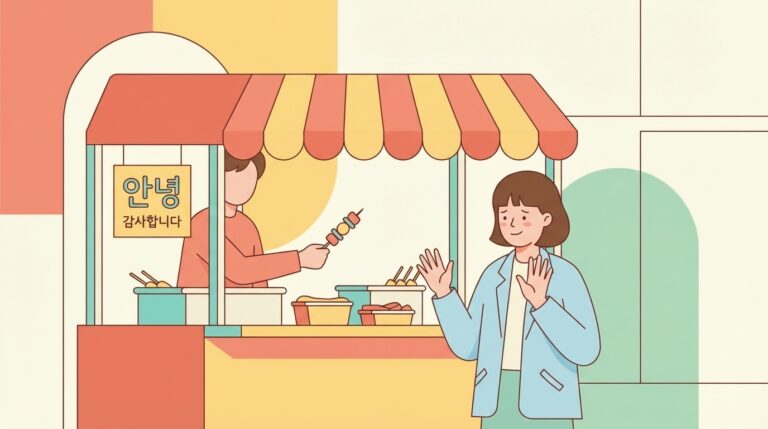
- K-Culture Moment: You are at a bustling local market, and a vendor enthusiastically offers you a free sample of something you really don’t want to eat. You don’t say “아니요 (No).” You gently wave your hand like you’re washing a window and say, “아, 괜찮습니다.”
- Editor’s Insight: This is the ultimate “soft shield.” It implies, “I am perfectly fine as I am, so you don’t need to trouble yourself.” It shows gratitude while firmly declining.
- Situation Spectrum:
[🚫 절대 금지] ———— [⚠️ 주의] ———— [✅ 자유롭게]
- Casual (Friends): ✅ (Say: 아, 괜찮아)
- Semi-formal (Co-workers): ✅
- Formal (Boss/Elders): ✅
- 🤔 Think About It: Why do Koreans prefer saying “I am fine” over “I don’t want it”? How does this reflect the Korean value of considering the other person’s effort?
2. 다음에 밥 한 번 같이 먹어요. (Daeume bap han beon gachi meogeoyo.)
- Pronunciation: [da-eu-me bap han beon ga-chi meo-geo-yo] + ‘meo-geo’ sounds like ‘mug-uh’.
- Meaning: Literal: Let’s eat a meal together next time. / Real nuance: Goodbye / I’m declining your current offer, but let’s keep a good relationship.
- K-Culture Moment: At the end of a blind date that didn’t go perfectly, or when bumping into an old acquaintance on the subway.
- Editor’s Insight: This is classic Binmal (빈말, empty words). It is not a lie; it is a social lubricant. Do not wait by your phone for a dinner invitation!
- Situation Spectrum:
[🚫 절대 금지] ———— [⚠️ 주의] ———— [✅ 자유롭게]
- Casual (Friends): ✅
- Semi-formal (Co-workers): ✅
- Formal (Boss/Elders): ⚠️ (Better to let the elder suggest it first)
- 🤔 Think About It: Food is deeply tied to affection in Korea. Why is the ultimate polite brush-off still related to sharing a meal?
3. 생각해 보겠습니다. (Saenggakhae bogetseumnida.)
- Pronunciation: [saeng-gak-hae bo-get-seum-ni-da]
- Meaning: Literal: I will think about it. / Real nuance: Absolutely not (Business context).
- K-Culture Moment: You pitch a brilliant idea to your Korean boss or client. They nod, smile slightly, and say this phrase.
- Editor’s Insight: If a Korean partner says they will “think about it” without asking follow-up questions or setting a deadline, it is a 99% guaranteed rejection. They are just trying not to embarrass you on the spot.
- Situation Spectrum:
[🚫 절대 금지] ———— [⚠️ 주의] ———— [✅ 자유롭게]
- Casual (Friends): 🚫 (Too rigid)
- Semi-formal (Co-workers): ⚠️
- Formal (Business): ✅
- 🤔 Think About It: In your culture, is a direct “no” in business considered professional or rude?
Phase 3: Textbook vs Real Life
| Situation | 📖 Textbook Korean | 🗣️ Real Life Korean | 💡 Why is it different? |
|---|---|---|---|
| Rejecting food | 아니요, 안 먹어요. (No, I won’t eat.) | 아유, 배불러서요. 괜찮습니다! (Oh, I’m too full. I’m okay!) | Direct refusal rejects the person’s Jeong (affection), not just the food. |
| Declining an invite | 아니요, 안 갈 거예요. (No, I won’t go.) | 아… 어쩌죠? 선약이 있어서요. (Ah… what should I do? I have a prior engagement.) | Showing hesitation (“어쩌죠?”) proves you want to go, preserving the host’s pride. |
| Ending a conversation | 안녕히 가세요. (Goodbye.) | 네~ 다음에 봬요! / 조심히 가세요~ (Yes~ See you next time! / Go safely~) | Koreans soften goodbyes with promises of the future or wishes for safety. |
Bottom Note: As a B2 learner, stop using the blunt “아니요 (No)” as a standalone sentence. Always pair it with a reason or a softer alternative!
Phase 4: Cultural Deep Dive
4-1. Non-verbal Communication: The “Window Wiper” Hand ✋
When a Korean says “괜찮습니다” (It’s okay), pay attention to their hands. They will often hold their hand up, palm facing you, and wave it side to side a few times. This isn’t a magical spell; it’s the physical embodiment of Nunchi (reading the room). It visually blocks the offer while smiling to keep things friendly.
4-2. K-Culture Connection: The Drama Tropes vs Reality 🎬
Have you ever noticed in K-Dramas how often characters get dragged into drinking sessions (Hoesik) because they simply couldn’t say no?
In traditional Korean corporate culture, refusing a superior’s offer to pour you a drink was seen as a rejection of their leadership.
Critical Viewpoint: Dramas often exaggerate this for comedic or dramatic effect. In modern, real-life Korea (especially among millennials and Gen Z), it is becoming much more acceptable to politely decline with “저는 술을 잘 못 마십니다” (I can’t drink well). The language is evolving to prioritize personal boundaries over strict hierarchy, though the polite tone remains mandatory.
Phase 5: Immersive Roleplay Scenario
Scenario A: The Friday Night K-BBQ
Setting: Friday night, 9 PM. A loud, smoky Samgyeopsal (pork belly) restaurant in Gangnam. You are with three Korean coworkers. Everyone has eaten well, and the Soju bottles are piling up.
Characters:
– YOU: An expat on your 3rd month working in Seoul. You want to go home and sleep.
– Minsu (32): Your energetic Korean coworker who loves a good party.
Dialogue:
Minsu: 뫄뫄 씨, 우리 2차로 노래방 갈 건데, 같이 갈 거죠? 🎤
(Mwa-mwa ssi, uri icharo noraebang gal geonde, gachi gal geojyo?)
(Mwa-mwa, we’re going to a karaoke room for the 2nd round, you’re coming, right?)
(🎭 Stage Direction: Minsu is already standing up, putting on his jacket, assuming you will say yes.)
YOU: 아… 노래방이요?
(Ah… noraebang-iyo?)
(Ah… karaoke?)
Minsu: 네! 한국에 왔으면 회식 2차는 필수죠! 가자, 가자!
(Ne! Hanguge wasseumyeon hoesik ichaneun pilsujyo! Gaja, gaja!)
(Yes! If you’re in Korea, the 2nd round of a company dinner is a must! Let’s go, let’s go!)
🔀 Your Turn! How should you reply?
– A) “아니요. 저는 피곤해서 집에 갈게요.” (No. I am tired so I will go home.)
– B) “아, 어쩌죠? 제가 내일 아침 일찍 일정이 있어서요. 다음에 꼭 같이 가요!” (Ah, what should I do? I have an early schedule tomorrow morning. Let’s definitely go together next time!)
– C) “생각해 보겠습니다.” (I will think about it.)✅ Best Choice: B — Why? You show hesitation (“어쩌죠?”), provide an undeniable external reason (early schedule), and use the magical Binmal (“다음에 꼭 같이 가요”) to protect Minsu’s pride.
⚠️ Choice A Analysis: Grammatically perfect, culturally disastrous. It sounds completely cold and kills the mood.
⚠️ Choice C Analysis: Minsu will think you are a robot. This is for formal business, not a Friday night BBQ!
Scenario B: The Street Food Overload 🍢
Setting: Gwangjang Market. You just finished eating Tteokbokki.
Vendor Auntie (Imo): “학생~ 이거 튀김 서비스야. 더 먹어!” (Student~ This fried food is on the house. Eat more!)
YOU: “아유, 사장님 너무 맛있는데 제가 배가 너무 불러서요. 아쉽지만 괜찮습니다!” (Oh, boss, it’s so delicious but I am so full. It’s a shame, but I’m okay!)
(Pro Tip: Blame your stomach capacity, not her food!)
Phase 6: 10-Second Shadowing Drill
Let’s practice the rhythm of a polite refusal. Pay attention to the pauses (/) and emotions!
🥺 아... 어쩌죠? / 제가 오늘 / 선약이 있어서요. (Ah... eojjeojyo? / jega oneul / seonyagi isseoseoyo.)
– Translation: Ah… what should I do? I have a prior engagement today.
– Tip: Drag out the “Ah…” slightly to show genuine regret.
😊 마음은 너무 감사하지만, / 아쉽게도 / 괜찮습니다! (Maeumeun neomu gamsahajiman, / aswipgedo / gwaenchanseumnida!)
– Translation: I am so thankful for the thought, but unfortunately, I am okay (no thank you)!
Phase 7: K-Culture Glossary
| Korean | Romanization | English | Contextual Meaning |
|---|---|---|---|
| 눈치 | nunchi | Social intelligence | The art of reading the room. Knowing someone wants to say ‘no’ even if they don’t say it. |
| 빈말 | binmal | Empty words | Socially acceptable white lies used to maintain harmony (e.g., “Let’s grab a meal”). |
| 정 | jeong | Affection/Bond | The deep emotional connection between people. Rejecting an offer too bluntly hurts Jeong. |
| 선약 | seonyak | Prior engagement | The ultimate bulletproof excuse to get out of sudden plans. |
| 거절 | geojeol | Refusal | The act of saying no, which Koreans try to wrap in as much padding as possible. |
Phase 8: Traveler’s Survival Kit 🧳
Even as a traveler, you will need to decline things: taxi drivers offering tours, aggressive cosmetic vendors in Myeongdong, or friendly locals offering too much food.
🆘 Survival Phrases for Travelers
– 🇰🇷 “아유, 괜찮습니다~” (A-yu, gwaen-chan-seum-ni-da~)
– 🗣️ English Guide: The “A-yu” adds a sigh of regret, making it softer.
– 📍 Where to use: Myeongdong cosmetic shops, street markets.
– 💡 Pro Tip: Combine this with the “window wiper” hand gesture and keep walking. Do not stop to explain yourself to street touts!
- 🇰🇷 “제가 매운 걸 잘 못 먹어서요.” (Jega maeun geol jal mot meogeoseoyo.)
- 🗣️ English Guide: “I can’t eat spicy things well.”
- 📍 Where to use: Restaurants when they offer “service” (free extra food) that looks fiery red.
📌 Editor’s Travel Note
– Personal Space Boundaries: In local markets, grandmas (Halmoni) might physically grab your arm to offer you a seat or food. It’s not a threat; it’s aggressive Jeong. A smiling “괜찮습니다” with a slight bow is your best defense.
– Tipping: Korea has NO tipping culture. If a waiter tries to return your change and you say “Keep it” (trying to be nice), they will be confused or even chase you down the street. To refuse change, you have to literally run away!
Phase 9: Think Deeper — “Language & Social Harmony”
🧠 Think Deeper: Social Harmony (Kibun) over Directness
In many Western cultures, “No means No,” and clarity is respected. However, in Korea, preserving a person’s Kibun (mood/face/pride) is paramount. A direct “No” feels like a sharp knife cutting the invisible thread of relationship between two people. By using phrases like “I’ll think about it” or blaming an external factor (“I have a stomachache”), you allow the other person to save face. The refusal is understood contextually through Nunchi. It is not deception; it is a highly evolved system of mutual empathy.💬 Your Turn: In your culture, is it considered rude to give an excuse when declining an invitation? Do you prefer the Korean “soft refusal” or direct honesty? Share in the comments!
Phase 10: FAQ & Troubleshooting
Q: “Can I just say ‘아니요’ (Aniyo) to my boss if I really can’t do something?”
No, please don’t! To a superior, a flat “아니요” sounds almost defiant. Instead, say “죄송하지만, 그 부분은 어려울 것 같습니다” (I am sorry, but that part seems difficult).
Q: “If an idol asks me ‘다음에 또 올 거죠?’ (You’ll come again next time, right?) at a fan sign, can I use these soft refusals?”
No! In a fan-idol dynamic, you want to show maximum enthusiasm. Even if you can’t come, say “당연하죠!” (Of course!). Applying “생각해 보겠습니다” to an idol would be a hilarious disaster.
❌ Common Mistake #1: Taking “다음에 밥 먹어요” literally.
✅ Do this instead: Just reply “네, 좋아요!” (Yes, sounds good!) and move on. Don’t pull out your calendar to schedule a date.❌ Common Mistake #2: Saying “아니요” with a serious face when offered a compliment.
✅ Do this instead: Koreans deflect compliments. If someone says your Korean is great, say “아유, 아직 멀었어요” (Oh, I still have a long way to go) while smiling.
Phase 11: Wrap-up & Action Items
✨ One-Liner Summary: In Korea, a polite refusal is always wrapped in hesitation, apologies, or a promise for the future to protect the other person’s pride.
🎯 Action Mission:
– 🥉 Bronze (Solo): Stand in front of a mirror, do the “window wiper” hand gesture, and practice saying “아, 괜찮습니다” with a gentle smile 3 times.
– 🥈 Silver (Online): Go to a Korean language forum and write a post declining a fictional invitation using “선약이 있어서요” (I have a prior engagement).
– 🥇 Gold (Real Life): Next time you are at a Korean restaurant or market and are offered something you don’t need (like a plastic bag or an extra side dish), gently refuse using today’s expressions!
🎬 K-Culture Mission:
Watch one episode of a slice-of-life K-Drama (like Hospital Playlist or Reply 1988). Spot the exact moment someone declines an offer. What excuse did they use? Did they rub their neck? Let me know below!
Phase 12: Interactive Quiz
1. Situational Judgment: Your Korean friend invites you to go hiking this Saturday at 6 AM. You hate waking up early. What is the most culturally appropriate response?
– A) 아니요. 저는 등산 싫어해요. (No. I hate hiking.)
– B) 아… 어쩌죠? 제가 주말에 밀린 일이 좀 있어서요. 다음에 꼭 같이 가요! (Ah… what should I do? I have some caught-up work this weekend. Let’s go next time!)
– C) 생각해 보겠습니다. (I will think about it.)
2. True or False – K-Culture Edition:
– When a Korean says “Let’s get a drink sometime,” you should immediately ask them “Which day works for you?”
3. Fill in the Blank:
You are full, but the restaurant owner offers you more rice.
“사장님, 마음은 감사하지만 제가 ____가 너무 불러서요. 아, ________!”
(Hint: stomach, it’s okay)
Answers (Click to reveal)
1. B (A is too harsh and hurts feelings. C is for formal business and sounds weird to a friend.)
2. False (It is usually ‘Binmal’, an empty polite greeting. Just agree casually.)
3. 배, 괜찮습니다 (Boss, thank you for the thought but my stomach is too full. Ah, I am okay!)
Frequently Asked Questions (FAQ)
Q: What does "아, 괜찮습니다. (Ah, gwaenchanseumnida.)" mean in Korean and how do you pronounce it?
A: In Korean, "아, 괜찮습니다. (Ah, gwaenchanseumnida.)" is pronounced [a, gwaen-chan-seum-ni-da] and means: Literal: Ah, it's okay/fine. / Real nuance: No, thank you.
Q: What does "다음에 밥 한 번 같이 먹어요. (Daeume bap han beon gachi meogeoyo.)" mean in Korean and how do you pronounce it?
A: In Korean, "다음에 밥 한 번 같이 먹어요. (Daeume bap han beon gachi meogeoyo.)" is pronounced [da-eu-me bap han beon ga-chi meo-geo-yo] and means: Literal: Let's eat a meal together next time. / Real nuance: Goodbye / I'm declining your current offer, but let's keep a good relationship.
Q: What does "생각해 보겠습니다. (Saenggakhae bogetseumnida.)" mean in Korean and how do you pronounce it?
A: In Korean, "생각해 보겠습니다. (Saenggakhae bogetseumnida.)" is pronounced [saeng-gak-hae bo-get-seum-ni-da] and means: Literal: I will think about it. / Real nuance: Absolutely not (Business context).







