

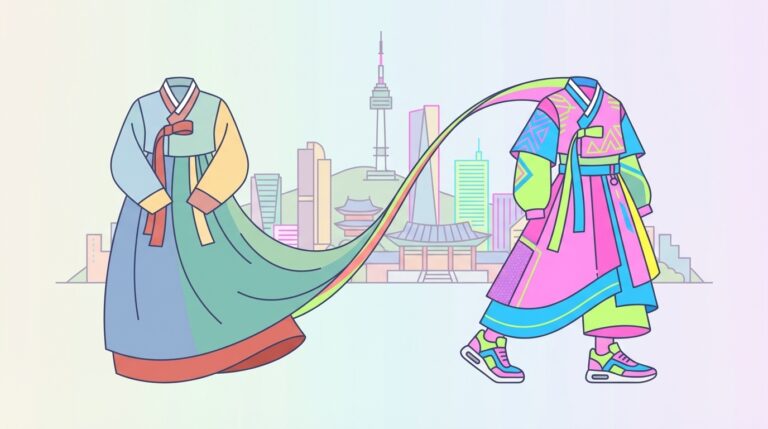
Phase 1: Immersive Hook
Hello there! I’m the Senior Editor at Daily Hangul.
Picture this: You are watching a breathtaking K-Pop music video—maybe BLACKPINK’s “How You Like That” or BTS’s “Idol.” The beat drops, and suddenly, the artists are dominating the screen wearing… Hanbok. But wait, it’s not the stiff, formal Hanbok you saw in a historical K-Drama like Kingdom. It’s cropped, paired with combat boots, emblazoned with golden traditional motifs, and absolutely dripping with swagger.
Or perhaps you’re walking down the trendy streets of Seongsu-dong or Yeonnam-dong in Seoul. You spot a local fashionista wearing what looks like a wrap skirt and a breezy linen jacket, but with unmistakable traditional collars.
Welcome to the fascinating world where Korea’s rich sartorial heritage collides with cutting-edge street fashion. Understanding how to talk about the aesthetics of Hanbok (한복) and its modern reinterpretation won’t just improve your Korean—it will give you a backstage pass to one of the hottest cultural conversations in Korea today. Let’s dive in!
Phase 2: Deep Dive into Core Expressions
To talk about Hanbok at a C1 level, you need to move beyond simply saying “예뻐요” (It’s pretty). Here are the nuanced expressions Koreans use to describe traditional beauty and modern flair.
1. 단아하다 (Graceful / Elegant)
- Pronunciation: [danahada] -> ‘Dahn-ah-ha-da’ (The ‘ah’ sounds like the gentle sigh you make when sipping warm tea).
- Meaning: Literal: To be graceful and neat. / Real nuance: A deeply traditional, understated, and modest form of beauty that doesn’t scream for attention but commands respect.
- K-Culture Moment: Think of an actress in a historical K-Drama playing a noblewoman (양반) calmly pouring tea. Netizens often use this word to describe celebrities with a very clean, innocent, and elegant vibe (e.g., “단아한 매력”).
- Editor’s Insight: This word captures the core aesthetic of traditional Korean culture—beauty in modesty and restraint. You wouldn’t use this for a neon club outfit.
- Situation Spectrum:
[🚫 절대 금지] ———— [⚠️ 주의] ———— [✅ 자유롭게]
- Casual friends: ✅ (If complimenting their elegant look)
- Coworkers: ✅
- Elders/Formal: ✅ (Highly complimentary)
- 🤔 Think About It: Why does Korean culture value ‘단아함’ (gracefulness) so highly alongside ‘화려함’ (glamour)? How does Confucianism’s emphasis on modesty play into this aesthetic?
2. 선이 곱다 (The lines are beautiful)
- Pronunciation: [seoni gopda] -> ‘Sun-ee gop-dah’ (‘Sun’ sounds like the word ‘sun’, ‘gop’ rhymes with ‘hope’ but with a sharp ‘p’).
- Meaning: Literal: The lines are finely textured/beautiful. / Real nuance: The silhouette, curves, and physical flow of a garment (or dance) are exquisitely beautiful.
- K-Culture Moment: A fashion designer on a TV show analyzing the curve of a Hanbok sleeve (배래) or the way the skirt (치마) billows gracefully in the wind.
- Editor’s Insight: The beauty of Hanbok lies not in tight fits, but in the voluminous, flowing lines. Using “선이 곱다” shows you truly understand Korean traditional aesthetics.
- Situation Spectrum:
[🚫 절대 금지] ———— [⚠️ 주의] ———— [✅ 자유롭게]
- Casual friends: ✅
- Coworkers: ✅
- Elders/Formal: ✅
- 🤔 Think About It: Western fashion historically emphasized the body’s natural shape (e.g., corsets), while traditional Hanbok conceals the body’s curves and creates its own architectural lines. Which approach do you prefer?
3. 힙하게 풀어내다 (To reinterpret in a hip/trendy way)
- Pronunciation: [hiphage pureonaeda] -> ‘Hip-ha-geh poo-ruh-nae-dah’
- Meaning: Literal: To untangle something hiply. / Real nuance: To take a classic or traditional concept and remix it so it feels incredibly modern, trendy, and “street-cool.”
- K-Culture Moment: This is the exact phrase fashion magazine editors or K-Pop stylists use when explaining how they transformed a 15th-century royal garment into a Coachella stage outfit.
- Editor’s Insight: “풀어내다” means to resolve or express something. Paired with the Konglish word “힙하다” (hip/trendy), it’s the ultimate C1 expression for describing modern creative adaptations.
- Situation Spectrum:
[🚫 절대 금지] ———— [⚠️ 주의] ———— [✅ 자유롭게]
- Casual friends: ✅
- Coworkers: ✅ (Great in creative brainstorming meetings)
- Elders/Formal: ⚠️ (Elders might not fully grasp the slang “힙하게”).
- 🤔 Think About It: Do you think mixing traditional heritage with modern slang like “힙하다” dilutes the culture, or keeps it alive?
Phase 3: Textbook vs. Real Life
Let’s look at how textbooks teach you to talk about traditional clothes versus how young Koreans actually speak today.
| Situation | 📖 Textbook Korean | 🗣️ Real Korean | 💡 Why the difference? |
|---|---|---|---|
| Describing modern Hanbok | 이것은 현대적인 전통 의상입니다. (This is modern traditional clothing.) | 이거 완전 생활 한복 스타일이네요! / 개량 한복인가요? | ‘생활 한복’ (Daily Hanbok) has become a massive trend, emphasizing comfort over strict tradition. |
| Complimenting the fit | 한복이 잘 어울립니다. (Hanbok looks good on you.) | 한복 핏이 장난 아니네요! 완전 찰떡이에요. | “찰떡” (sticky rice cake) is a common slang for “a perfect match/fit.” |
| Describing the vibe | 무늬가 화려합니다. (The pattern is colorful.) | 와, 전통 문양인데 엄청 힙한데요? | Koreans freely use English loanwords like “힙하다” (hip) to bridge the gap between old and new. |
Bottom Note: At a C1 level, weaving in words like
생활 한복(Daily Hanbok) and찰떡(perfect match) will immediately make you sound like an insider deeply embedded in modern Korean culture.
Phase 4: Cultural Deep Dive
4-1. Non-verbal Communication: The “Hanbok Attitude”
When Koreans wear traditional Hanbok, their body language naturally changes. Because the skirt is voluminous and long, you naturally take slower, more measured steps. There’s an unwritten rule of carrying yourself with a bit more danahada (grace).
However, with modern Hanbok (생활 한복), the non-verbal cue flips entirely. It’s paired with sneakers, eco-bags, and a carefree attitude. The juxtaposition of a traditional collar (동정) with hands casually shoved into the pockets of a modernized Hanbok skirt is the epitome of Seoul street style.
4-2. K-Culture Connection: K-Pop’s Hanbok Revolution
For decades, Hanbok was strictly reserved for national holidays like Chuseok and Seollal, or weddings. It was beautiful, but “uncomfortable.”
Everything changed when K-Pop idols took Hanbok to the global stage. By cropping the Jeogori (top), removing the heavy layers, and adding modern fabrics like leather or lace, idols shattered the stereotype that Hanbok is old-fashioned. This isn’t just a fashion statement; it’s a bold declaration of identity. Now, young fans buy modernized Hanbok to wear to concerts or cafes. It’s a brilliant example of how K-Pop doesn’t just export music—it revives and exports heritage.
Phase 5: Immersive Roleplay
Scenario A: The Modern Hanbok Boutique
- Setting: A warm Saturday afternoon in a trendy boutique in Yeonnam-dong. Racks of clothing blend traditional Hanbok silhouettes with modern linen and denim fabrics.
- Characters:
- YOU: An advanced Korean learner looking for a stylish everyday Hanbok to wear back home.
- Eun-ji (은지, 28): The friendly boutique owner and designer.
은지: 어서 오세요! 혹시 찾으시는 스타일 있으신가요? 😊
(eoseo oseyo! hoksi chajeusineun seutail isseusingayo?)
[Welcome! Is there a specific style you’re looking for?]
YOU: 네, 그냥 명절에 입는 거 말고, 평소에 편하게 입을 수 있는 생활 한복을 좀 보려고요.
(ne, geunyang myeongjeore imneun geo malgo, pyeongsoe pyeonhage ibeul su itneun saenghwal hanbogeul jom boryeogoyo.)
[Yes, instead of something just for holidays, I’m looking for a daily Hanbok I can wear comfortably everyday.]
은지: 아! 그럼 이쪽 철릭 원피스는 어떠세요? 스니커즈랑 매치하면 정말 힙하게 풀어낼 수 있거든요.
(a! geureom ijjok cheollik wonpiseuneun eotteoseyo? seunikeojeurang maechihaemyeon jeongmal hiphage pureonael su itgeodeunyo.)
[Ah! Then how about this Cheollik dress over here? If you match it with sneakers, you can really pull off a hip vibe.]
(🎭 Stage Direction: Eun-ji pulls out a beautifully tailored navy dress with a traditional wrap-around collar.)
YOU: 와, 디자인이 너무 예뻐요. 특히 옷깃 선이 진짜 곱네요.
(wa, dijaini neomu yeppeoyo. teukhi otgit seoni jinjja gomneyo.)
[Wow, the design is so pretty. Especially the lines of the collar are truly beautiful.]
은지: 한국 문화를 정말 잘 아시네요! 한번 입어보실래요? 피팅룸 저쪽이에요.
(hanguk munhwareul jeongmal jal asineyo! hanbeon ibeobosillaeyo? pitingrum jeojjogieyo.)
[You really know Korean culture well! Would you like to try it on? The fitting room is over there.]
(A few minutes later, you step out. The fit is perfect.)
은지: 어머! 손님, 완전 찰떡이에요! 생각보다 너무 단아하게 잘 어울리시는데요?
(eomeo! sonnim, wanjeon chaltteogieyo! saenggakboda neomu danahage jal eoullisineundeyo?)
[Oh my! It’s a perfect match on you! It looks much more graceful and elegant on you than I expected!]
🔀 Your Turn! How should you respond?
– A) “감사합니다. 제가 좀 단아하죠.” (Thank you. I am quite graceful, aren’t I?)
– B) “에이, 아니에요. 옷이 날개네요!” (Oh, no way. The clothes make the person!)
– C) “진짜요? 이거 입고 클럽 가도 될까요?” (Really? Can I wear this to a club?)✅ Best Choice: B — Reason: In Korean culture, modesty is key when accepting a compliment. “옷이 날개다” (Clothes are wings -> Fine feathers make fine birds) is a highly idiomatic, advanced expression that shifts the credit to the beautiful clothes. The owner will be extremely impressed!
⚠️ Choice A Analysis: Agreeing too strongly with a compliment about your own “gracefulness” can sound a bit arrogant in Korean culture.
Scenario B: Bonus Roleplay (Palace Rental Shop)
You are at Gyeongbokgung Palace renting a traditional Hanbok.
직원 (Staff): 치마 길이가 조금 기네요. 밟힐 수도 있으니까 속치마를 한 단 올려드릴까요?
(chima giriga jogeum gineyo. baphil sudo isseunikka sokchimareul han dan ollyeodeurilkkayo?)
[The skirt is a bit long. You might step on it, so shall I pin up the underskirt one tier?]
YOU: 네, 부탁드릴게요! 아, 혹시 고름 매는 법 좀 알려주실 수 있나요? 자꾸 풀려서요.
(ne, butakdeurilgeyo! a, hoksi goreum maeneun beop jom allyeojusil su itnayo? jakku pullyeoseoyo.)
[Yes, please! Ah, could you also show me how to tie the ribbon (goreum)? It keeps coming undone.]
Phase 6: 10-Second Shadowing Drill
Master the melody of modern Korean! Try saying this sentence naturally, paying attention to the pauses (/) and emotions.
😲 와, / 전통 문양인데 / 스니커즈랑 매치하니까 / 완전 힙한데요?
(wa, / jeontong munyanginde / seunikeojeurang maechihaenikka / wanjeon hiphandeyo?)
“Wow, it’s a traditional pattern, but matching it with sneakers makes it look totally hip!”
Pro-tip: Stress the word “완전” (totally) by making it slightly longer to sound like a native Seoulite.
Phase 7: K-Culture Glossary
Here are the essential Hanbok anatomy and style terms you need to know:
| Korean | Romanization | English | Cultural Context |
|---|---|---|---|
| 저고리 | jeogori | Traditional upper garment | The jacket part of the Hanbok. Modern versions often feature crop-top lengths. |
| 치마 | chima | Skirt | Traditional skirts are full and start from the chest. Modern versions sit at the waist. |
| 고름 | goreum | Coat string / Ribbon | The beautiful, asymmetrical ribbon tied on the chest. Tying it perfectly is considered an art. |
| 생활 한복 | saenghwal hanbok | Daily / Everyday Hanbok | Practical, modernized Hanbok made with breathable, washable fabrics like cotton or linen. |
| 퓨전 한복 | pyujeon hanbok | Fusion Hanbok | Often seen in rental shops or K-Pop stages, heavily stylized with Western elements like lace or gold foil. |
Phase 8: Traveler’s Survival Kit
Planning to rent or buy Hanbok in Seoul? Here are your C1 survival expressions.
🆘 Survival Expressions
– 🇰🇷 “치마 기장 좀 줄여주실 수 있나요?” (chima gijang jom juryeojusil su itnayo?) – “Could you shorten the skirt length a bit?”
– 🇰🇷 “이거 물빨래 해도 되는 소재인가요?” (igeo mulppallae haedo doeneun sojaeingayo?) – “Is this material safe for machine/water washing?” (Crucial if buying Daily Hanbok!)
– 🇰🇷 “고름이 예쁘게 안 매지는데, 좀 도와주시겠어요?” (goreumi yeppeuge an maejineunde, jom dowajusigesseoyo?) – “The ribbon isn’t tying nicely, could you help me?”📌 Editor’s Travel Note
– Palace Perks: If you wear Hanbok, entry to major palaces (Gyeongbokgung, Changdeokgung) is 100% FREE.
– Footwear matters: Traditional shoes (꽃신) are beautiful but notoriously painful for walking around palaces. Many locals now pair traditional Hanbok with clean white sneakers—it’s accepted and much more comfortable!
– Appropriation vs. Appreciation: Nervous about wearing Hanbok as a foreigner? Don’t be! Koreans love seeing foreigners embrace their traditional clothing. It is widely viewed as cultural appreciation, not appropriation.
Phase 9: Think Deeper — Korean in the Global Era
🧠 Think Deeper: The Evolution of Tradition
As Hanbok enters the global fashion stage, the language used to describe it is changing. Historically, Hanbok was strictly discussed using pure, elegant Korean words. Today, however, you’ll constantly hear English loanwords like “힙하다” (hip), “트렌디하다” (trendy), or “믹스매치” (mix-and-match) used alongside traditional terms. Some purists argue that modifying Hanbok so drastically—and using Western slang to describe it—erodes the garment’s traditional dignity. Others argue that fashion must evolve to survive, and that an “Everyday Hanbok” paired with sneakers is simply the 21st-century evolution of Korean clothing. This mirrors the Korean language itself, which rapidly absorbs foreign words while retaining its core grammatical soul.💬 Your Turn: Does your culture have a traditional garment? How do people feel when it is modernized or altered for daily wear? Share your thoughts in the comments!
Phase 10: FAQ & Troubleshooting
Q: Is it rude if I wear my Hanbok top (저고리) incorrectly?
Yes and no. It’s not “offensive,” but it can be socially awkward. The front panels of a Hanbok top must ALWAYS be folded left-over-right. Right-over-left is traditionally reserved for the deceased at funerals. Rental shop owners will ensure you wear it correctly, but if you buy one, remember this rule!
Q: Can I use “단아하다” to describe a man?
Technically you can, but it is overwhelmingly used to describe feminine grace. For a man looking sharp in a Hanbok, it’s better to use expressions like “정갈하다” (neat and clean) or “기품 있다” (dignified/noble).
❌ Common Mistake: Calling Hanbok a “Korean Kimono.”
✅ Do this instead: Always call it “Hanbok.” Equating the two ignores the distinct, thousands-of-years-old history of Korean garments and can highly offend locals due to historical sensitivities.
Phase 11: Wrap-up & Action Items
- One-Liner Summary: Mastering advanced expressions like 단아하다 and 힙하게 풀어내다 allows you to discuss the juxtaposition of Korea’s deeply traditional aesthetics with its explosive modern street style.
Action Mission:
– 🥉 Bronze (Solo): Look at a photo of a modernized Hanbok and describe it out loud using today’s expressions: “이 선이 참 곱네요.”
– 🥈 Silver (Online): Find a K-Pop music video featuring Hanbok (e.g., Agust D’s “Daechwita”) and leave a Korean comment praising how they “힙하게 풀어냈다.”
– 🥇 Gold (Real Life): Next time you are in Korea (or at a Korean cultural festival), visit a ‘생활 한복’ (Daily Hanbok) shop and use the phrase “생활 한복을 보러 왔어요” to the staff!
Phase 12: Interactive Challenge (Quiz)
Let’s test your C1 cultural and linguistic knowledge!
1. Fill in the blank (Situational):
You see your friend wearing a stunning, flowing traditional skirt. You want to compliment the beautiful silhouette.
“와, 치마 ___(이/가) 정말 곱네요!”
*(Hint: The word for ‘lines’)*
2. True or False – K-Culture Edition:
“It is considered cultural appropriation and offensive for a non-Korean tourist to wear Hanbok at Gyeongbokgung Palace.” (T/F)
3. Situational Judgment:
You are at a modern Hanbok store and the owner tells you the dress is “완전 찰떡이에요” (A perfect match). What is the most culturally appropriate, humble response?
A) “제가 힙하잖아요.” (I’m hip, you know.)
B) “옷이 날개네요.” (The clothes are wings / Fine feathers make fine birds.)
C) “단아하죠?” (I’m graceful, right?)
Click here for Answers!
1. 선 (The line/silhouette)
2. False. Koreans enthusiastically encourage foreigners to wear Hanbok and view it as wonderful cultural appreciation. Plus, you get free palace entry!
3. B. Deflecting the compliment to the beautiful clothes is the ultimate show of high-level Korean cultural fluency (눈치/겸손).
Frequently Asked Questions (FAQ)
Q: What does "단아하다 (Graceful / Elegant)" mean in Korean and how do you pronounce it?
A: In Korean, "단아하다 (Graceful / Elegant)" is pronounced [danahada] and means: Literal: To be graceful and neat. / Real nuance: A deeply traditional, understated, and modest form of beauty that doesn't scream for attention but commands respect.
Q: What does "선이 곱다 (The lines are beautiful)" mean in Korean and how do you pronounce it?
A: In Korean, "선이 곱다 (The lines are beautiful)" is pronounced [seoni gopda] and means: Literal: The lines are finely textured/beautiful. / Real nuance: The silhouette, curves, and physical flow of a garment (or dance) are exquisitely beautiful.
Q: What does "힙하게 풀어내다 (To reinterpret in a hip/trendy way)" mean in Korean and how do you pronounce it?
A: In Korean, "힙하게 풀어내다 (To reinterpret in a hip/trendy way)" is pronounced [hiphage pureonaeda] and means: Literal: To untangle something hiply. / Real nuance: To take a classic or traditional concept and remix it so it feels incredibly modern, trendy, and "street-cool."







