

Phase 1: Immersive Hook — Welcome to the Holiday Kitchen!
Hello! I’m your Daily Hangul Editor.
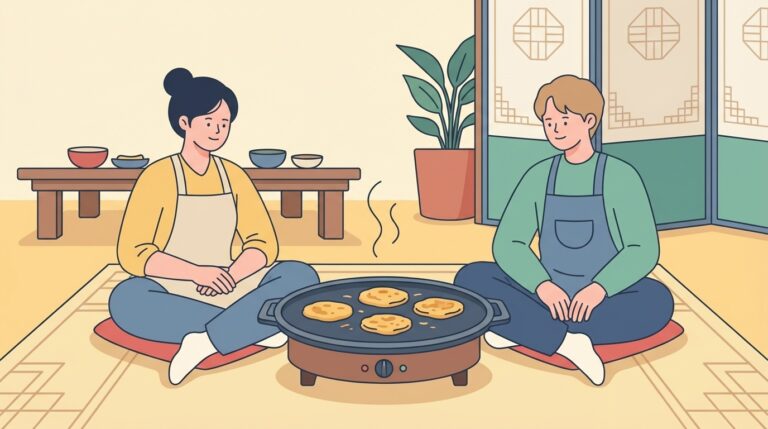
Picture this: It’s the day before Seollal (Korean Lunar New Year). You’ve been invited to your Korean friend’s (or partner’s) family home. You walk in, and the air is thick with the savory smell of sesame oil and frying batter. In the center of the living room, the mother is surrounded by mountains of ingredients, furiously flipping Jeon (Korean pancakes) in a frying pan.
If you’ve watched K-Dramas, you know this scene. The camera usually zooms in on a stressed-out daughter-in-law, right? But for you, the honored foreign guest, they will likely say, “Oh, go sit on the sofa and watch TV!”
But here is the secret: If you actually just sit on the sofa like a VIP, you’re missing out on the ultimate Korean bonding experience. Stepping into that chaotic holiday kitchen and offering a helping hand is the ultimate cheat code to unlocking true Insider status.
Today, we are going to learn exactly what to say to roll up your sleeves and help set up the Charye (ancestral memorial) table like a seasoned K-Drama protagonist. Let’s dive in!
Phase 2: Deep Dive into Core Expressions
Here are the top 3 phrases you need to survive and thrive in the Seollal kitchen.
1. 제가 거들게요! (I’ll pitch in / let me help!)
- Pronunciation: [jega geodeulgeyo!] + [Sounds like: jeh-gah guh-deul-geh-yo!]
- Meaning: Literal: “I will assist.” / Real nuance: “Let me roll up my sleeves and join the team effort!”
- K-Culture Moment: You usually learn “도와드릴까요?” (Shall I help?) in textbooks. But geodeulda (거들다) is a magic word. It implies that someone is already working hard, and you are going to add your hands to lighten their physical load. When you say this in a busy holiday kitchen, the elders will look at you with hearts in their eyes.
- Editor’s Insight: It feels much warmer and more “action-oriented” than just offering help. It sounds like you are already part of the family.
- Situation Spectrum:
[🚫 Never] ———— [⚠️ Be Careful] ———— [✅ Freely]- Close Friends (Casual): ✅ (내가 거들게!)
- Colleague/In-laws (Polite): ✅ (제가 거들게요)
- Very Formal/Boss (Honorific): ⚠️ (제가 돕겠습니다 is safer)
- 🤔 Think About It: Why does Korean have a specific word (거들다) just for “pitching in” on physical labor, separate from general “help” (돕다)? How does this reflect Korea’s agrarian, community-based history?
2. 이거 어디에 놓을까요? (Where should I put this?)
- Pronunciation: [igeo eodie noeulkkayo?] + [Sounds like: ee-guh uh-dee-eh no-eul-kka-yo?]
- Meaning: “Where shall I place this?”
- K-Culture Moment: Setting the Charye table is like a strategic board game. There are strict traditional rules! For example, Hong-dong-baek-seo (홍동백서): Red fruits go on the East, white fruits on the West. If you just drop an apple anywhere, you might ruin the universe’s harmony (or at least get scolded by Grandpa).
- Editor’s Insight: Never guess. Always ask. Holding a plate of food and asking this politely shows immense respect for their traditions.
- Situation Spectrum:
[🚫 Never] ———— [⚠️ Be Careful] ———— [✅ Freely]- Close Friends (Casual): ✅ (이거 어디 놔?)
- In-laws/Elders (Polite): ✅ (이거 어디에 놓을까요?)
- 🤔 Think About It: The Charye table has specific directions (North, South, East, West) regardless of where the room actually faces. What does this tell us about the importance of spiritual order in traditional Korean culture?
3. 간이 딱 맞아요! (The seasoning is perfect!)
- Pronunciation: [gani ttak majayo!] + [Sounds like: gahn-ee ttahk mah-jah-yo!]
- Meaning: Literal: “The saltiness fits exactly!” / Real nuance: “This tastes absolutely incredible!”
- K-Culture Moment: While making Jeon, the chef will often pop a piping hot piece directly into your mouth to taste-test. If you just say “맛있어요” (It’s delicious), it’s a bit basic. Saying “간이 딱 맞아요” proves you have the sophisticated palate of a true Korean.
- Editor’s Insight: Gan (간) refers to the base seasoning (usually salt or soy sauce). Nailing the gan is the pride of every Korean mom. Complimenting it is the highest form of praise.
- Situation Spectrum:
[🚫 Never] ———— [⚠️ Be Careful] ———— [✅ Freely]- Anyone cooking for you: ✅
Phase 3: Textbook vs Real Life
Let’s see how the chaotic holiday kitchen changes our textbook Korean.
| Situation | 📖 Textbook Korean | 🗣️ Real Korean | 💡 Why is it different? |
|---|---|---|---|
| Offering to help | 무엇을 도와드릴까요? (How may I help you?) | 뭐 하면 돼요? (What should I do?) | Family settings favor proactive, action-oriented questions over formal retail-style phrasing. |
| Handing over an item | 여기 있습니다. (Here it is.) | 여기요! / 자요! (Here!) | The kitchen is fast-paced. Shorter words keep the rhythm going! |
| Asking to taste | 맛을 보시겠어요? (Would you like to taste?) | 간 좀 봐줄래? (Can you check the seasoning?) | In cooking, checking the gan (seasoning) is more crucial than the general “taste.” |
Bottom Note: Stick to “뭐 하면 될까요?” (What should I do?) instead of “무엇을 도와드릴까요?”. It sounds 100x more natural for a B1 learner in a home setting!
Phase 4: Cultural Deep Dive
4-1. Non-verbal Communication: The Power of Nunchi
Language is only half the battle. If you want to help, Nunchi (눈치) is your best friend.
Don’t just stand in the middle of the room asking “What should I do?” while people are rushing around you with hot pans.
– The Pro Move: Wash your hands, quietly bring a cushion to the floor next to the person frying Jeon, sit down, and then ask, “제가 뭐 거들까요?” (What can I pitch in with?).
– Eye Contact: When receiving a plate to put on the Charye table, take it with two hands. It’s a sacred ritual!
4-2. K-Culture Connection: The K-Drama Holiday Trope
If you watch family K-Dramas like Reply 1988 or weekend soap operas, Seollal is always a dramatic plot device. The daughters-in-law are sweating over a hot stove, frying hundreds of Jeon, while the men are playing Hwatu (flower cards) in the next room.
While modern Korean families are changing rapidly (with many families ordering pre-made holiday food or men joining the kitchen), the image of the “Holiday Kitchen Labor” is deeply ingrained in the Korean psyche. By stepping into the kitchen as a foreigner, you are breaking a cultural wall and showing empathy. It’s a gesture that transcends language!
Phase 5: Immersive Roleplay Scenario
Scenario A: The Jeon Frying Station
- Setting: Friday night, Seollal Eve. Your Korean partner’s family living room. Newspapers are spread on the floor. An electric griddle is sizzling with oil.
- Characters:
- YOU: A B1 Korean learner, eager to make a good impression.
- Eomeoni (Mother): 50s, warm but currently slightly stressed by the sheer volume of zucchini and fish to be fried.
Eomeoni: (Sighs) 아이고, 허리야. 전이 끝이 없네.
(aigo, heoriya. jeoni kkeuchi eomne.)
[Oh, my back. The Jeon is never-ending.]
YOU: 어머니, 많이 힘드시죠?
(eomeoni, mani himdeusijyo?)
[Mother, you must be very tired, right?]
Eomeoni: 아니야~ 명절이 다 그렇지 뭐. 넌 들어가서 쉬어!
(aniya~ myeongjeori da geureochi mwo. neon deureogaseo swieo!)
[No~ That’s just how holidays are. You go inside and rest!]
YOU: 에이, 아니에요. 같이 하면 금방 끝나잖아요. 제가 뭐 거들까요?
(ei, anieyo. gachi hamyeon geumbang kkeunnajannayo. jega mwo geodeulkkayo?)
[Aw, no way. If we do it together, it’ll finish quickly. What can I pitch in with?]
Eomeoni: 진짜? 그럼 저기 계란물 좀 넘겨줄래?
(jinjja? geureom jeogi gyeranmul jom neomgyeojullae?)
[Really? Then can you pass me that egg wash over there?]
YOU: 네, 여기 있어요! 제가 뒤집을까요?
(ne, yeogi isseoyo! jega dwijibeulkkayo?)
[Yes, here it is! Should I flip them?]
Eomeoni: 오, 전 뒤집을 줄 알아?
(o, jeon dwijibeul jul ara?)
[Oh, do you know how to flip Jeon?]
YOU: 그럼요! 한국 드라마에서 많이 봤어요!
(geureomyo! hanguk deuramaeseo mani bwasseoyo!)
[Of course! I saw it a lot in Korean dramas!]
Eomeoni: 호호, 그래? 그럼 이거 하나 맛 좀 볼래? 아~ 해봐.
(hoho, geurae? geureom igeo hana mat jom bollae? a~ haebwa.)
[Haha, really? Then do you want to taste one? Say ‘Ah~’]
🔀 Your Turn! How do you respond after tasting it?
– A) “음~ 굿! (Mmm~ Good!)”
– B) “우와, 어머니! 간이 딱 맞아요! 너무 맛있어요! (Wow, Mother! The seasoning is perfect! It’s so delicious!)”
– C) “조금 짠 것 같아요. (I think it’s a bit salty.)”✅ Best Choice: B — You hit the magic keyword “간이 딱 맞아요” (The seasoning is perfect) AND praised her skills. You are now the favorite child.
⚠️ Choice C Analysis: Even if it’s salty, Seollal is not the time to become Gordon Ramsay. Keep it positive!
Scenario B: Emergency Grocery Run
(Suddenly, you run out of tofu!)
Eomeoni: 어머! 두부가 모자라네.
(eomeo! dubuga mojarane.)
[Oh my! We don’t have enough tofu.]
YOU: 제가 편의점 가서 사 올까요?
(jega pyeonijeom gaseo sa olkkayo?)
[Shall I go to the convenience store and buy some?]
Eomeoni: 그래줄래? 정말 고마워!
(geuraejullae? jeongmal gomawo!)
[Would you? Thank you so much!]
Phase 6: 10-Second Shadowing Drill
Practice making it sound completely natural! Pay attention to the pauses (/) and emotions.
🥺 에이, 아니에요. / 😊 같이 하면 / 금방 끝나잖아요! / 💪 제가 / 거들게요!
(ei, anieyo. / gachi hamyeon / geumbang kkeunnajannayo! / jega / geodeulgeyo!)
Tip: Drag out the “에이~” slightly to sound playfully modest when rejecting their offer to let you rest.
Phase 7: K-Culture Glossary
| Korean | Romanization | English | Context |
|---|---|---|---|
| 차례상 | charyesang | Memorial table | The ceremonial table of food set for ancestors during major holidays. |
| 전 | jeon | Pan-fried battered food | The iconic holiday food. Making it is notorious for causing “holiday backaches.” |
| 눈치 | nunchi | Social intuition | The ability to read the room. Anticipating they need the spatula before they ask. |
| 홍동백서 | hong-dong-baek-seo | Red East, White West | The traditional rule of placing red fruits on the east side of the Charye table and white on the west. |
| 명절 | myeongjeol | Traditional Holiday | Refers to major holidays like Seollal (Lunar New Year) and Chuseok (Harvest Festival). |
Phase 8: Traveler’s Survival Kit
If you are traveling in Korea during Seollal, you will notice something shocking: Seoul becomes a ghost town! Many restaurants close as people visit their hometowns. Here is your Holiday Survival Kit.
🆘 Survival Phrases for the Holidays
1. 오늘 영업하나요? (oneul yeongeophanayo?)
– 🗣️ Meaning: Are you open for business today?
– 📍 Where to use: Calling a restaurant before visiting during Seollal.2. 명절 잘 보내세요! (myeongjeol jal bonaeseyo!)
– 🗣️ Meaning: Have a great holiday!
– 📍 Where to use: Saying goodbye to a taxi driver or cashier during the holiday season.3. 혹시 명절 선물 세트 있나요? (hoksi myeongjeol seonmul sete itnayo?)
– 🗣️ Meaning: Do you happen to have holiday gift sets?
– 📍 Where to use: When you need a quick gift (like SPAM or fruit sets) at a mart for your Korean hosts.📌 Editor’s Travel Note
– Apps: Always check KakaoMap or Naver Map for “명절 연휴 영업” (Holiday operating hours) tags. Google Maps won’t have this updated!
– Gifts: If invited to a Korean home for Seollal, don’t show up empty-handed. A box of nice fruit (apples/pears) or a fancy Hanwoo (Korean beef) set is standard. If on a budget, a nice cake or traditional sweets from a bakery works perfectly!
Phase 9: Think Deeper — “One Step Further”
Food & Identity: The Labor of Love
🧠 Think Deeper:
Why do Koreans insist on making so much Jeon, a highly labor-intensive food, during holidays? In modern times, you can easily buy it at the market. However, the act of sitting together on the floor, preparing ingredients, frying, and feeding each other hot pieces straight from the pan is more than just cooking. It is a ritual of bonding. The shared physical labor creates a sense of Jeong (정 – deep affection and attachment). The food on the Charye table is a bridge connecting the ancestors to the living, and the living to each other.💬 Your Turn: Does your culture have a specific holiday food that takes forever to make, but brings the family together? Share it in the comments!
Phase 10: FAQ & Troubleshooting
Q1. Can I eat the food while setting the Charye table?
Maybe! The strict rule is that the ancestors must “eat” first during the bowing ceremony. However, the chef (usually the mother) is allowed to taste-test, and she will often pop a piece of Jeon into your mouth. Accept it graciously, but don’t actively snack from the finished plates!
Q2. Do I have to do the traditional deep bow (절 – Jeol) to the ancestors?
No, but it’s appreciated. Koreans generally don’t expect foreigners to perform the ancestral rites. Watching respectfully from the side is 100% okay. But if you try to learn and do the bow alongside the family, they will be incredibly touched by your respect for their culture.
❌ Common Mistake #1: Asking “도와줄게?” (Informal “Shall I help?”) to your partner’s parents.
✅ Do this instead: Even if they are friendly, always use polite forms with elders. Stick to “제가 도와드릴까요?” or “제가 거들게요!”
Phase 11: Wrap-up & Action Items
One-Liner Summary: Don’t just watch the holiday kitchen from the sofa; roll up your sleeves and say “제가 거들게요!” to become part of the family.
Your 3-Step Action Mission:
– 🥉 Bronze: Look in the mirror and practice saying “어머니, 간이 딱 맞아요!” with the brightest smile you can muster.
– 🥈 Silver: Leave a comment below telling us what dish you would love to help cook in a Korean kitchen.
– 🥇 Gold: Next time you see a Korean friend or colleague organizing something or working hard, surprise them by saying, “제가 거들게요!”
K-Culture Mission:
Search “명절 전 부치기” (Frying holiday Jeon) on YouTube. Watch how fast Korean moms can flip those pancakes, and try to spot the electric griddles they use on the floor!
Phase 12: Interactive Quiz
1. You are holding a plate of apples for the Charye table. What is the best thing to say to the grandfather?
– A) 할아버지, 사과 드세요! (Grandpa, eat the apple!)
– B) 이거 어디에 놓을까요? (Where should I put this?)
– C) 식탁에 놔도 돼요? (Can I put this on the dining table?)
2. True or False: During Seollal, it is very easy to find open restaurants everywhere in Seoul.
– True or False?
3. Fill in the blank: Wow! Mother, the seasoning is perfect!
– 우와! 어머니, ( ) 딱 맞아요!
(Answers: 1: B – Never place things randomly on the Charye table. 2: False – Many places close as people visit hometowns. 3: 간이 / gani)
Frequently Asked Questions (FAQ)
Q: What does "제가 거들게요! (I'll pitch in / let me help!)" mean in Korean and how do you pronounce it?
A: In Korean, "제가 거들게요! (I'll pitch in / let me help!)" is pronounced [jega geodeulgeyo!] and means: Literal: "I will assist." / Real nuance: "Let me roll up my sleeves and join the team effort!"
Q: What does "이거 어디에 놓을까요? (Where should I put this?)" mean in Korean and how do you pronounce it?
A: In Korean, "이거 어디에 놓을까요? (Where should I put this?)" is pronounced [igeo eodie noeulkkayo?] and means: "Where shall I place this?"
Q: What does "간이 딱 맞아요! (The seasoning is perfect!)" mean in Korean and how do you pronounce it?
A: In Korean, "간이 딱 맞아요! (The seasoning is perfect!)" is pronounced [gani ttak majayo!] and means: Literal: "The saltiness fits exactly!" / Real nuance: "This tastes absolutely incredible!"







