

Phase 1: 공감 — 몰입형 오프닝 (Immersive Hook)
Hello there! Welcome back to Daily Hangul. I’m your editor, veteran tutor, and personal K-Culture navigator.
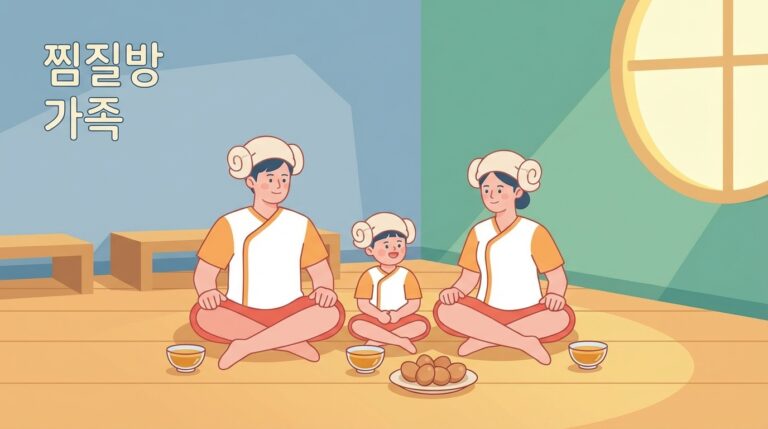
Picture this: You are watching a classic K-Drama. The main characters have suddenly relocated from a fancy cafe to a massive, warm room with wooden floors. They are wearing identical oversized T-shirts and shorts. Strangely, they have towels folded on their heads like sheep horns 🐑. Suddenly, the male lead takes a brown roasted egg and SMASHES it against the female lead’s head to crack the shell. She yells, but then they both laugh while sipping a sweet, icy rice drink.
Have you ever seen this scene? Welcome to the 찜질방 (Jjimjilbang), the ultimate Korean bathhouse and sauna!
Visiting a Jjimjilbang isn’t just about taking a bath; it’s a full-day family outing, a cheap staycation, and a massive cultural experience. But what happens when your Korean friend’s family actually invites you to one? How do you order those eggs? How do you claim a sleeping mat without being rude?
Don’t worry. This guide is crafted from the real, sometimes embarrassing experiences of my B1 students who bravely stepped into the saunas of Seoul. Let’s get you ready to sweat, snack, and speak like a local!
Phase 2: 핵심 표현 심층 분석 (Deep Dive)
Let’s look at the survival phrases you’ll need on the heated floors of the Jjimjilbang.
1. 식혜랑 계란 주세요.
- Pronunciation: [sikhye-rang gyeran juseyo] / Sheek-hyeh-rahng gyeh-rahn joo-seh-yo
- Meaning: Please give me sweet rice punch and eggs. (Literal) / I’d like the Jjimjilbang snack combo. (Real nuance)
- K-Culture Moment: You approach the 매점 (Maejeom – snack bar). This is the holy grail of the Jjimjilbang. Everyone around you is eating this exact combo after sweating in a 70°C salt room.
- Editor’s Insight: ~랑/이랑 (rang/irang) is the conversational way to say “and.” It sounds much more natural and friendly than the textbook ~와/과 (wa/gwa).
- Situation Spectrum:
[🚫 절대 금지] ———— [⚠️ 주의] ———— [✅ 자유롭게]
- Casual / Auntie at the counter: ✅ (Totally fine! Add a polite smile)
- Formal: ⚠️ (A bit too casual for a strict business meeting, but perfect here)
- 🤔 Think About It: Why do Koreans love eating hot, roasted eggs immediately after coming out of a boiling hot sauna? Does your culture have a “fight fire with fire” food tradition?
2. 여기 자리 있어요?
- Pronunciation: [yeogi jari isseoyo?] / Yuh-gee jah-ree ee-suh-yo?
- Meaning: Is there a seat here? (Literal) / Is this spot taken? (Real nuance)
- K-Culture Moment: The main hall is packed with families sleeping on thin mats. You spot an empty mat, but there’s a towel or a water bottle next to it. You need to ask the person nearby before claiming it.
- Editor’s Insight: This phrase is a double-edged sword! If you ask with a rising intonation (여기 자리 있어요? ↗️), it means “Is this taken?” But if you state it flatly while pointing to your own mat (여기 자리 있어요 ↘️), it means “This spot is mine/taken.”
- Situation Spectrum:
[🚫 절대 금지] ———— [⚠️ 주의] ———— [✅ 자유롭게]
- Strangers in public: ✅ (Use polite tone)
- 🤔 Think About It: In Korea, leaving your phone or bag on a table/mat means “reserved,” and no one steals it. How does this level of social trust work in your country?
3. 아~ 시원하다!
- Pronunciation: [a~ siwonhada!] / Ah~ shee-won-hah-dah!
- Meaning: Ah, it’s cool/refreshing! (Literal) / Ah, this hits the spot! / That feels amazing! (Real nuance)
- K-Culture Moment: An older Korean man steps into a scorching 42°C hot bath. Instead of screaming in pain, he closes his eyes, sighs deeply, and says, “아~ 시원하다!”
- Editor’s Insight: This is the ultimate B1 milestone. “시원하다” doesn’t just mean temperature-cool. It means the release of tension. You say it when drinking hot soup, stretching, getting a massage, or soaking in hot water.
- Situation Spectrum:
[🚫 절대 금지] ———— [⚠️ 주의] ———— [✅ 자유롭게]
- Murmuring to yourself: ✅ (Very natural)
- Saying it to elders: ✅ (They will be so impressed by your Korean soul!)
- 🤔 Think About It: Does the concept of finding “cooling relief” in “hot” things exist in your mother tongue?
Phase 3: 교과서 vs 진짜 한국어 (Textbook vs Real Life)
| 상황 | 📖 교과서 한국어 | 🗣️ 진짜 한국어 | 💡 왜 다를까? |
|---|---|---|---|
| 간식 주문할 때 | 음료수 한 잔과 달걀을 주시겠습니까? | 이모(님)! 여기 식혜 하나, 계란 세 개요! | “이모(Auntie)” is a friendly title for female staff, showing affection and building rapport. |
| 매트 빌릴 때 | 바닥 깔개를 사용할 수 있습니까? | 매트 좀 쓸게요~ / 가져갈게요~ | Jjimjilbangs are communal spaces. Quick, polite announcements are preferred over formal requests. |
| 더워서 나갈 때 | 온도가 너무 높아서 나가고 싶습니다. | 아유, 덥다. 나갈래! (To family/friends) | Expressing physical feelings is usually done through short exclamations and casual verbs. |
Phase 4: 문화적 맥락 — K-Culture 딥다이브 (Cultural Deep Dive)
4-1. 비언어적 요소: 눈치 (Nunchi) at the Jjimjilbang
When navigating the Jjimjilbang, 눈치 (Nunchi – the art of reading the room) is everything. Even if a spot looks empty, if there is a single towel, a locker key, or a half-drank bottle of water next to the pillow, do not touch it. Koreans “reserve” spaces with minimal items. Use your Nunchi, scan the area, and ask “여기 자리 있어요?” just to be safe!
4-2. K-Drama Connection: The Yangmori & Egg Smash 🥚🐑
If you go to a Jjimjilbang, you must make a 양머리 (Yangmori – Sheep Head) out of your towel. It was popularized by the legendary 2005 K-Drama My Lovely Sam Soon and remains a cultural staple.
Also, the “cracking the egg on the head” trope is real! Families and friends do it for fun.
A critical tip: There are two types of eggs.
1. 삶은 계란 (Salmeun gyeran) – Regular boiled eggs.
2. 맥반석 계란 (Maekbanseok gyeran) – Jjimjilbang-style roasted eggs (brown shell).
Always use the brown ones for head-smashing! They are roasted, making the shells more brittle and less painful. Do NOT smash a regular hard-boiled egg on your friend’s head unless you want to end your friendship!
Phase 5: 실전 롤플레이 시나리오 (Immersive Roleplay)
시나리오 A: The Snack Bar Showdown (Main Scenario)
Setting: Saturday afternoon, 3 PM. Dragon Hill Spa in Seoul. You’ve just survived 15 minutes in the 65°C Loess Sauna with your Korean friend, Minsu. You are both sweaty and dehydrated.
Characters:
– YOU: A B1-level Korean learner, excited but very thirsty.
– Minsu (30): Your Korean buddy who invited you to experience this “healing” culture.
– 이모님 (Auntie NPC): The busy, fast-talking snack bar owner.
Dialogue:
민수: 아~ 땀 빼니까 진짜 좋다. 우리 매점 갈까? 💦
(Ah~ ttam ppaenikka jinjja jota. uri maejeom galkka?)
[Ah~ sweating feels so good. Should we go to the snack bar?]
(🎭 Stage Direction: Minsu wipes his forehead with his sheep-head towel.)
YOU: 네! 저 너무 목말라요.
(Ne! jeo neomu mongmallayo.)
[Yes! I’m so thirsty.]
민수: 찜질방 오면 무조건 식혜지! 이모님~
(Jjimjilbang omyeon mujogeon sikhye-ji! Eemo-nim~)
[When at a Jjimjilbang, Sikhye is a must! Auntie~]
이모님: 네~ 삼촌, 뭐 줄까?
(Ne~ samchon, mwo julkka?)
[Yes~ young man(uncle), what can I get you?]
(🎭 Stage Direction: The Auntie calls Minsu ‘Samchon’ (Uncle) – a friendly reciprocal term for young men!)
YOU: 음… 식혜 두 잔이랑, 계란 세 개 주세요! 🥚🥤
(Eum… sikhye du jan-irang, gyeran se gae juseyo!)
[Umm… Two glasses of Sikhye and three eggs, please!]
이모님: 맥반석 맞지? 육천오백 원. 키 줘요.
(Maekbanseok majji? yuk-cheon-o-baek won. Ki jwoyo.)
[Roasted eggs, right? 6,500 won. Give me your key.]
YOU: 네? 키요? (Looking confused)
(Ne? Kiyo?)
[Pardon? Key?]
민수: 아, 내 걸로 할게. 여기요.
(Ah, nae geollo halge. Yeogiyo.)
[Ah, I’ll pay with mine. Here.]
(🎭 Stage Direction: Minsu extends his wrist with the locker key bracelet.)
이모님: (Beep!) 결제됐어요. 맛있게 먹어~
(Gyeoljedaesseoyo. masitge meogeo~)
[(Beep!) Paid. Enjoy your food~]
🔀 당신의 차례! 어떻게 대답할까요? (Decision Point)
– A) (Pulling out a 10,000 won bill from your pocket) “여기 돈이요!”
– B) “민수 씨, 제가 나중에 계좌이체 할게요! 잘 먹겠습니다~”
– C) “왜 카드를 안 써요?”✅ Best Choice: B — Jjimjilbangs are cash-free zones inside! You pay by tapping your locker key, and settle the bill at the front desk when leaving. Promising to wire the money (계좌이체) or buy the next meal is the perfect Korean response.
⚠️ Choice A 분석: Where did you even keep that cash? You don’t have pockets in your Jjimjilbang clothes!
민수: (Handing you an egg) 자, 머리 대봐. 😈
(Ja, meori daebwa.)
[Here, offer your head.]
YOU: 앗! 살살 쳐주세요!
(At! salsal chyeojuseyo!)
[Ah! Hit it gently please!]
시나리오 B: K-Culture 보너스 롤플레이 (The Seshin Uncle/Auntie)
(Inside the wet bath area. You decided to get a 세신 (Seshin – professional body scrub). You are lying on a waterproof table.)
세신사 (Scrub Master): 아플 수 있어요. 아프면 말해요~
(Apeul su isseoyo. apeumyeon malhaeyo~)
[It might hurt. Tell me if it hurts~]
YOU: 네, 알겠습니다.
(Ne, algetseumnida.)
[Yes, understood.]
세신사: (Scrubbing vigorously) 자, 뒤집으세요!
(Ja, dwijibeuseyo!)
[Now, turn over!]
YOU: 아, 네! 아~ 시원하다!
(Ah, ne! Ah~ siwonhada!)
[Ah, yes! Ah~ so refreshing!]
Phase 6: 10초 섀도잉 드릴 (Shadowing Drill)
Let’s practice ordering your snacks like a pro. Read it out loud, paying attention to the pauses!
😊 이모님~ / 여기 / 식혜 두 잔이랑 / 계란 세 개 / 주세요!
(Eemo-nim~ / yeogi / sikhye du jan-irang / gyeran se gae / juseyo!)
Tip: Stretch the ‘님(nim)’ playfully to sound more native!
Phase 7: K-Culture 미니 사전 (K-Culture Glossary)
| 한국어 | Romanization | 영어 | 맥락 설명 |
|---|---|---|---|
| 양머리 | Yangmori | Sheep Head | Folding a towel to look like sheep horns. A Jjimjilbang photo essential! |
| 매점 | Maejeom | Snack Bar | The kiosk selling snacks and drinks. Usually run by a friendly ‘Auntie’. |
| 식혜 | Sikhye | Sweet Rice Punch | A traditional sweet drink served ice-cold. Best paired with hot rooms. |
| 맥반석 계란 | Maekbanseok Gyeran | Elvan Stone-roasted Eggs | Distinctive brown eggs slow-roasted on hot stones. Chewier than boiled eggs. |
| 세신 | Seshin | Body Scrub | The intense, full-body exfoliation service in the wet bath area. |
| 온돌 | Ondol | Korean Underfloor Heating | The traditional heating system that makes the Jjimjilbang floors so warm and cozy. |
Phase 8: 여행자 서바이벌 키트 (Traveler’s Survival Kit)
Since visiting a Jjimjilbang is a must-do travel activity, you need to know the “Key System.”
🆘 서바이벌 표현 #1: Paying with your wristband
– 🇰🇷 “이걸로 결제할게요.” (igeollo gyeoljehalgeyo.)
– 🗣️ 영어 발음 가이드: Ee-gull-lo gyul-jeh-hal-geh-yo.
– 📍 쓰는 곳: Jjimjilbang snack bar, massage chairs, arcade games inside.
– 💡 Pro Tip: You don’t bring your wallet inside. Your locker key (usually an electronic wristband) acts as your credit card. You tap it everywhere, then pay the total at the exit desk!📌 Editor’s Travel Note
– Tattoos: While Japan is strict about tattoos in Onsens, most Korean Jjimjilbangs are completely fine with tattoos now!
– Sleeping: You can literally sleep anywhere on the floor overnight. It’s a great budget travel hack (usually $10-$15 a night).
– Gender Separation: The hot baths (saunas/showers) are strictly separated by gender (and you must be completely naked!). But the “Jjimjilbang” (dry saunas and snack areas) is a co-ed, communal space where everyone wears the provided uniforms.
Phase 9: 비판적 사고 코너 — “한 발 더 깊이” (Think Deeper)
음식과 정체성 (Food, Community & Identity): The Power of ‘Jeong’ (정)
Why do Koreans love to gather in a massive room, lie on the hard floor together, and crack eggs on each other’s heads? It all traces back to the traditional 온돌 (Ondol – heated floor) culture. Historically, the warmest spot on the floor (아랫목) was where the family gathered to eat, talk, and bond.
Furthermore, the bathing aspect strips away social hierarchy. When everyone is wearing the exact same oversized uniform (or nothing at all in the wet baths), your job title, wealth, or status disappears. You are just people sharing warmth. It’s the ultimate manifestation of 정 (Jeong – collective affection and bonding).
💬 Your Turn: Have you ever experienced a communal bathhouse or sauna in your culture? Does it break down social walls the way it does in Korea? Let us know in the comments!
Phase 10: FAQ & 오해 방지 (Troubleshooting)
- Q: “Can I wear my swimsuit in the bath area?”
- No. You must be 100% naked in the gender-segregated wet bath area. Wearing a swimsuit is considered unhygienic there. Don’t be shy; nobody is looking at you!
- Q: “Can I say ‘아줌마(Ajumma)’ instead of ‘이모님(Eemo-nim)’ to the snack bar lady?”
- Maybe, but avoid it. “Ajumma” can sometimes sound rude or dismissive. “이모님 (Auntie)” or “사장님 (Boss/Owner)” is much more polite and endearing.
- Q: “Is it okay to bring outside food?”
- No. Jjimjilbangs make their profit from the snack bar. Bringing a whole pizza inside is a big no-no!
❌ 흔한 실수 (Common Mistake):
Trying to keep your underwear on under the Jjimjilbang uniform.
✅ 이렇게 하세요: You wear your underwear under the provided T-shirt and shorts in the co-ed area. But in the wet bath, take everything off!
Phase 11: 요약 및 액션 아이템 (Wrap-up)
One-Liner Summary: Grab your sheep head towel, tap your wristband for Sikhye, and remember that Jjimjilbangs are Korea’s ultimate communal healing spots!
Action Mission:
– 🥉 Bronze: Stand in front of a mirror, wipe imaginary sweat from your brow, and say “아~ 시원하다!” with deep emotion.
– 🥈 Silver: Search YouTube for “How to make a Yangmori (sheep head towel)” and try making one with a towel at home!
– 🥇 Gold: Visit a Jjimjilbang on your next trip to Korea (or a Korean spa in your country) and successfully order “식혜랑 맥반석 계란 주세요!”
Phase 12: 퀴즈 — 인터랙티브 챌린지 (Interactive Quiz)
1. Fill in the blank:
You are paying for your snacks at the Jjimjilbang. You show your wristband and say:
“_________ 결제할게요!”
(A) 현금으로 (With cash)
(B) 카드로 (With card)
(C) 이걸로 (With this)
2. True or False – K-Culture Edition:
If someone says “여기 자리 있어요 ↘️” with a flat intonation while pointing at their mat, they are inviting you to sit with them. (T/F)
3. Situational Judgment:
You just stepped into a 40°C hot bath. What is the most ‘Korean’ thing to say?
(A) 너무 아파요! (It hurts so much!)
(B) 아~ 시원하다! (Ah~ so refreshing/relieving!)
(C) 불이야! (Fire!)
👀 정답 확인하기 (Click to see answers)
1. (C) 이걸로 (With this). You use your electronic key!
2. False! It means “This spot is taken/mine.”
3. (B) 아~ 시원하다! You have now mastered the Korean soul.
See you in the next lesson! 매일매일 재미있게, 매일한글! 💙
Frequently Asked Questions (FAQ)
Q: What does "식혜랑 계란 주세요." mean in Korean and how do you pronounce it?
A: In Korean, "식혜랑 계란 주세요." is pronounced [sikhye-rang gyeran juseyo] and means: Please give me sweet rice punch and eggs. (Literal) / I'd like the Jjimjilbang snack combo. (Real nuance)
Q: What does "여기 자리 있어요?" mean in Korean and how do you pronounce it?
A: In Korean, "여기 자리 있어요?" is pronounced [yeogi jari isseoyo?] and means: Is there a seat here? (Literal) / Is this spot taken? (Real nuance)
Q: What does "아~ 시원하다!" mean in Korean and how do you pronounce it?
A: In Korean, "아~ 시원하다!" is pronounced [a~ siwonhada!] and means: Ah, it's cool/refreshing! (Literal) / Ah, this hits the spot! / That feels amazing! (Real nuance)







