

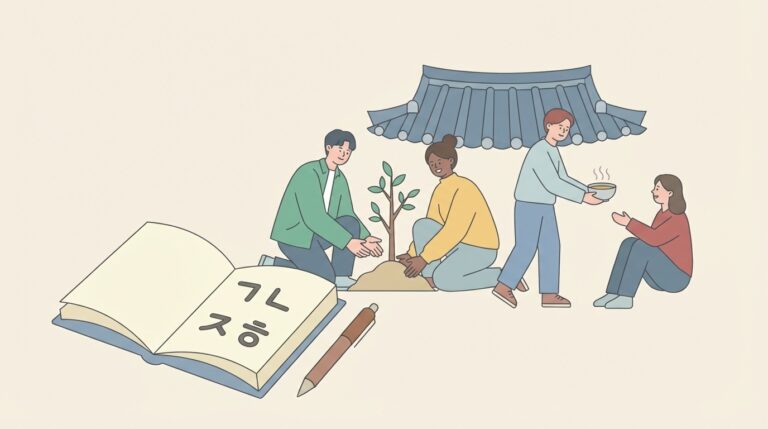
Phase 1: Immersive Hook — The “Good Influence” of K-Culture
Hello! It’s your Daily Hangul Editor.
Picture this: It’s your favorite K-Pop idol’s birthday. Instead of just sending expensive gifts, the fandom rallies together to donate thousands of kilograms of rice (쌀 화환), plant a “forest” in the idol’s name, or volunteer at an animal shelter. Or maybe you remember that iconic K-Drama scene where the male lead travels to a remote village overseas for medical volunteering, and when asked why he’s there, he doesn’t say “Because I’m a hero who wants to save the world.” Instead, he looks down modestly and mutters something about wanting to be “just a tiny bit of help.”
If you’re planning to apply for an overseas volunteer program (해외 봉사 활동) or even just want to talk about giving back to the community with your Korean friends, you need to know how Koreans talk about volunteering. It’s not just about saying “I want to help.” It’s about a delicate balance of deep empathy, community spirit, and above all, modesty (겸손).
Today, based on real interviews and deep conversations I’ve had with my students preparing for Korean university clubs, we’re going to learn how to express your volunteering motivations like a true insider. Let’s dive in!
Phase 2: Deep Dive into Core Expressions
Here are the top three expressions that will instantly make your motivation sound natural, professional, and culturally attuned (B2 Level).
1. 선한 영향력을 나누고 싶습니다.
- Pronunciation: [seonhan yeonghyangryeogeul nanugo sipseumnida] / Sun-han young-hyang-ryuck-eul na-nu-go ship-seum-ni-da
- Meaning: (Literal) I want to share a good influence. / (Real nuance) I want to make a positive impact on the world.
- K-Culture Moment: This is the ultimate buzzword in the K-Pop and K-Entertainment industry. Whenever celebrities donate to charities, news articles title it: “[Idol Name]’s Seon-han Yeong-hyang-ryeok.” If you use this in an interview, the interviewers will instantly nod in approval.
- Editor’s Insight: It feels grand but warm. You aren’t saying you will “fix” things; you are “sharing” a positive ripple effect.
- Situation Spectrum:
[🚫 절대 금지] ———— [⚠️ 주의] ———— [✅ 자유롭게]
- Casual with friends: ⚠️ (A bit too formal/serious for a casual beer chat)
- Professional/Interview: ✅ (Absolute perfection)
- 🤔 Think About It: Why “sharing” (나누다) instead of “giving” (주다)? In Korean culture, volunteering is seen as an exchange where you also grow, not just a one-way transaction.
2. 작은 힘이나마 보탬이 되고 싶어요.
- Pronunciation: [jageun himinama botaemi doego sipeoyo] / Ja-geun him-i-na-ma bo-tem-i dwe-go shi-po-yo
- Meaning: (Literal) I want to become an addition, even if it’s a small strength. / (Real nuance) I’d like to help out in whatever small way I can.
- K-Culture Moment: Picture a K-Drama where a humble protagonist is thanked by a village elder. They will wave their hands defensively and say this line to show they didn’t do much.
- Editor’s Insight: This is the ultimate “modesty” flex. Even if you are a highly skilled doctor going on a medical mission, you say this. It shows you don’t think you are superior to those you are helping.
- Situation Spectrum:
[🚫 절대 금지] ———— [⚠️ 주의] ———— [✅ 자유롭게]
- Casual with friends: ✅
- Co-workers: ✅
- Formal/Elders: ✅ (Use ‘싶습니다’ instead of ‘싶어요’ for interviews)
- 🤔 Think About It: Does your native language have a way of downplaying your own skills when offering help? Why do you think Koreans avoid saying “I am very helpful”?
3. 세상을 보는 시야를 넓히고 싶습니다.
- Pronunciation: [sesangeul boneun siyareul neolphigo sipseumnida] / Se-sang-eul bo-neun shi-ya-reul nul-pi-go ship-seum-ni-da
- Meaning: (Literal) I want to widen my field of vision looking at the world. / (Real nuance) I want to broaden my horizons and gain a global perspective.
- K-Culture Moment: This is the classic “University Student applying for an overseas NGO” trope. It highlights personal growth alongside helping others.
- Editor’s Insight: Volunteering isn’t just about the receivers; it’s about the volunteer’s growth. This phrase perfectly captures the educational aspect of volunteering abroad.
- Situation Spectrum:
[🚫 절대 금지] ———— [⚠️ 주의] ———— [✅ 자유롭게]
- Casual with friends: ⚠️ (A bit poetic)
- Professional/Interview: ✅
Phase 3: Textbook vs Real Life
When you express your desire to help, textbooks often teach very direct translations. Let’s see how real Koreans tweak them.
| Situation | 📖 Textbook Korean | 🗣️ Real Korean | 💡 Why the difference? |
|---|---|---|---|
| Stating your goal | 저는 다른 사람을 돕고 싶습니다. (I want to help others.) | 누군가에게 작은 보탬이라도 되면 좋잖아요. (It’d be nice to be even a small help to someone.) | Direct claims of “helping” can sound mildly arrogant. Downplaying it makes you sound genuine and humble. |
| Offering help on-site | 제가 당신을 도와주겠습니다. (I will help you.) | 제가 도와드릴게요! or 이거 제가 할게요! (I will give you help! / I’ll do this!) | “도와주다” (to give help) can sound condescending to elders. “도와드리다” (to offer help humbly) is the polite standard. |
| Expressing feelings after | 기분이 아주 좋습니다. (I feel very good.) | 정말 뜻깊은 시간이었어요. (It was a truly meaningful time.) | “Good” is too simple. “Meaningful” (뜻깊다) captures the emotional and societal weight of the act. |
Bottom Note: At the B2 level, swapping “돕다” (to help) with “보탬이 되다” (to be of an addition/help) is the quickest way to sound like a native speaker.
Phase 4: Cultural Deep Dive
4-1. Non-verbal Communication: The Art of Modesty
When expressing your motivation to volunteer, your body language should match the humility of your words. If you say “작은 힘이나마 보탬이 되고 싶습니다” while leaning back with your arms crossed, it creates a massive disconnect.
– Eye contact: Maintain warm, sincere eye contact, but don’t stare intensely like you’re trying to dominate a business negotiation.
– Hands: Keep your hands neatly folded on your lap or on the table during an interview.
4-2. K-Culture Connection: Fandoms and “Seon-han Yeong-hyang-ryeok”
If you’re a K-Pop fan, you’ve likely witnessed one of the most unique volunteering cultures in the world. In the past, fans would send luxury gifts to idols. But over the last decade, a beautiful culture of “선한 영향력” (Good Influence) took over. Fandoms now organize massive charity drives, build schools in developing countries, and volunteer at disaster sites under their idol’s name.
Critical View: While this is incredibly positive, sometimes it becomes a “competition” between rival fandoms to see who can donate more. However, the end result is still a massive benefit to society. When you use the term 선한 영향력, you are tapping into this modern, collective spirit of mobilizing for good.
Phase 5: Immersive Roleplay — The Club Interview
Setting: It’s a crisp Wednesday afternoon in a university lecture hall. You are applying for the “Global Outreach Volunteer Club” (해외 봉사 동아리). Sitting across from you is Ji-hoon (23, Club President, friendly but takes his duties seriously).
Characters:
– YOU: An exchange student who genuinely wants to help and experience a new culture.
– Ji-hoon: The interviewer who wants to see your true intentions.
Dialogue:
Ji-hoon: 지원서 잘 읽었습니다. 우리 동아리 해외 봉사 프로그램에 지원하게 된 특별한 계기가 있나요? 📝
(Ji-won-seo jal il-geot-seum-ni-da. U-ri dong-a-ri hae-oe bong-sa peu-ro-geu-raem-e ji-won-ha-ge doen teuk-byeol-han gye-gi-ga in-na-yo?)
[I read your application well. Is there a special reason you applied for our club’s overseas volunteer program?]
YOU: 네, 저는 평소에도 봉사활동에 관심이 많았습니다.
(Ne, jeo-neun pyeong-so-e-do bong-sa-hwal-dong-e gwan-sim-i man-at-seum-ni-da.)
[Yes, I’ve always been very interested in volunteer work.]
Ji-hoon: 아, 그러시군요. 그런데 해외로 나가는 건 육체적으로 많이 힘들 텐데 괜찮으시겠어요?
(A, geu-reo-si-gun-yo. Geu-reon-de hae-oe-ro na-ga-neun geon yuk-che-jeog-eu-ro man-i him-deul ten-de gwaen-chan-eu-si-get-seo-yo?)
[Ah, I see. But going overseas can be physically very exhausting. Will you be okay?]
🔀 Your Turn! How do you answer?
– A) “저는 힘이 셉니다! 제가 다 도와주겠습니다!” (I am strong! I will help everyone!)
– B) “네, 조금 힘들겠지만, 그곳 사람들에게 작은 힘이나마 보탬이 되고 싶습니다.”
– C) “저는 완벽하니까 걱정 마세요.”✅ Best Choice: B — “Yes, it might be a bit hard, but I want to be of help to the people there, even if it’s just a small effort.”
Why? Choice A uses “도와주겠습니다” which sounds a bit aggressive and arrogant. Choice B uses the golden phrase of modesty we learned. Ji-hoon will definitely pass you!
(Assuming you chose B)
Ji-hoon: (Smiling warmly) 말씀만 들어도 든든하네요. 같이 선한 영향력을 나누면 좋겠습니다!
(Mal-sseum-man deu-reo-do deun-deun-ha-ne-yo. Ga-chi seon-han yeong-hyang-ryeok-eul na-nu-myeon jo-ket-seum-ni-da!)
[Just hearing that makes me feel reassured. I hope we can share a positive influence together!]
Phase 6: 10-Second Shadowing Drill
Practice speaking like a native! Pay attention to the pauses (/) and the emotion tags.
- 🥺 (Modestly and sincerely):
비록 / 작은 힘이지만, / 그분들에게 / 보탬이 / 되고 싶습니다.
(bi-rok / ja-geun him-i-ji-man, / geu-bun-deul-e-ge / bo-tem-i / doe-go sip-seum-ni-da.)
[Even though it’s a small strength, I want to be of help to them.] -
😊 (Bright and hopeful):
이번 기회를 통해 / 세상을 보는 / 시야를 / 넓히고 싶어요!
(i-beon gi-hoe-reul tong-hae / se-sang-eul bo-neun / si-ya-reul / neol-pi-go si-peo-yo!)
[Through this opportunity, I want to broaden my perspective of the world!]
Phase 7: K-Culture Glossary
| Korean | Romanization | English | Cultural Context |
|---|---|---|---|
| 봉사활동 | bong-sa-hwal-dong | Volunteer work | ‘봉사’ means service. Used for everything from soup kitchens to overseas NGO work. |
| 선한 영향력 | seon-han yeong-hyang-ryeok | Positive influence | A major buzzword used by celebrities and influencers when doing charity work. |
| 보탬이 되다 | bo-taem-i doe-da | To be of help | The most polite, humble way to say “I will help.” |
| 재능 기부 | jae-neung gi-bu | Talent donation | Pro-bono work. E.g., a musician playing for free at a hospital, or you translating for an NGO. |
| 뜻깊다 | tteut-gip-da | Meaningful | The go-to adjective to describe how you felt after volunteering. |
Phase 8: Traveler’s Survival Kit (NGO / Volunteer Visit Edition)
Are you planning to visit a local charity, an animal shelter, or participate in a volunteer event while traveling in Korea? Here are the top survival phrases you’ll need on the ground.
🆘 Survival Expressions
– 🇰🇷 “제가 할게요!” (je-ga hal-ge-yo!) — “I’ll do it!”
Use this when someone needs a volunteer to lift something or clean up.
– 🇰🇷 “어떻게 도와드리면 될까요?” (eo-tteo-ke do-wa-deu-ri-myeon doelkka-yo?) — “How can I help you?”
The most polite way to ask for instructions from the coordinator.
– 🇰🇷 “여기에 두면 되나요?” (yeo-gi-e du-myeon doe-na-yo?) — “Should I put it here?”
Essential when moving boxes or supplies.📌 Editor’s Travel Note
– Navigation Apps: Welfare centers or rural volunteer sites can be tricky to find on Google Maps. Always use KakaoMap or Naver Map when navigating outside of major tourist zones in Korea.
– Work Ethic (눈치): At a Korean volunteer site, people rarely stand around waiting for instructions. If you finish your task, use your Nunchi (situational awareness), find the coordinator, and ask “다 했는데, 다른 거 할 일 있을까요?” (I’m done, is there anything else to do?). They will love you for this!
Phase 9: Think Deeper — The Culture of Modesty (겸손)
🧠 Think Deeper: Language & Modesty
Why is the Korean language structured to downplay one’s own contributions? In traditional Korean society, harmony (조화) within the community was valued far above individual heroism. To say “I am a great help” disrupts that harmony by elevating yourself above the group. By saying “작은 보탬이 되다” (to be a small addition), you are grammatically placing yourself as merely a small piece of a larger, collective effort. It’s not a lack of self-confidence; it’s a profound display of respect for the community.💬 Your Turn: In your culture, when you apply for a volunteer position, are you expected to confidently list your skills and how much you can “fix” things, or are you expected to be humble like in Korea? Let me know in the comments!
Phase 10: FAQ & Troubleshooting
Q: Can I use “선한 영향력” with my close friends when we decide to volunteer?
It might sound a bit cheesy or overly dramatic! With friends, you’d usually say something simpler like, “우리도 좋은 일 한 번 하자” (Let’s do a good deed for once).
Q: If I’m translating for an NGO (Talent Donation), how do I say that?
Use the word “재능 기부” (Talent donation). “이번에 통역으로 재능 기부를 하게 되었습니다” (I will be making a talent donation as an interpreter this time).
❌ Common Mistake: Using “내가 다 도와줄게” (I will help you with everything) to an older person or a coordinator.
✅ Do this instead: “제가 도와드리겠습니다” (I will humbly offer my help). Remember, the verb ‘주다’ (to give) becomes ‘드리다’ (to offer humbly) when speaking to superiors or elders!
Phase 11: Wrap-up & Action Items
🎯 One-Liner Summary:
When talking about volunteering in Korean, replace the direct “I want to help” with the humble “I want to be a small addition” (보탬이 되다) and “I want to share a positive influence” (선한 영향력을 나누다).
🚀 Action Mission:
– 🥉 Bronze: Stand in front of a mirror and say “작은 힘이나마 보탬이 되고 싶습니다” three times with a modest smile.
– 🥈 Silver: Write a comment below (or on a language exchange app) explaining why you want to volunteer, using today’s vocabulary!
– 🥇 Gold (K-Culture Mission): Go to Twitter or Instagram and search the hashtag #선한영향력. See what kind of amazing charity work Korean fandoms and celebrities are doing right now!
Phase 12: Interactive Quiz 🏆
Let’s test your B2 instincts!
1. Situational Judgment: You are at an interview for an overseas medical volunteer program. The interviewer asks why you applied. Which is the BEST response?
– A) 제 의학 기술이 뛰어나서 다른 사람을 도와줄 수 있습니다.
– B) 세상을 보는 시야를 넓히고, 그곳에 작은 보탬이 되고 싶습니다.
– C) 선한 영향력을 받기 위해서입니다.
2. Fill in the Blank:
“유기견 보호소에서 제 특기인 사진 촬영으로 ( _______ )를 하고 싶습니다.”
(I want to do a _________ using my photography skills at the dog shelter.)
– A) 쌀 화환
– B) 재능 기부
– C) 눈치
3. True or False — K-Culture Edition:
In Korean culture, when you volunteer, it is best to confidently tell everyone how much you are helping so they recognize your effort. (T/F)
(Scroll down for answers)
Answers:
1. B (A is too arrogant using ‘도와줄 수 있다’. C is grammatically awkward because you share/give (나누다) good influence, you don’t usually say you want to receive (받다) it as a primary motivation.)
2. B (재능 기부 – Talent donation. Photography is a talent you are donating!)
3. False (Modesty/겸손 is key! Downplaying your contribution is the polite way to go.)
Frequently Asked Questions (FAQ)
Q: What does "선한 영향력을 나누고 싶습니다." mean in Korean and how do you pronounce it?
A: In Korean, "선한 영향력을 나누고 싶습니다." is pronounced [seonhan yeonghyangryeogeul nanugo sipseumnida] and means: (Literal) I want to share a good influence. / (Real nuance) I want to make a positive impact on the world.
Q: What does "작은 힘이나마 보탬이 되고 싶어요." mean in Korean and how do you pronounce it?
A: In Korean, "작은 힘이나마 보탬이 되고 싶어요." is pronounced [jageun himinama botaemi doego sipeoyo] and means: (Literal) I want to become an addition, even if it's a small strength. / (Real nuance) I'd like to help out in whatever small way I can.
Q: What does "세상을 보는 시야를 넓히고 싶습니다." mean in Korean and how do you pronounce it?
A: In Korean, "세상을 보는 시야를 넓히고 싶습니다." is pronounced [sesangeul boneun siyareul neolphigo sipseumnida] and means: (Literal) I want to widen my field of vision looking at the world. / (Real nuance) I want to broaden my horizons and gain a global perspective.







