

안녕하세요! I’m the Head Editor of Daily Hangul.
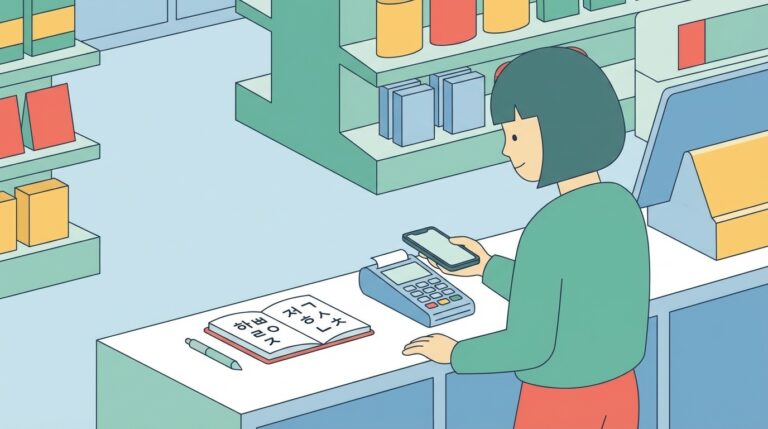
In K-Dramas, you’ve probably seen the stylish chaebol CEO effortlessly tap his smartphone on a card reader to buy an entire café. No bulky wallet, no counting cash. Just a sleek beep and a cool nod.
But this isn’t just a drama trope—it’s everyday reality in South Korea! Welcome to the ultimate cashless society. If you pull out a handful of coins at a busy Seoul convenience store, you might actually feel the burning gaze of the “Pali-pali” (hurry up) culture from the people in line behind you.
Today, we’re diving into Smartphone Life (스마트폰과 앱 라이프), specifically how to navigate Korea like a local using just your phone. Knowing these expressions won’t just save you time; it’ll earn you that coveted “Insider (인싸)” nod from locals. Let’s tap in!
Phase 2: Core Expressions Deep Dive
1. 지갑 안 들고 다녀요
- Pronunciation: jigap an deulgo danyeoyo [jee-gap ahn deul-go dahn-yuh-yo]
- Meaning: Literal: I don’t carry a wallet around. / Real nuance: I live that phone-only lifestyle.
- K-Culture Moment: You’re at a team dinner (회식) and someone asks if you have cash to split the bill. You casually wave your phone and drop this line. Instantly, you look like you’ve lived in Seoul for 10 years.
- Editor’s Insight: This isn’t an apology for forgetting your wallet. It’s a statement of fact! In Korea, carrying a thick wallet is almost seen as “old school.”
- Situation Spectrum:
[🚫 절대 금지] ———— [⚠️ 주의] ———— [✅ 자유롭게]
- Friends (Casual): ✅ (지갑 안 들고 다녀!)
- Co-workers (Semi-formal): ✅
- Boss/Elders (Formal): ⚠️ (Better to say: 아, 제가 지갑을 안 가져왔습니다 – Ah, I didn’t bring my wallet.)
- 🤔 Think About It: Why did Korea transition to a cashless society so rapidly? Does your home country still rely heavily on cash?
2. 삼성페이(로) 할게요 / 핸드폰으로 결제할게요
- Pronunciation: samseong-peiro halgeyo [sahm-sung pay-ro hal-geh-yo]
- Meaning: I’ll pay with Samsung Pay. / I’ll pay with my phone.
- K-Culture Moment: The cashier has scanned your 2+1 banana milks. Instead of awkwardly holding out your card, you say this while simultaneously extending your phone toward the terminal. Perfect synchronization!
- Editor’s Insight: “할게요” (I will do) is your best friend in Korea. It shows intention and polite decision-making. If you use Apple Pay, just swap the word: “애플페이 할게요” (Though Apple Pay acceptance is still growing compared to Samsung Pay).
- Situation Spectrum:
[🚫 절대 금지] ———— [⚠️ 주의] ———— [✅ 자유롭게]
- Friends/Staff (Casual/Polite): ✅
- Co-workers (Semi-formal): ✅
- Boss/Elders (Formal): ✅
- 🤔 Think About It: Notice how Koreans use the tool (Samsung Pay) + the action verb (할게요) instead of directly translating “I will pay.” It focuses on how the action is done!
3. 영수증은 버려주세요
- Pronunciation: yeongsujeung-eun beoryeojuseyo [young-soo-jeung-eun buh-ryuh-joo-seh-yo]
- Meaning: Literal: Please throw away the receipt. / Real nuance: I don’t need the receipt, trash it for me.
- K-Culture Moment: You just bought an Americano. The barista asks “영수증 드릴까요?” (Would you like the receipt?). You reply with this, saving them the effort of even printing it.
- Editor’s Insight: Because banking apps give you a push notification the millisecond a transaction happens, paper receipts are basically extinct for personal use. Saying this is considered polite because it saves the cashier time and saves paper!
- Situation Spectrum:
[🚫 절대 금지] ———— [⚠️ 주의] ———— [✅ 자유롭게]
- Convenience Store/Cafe Staff: ✅
- Taxi Drivers: ✅
- Business Expense situations: 🚫 (You need that receipt for reimbursement!)
- 🤔 Think About It: Have you noticed how much Korean customer service revolves around anticipating needs and saving time?
Phase 3: Textbook vs Real Life
| Situation | 📖 Textbook Korean | 🗣️ Real Korean | 💡 Why the difference? |
|---|---|---|---|
| No cash | 현금이 없습니다 (I have no cash) | 아, 저 폰밖에 없는데… (Ah, I only have my phone…) | Modern Koreans rarely mention “cash”; they emphasize what they do have. |
| Choosing to pay | 카드로 계산하겠습니다 (I will pay by card) | 삼성페이(로) 할게요 (I’ll do Samsung Pay) | “계산하다” is formal. “할게요” is the daily go-to for quick transactions. |
| Refusing receipt | 아니요, 괜찮습니다 (No, I am fine) | 영수증 버려주세요 / 괜찮아요 (Throw it away / It’s fine) | Action-oriented. Telling them to throw it away is completely polite and expected! |
Phase 4: Cultural Deep Dive
4-1. Non-verbal Communication: The “Manner Hand”
Even though you’re paying with a futuristic smartphone, traditional Korean manners still apply! When handing your phone to a cashier to tap, don’t just shove it at them with one hand. Support your right elbow with your left hand, or hold the phone with both hands. It’s the perfect blend of high-tech and deep respect!
4-2. K-Culture Connection: “Pali-pali” (빨리빨리) Meets Tech
If you’ve watched K-Dramas or traveled to Seoul, you’ve experienced the “Pali-pali” (hurry, hurry) culture. This is why Samsung Pay is king. Searching your bag, opening a wallet, pulling out a card, and inserting it? That takes 15 seconds. Tapping your phone? 1 second. In a bustling subway station or a crowded cafe, saving those 14 seconds is an act of ultimate consideration (Nunchi) for the people waiting behind you!
Phase 5: Immersive Roleplay
Scenario A: The Late-Night Snack Run
Setting: Friday, 11:30 PM. A brightly lit GS25 convenience store near Hongdae. You’re buying late-night snacks after hanging out with friends.
Characters:
– YOU: A foreigner living in Seoul, getting the hang of the local vibe.
– Ji-hoon (22): A tired but polite university student working the night shift.
Ji-hoon: 어서 오세요.
(eoseo oseyo.)
[Welcome.]
YOU: 안녕하세요! 이거 2플러스 1 맞나요?
(annyeonghaseyo! igeo i-peulleoseu il mannayo?)
[Hello! Is this 2+1?]
Ji-hoon: 네, 맞습니다. 하나 더 가져오시면 돼요.
(ne, matseumnida. hana deo gajyeoosimyeon dwaeyo.)
[Yes, it is. You can go grab one more.]
(🎭 Stage Direction: You run to the fridge and bring another banana milk.)
YOU: 여기요!
(yeogiyo!)
[Here you go!]
Ji-hoon: 봉투 필요하신가요?
(bongtu piryohasingayo?)
[Do you need a plastic bag?]
YOU: 아니요, 괜찮아요. 그냥 가져갈게요.
(aniyo, gwaenchanayo. geunyang gajyeogalgeyo.)
[No, it’s okay. I’ll just take them as is.]
Ji-hoon: 네, 4,500원입니다. 결제 도와드릴까요?
(ne, sacheonobaegwonimnida. gyeolje dowadeurilkkayo?)
[Okay, that’s 4,500 won. How would you like to pay?]
YOU: 삼성페이로 할게요.
(samseong-peiro halgeyo.)
[I’ll pay with Samsung Pay.]
Ji-hoon: 네, 단말기에 대주세요.
(ne, danmalgie daejuseyo.)
[Okay, please tap it on the terminal.]
(🎭 Stage Direction: You elegantly tap your phone. Beep!)
Ji-hoon: 결제되었습니다. 영수증 드릴까요?
(gyeoljedoeeotseumnida. yeongsujeung deurilkkayo?)
[Payment complete. Do you need the receipt?]
🔀 Your Turn! How should you reply?
– A) “네, 주세요.” (Yes, please give it to me.)
– B) “아, 영수증은 버려주세요!” (Ah, please throw the receipt away!)
– C) “영수증이 뭐예요?” (What is a receipt?)✅ Best Choice: B — It shows you are totally adapted to the Korean cashless, paperless lifestyle! A is fine if you actually need it, but B is the ultimate “local” move. C will just confuse poor Ji-hoon!
Phase 6: 10-Second Shadowing Drill
😊 아, / 저는 / 지갑 / 안 들고 다녀요!
(a, / jeo-neun / ji-gap / an deul-go da-nyeo-yo!)
[Ah, I don’t carry a wallet!]
Phase 7: K-Culture Glossary
| 한국어 | Romanization | 영어 | 맥락 설명 |
|---|---|---|---|
| 삼성페이 | samseong-pei | Samsung Pay | The ultimate tool for a wallet-free life in Korea. |
| 단말기 | danmalgi | Card reader / Terminal | The machine you tap your phone or card on. |
| 영수증 | yeongsujeung | Receipt | Paper receipts are rapidly disappearing in Korea. |
| 더치페이 / 엔빵 | deochipei / enppang | Splitting the bill | Doing this via mobile banking apps is the norm. |
| 빨리빨리 | ppallippalli | Hurry hurry | Korea’s speed-oriented cultural mindset. |
Phase 8: Traveler’s Survival Kit
🆘 Survival Expressions TOP 3
– 🇰🇷 “이거 (애플페이/삼성페이) 되나요?” (igeo aepeul-pei/samseong-pei doenayo?)
– 🗣️ Does this take (Apple Pay/Samsung Pay)?
– 📍 Use at: Small shops, cafes, taxis.
- 🇰🇷 “카드로 할게요.” (kadeuro halgeyo.)
- 🗣️ I’ll pay by card. (You can say this even when using a phone card app!)
- 📍 Use at: Everywhere.
🇰🇷 “교통카드 찍어주세요.” (gyotongkadeu jjigeojuseyo.)
- 🗣️ Please charge my transit card.
- 📍 Use at: Convenience stores when reloading your T-money app.
📌 Editor’s Travel Note
While Samsung Pay works on almost 100% of card terminals in Korea, Apple Pay is still rolling out and mostly works at large franchises (like McDonald’s or GS25). If you only have Apple Pay, it’s wise to carry a physical backup card!
Phase 9: Think Deeper
🧠 Think Deeper: Tech vs Reality (The Digital Divide)
While the convenience of “Smartphone Life” is amazing, it has created a new social phenomenon in Korea: the digital divide. Young people can navigate a kiosk, split a bill on a banking app, and order a taxi in seconds. However, the elderly population often struggles with cafes that proudly declare “Cashless Store” or buses that no longer have coin boxes. As you enjoy the seamless tech of Korea, it’s worth asking: Does total efficiency sometimes leave the vulnerable behind?💬 Your Turn: Is your home country moving towards a completely cashless society? How do older generations adapt there? Share in the comments!
Phase 10: FAQ & Troubleshooting
- “Can I use these expressions with elders?” Yes, but use the polite forms. Instead of “지갑 안 들고 다녀요,” say “지갑을 안 가져왔습니다” to a boss.
- “Is cash completely dead in Korea?” Not exactly! If you visit a traditional market (like Gwangjang Market) or buy street food (Pojangmacha), cash or a local banking transfer is highly preferred!
❌ Common Mistake: Handing your phone to the cashier with one hand while looking away or talking to a friend.
✅ Do this instead: Make slight eye contact, use the “manner hand” (support your elbow), and politely say “결제할게요” (I’ll pay).
Phase 11: Wrap-up & Action Items
One-Liner Summary: Ditch the physical wallet and embrace the “Pali-pali” efficiency of Korea by confidently paying with your smartphone!
Action Mission:
– 🥉 Bronze: Read the shadowing drill out loud 3 times today.
– 🥈 Silver: Write a comment below telling us if you prefer cash or phone payments!
– 🥇 Gold: Next time you’re at a Korean cafe or convenience store, use “삼성페이로 할게요” or “영수증 버려주세요”!
✨ K-Culture Mission: Watch a Korean vlog on YouTube and count how many times they pay for something using their phone instead of a physical card!
Phase 12: Interactive Quiz
1. Situational Judgment: You bought a coffee and the cashier asks “영수증 드릴까요?” (Do you need the receipt?). You don’t need it. What is the most natural Korean response?
– A) 영수증 싫어요. (I hate receipts.)
– B) 영수증 버려주세요. (Please throw it away.)
– C) 안 됩니다. (No you can’t.)
👉 Click for Answer
Answer: B! A is too emotional, and C sounds like a strict prohibition!
2. Fill in the Blank: To say “I don’t carry a wallet,” you say: “지갑 안 들고 (_____)!”
👉 Click for Answer
Answer: 다녀요 (danyeoyo)
3. True or False: You should always give your phone to the cashier using only one hand to look cool like in K-Dramas.
👉 Click for Answer
Answer: False! Always use the “Manner Hand” to show respect!
Frequently Asked Questions (FAQ)
Q: What does "지갑 안 들고 다녀요" mean in Korean and how do you pronounce it?
A: In Korean, "지갑 안 들고 다녀요" is pronounced [jigap an deulgo danyeoyo [jee-gap ahn deul-go dahn-yuh-yo] and means: Literal: I don't carry a wallet around. / Real nuance: I live that phone-only lifestyle.
Q: What does "삼성페이(로) 할게요 / 핸드폰으로 결제할게요" mean in Korean and how do you pronounce it?
A: In Korean, "삼성페이(로) 할게요 / 핸드폰으로 결제할게요" is pronounced [samseong-peiro halgeyo [sahm-sung pay-ro hal-geh-yo] and means: I'll pay with Samsung Pay. / I'll pay with my phone.
Q: What does "영수증은 버려주세요" mean in Korean and how do you pronounce it?
A: In Korean, "영수증은 버려주세요" is pronounced [yeongsujeung-eun beoryeojuseyo [young-soo-jeung-eun buh-ryuh-joo-seh-yo] and means: Literal: Please throw away the receipt. / Real nuance: I don't need the receipt, trash it for me.







