Phase 1: 공감 — 몰입형 오프닝 (Immersive Hook)
Hello! I am the lead editor of Daily Hangul.
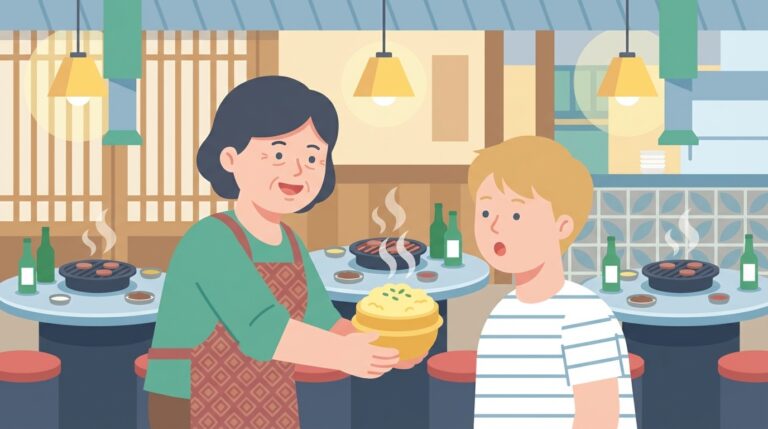
Picture this: You are sitting at a bustling K-BBQ restaurant in Seoul. Sizzling pork belly on the grill, the clinking of green Soju bottles, and the loud, energetic chatter around you. Suddenly, the restaurant auntie (the owner) walks over and forcefully plops down a steaming, fluffy bowl of steamed egg (Gyeranjjim) or a bottle of Coke on your table.
You panic. “Wait, I didn’t order this! Will she charge me for it? How do I say ‘I think you have the wrong table’ in Korean?”
Just as you’re about to protest, she flashes a warm smile and says one magical word: “서비스! (Service!)”
If you’ve watched enough K-Dramas or eaten at authentic Korean spots, you’ve probably seen this moment. But what does “Service” actually mean here? (Spoiler: It’s not customer service!)
If you don’t know how to react to this, you might accidentally offend the owner or ruin a beautiful moment of connection. Today, we are going to dive into the beautiful Korean culture of 정 (Jeong – affection/bonding) and learn exactly how to handle the legendary “Restaurant Auntie’s Service” like a true local.
Let’s go! 🚀
Phase 2: 핵심 표현 심층 분석 (Deep Dive)
Here are the top 3 expressions you need to master this cultural moment.
1. 이거 서비스예요. (This is ‘Service’.)
- Pronunciation: [igeo seobiseuyeyo] — ‘seobiseu’ sounds exactly like the English word ‘service’, but spoken with a bouncy, staccato rhythm.
- Meaning: Literal: “This is service.” / Real Nuance: “This is on the house! It’s a free gift for you.”
- K-Culture Moment: You’ll hear this in local pubs (Pocha), BBQ joints, or even cafes when the owner likes your vibe, or when you order a lot of food. In K-Dramas, this is often the moment a struggling protagonist gets a free bowl of warm soup from a kind restaurant owner.
- Editor’s Insight: In Korea, Service is a noun that means “freebie.” It’s the ultimate expression of Korean hospitality. When you hear this, relax! Your wallet is safe.
- Situation Spectrum:
[🚫 절대 금지] ———— [⚠️ 주의] ———— [✅ 자유롭게]
- Casual / Restaurants: ✅
- Formal business meetings (when handing a contract): 🚫 (Use ‘무료 제공입니다’ instead)
- 🤔 Think About It: Why did Koreans adopt the English word ‘service’ to mean ‘free food’? How do restaurants in your home country show appreciation to regular customers?
2. 이모님! / 사장님! (Auntie! / Boss!)
- Pronunciation: [imonim / sajangnim] — ‘imo’ sounds like the ‘emo’ music genre but shorter.
- Meaning: Literal: Aunt / Boss / Real Nuance: A friendly, respectful way to call a restaurant worker or owner.
- K-Culture Moment: In a crowded, noisy restaurant, you don’t politely raise your hand and wait for eye contact. You boldly call out “Sajangniiim!” Just like you see in K-Dramas when the office workers are having a team dinner (Hoesik).
- Editor’s Insight: 이모 (Imo) literally means “mother’s sister.” Calling a middle-aged female restaurant worker “Auntie” instantly breaks the ice and creates a familial bond. Adding 님 (-nim) makes it perfectly polite!
- Situation Spectrum:
[🚫 절대 금지] ———— [⚠️ 주의] ———— [✅ 자유롭게]
- To a middle-aged female owner at a casual spot: ✅ (이모님)
- To a young part-timer in their 20s: 🚫 (They will be horrified. Call them ‘저기요’ (Excuse me) instead.)
- 🤔 Think About It: Calling a stranger “Auntie” creates an instant family-like dynamic. How does language shape our emotional distance from strangers?
3. 우와, 잘 먹겠습니다! (Wow, I will eat it well!)
- Pronunciation: [uwa, jal meokgetseumnida] — ‘jal’ rhymes with ‘pal’. ‘meok’ sounds like ‘muck’.
- Meaning: Literal: I will eat well. / Real Nuance: Thank you for the food, I really appreciate it!
- K-Culture Moment: This is the only correct response when you receive a ‘Service’. Idols say this loudly before digging into the lunch boxes sent by their fans!
- Editor’s Insight: Simply saying “감사합니다” (Thank you) is fine, but adding “잘 먹겠습니다” shows you are truly excited to eat their food. It makes the Auntie’s heart melt.
- Situation Spectrum:
[🚫 절대 금지] ———— [⚠️ 주의] ———— [✅ 자유롭게]
- Every time you receive food: ✅
- 🤔 Think About It: Korean has a specific, fixed phrase you must say before eating. Does your language have a direct equivalent to “Bon appétit” or “Itadakimasu”?
Phase 3: 교과서 vs 진짜 한국어 (Textbook vs Real Life)
| 상황 | 📖 교과서 한국어 | 🗣️ 진짜 한국어 | 💡 왜 다를까? |
|---|---|---|---|
| 종업원을 부를 때 | 저기요. (Excuse me.) | 이모님! / 사장님! | ‘이모’라고 부르면 정(Jeong)이 생겨 서비스가 나올 확률이 올라갑니다! |
| 공짜 음식을 받았을 때 | 이것은 무료입니까? (Is this free?) | 이거 서비스예요? 헐 대박! | ‘무료(Free)’는 계약서에 나오는 딱딱한 단어! 식당에선 무조건 ‘서비스’를 씁니다. |
| 감사함을 표현할 때 | 대단히 감사합니다. (Thank you very much.) | 우와, 진짜 잘 먹겠습니다! | 교과서 표현은 너무 로봇 같아요. 감탄사(우와)를 넣으면 훨씬 친근해요. |
Phase 4: 문화적 맥락 — K-Culture 딥다이브 (Cultural Deep Dive)
4-1. 비언어적 요소 (Non-verbal Communication)
When the Imo brings you that free plate of dumplings, language is only half the battle.
– The Two-Handed Receive: Even if you are sitting, try to lightly touch the plate with both hands or place your left hand on your right arm as she puts it down. It shows immense respect.
– The “Nunchi” Smile: Make brief eye contact and give a slight head bow while smiling. In Korea, expressing joy through your facial expression when receiving food is considered highly polite.
4-2. K-Culture 연결 고리: Food, Community, and “Jeong” (정)
In Korea, food is never just calories; it’s the ultimate love language.
Have you noticed in K-Dramas that parents rarely say “I love you” but always ask, “밥 먹었어?” (Did you eat?)
This all ties back to 정 (Jeong)—a unique Korean concept of affection, compassion, and communal bonding. When the restaurant Auntie gives you a ‘Service’, she’s not calculating profit. She sees you enjoying her food, feels a sudden burst of Jeong towards you, and wants to feed you more. Rejecting it or insisting on paying for it actually breaks that invisible emotional bond. The best way to repay Jeong is simply to eat it happily and come back next time as a 단골 (Dangol – Regular customer)!
Phase 5: 실전 롤플레이 시나리오 (Immersive Roleplay)
시나리오 A: 메인 롤플레이 (The K-BBQ Surprise)
- Setting: Friday night, 7:30 PM. A bustling, smoky pork belly (Samgyeopsal) restaurant in Hongdae. You are with two Korean friends.
- Characters:
- YOU: A foreigner who loves Korean food but is still navigating the culture.
- 이모님 (Imonim): The energetic, friendly owner holding a tray.
이모님: (Sliding a bubbly, boiling pot of Kimchi Stew onto your table) 자, 이거 우리 예쁜 손님들 먹으라고 주는 서비스!
(Ja, igeo uri yeppeun sonnimdeul meogeurago juneun seobiseu!)
[Here, this is ‘service’ for our pretty customers to eat!]
(🎭 Stage Direction: She winks at you and wipes her hands on her apron.)
YOU: 어? 저희 김치찌개 안 시켰는데요…?
(Eo? jeohui gimchijjigae an sikhyeon-neundeyo…?)
[Huh? We didn’t order Kimchi Stew…?]
이모님: 아이구, 외국에서 왔잖아! 고기 먹을 때 국물도 같이 먹어야지. 그냥 서비스예요!
(Aigu, oegugeseo watjana! gogi meogeul ttae gungmuldo gachi meogeoyaji. geunyang seobiseuyeyo!)
[Aigoo, you came all the way from abroad! You need soup when you eat meat. It’s just ‘service’!]
🔀 당신의 차례! 어떻게 대답할까요? (Your turn! How do you reply?)
– A) “아니요, 괜찮습니다. 다시 가져가세요.” (No, it’s okay. Please take it back.)
– B) “얼마예요? 돈 낼게요.” (How much is it? I will pay.)
– C) “우와! 이모님 최고! 잘 먹겠습니다~” (Wow! Auntie is the best! I will eat it well~)✅ Best Choice: C — You acknowledge her generosity, flatter her a bit (“이모님 최고!”), and accept the Jeong.
⚠️ Choice A & B 분석: Rejecting the food or trying to pay for it will make the Imonim feel awkward and slightly offended. In the world of Jeong, accepting graciously is the highest form of politeness!
시나리오 B: K-Culture 보너스 롤플레이 (The Market Hustle)
- Setting: Gwangjang Market. You are buying a mountain of Bindaetteok (Mung bean pancakes).
- 사장님 (Sajangnim): 학생, 이거 떡볶이 조금 남은 건데 서비스로 줄게. 먹어봐요!
(Haksaeng, igeo tteokbokki jogeum nameun geonde seobiseuro julge. meogeobwayo!)
[Student, I have a little bit of Tteokbokki left, I’ll give it to you as ‘service’. Try it!] - YOU: 헐, 진짜요? 사장님 인심 대박! 감사합니다!
(Heol, jinjjayo? sajangnim insim daebak! gamsahamnida!)
[Omg, really? Your generosity is amazing! Thank you!]
Phase 6: 10초 섀도잉 드릴 (Shadowing Drill)
Practice speaking like a local! Pay attention to the pauses (/) and the emotion tags.
- 😲 놀라며 (Surprised):
어? / 이거 / 저희 안 시켰는데요? (Eo? / igeo / jeohui an sikhyeon-neundeyo?) - 😊 기쁘게 (Happily):
우와~~~ / 진짜요? / 이모님 / 최고! (Uwa~~~ / jinjjayo? / imonim / choego!) - 🥺 감동받아서 (Touched):
감사합니다. / 정말 / 잘 먹겠습니다! (Gamsahamnida. / jeongmal / jal meokgetseumnida!)
Phase 7: K-Culture 미니 사전 (K-Culture Glossary)
| 한국어 | Romanization | English | 맥락 설명 (Context) |
|---|---|---|---|
| 정 | jeong | Affection/Bond | The deep emotional connection, warmth, and sense of community among Koreans. |
| 서비스 | seobiseu | Freebie/On the house | Free food/drinks given by the restaurant to show appreciation. |
| 인심 | insim | Generosity | Often used as “인심 좋다” (Good generosity) when food portions are huge. |
| 단골 | dangol | Regular customer | If you visit a place often, you become a ‘dangol’ and get MORE service! |
| 회식 | hoesik | Company dinner | Team bonding dinners where lots of food, alcohol, and ‘service’ are shared. |
Phase 8: 여행자 서바이벌 키트 (Traveler’s Survival Kit)
If you are traveling in Korea and eating your way through Seoul, keep these survival phrases in your back pocket!
🆘 서바이벌 표현 (Survival Phrases)
– 🇰🇷 “혹시… 이거 서비스예요?” (Hoksi… igeo seobiseuyeyo?)
– 🗣️ English: “By any chance… is this free/service?”
– 📍 Where to use: When a random dish appears and you want to double-check before eating it (just in case it was a mistake!).
- 🇰🇷 “반찬 좀 더 주실 수 있나요?” (Banchan jom deo jusil su innayo?)
- 🗣️ English: “Can I get some more side dishes?”
- 📍 Where to use: Korean side dishes (Banchan) are ALWAYS free to refill. Don’t be shy!
📌 Editor’s Travel Note
– No Tipping Culture: Korea does NOT have a tipping culture. If you try to leave cash on the table for the amazing “service” food, the Auntie will literally chase you down the street thinking you forgot your money! Your “tip” is simply saying “잘 먹었습니다!” (I ate well!) loudly when leaving.
Phase 9: 비판적 사고 코너 — “한 발 더 깊이” (Think Deeper)
🧠 Think Deeper: Food & Identity (음식과 정체성)
In Korea, you rarely order just for yourself. Stews are placed in the middle of the table, meat is shared on one grill, and “service” is given to the whole table to share. This communal dining culture reflects Korea’s “We” (우리) identity over the “I” (나) identity. Sharing saliva from the same soup pot used to be the ultimate proof of being a family (Sikgu – meaning ‘mouths that eat together’). Giving free food is an extension of bringing strangers into that “We” boundary.
💬 Your Turn: How is sharing food viewed in your culture? Is it strictly individual, or do you share everything like in Korea? Let me know in the comments!
Phase 10: FAQ & 오해 방지 (Troubleshooting)
❌ 흔한 실수 #1: Calling a young waiter ‘이모’ (Auntie)
✅ 이렇게 하세요: ‘Imo’ is strictly for middle-aged or older female staff. If the server looks like they are in their 20s or 30s, call out “저기요!” (Excuse me!) or “사장님!” (Boss!) instead.
Q: Can I ask for service? (e.g., “이모님, 서비스 주세요!”)
A: Maybe, but mostly NO. If you are a recognized regular (Dangol) or if you just ordered $100 worth of meat, you might playfully say “사장님, 서비스 없어요~?” (Boss, no service today?). But as a first-time visitor, demanding service is considered very rude. It must be given freely!
Q: Do fancy restaurants or franchises give ‘service’?
A: Rarely. You will mostly experience this magical Jeong at mom-and-pop shops, traditional markets, and local pubs.
Phase 11: 요약 및 액션 아이템 (Wrap-up)
🎯 One-Liner Summary:
When a Korean restaurant gives you free food and says “Service!”, don’t panic—just smile, say “이모님 최고! 잘 먹겠습니다!”, and enjoy the warm Korean Jeong.
🔥 Action Mission:
– 🥉 Bronze: Stand in front of a mirror, pretend someone handed you a free Coke, and practice saying “헐! 잘 먹겠습니다!” with a bright smile.
– 🥈 Silver: Watch a K-Drama eating scene today. Try to spot the moment they call “사장님!” or “이모님!” to order.
– 🥇 Gold (For those in Korea): Next time you eat at a local Korean BBQ place, try calling the owner “이모님” or “사장님” warmly. You might just score a free steamed egg!
Phase 12: 퀴즈 — 인터랙티브 챌린지 (Interactive Quiz)
Q1. You are at a local Korean restaurant. The middle-aged female owner gives you a free bottle of cider. What is the BEST thing to say?
1) 이거 얼마예요? (How much is this?)
2) 우와, 이모님 감사합니다! 잘 먹겠습니다!
3) 팁 여기 있습니다. (Here is the tip.)
Q2. True or False?
“It is highly polite to leave a 15% tip if the restaurant owner gives you free ‘service’ food.”
Q3. Fill in the blank:
To instantly build a friendly bond with a middle-aged female restaurant owner, you should call her “________님”.
(Answers below!)
정답 보기 (Click for Answers)
A1: 2) “우와, 이모님 감사합니다! 잘 먹겠습니다!” (Asking how much it is kills the mood, and there is no tipping in Korea!)
A2: False. Tipping is not a part of Korean culture and can actually cause confusion.
A3: 이모 (Imo)
Frequently Asked Questions (FAQ)
Q: What does "이거 서비스예요. (This is 'Service'.)" mean in Korean and how do you pronounce it?
A: In Korean, "이거 서비스예요. (This is 'Service'.)" is pronounced [igeo seobiseuyeyo] and means: Literal: "This is service." / Real Nuance: "This is on the house! It's a free gift for you."
Q: What does "이모님! / 사장님! (Auntie! / Boss!)" mean in Korean and how do you pronounce it?
A: In Korean, "이모님! / 사장님! (Auntie! / Boss!)" is pronounced [imonim / sajangnim] and means: Literal: Aunt / Boss / Real Nuance: A friendly, respectful way to call a restaurant worker or owner.
Q: What does "우와, 잘 먹겠습니다! (Wow, I will eat it well!)" mean in Korean and how do you pronounce it?
A: In Korean, "우와, 잘 먹겠습니다! (Wow, I will eat it well!)" is pronounced [uwa, jal meokgetseumnida] and means: Literal: I will eat well. / Real Nuance: Thank you for the food, I really appreciate it!