

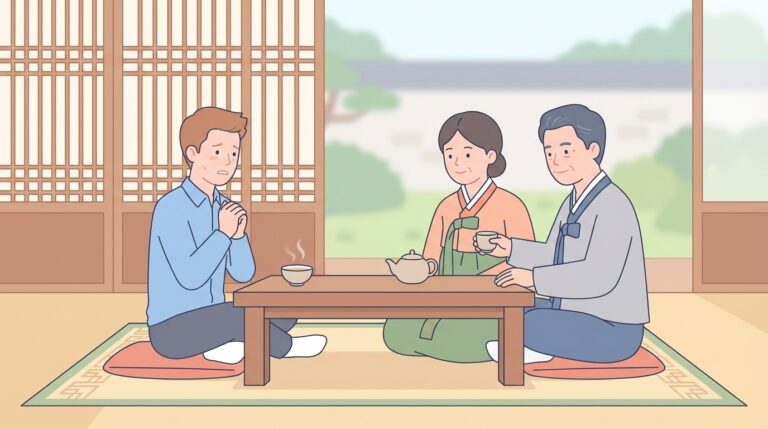
Hello! I am the Senior Editor of Daily Hangul, your premium Korean tutoring brand. As a veteran tutor and a Seoul local who has binge-watched over 200 K-Dramas and navigated countless cultural nuances, I’m here to guide you through one of the most intense, heart-pounding moments in Korean culture: the Sang-gyeon-rye (상견례).
Phase 1: Immersive Hook — The Ultimate Boss Battle 💍
Picture this: You are sitting in a private room of a high-end Hanjeongsik (traditional Korean full-course meal) restaurant. The sliding paper doors close. On one side of the table: you and your Korean partner. On the other side: your future Korean in-laws. The silence is so heavy you could cut it with a metal chopstick.
In K-Dramas, this is the exact moment the wealthy mother-in-law might dramatically slide an envelope of cash across the table, or worse, throw a glass of water in your face! 💦 (Don’t worry, that almost never happens in real life!)
But in reality? This is the Sang-gyeon-rye, the formal meeting between families before a wedding. It is notoriously nerve-wracking. You might want to say, “I am so nervous!” but how do you express that politely without sounding like a terrified child? Let’s dive into the phrases that will melt the ice and win over your future Korean family.
Phase 2: Deep Dive — Core Expressions 🤿
1. 너무 긴장했어요 (I was so nervous)
- Pronunciation: neo-mu gin-jang-hae-sseo-yo
(Sound guide: Think of wearing tight “jeans” that make you feel tense. Jean-jang!) - Meaning: I am/was very nervous. (Literal: I did too much tension.)
- K-Culture Moment: Admitting you are nervous is actually a brilliant strategy in Korea. Korean elders appreciate humility. When you say this with a shy smile, it shows you respect the weight of the meeting. It instantly softens their hearts!
- Situation Spectrum:
[🚫 Never] ———— [⚠️ Be Careful] ———— [✅ Freely]- Friends (Casual): ✅ (Drop the ‘yo’: 너무 긴장했어!)
- Co-workers (Semi-formal): ✅
- Elders/In-laws (Formal): ✅ (Very endearing!)
- 🤔 Think About It: Why do Koreans view vulnerability (like admitting nervousness) as a polite gesture in formal settings, rather than a sign of weakness? How does your culture view it?
2. 잘 부탁드립니다 (Please look favorably upon me)
- Pronunciation: jal bu-tak-deu-rim-ni-da
(Sound guide: jal boo-tack-doo-rim-nee-da) - Meaning: “Please take good care of me” or “I look forward to our relationship.”
- K-Culture Moment: This is the magic password of Korean society. You use it when starting a new job, meeting a client, and especially when officially joining a new family. It’s the ultimate expression of entrusting yourself to someone else’s care.
- Situation Spectrum:
[🚫 Never] ———— [⚠️ Be Careful] ———— [✅ Freely]- Friends (Casual): 🚫 (Too stiff!)
- Co-workers (Semi-formal): ✅
- Elders/In-laws (Formal): ✅ (Absolute must-say!)
- 🤔 Think About It: There is no direct translation for this in English. What does this phrase tell us about Korea’s emphasis on community and interpersonal bonds?
3. 분위기를 띄우다 (To lighten the mood)
- Pronunciation: bun-wi-gi-reul tti-u-da
(Sound guide: boon-wee-gee-rool tee-woo-da) - Meaning: To break the ice / lighten the mood. (Literal: To make the atmosphere float.)
- K-Culture Moment: When the dads start pouring Soju for each other and talking about their hometowns, or when someone tells a light joke—they are trying to bun-wi-gi-reul tti-u-da.
- Situation Spectrum:
[🚫 Never] ———— [⚠️ Be Careful] ———— [✅ Freely]- Friends (Casual): ✅
- Co-workers (Semi-formal): ✅
- Elders/In-laws (Formal): ⚠️ (You can say “제가 분위기를 띄워볼게요” – “I’ll try to lighten the mood,” but usually, the older folks or your partner should lead this.)
Phase 3: Textbook vs. Real Life 📖 vs 🗣️
| Situation | 📖 Textbook Korean | 🗣️ Real Korean | 💡 Why the difference? |
|---|---|---|---|
| Expressing nerves | 긴장됩니다. (I am nervous.) | 으아, 저 지금 손에서 땀 나요! 😅 (Wow, my hands are sweating right now!) | Expressing physical symptoms is seen as cute and breaks the tension immediately. |
| Greeting the parents | 처음 뵙겠습니다. (Nice to meet you for the first time.) | 아버님, 어머님! 뵙게 되어 영광입니다. (Father, Mother! It’s an honor to meet you.) | Calling them “Father/Mother” (even before marriage) builds instant family intimacy. |
| When the food arrives | 맛있게 드십시오. (Please eat deliciously.) | 와, 너무 맛있겠네요! 잘 먹겠습니다! (Wow, this looks delicious! I will eat well!) | Adding an emotional reaction (“Wow!”) makes you look enthusiastic and appreciative. |
Bottom Note: For B1 learners, sticking to standard polite Korean (존댓말) is safest, but adding a tiny bit of emotional flair (like “와!” or “으아~”) makes you sound like a native!
Phase 4: Cultural Deep Dive — K-Culture Connection 🇰🇷
4-1. Non-verbal Communication: The Art of Nunchi
Language is only 20% of a Sang-gyeon-rye. The rest is body language and Nunchi (눈치 – reading the room).
– Eye Contact: Do not stare down your future father-in-law. In Western cultures, strong eye contact means confidence. In Korea, prolonged eye contact with an elder can seem defiant. Soften your gaze.
– Two Hands: Whether you are pouring tea, receiving a gift, or handing over the menu, always use two hands. It is the ultimate sign of respect.
4-2. K-Food Connection: The Hanjeongsik Hustle 🥢
Sang-gyeon-rye almost always happens at a high-end, private Hanjeongsik (한정식) restaurant. Course after course of beautifully plated royal cuisine will arrive.
– The Irony: It’s the most expensive meal you’ll buy, but nobody really eats much because everyone is so nervous! (Koreans even have a saying: “I got indigestion from the Sang-gyeon-rye.”)
– Dining Etiquette: Wait for the eldest person to lift their spoon before you start eating. And never stick your chopsticks vertically into your rice!
Phase 5: Immersive Roleplay Scenario 🎭
Setting: Friday evening, 6:30 PM. A private room in a luxurious traditional restaurant in Bukchon Hanok Village. The floor is heated (Ondol). Your knees are locked. You are sitting across from Mr. and Mrs. Kim, your fiancée’s parents.
Characters:
– YOU: The nervous foreign partner, trying to make a flawless first impression.
– Mr. Kim: Your future father-in-law. Stern face, but has a soft heart.
Dialogue:
Mr. Kim: 먼 길 오느라 고생했어요. 한국 음식은 입에 맞아요?
(meon gil o-neu-ra go-saeng-hae-sseo-yo. hanguk eum-sigeun ibe ma-ja-yo?)
[Translation: You worked hard coming all this way. Does Korean food suit your taste?]
YOU: 네! 아버님, 어머님 뵙게 되어 정말 영광입니다.
(ne! a-beo-nim, eo-meo-nim boep-ge doe-eo jeong-mal yeong-gwang-im-ni-da.)
[Translation: Yes! Father, Mother, it is truly an honor to meet you.]
Mr. Kim: (Smiling slightly) 하하, 한국말을 참 잘하네요. 한잔 받을래요? 🍶
(ha-ha, hangungmareul cham jal-ha-ne-yo. han-jan ba-deul-lae-yo?)
(🎭 Stage Direction: Mr. Kim picks up a bottle of Soju to pour you a drink.)
🔀 Your Turn! How should you react?
– A) “No thank you, sir. I don’t drink on an empty stomach.”
– B) Hold up your glass with two hands, let him pour, then turn your head slightly to the side to drink it.
– C) Hold out your glass with one hand and say, “원샷! (One shot!)”✅ Best Choice: B — This is the gold standard of Korean drinking etiquette! Receiving with two hands shows respect, and turning your head away from the elder when you drink is a traditional sign of politeness.
⚠️ Choice A Analysis: Refusing the first drink from an elder can kill the mood. If you truly cannot drink for religious or health reasons, politely explain before he pours, and ask if you can receive a glass of water or cider to toast with instead.
Phase 6: 10-Second Shadowing Drill 🗣️
Take a deep breath and practice this lifesaver combo before walking into the restaurant:
😊 아버님, 어머님 / 뵙게 되어 / 정~~~말 영광입니다.
(a-beo-nim, eo-meo-nim / boep-ge doe-eo / jeong~~~mal yeong-gwang-im-ni-da.)
[Father, Mother / to meet you / it is truly an honor.]
😅 사실 / 제가 오늘 / 너무 긴장했어요.
(sa-sil / je-ga o-neul / neo-mu gin-jang-hae-sseo-yo.)
[Actually / I today / was so nervous.]
(Pro-tip: Put a little cute emphasis on ‘너무’ to sound endearing!)
Phase 7: K-Culture Glossary 📚
| Korean | Romanization | English | Context |
|---|---|---|---|
| 상견례 | Sang-gyeon-rye | Formal family meeting | The final boss of dating. The families meet to approve the marriage. |
| 예비 장인/장모 | Ye-bi Jang-in/Jang-mo | Future Father/Mother-in-law | The formal terms for the bride’s parents. |
| 한정식 | Han-jeong-sik | Traditional full-course meal | The standard cuisine for formal meetings. Very fancy, many side dishes. |
| 체하다 | Che-ha-da | To have indigestion | What happens when you eat Hanjeongsik while sweating profusely from nerves! |
| 눈치 | Nun-chi | Social situational awareness | Crucial here. Knowing when to speak and when to listen. |
Phase 8: Traveler’s Survival Kit 🧳
Even if you aren’t getting married, you might visit a high-end Korean restaurant during your travels or meet an older Korean friend’s parents. Here is your survival kit:
🆘 Survival Phrases for Formal Dining
– 🇰🇷 “조용한 자리로 부탁드립니다.” (jo-yong-han ja-ri-ro bu-tak-deu-rim-ni-da)
– 🗣️ Meaning: Please give us a quiet seat (or private room).
– 🇰🇷 “화장실이 어디예요?” (hwa-jang-siri eo-di-ye-yo?)
– 🗣️ Meaning: Where is the restroom? (Your perfect excuse to take a breather!)
– 🇰🇷 “제가 계산할게요.” (je-ga gye-san-hal-ge-yo)
– 🗣️ Meaning: I will pay. (Be prepared for a polite fight over the bill!)📌 Editor’s Travel Note
High-end Korean restaurants often have a small call button (벨) hidden on the table or under the edge. Don’t shout “Yogiyo!” (Over here!) in a fancy place—just press the button gracefully!
Phase 9: Think Deeper — “One Step Further” 🧠
Family & Identity: The Union of Two Worlds
In many Western cultures, marriage is primarily seen as the union of two individuals. However, in Korea, marriage has historically been viewed as the union of two families (가문의 결합). This is why the Sang-gyeon-rye is such a massive deal. The hyper-polite language (존댓말) used during this meeting isn’t just about showing off good manners; it’s a profound linguistic ritual to show that you respect their family’s history, hierarchy, and values. You aren’t just gaining a spouse; you are being adopted into a new lineage.
💬 Your Turn: How are “meet the parents” moments handled in your culture? Is it casual over a backyard BBQ, or a formal dinner? Share in the comments!
Phase 10: FAQ & Troubleshooting 🛠️
Q: Should I call them Mr. and Mrs. Kim?
A: No! This is a very common mistake. Calling them “김 선생님” (Mr. Kim) creates a business-like distance. Even before the wedding, it is highly charming and respectful to call them 아버님 (A-beo-nim – Father) and 어머님 (Eo-meo-nim – Mother).
Q: What if my Korean isn’t perfect? Should I just speak English?
A: Try to speak Korean for the greetings and the “I’m nervous” part. Even broken Korean, delivered with sincerity and a deep bow, will score you 100 points! After the ice is broken, your partner can translate the deeper conversations.
❌ Common Mistake #1: Pouring your own drink.
✅ Do this instead: In Korea, you never pour your own alcohol. Pour for the elders first (with two hands), and wait for them to pour yours.
Phase 11: Wrap-up & Action Items 🎬
One-Liner Summary: A successful Sang-gyeon-rye isn’t about perfect grammar; it’s about showing respect, humility, and a little bit of cute nervousness!
Your Action Missions:
– 🥉 Bronze (Solo): Stand in front of a mirror, do a slight bow, and practice saying “잘 부탁드립니다!” with a warm smile.
– 🥈 Silver (Online): Comment below with the Korean phrase you would be most nervous to say!
– 🥇 Gold (Real Life): Next time you meet a Korean elder or go to a traditional restaurant, use “잘 먹겠습니다” (I will eat well) to show off your manners.
📺 K-Culture Mission:
Go to YouTube and search for “K-Drama Sang-gyeon-rye”. Watch how the actors sit, how they pour tea, and notice the intense background music!
Phase 12: Interactive Quiz 🏆
1. Fill in the blank: To break the ice and lighten the mood, you are trying to ___________ 띄우다.
a) 마음을 (ma-eum-eul)
b) 분위기를 (bun-wi-gi-reul)
c) 식당을 (sik-dang-eul)
2. True or False: When your future Korean father-in-law pours you Soju, you should look him straight in the eyes to show confidence and respect.
3. Situational Judgment: The food arrives. It’s an incredibly lavish spread. What is the BEST thing to say?
a) “이거 얼마예요?” (How much is this?)
b) “너무 긴장했어요.” (I’m too nervous.)
c) “와! 아버님, 어머님, 잘 먹겠습니다!” (Wow! Father, Mother, I will eat well!)
(Answers: 1: b, 2: False – slightly avert your eyes when drinking with elders!, 3: c)
You’ve got this! Love transcends language, but a little Korean politeness goes a long way. See you in the next lesson! 💖
Frequently Asked Questions (FAQ)
Q: What does "너무 긴장했어요 (I was so nervous)" mean in Korean and how do you pronounce it?
A: In Korean, "너무 긴장했어요 (I was so nervous)" is pronounced [neo-mu gin-jang-hae-sseo-yo] and means: I am/was very nervous. (Literal: I did too much tension.)
Q: What does "잘 부탁드립니다 (Please look favorably upon me)" mean in Korean and how do you pronounce it?
A: In Korean, "잘 부탁드립니다 (Please look favorably upon me)" is pronounced [jal bu-tak-deu-rim-ni-da] and means: "Please take good care of me" or "I look forward to our relationship."
Q: What does "분위기를 띄우다 (To lighten the mood)" mean in Korean and how do you pronounce it?
A: In Korean, "분위기를 띄우다 (To lighten the mood)" is pronounced [bun-wi-gi-reul tti-u-da] and means: To break the ice / lighten the mood. (Literal: To make the atmosphere float.)







