

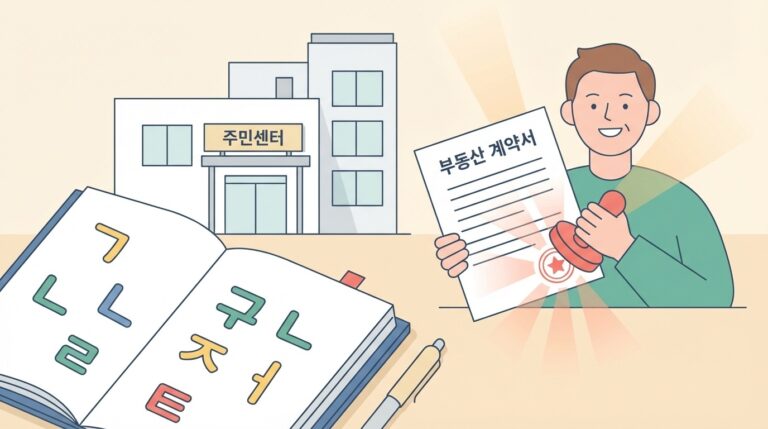
Don’t Lose Your Deposit! The Ultimate K-Real Estate Survival Guide
Phase 1: Immersive Hook (The K-Drama Nightmare You Want to Avoid)
Hello! I’m the lead editor of Daily Hangul, your veteran Korean tutor and local culture navigator.
Imagine this classic K-Drama scene: It’s pouring rain. The protagonist is drinking a bitter shot of soju at a pojangmacha (street tent cart). They’ve just been kicked out of their cozy rooftop apartment because the landlord went bankrupt. The subtitles simply read, ‘I lost my home.’ But what they actually lost was their 보증금 (Bojeunggeum – Housing Deposit).
In Korea, housing deposits aren’t just a month’s rent. Whether you’re doing Wolse (monthly rent with a high deposit) or Jeonse (a massive lump-sum deposit with no monthly rent), we are talking about thousands—sometimes hundreds of thousands—of dollars.
I’ve seen so many expats successfully navigate the language barrier, only to freeze when the real estate agent asks, ‘Did you get your fixed date yet?’ Not knowing these terms doesn’t just mean a missed cultural connection; it could literally cost you your life savings.
Don’t worry! This guide is built on the real-life struggles (and victories!) of my students. Let’s make sure your deposit is bulletproof.
Phase 2: Deep Dive into Core Expressions
Here are the lifesaver phrases you must know to protect your money.
1. 확정일자 받으러 왔어요. (I came to get a fixed date.)
- Pronunciation: [hwakjeong-ilja badeureo wasseoyo]
(Sound-alike guide: ‘Hwak-jeong’ sounds like a sharp exhale followed by ‘jong’. ‘Il-ja’ sounds like ‘eel-jah’.)- Meaning: Literal: ‘I came to receive a confirmed date.’ / Real nuance: ‘Please stamp my contract so the government knows I legally live here and my deposit is protected.’
- K-Culture Moment: You’ve just signed your contract. The real estate agent (usually a friendly but no-nonsense Ajumma or Ajeossi) will look at you and urgently say, ‘Go to the Jumin Center right now and get this stamped.’ It’s a rite of passage for every adult in Korea.
- Editor’s Insight: Think of ‘확정일자’ as a magical shield. Without this red stamp on your contract, if the house goes to auction, you are at the back of the line to get your money back. Say this phrase with a polite but determined tone.
- Situation Spectrum:
[🚫 Never] ———— [⚠️ Caution] ———— [✅ Freely]
- Casual friends: 🚫 (They don’t issue the stamp!)
- Real Estate Agent / Jumin Center Clerk (Formal): ✅
- 🤔 Think About It: Why does Korea require you to physically (or digitally) register a ‘fixed date’ to protect your money? It shows a legal system that prioritizes a first-come, first-served hierarchy of debt. How does your home country protect tenant deposits?
2. 전입신고 하려고요. (I’d like to report my move-in.)
- Pronunciation: [jeonipsingo haryeogoyo]
(Sound-alike guide: ‘Jeon-ip’ sounds like ‘john-eep’, ‘singo’ sounds like ‘sing-go’.)- Meaning: Literal: ‘I intend to do a move-in report.’ / Real nuance: ‘I’m officially registering this address as my legal residence.’
- K-Culture Moment: In K-Dramas, when a couple finally moves in together, they take a selfie holding a document in front of the community center. That document is the result of Jeonipsingo. It’s the ultimate ‘we are officially living here’ proof.
- Editor’s Insight: You usually do this at the exact same time as getting your Hwakjeong-ilja. If you are a foreigner, you might do this at the local Immigration Office or Jumin Center by updating your Alien Registration Card (ARC).
- Situation Spectrum:
[🚫 Never] ———— [⚠️ Caution] ———— [✅ Freely]
- Jumin Center Clerk (Formal): ✅
- 🤔 Think About It: ‘신고(Singo)’ means ‘report’ or ‘declaration’. The word is also used for reporting a crime! It shows how seriously the Korean government takes administrative tracking.
3. 등기부등본 확인하셨어요? (Did you check the real estate register?)
- Pronunciation: [deunggibudeungbon hwaginhasyeosseoyo]
(Sound-alike guide: ‘Deung-gi-bu-deung-bon’ is a mouthful! Break it down: deung-gee-boo-deung-bone.)- Meaning: Literal: ‘Did you check the certified copy of the register?’ / Real nuance: ‘Did you check if the landlord is secretly drowning in debt?’
- K-Culture Moment: Picture a tense scene in a thriller drama where the clever protagonist pulls out a piece of paper, slams it on the desk, and reveals the villain doesn’t actually own the building. That paper is the Deunggibudeungbon.
- Editor’s Insight: This is the background check of the house. It shows who owns it and, crucially, how much debt (mortgage) is tied to it. If the debt + your deposit is higher than the house’s value… RUN.
- Situation Spectrum:
[🚫 Never] ———— [⚠️ Caution] ———— [✅ Freely]
- Asking a friend for advice: ✅
- Asking your realtor: ✅
- 🤔 Think About It: Korean real estate relies heavily on absolute transparency of property debt, accessible to anyone for a small fee online.
Phase 3: Textbook vs Real Life
How the textbook teaches real estate vs. how you’ll actually hear it in a fast-paced Seoul office.
| Situation | 📖 Textbook Korean | 🗣️ Real Korean | 💡 Why the Difference? |
|---|---|---|---|
| Asking about the deposit protection | 주택임대차보호법에 의해 보호받을 수 있습니까? (Can I be protected by the housing lease protection act?) | 확정일자 받으면 안전하죠? (It’s safe if I get the fixed date, right?) | Real Koreans don’t cite laws in daily life; they focus on the practical action (getting the stamp). |
| Checking the property’s debt | 융자가 얼마나 있습니까? (How much loan is there?) | 빚 많아요? / 융자 얼마나 껴있어요? (Is there a lot of debt? / How much loan is wedged in?) | ‘껴있다’ (wedged/stuck in) is a vivid, colloquial way to describe debt attached to a property. |
| Receiving the fixed date | 확정일자를 부여받았습니다. (I have been granted a fixed date.) | 확정일자 찍었어요. (I got the fixed date stamped.) | Because historically it was a literal physical stamp (‘찍다’), the verb remains even in the digital age. |
Phase 4: Cultural Deep Dive – The Fast & Furious K-Real Estate
4-1. Non-verbal Communication: The Art of Nunchi at the Realtor’s
When discussing contracts, Nunchi (눈치 – the ability to read the room) is vital. When the realtor is flipping through the contract, don’t just stare at your phone. Nod along, make eye contact when they highlight key numbers (deposit and rent), and when they hand you the pen, take it with your right hand, supporting your right elbow with your left hand. It shows respect for the gravity of the transaction.
4-2. K-Culture Connection: The Gap Between K-Dramas and Reality
In dramas, characters often find a picturesque rooftop room (Oktapbang) with a view of Namsan Tower, or a massive, sleek officetel.
The Reality Check: Drama characters rarely show the grueling process of real estate hunting. In reality, the Korean housing market moves at the speed of light—a concept known as Ppalijeonse (fast Jeonse). If you see a good room, you are often expected to transfer a ‘holding fee’ (가계약금) within hours, sometimes before even seeing the physical contract! This hyper-competitive, fast-paced environment means you must have your vocabulary and checklist ready before you step into the Budongsan (Real Estate Agency).
Phase 5: Immersive Roleplay Scenario
Scenario A: The Golden Stamp Mission
– Setting: Friday, 3:30 PM. The local Jumin Center (Community Center). You are holding a numbered ticket. The waiting room is buzzing with people. You just signed a lease for a sweet officetel in Gangnam, and the realtor warned you to get this done before the weekend.
– Characters:
– YOU: An expat who has been in Korea for 2 years, determined not to lose your hard-earned deposit.
– Clerk Lee: A very efficient, fast-talking civil servant in her 40s. She has a stack of papers and a stamp pad next to her.
Clerk Lee: 72번 고객님, 이쪽으로 오세요. 어떤 업무 보러 오셨어요?
(72-beon gogaengnim, ijjogeuro oseyo. Eotteon eommu boreo osyeosseoyo?)
[Customer number 72, please come here. What business brings you here today?]
(🎭 Stage Direction: Clerk Lee clicks her mouse rapidly, looking at you over her glasses.)
YOU: 안녕하세요. 오늘 이사해서요. 전입신고하고 확정일자 받으러 왔어요.
(Annyeonghaseyo. Oneul isahaeseoyo. Jeonipsingohago hwakjeong-ilja badeureo wasseoyo.)
[Hello. I moved today. I came to do my move-in report and get a fixed date.]
Clerk Lee: 네, 신분증이랑 계약서 원본 주세요. 외국인 등록증 주소지 변경도 같이 하시는 거죠?
(Ne, sinbunjeung-irang gyeyakseo wonbon juseyo. Oegugin deungnokjeung jusoji byeonggyeongdo gachi hasineun geojyo?)
[Yes, please give me your ID and original contract. You are updating your Alien Registration Card address together, right?]
(🎭 Stage Direction: You hand over your passport, ARC, and the pristine rental contract with two hands.)
YOU: 네, 맞아요. 같이 해주세요.
(Ne, majayo. Gachi haejuseyo.)
[Yes, that’s right. Please do them together.]
Clerk Lee: 계약서에 특약 사항은 다 확인하셨죠? 도장 찍어드릴게요. 수수료 600원입니다.
(Gyeyakseoe teugyak sahang-eun da hwaginhasyeotjyo? Dojang jjigeodeurilgeyo. Susuryo yupbaegwon-imnida.)
[You checked all the special conditions on the contract, right? I’ll stamp it for you. The fee is 600 won.]
🔀 Your Turn! How do you respond to the fee?
– A) ‘비싸네요. 깎아주세요.’ (It’s expensive. Give me a discount.)
– B) ‘카드로 결제할게요.’ (I’ll pay by card.)
– C) ‘현금 여기 있습니다. 감사합니다!’ (Here is cash. Thank you!)✅ Best Choice: C or B.
Why? Government administrative fees are fixed. You absolutely cannot haggle (Choice A is a major faux pas here!). While they do accept cards (Choice B) nowadays, for tiny amounts like 600 won, having a 1,000 won bill (Choice C) makes you look incredibly prepared and respectful of their busy queue.
YOU: 현금 여기 있습니다. 정말 감사합니다!
(Hyeongeum yeogi isseumnida. Jeongmal gamsahamnida!)
[Here is cash. Thank you so much!]
Clerk Lee: 네, 다 됐습니다. 뒷면에 확정일자 도장 찍혔고요. 보증금 안전하게 지키시길 바랄게요. 안녕히 가세요!
(Ne, da dwaetseumnida. Dwinmyeone hwakjeong-ilja dojang jjikhyeotgoyo. Bojeunggeum anjeonhage jikisigil baralgeyo. Annyeonghi gaseyo!)
[Yes, it’s all done. The fixed date is stamped on the back. I hope you keep your deposit safe. Goodbye!]
Bonus Scenario: The Nunchi Check at the Realtor’s
You are looking at a contract with your realtor.
– Realtor: 등기부등본 확인해 보니까 융자가 조금 껴있는데, 괜찮으시겠어요?
(I checked the register and there’s a little bit of loan tied to it, will you be okay with that?)
– YOU: 융자가 보증금보다 많나요? 너무 많으면 계약 안 할게요.
(Is the loan more than my deposit? If it’s too much, I won’t sign the contract.)
– Realtor: 아이고, 똑똑하시네. 걱정 마요. 안전한 매물이에요.
(Oh my, you’re smart. Don’t worry. It’s a safe property.)
Phase 6: 10-Second Shadowing Drill
Practice this out loud. Focus on sounding polite, clear, and confident. The slash (/) indicates where to pause naturally.
😊 안녕하세요! / 오늘 계약을 했는데요, / 확정일자 / 받으러 왔습니다.
(Annyeonghaseyo! / Oneul gyeyageul haenneundeyo, / Hwakjeong-ilja / badeureo watseumnida.)
Pro-tip: Emphasize ‘확정일자’ slightly, as it’s the most important keyword the clerk is listening for.
Phase 7: K-Culture Real Estate Glossary
| 한국어 | Romanization | English | Context |
|---|---|---|---|
| 전세 | jeonse | Key money deposit | A uniquely Korean system where you give a huge deposit (often 50-80% of house value) instead of paying monthly rent. You get it all back when you move out. |
| 월세 | wolse | Monthly rent | You pay a smaller deposit and a monthly rent. (Still, the deposit is usually $5,000 – $10,000+). |
| 부동산 / 공인중개사 | budongsan / gong-injunggaesa | Real Estate Agency / Realtor | The literal meaning is ‘immovable property’, but people use it to refer to the agency itself. |
| 임대인 | imdae-in | Landlord/Lessor | The formal legal term for the owner. Used on contracts. |
| 임차인 | imcha-in | Tenant/Lessee | The formal legal term for you, the renter. |
Phase 8: Traveler/Expat Survival Kit
Even if you are just coming to Korea for a working holiday or a 3-month language program, you might deal with 단기 임대 (Short-term leases).
🆘 Survival Phrases for Short-Term Renters
– 🇰🇷 ‘단기 임대도 확정일자 받을 수 있나요?’ (Dangi imdaedo hwakjeong-ilja badeul su innayo? – Can I get a fixed date for a short-term lease too?)
– 🇰🇷 ‘보증금은 언제 돌려주시나요?’ (Bojeunggeumeun eonje dollyeojusinayo? – When will you return my deposit?)
– 📍 Where to use: Real estate agencies near universities (Hongdae, Sinchon).📌 Editor’s Note: Real Estate Apps
Don’t wander the streets! Use apps like 직방 (Zigbang), 다방 (Dabang), or 네이버 부동산 (Naver Real Estate) to check average deposit prices in your desired neighborhood before visiting an agent. This prevents you from being overcharged!
Phase 9: Think Deeper — “A Step Further”
Media vs Reality: The Romanticized ‘Oktapbang’ (Rooftop Room)
In K-Dramas, rooftop rooms are the ultimate symbol of romantic struggle. Young protagonists drink beer on the roof looking at the glittering Seoul skyline. However, the reality of the Korean housing market is quite harsh. Rooftop rooms are often freezing in the winter, boiling in the summer, and legally precarious. The intense focus on securing a safe Jeonse deposit is a reflection of Korea’s rapid economic development, where high interest rates once made this system mutually beneficial for landlords and tenants. Today, as interest rates fluctuate, protecting your deposit through a ‘Fixed Date’ isn’t just an administrative chore; it’s a critical survival skill in a highly capitalist society.
💬 Your Turn: Does your country have a unique housing system like Jeonse? How hard is it for young people to find housing in your culture? Share your thoughts in the comments!
Phase 10: FAQ & Troubleshooting
Q: ‘Can I just get the fixed date a week after I move in?’
NO! Absolutely not. If your landlord takes out a loan against the house the day after you move in, and you haven’t gotten your fixed date, their bank gets priority over your deposit. Go on the exact day your lease starts.
Q: ‘I’m a foreigner. Can I do this at the Jumin Center?’
Sometimes. If you are updating your address on your Alien Registration Card, you often go to the local Gu-Office (구청) or Jumin Center, and they can process the move-in report and fixed date together. Always bring your physical ARC, Passport, and original lease contract.
❌ Common Mistake #1: Leaving the Jumin Center without checking the back of the contract.
✅ Do this instead: Physically flip your contract over and look for the rectangular red stamp with a date on it. No stamp = No fixed date.
Phase 11: Wrap-up & Action Items
One-Liner Summary: To protect your massive Korean housing deposit, memorize ‘확정일자 (Hwakjeong-ilja)’ and get it stamped the moment you move in!
Action Mission:
– 🥉 Bronze (Solo): Stand in front of a mirror and say ‘확정일자 받으러 왔어요’ three times with a confident voice.
– 🥈 Silver (Online): Go to a Korean expat forum (like a Reddit Korea sub) and search ‘Fixed Date’ to read real horror/success stories.
– 🥇 Gold (Real Life): If you are moving soon, physically locate your nearest Jumin Center on KakaoMap so you know exactly where to run on moving day!
K-Culture Mission: Next time you watch a K-Drama where someone moves into a new house (like Because This Is My First Life), look closely at the paperwork scenes. You’ll spot the Deunggibudeungbon and the red stamps!
Phase 12: Interactive Quiz
1. Situational Judgment: You just transferred your $10,000 deposit to the landlord and got the keys. It is 4:00 PM on a Friday. What should you do next?
– A) Order Jajangmyeon (Black bean noodles) to celebrate moving in.
– B) Unpack your boxes slowly.
– C) Sprint to the Jumin Center to say ‘확정일자 받으러 왔어요’.
(Answer: C! Government offices close at 6 PM. If you wait until Monday, your deposit is unprotected all weekend. You can eat your Jajangmyeon at 6:01 PM!)
2. Fill in the Blank:
Realtor: ‘Did you check the property’s debt history?’
Korean: ‘_____________ 확인하셨어요?’
(Answer: 등기부등본 – Deunggibudeungbon)
3. True or False – K-Culture Edition:
In Korea, haggling over government administrative fees (like the 600 won stamp fee) is considered a fun, acceptable cultural practice.
(Answer: False. Never haggle at a government office! It will only cause immense confusion and delay.)
See you in the next lesson! Stay safe, and keep your deposit protected! 🏠💙
Frequently Asked Questions (FAQ)
Q: What does "확정일자 받으러 왔어요. (I came to get a fixed date.)" mean in Korean and how do you pronounce it?
A: In Korean, "확정일자 받으러 왔어요. (I came to get a fixed date.)" is pronounced [hwakjeong-ilja badeureo wasseoyo] and means: Literal: 'I came to receive a confirmed date.' / Real nuance: 'Please stamp my contract so the government knows I legally live here and my deposit is protected.'
Q: What does "전입신고 하려고요. (I'd like to report my move-in.)" mean in Korean and how do you pronounce it?
A: In Korean, "전입신고 하려고요. (I'd like to report my move-in.)" is pronounced [jeonipsingo haryeogoyo] and means: Literal: 'I intend to do a move-in report.' / Real nuance: 'I'm officially registering this address as my legal residence.'
Q: What does "등기부등본 확인하셨어요? (Did you check the real estate register?)" mean in Korean and how do you pronounce it?
A: In Korean, "등기부등본 확인하셨어요? (Did you check the real estate register?)" is pronounced [deunggibudeungbon hwaginhasyeosseoyo] and means: Literal: 'Did you check the certified copy of the register?' / Real nuance: 'Did you check if the landlord is secretly drowning in debt?'







