

Don’t Panic at the Korean Register! The Magic Phrase for Getting a Shopping Bag
Phase 1: Immersive Hook — The K-Drama Makeover Reality Check
Hello! I’m your Daily Hangul Editor.
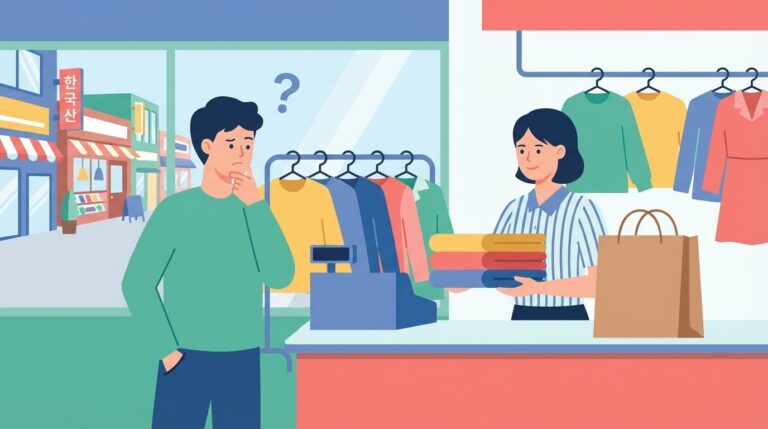
Imagine this: You are the main character in your very own K-Drama. You just had your fabulous “makeover montage” at a trendy clothing boutique in Hongdae or Seongsu-dong. You confidently place your new outfits on the counter. You hand over your credit card.
The cashier rings you up, looks at you, and fires off a rapid sentence ending in “…seyo?”
Then, she just hands you your clothes. No bag. Just a pile of shirts.
You stand there awkwardly hugging your new clothes, wondering, “Wait, in the dramas, they always walk out holding a dozen shiny shopping bags! What did I do wrong?”
Don’t worry! You didn’t do anything wrong. In Korea, strict environmental laws mean stores cannot give out free shopping bags (even paper ones!). If you don’t know the magic phrase, you might end up carrying your new clothes in your arms all the way to the subway. Let’s fix that today!
Phase 2: Deep Dive into Core Expressions
Here are the absolute must-know phrases for the checkout counter.
1. 봉투 필요하세요?
- Pronunciation: [bongtu piryohaseyo?]
(Sound-alike guide: ‘Bong’ sounds like the bouncy sound of a ball. ‘Piryohaseyo’ sounds like ‘pee-ryo-ha-say-yo’.)- Meaning: Do you need a bag? (Literal: Is a bag needed?)
- K-Culture Moment: This is what the cashier will say 99% of the time. In the fast-paced ‘Pali-pali’ (hurry hurry) Korean shopping culture, cashiers say this incredibly fast while scanning your clothes.
- Editor’s Insight: ‘봉투’ originally means envelope, but in shopping, it means a plastic or paper shopping bag. When you hear “…haseyo?” at the register, they are usually asking this!
- Situation Spectrum:
[🚫 Never] ———— [⚠️ Caution] ———— [✅ Freely]
- Cashier to Customer: ✅
- 🤔 Think About It: Notice how the subject “you” (당신) is missing? Korean often drops the subject when it’s obvious! Does your language always require a “you”?
2. 네, 하나 주세요.
- Pronunciation: [ne, hana juseyo.]
- Meaning: Yes, please give me one. (Literal: Yes, one give please.)
- K-Culture Moment: This is your life-saving response! It’s polite, natural, and exactly what locals say.
- Editor’s Insight: You don’t need to say the full sentence “I would like to buy a shopping bag.” Just “Yes, one please” is the perfect, natural way to respond to a busy cashier.
- Situation Spectrum:
[🚫 Never] ———— [⚠️ Caution] ———— [✅ Freely]
- To a cashier: ✅
- To a friend: ⚠️ (Too formal)
3. 쇼핑백에 담아주세요.
- Pronunciation: [syopingbaege damajuseyo.]
- Meaning: Please put it in a shopping bag.
- Editor’s Insight: If the cashier didn’t ask you first, and you realize you need a bag, use this! ‘담아주세요’ means “please put (items) inside”.
- Situation Spectrum:
[🚫 Never] ———— [⚠️ Caution] ———— [✅ Freely]
- To a cashier: ✅
Phase 3: Textbook vs Real Life Korean
| Situation | 📖 Textbook Korean | 🗣️ Real Life Korean | 💡 Why the difference? |
|---|---|---|---|
| Cashier asking if you need a bag | 쇼핑백을 원하십니까? (Do you want a shopping bag?) | 봉투 필요하세요? (Bag needed?) | Pali-pali culture! Shorter and softer sounds are preferred at the register. |
| Asking for a bag yourself | 저는 쇼핑백을 사고 싶습니다. (I want to buy a shopping bag.) | 쇼핑백 하나 주세요. (One shopping bag, please.) | Real life requires efficiency. “Give me one” is perfectly polite in this context! |
Phase 4: Cultural Deep Dive
4-1. Non-verbal Communication: The Card Handover
In Korea, politeness isn’t just in the words—it’s in the hands! When paying for your bag, always hand your credit card to the cashier using two hands, or with your right hand while your left hand lightly touches your right elbow. It’s a sign of respect, even to strangers!
4-2. K-Travel Connection: The “100 Won” Surprise
If you are shopping in Myeongdong or Gangnam, prepare for a tiny surprise. When you say “Yes, I need a bag,” the cashier might say: “백 원입니다” (baek won-imnida / It’s 100 won).
Because of Korea’s “Resource Recycling Act” to protect the environment, large stores are legally forbidden to give out free bags. You must buy them! Don’t worry, you don’t need a physical coin; they will just add the 100 won to your credit card total.
Phase 5: Immersive Roleplay Scenario
Setting: Saturday afternoon. A crowded, aesthetic clothing boutique in Hongdae. K-Pop (NewJeans) is playing loudly. You finally found the perfect oversized jacket. You go to the counter where Minji, a busy cashier, is quickly scanning items.
Characters:
– YOU: A traveler trying to survive their first Korean shopping spree.
– Minji (20s): The friendly but extremely fast cashier.
Minji: 결제 도와드리겠습니다. 봉투 필요하세요? 💳
(gyeolje dowadeurigetseumnida. bongtu piryohaseyo?)
(English) I’ll help you with the payment. Do you need a bag?
(🎭 Stage Direction: Minji holds your jacket, looking at you expectantly)
🔀 Your Turn! How should you reply?
– A) “아니요, 괜찮아요.” (No, it’s okay.)
– B) “네, 하나 주세요.” (Yes, please give me one.)
– C) “얼마예요?” (How much is it?)✅ Best Choice: B — Reason: You bought a big jacket, so you definitely need a bag! It’s the most natural and polite way to accept.
⚠️ Choice A Analysis: Only say this if you brought your own eco-bag. Otherwise, you’re carrying that jacket by hand!
⚠️ Choice C Analysis: It’s usually 100 won everywhere, so asking the price might slow down the fast-paced line behind you.
Minji: 네, 봉투값 백 원 추가해서 결제해 드릴게요. 카드를 꽂아주세요!
(ne, bongtugap baek won chugahaeseo gyeoljehae deurilgeyo. kadeureul kkojajuseyo!)
(English) Yes, I will add the 100 won bag fee and process the payment. Please insert your card!
Phase 6: 10-Second Shadowing Drill
Practice speaking like a local! Pay attention to the pauses (/) and emotion.
😊 네, / 쇼핑백 / 하나 주세요! (Ne, / syopingbaek / hana juseyo!)
(Emotion: Bright, polite, and quick!)
🤔 아, / 봉투에 / 담아주세요. (Ah, / bongtue / damajuseyo.)
(Emotion: Realizing you need a bag at the last minute!)
Phase 7: K-Culture Glossary
| Korean | Romanization | English | Context |
|---|---|---|---|
| 봉투 | bongtu | Bag / Envelope | Can mean paper (종이) or plastic (비닐) bag at a store. |
| 쇼핑백 | syopingbaek | Shopping Bag | Usually refers to nice paper bags with handles. |
| 영수증 | yeongsujeung | Receipt | Cashiers often ask “영수증 드릴까요?” (Need the receipt?). |
| 환불 | hwanbul | Refund | You usually have 7 days to get a refund in Korea! |
| 빨리빨리 | ppalli-ppalli | Hurry, hurry | The core mindset of Korean service culture. |
Phase 8: Traveler’s Survival Kit
🆘 Survival Phrase #1: Card please!
– 🇰🇷 “카드로 할게요.” (kadeuro halgeyo.)
– 🗣️ Pronunciation: [kah-deu-ro hal-ge-yo]
– 📍 Where to use: Any store, cafe, or taxi.
– 💡 Pro Tip: Korea is a cashless society! 99% of places prefer cards over cash.🆘 Survival Phrase #2: Throw away the receipt!
– 🇰🇷 “영수증 버려주세요.” (yeongsujeung beoryeojuseyo.)
– 🗣️ Pronunciation: [young-soo-jeung buh-ryuh-ju-say-yo]
– 💡 Pro Tip: If you don’t need to return the clothes, just say this. It saves time and paper!📌 Editor’s Travel Note
– Eco-bags: Koreans carry reusable “eco-bags” everywhere. Buy a cute one in Korea—they make great souvenirs and save you 100 won every time you shop!
– Self-Checkout: In stores like Daiso or large supermarkets, you will use a self-checkout kiosk. Look for the button that says “종이 봉투” (Paper bag) on the screen to add it to your cart.
Phase 9: Think Deeper — K-Culture Behind the Language
Global Era & Environment (글로벌 시대와 환경)
Why do you have to pay for a simple paper bag in Korea? This reflects a fascinating clash in modern Korean society. On one hand, Korea is the land of “fast fashion” and Pali-pali convenience. On the other hand, Korea has one of the strictest recycling systems in the world (ranking top 3 globally!). Charging 100 won for a bag is a collective social agreement to reduce waste. It shows how Korean language at the register has evolved from simply serving the customer to enforcing a national environmental goal.
💬 Your Turn: Does your country charge for shopping bags? How do cashiers ask about it in your language? Tell us in the comments!
Phase 10: FAQ & Troubleshooting
Q: Can I use the word “가방 (gabang)” for a shopping bag?
No! This is a very common mistake. “가방” refers to a backpack, handbag, or luggage. If you say “가방 주세요” (Give me a gabang), the cashier will be very confused because they sell clothes, not luggage! Always use 쇼핑백 or 봉투.
Q: Do I need to give them a 100 won coin physically?
Nope! You almost never use physical coins. The cashier will just add it to your final credit card bill.
❌ Common Mistake #1: Pointing at the clothes and just saying “백!” (Bag!). In Korean, “백” alone usually refers to an expensive luxury handbag.
✅ Do this instead: Say “쇼핑백 하나 주세요” (One shopping bag, please).
Phase 11: Wrap-up & Action Missions
One-Liner Summary: When the cashier speaks fast and asks “Bongtu piryohaseyo?”, just smile and say “Ne, hana juseyo!”
Action Mission:
– 🥉 Bronze: Say “봉투 필요하세요?” and “네, 하나 주세요” out loud 3 times right now.
– 🥈 Silver: Next time you watch a K-Drama where someone goes shopping, listen closely for the word “쇼핑백”.
– 🥇 Gold: On your trip to Korea, buy a pair of socks at a store and successfully ask for a bag using today’s phrase!
Phase 12: Interactive Quiz
1. You bought a t-shirt in Hongdae. The cashier asks: “봉투 필요하세요?” What is the most natural reply?
A) 가방 주세요. (Give me a bag.)
B) 네, 하나 주세요. (Yes, give me one please.)
C) 저는 쇼핑백을 원합니다. (I desire a shopping bag.)
2. True or False:
In Korea, you can usually get a free plastic shopping bag at large clothing stores if you ask nicely. (T/F)
3. Fill in the blank:
Please put it in a shopping bag -> 쇼핑백에 [ ]주세요.
👀 Click here to see the answers!
1. B (‘가방’ means backpack, and C is too robotic/textbook!)
2. False (It is illegal for large stores to give free bags due to environmental laws. It usually costs 50-100 won!)
3. 담아 (damajuseyo)
Frequently Asked Questions (FAQ)
Q: What does "봉투 필요하세요?" mean in Korean and how do you pronounce it?
A: In Korean, "봉투 필요하세요?" is pronounced [bongtu piryohaseyo?] and means: Do you need a bag? (Literal: Is a bag needed?)
Q: What does "네, 하나 주세요." mean in Korean and how do you pronounce it?
A: In Korean, "네, 하나 주세요." is pronounced [ne, hana juseyo.] and means: Yes, please give me one. (Literal: Yes, one give please.)
Q: What does "쇼핑백에 담아주세요." mean in Korean and how do you pronounce it?
A: In Korean, "쇼핑백에 담아주세요." is pronounced [syopingbaege damajuseyo.] and means: Please put it in a shopping bag.







