

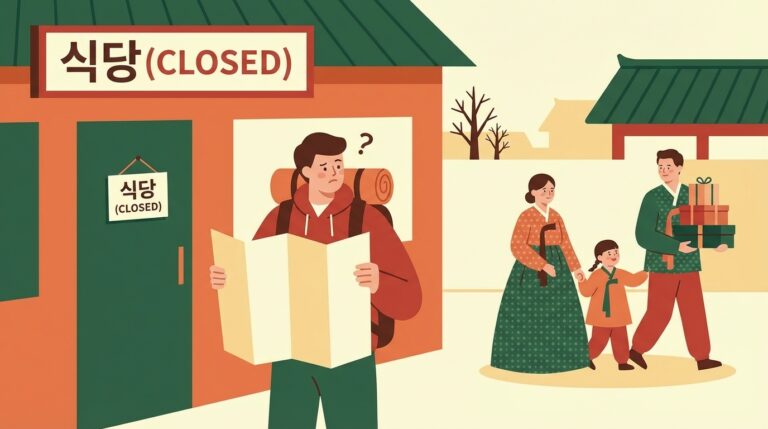
Title: Don’t Be Left Out in Seoul! The Ultimate A1 Guide to Surviving the Seollal Holidays
Phase 1: Empathy & Immersion (Immersive Hook)
Hello! I’m the Head Editor at Daily Hangul.
Imagine this K-Drama scene: The usually crowded streets of Gangnam are completely empty. It looks like a ghost town! Cut to the next scene—our main characters are stuck in an endless, unmoving line of cars on the highway, boxes of spam and fresh fruit in the backseat. What on earth is going on?
Welcome to Seollal (설날)—the Korean Lunar New Year, and one of the biggest Yeonhyu (연휴, long consecutive holidays) of the year!
If you’re traveling or living in Korea during this time, not knowing the right survival phrases can lead to you standing hungry in front of a closed restaurant. But don’t worry! I’ve been teaching Korean to expats for years, and today, I’ll teach you exactly how to navigate the holidays, greet your Korean friends, and find an open café like a true insider. Let’s dive in!
Phase 2: Core Expressions Deep Dive
Let’s learn the 3 absolute essential phrases you need for the Seollal Yeonhyu!
1. 새해 복 많이 받으세요
- Pronunciation: sae-hae bok ma-ni ba-deu-se-yo
(Sound guide: “sae-hae” sounds like ‘say hay’. “eu” in ‘deu’ sounds like the disgusted sound you make when you step in gum!) - Meaning:
- Literal: Receive a lot of new year luck.
- Real nuance: Happy New Year!
- K-Culture Moment: You’ll see K-Pop idols holding cute handwritten signs with this exact phrase during their holiday greetings. This is the ultimate, universally loved New Year greeting in Korea!
- Editor’s Insight: Don’t stress about the grammar here. Just memorize it like a catchy K-Pop chorus. It literally works for everyone.
- Situation Spectrum:
[🚫 Never] ———— [⚠️ Caution] ———— [✅ Freely]- Close friends (Casual): ✅ (You can just say “새해 복 많이 받아!”)
- Coworkers (Semi-formal): ✅
- Boss / Elders (Formal): ✅
- 🤔 Think About It: Koreans emphasize “receiving luck (복 – bok)” rather than just having a “happy” year. How do people wish each other well in your native language?
2. 연휴 잘 보내세요
- Pronunciation: yeon-hyu jal bo-nae-se-yo
(Sound guide: ‘yeon-hyu’ = yuhn-hyoo. ‘jal’ = jal. ‘bo-nae-se-yo’ = bo-nay-seh-yo) - Meaning:
- Literal: Send the consecutive holidays well.
- Real nuance: Have a great long holiday!
- K-Culture Moment: This is the magic phrase you say at 5:59 PM on the Friday before the holiday starts, as everyone runs out of the office.
- Editor’s Insight: Yeonhyu means a string of consecutive holidays. Use this phrase for Seollal, Chuseok, or any long weekend!
- Situation Spectrum:
[🚫 Never] ———— [⚠️ Caution] ———— [✅ Freely]- Close friends (Casual): ✅
- Coworkers (Semi-formal): ✅
- Boss / Elders (Formal): ⚠️ (Better to stick to “새해 복 많이 받으세요” for older relatives).
- 🤔 Think About It: Why is acknowledging someone’s rest/holiday so important in Korean workplace culture? It shows empathy for their hard work!
3. 오늘 열어요?
- Pronunciation: o-neul yeo-reo-yo?
(Sound guide: ‘o-neul’ = oh-neul. ‘yeo-reo-yo’ = yuh-ruh-yo) - Meaning:
- Literal: Do you open today?
- Real nuance: Are you open for business today?
- K-Culture Moment: You’re starving. You walk up to a famous K-BBQ spot, but the lights look dim. You poke your head in and ask the owner holding a mop: “오늘 열어요…?”
- Editor’s Insight: This is a pure survival phrase. During Seollal, Google Maps might say “Open,” but the restaurant might actually be closed. Always call or ask!
- Situation Spectrum:
[🚫 Never] ———— [⚠️ Caution] ———— [✅ Freely]- Store owners / Staff: ✅
- Friends/Coworkers: 🚫 (Makes no sense, unless they are a door!)
Phase 3: Textbook vs Real Life Korean
| Situation | 📖 Textbook Korean | 🗣️ Real Korean | 💡 Why is it different? |
|---|---|---|---|
| Asking a store’s hours | 오늘 영업합니까? (o-neul yeong-eop-ham-ni-kka?) | 오늘 열어요? (o-neul yeo-reo-yo?) | “영업합니까” is too formal and stiff. “열어요?” is natural, everyday language. |
| Saying Goodbye before holiday | 명절 잘 지내십시오. (myeong-jeol jal ji-nae-sip-si-o.) | 연휴 잘 보내세요~ (yeon-hyu jal bo-nae-se-yo~) | The textbook is overly formal. “연휴 잘 보내세요” is friendly and widely used in modern offices. |
| Wishing Happy New Year | 새해에 복 많이 받으시길 바랍니다. (sae-hae-e bok ma-ni ba-deu-si-gil ba-ram-ni-da.) | 새해 복 많이 받으세요! (sae-hae bok ma-ni ba-deu-se-yo!) | We love dropping unnecessary grammar particles to make greetings punchy and sincere! |
Phase 4: Cultural Deep Dive — K-Culture Connection
4-1. Non-verbal Communication: The Art of “Sebae”
When saying “새해 복 많이 받으세요” to grandparents or parents, Koreans don’t just wave. They perform a deep, formal bow on their knees called Sebae (세배).
Here’s the fun part: After you bow, the elders will give you words of blessing… and an envelope of cash called Sebaetdon (세뱃돈)!
Pro Tip: When receiving that beautiful envelope, never use just one hand. Use two hands and bow your head slightly. It’s the ultimate sign of respect (and gratitude for the cash!).
4-2. K-Travel Connection: The “Ghost Town” vs The “Palaces”
During the Seollal Yeonhyu, Seoul experiences a bizarre phenomenon. Millions of people travel to their hometowns (hence the K-Drama highway traffic jams!). Many local mom-and-pop shops and restaurants will close.
However, major tourist spots like Gyeongbokgung Palace actually become more vibrant! In fact, during Seollal, entry to the palaces is usually FREE, and you’ll see hundreds of people taking photos in beautiful Hanbok.
Phase 5: Immersive Roleplay Scenario
Scenario A: The Friday Office Escape
Setting: 5:30 PM, the Friday before the Seollal Yeonhyu. You are at your desk in a Seoul office. Your Korean coworker, Minsu (32, friendly and helpful), is packing his bag in a hurry.
Characters:
– YOU: An expat working in Korea, excited for your first long holiday.
– Minsu: Your coworker, currently stressing out about train tickets.
Minsu: 아, 드디어 퇴근이네요! (a, deu-di-eo toe-geu-ni-ne-yo!)
(English) Ah, it’s finally time to leave work!
(🎭 Stage Direction: Minsu grabs his coat and looks relieved)
YOU: 네! 너무 신나요. 연휴 때 뭐 할 거예요? (ne! neo-mu sin-na-yo. yeon-hyu ttae mwo hal geo-e-yo?)
(English) Yes! I’m so excited. What are you doing during the holiday?
Minsu: 저는 고향에 가요. ㅇㅇ씨는요? (jeo-neun go-hyang-e ga-yo. OO-ssi-neun-yo?)
(English) I’m going to my hometown. What about you?
YOU: 저는 명동에 가서 쇼핑할 거예요. (jeo-neun myeong-dong-e ga-seo syo-ping-hal geo-e-yo.)
(English) I’m going to Myeongdong to shop.
Minsu: 명동이요? 설날에는 문 닫는 식당이 많아요. (myeong-dong-i-yo? seol-la-re-neun mun dan-neun sik-dang-i ma-na-yo.)
(English) Myeongdong? Many restaurants close on Seollal.
YOU: 헉, 진짜요? 그럼 밥은 어디서 먹어요? (heok, jin-jja-yo? geu-reom ba-beun eo-di-seo meo-geo-yo?)
(English) Gasp, really? Then where do I eat?
Minsu: 가기 전에 꼭 전화해 보세요. (ga-gi jeo-ne kkok jeon-hwa-hae bo-se-yo.)
(English) Make sure to call before you go.
YOU: 한국어로 뭐라고 물어봐요? (han-gu-geo-ro mwo-ra-go mu-reo-bwa-yo?)
(English) How do I ask in Korean?
Minsu: 그냥 “오늘 열어요?” 라고 하시면 돼요. 전 기차 타러 갈게요! (geu-nyang “o-neul yeo-reo-yo?” ra-go ha-si-myeon dwae-yo. jeon gi-cha ta-reo gal-ge-yo!)
(English) Just say “Are you open today?”. I’m going to catch my train!
🔀 Your Turn! How should you reply to Minsu as he leaves?
– A) “네, 안녕히 가세요.” (Yes, goodbye – polite but a bit dry)
– B) “연휴 잘 보내세요! 새해 복 많이 받으세요!” (Have a great holiday! Happy New Year!)
– C) “오늘 열어요?” (Are you open today?)✅ Best Choice: B — Why? It’s the ultimate Seollal combo! You acknowledge his long break AND wish him luck. You’ll instantly become his favorite coworker.
⚠️ Choice C Analysis: Do not say this to a human! Minsu is a person, not a convenience store!
Scenario B: Bonus Roleplay – The Hungry Traveler
Setting: You are standing in front of a dark K-BBQ restaurant. The owner walks out.
YOU: 사장님, 오늘 열어요? (sa-jang-nim, o-neul yeo-reo-yo?)
(English) Boss, are you open today?
Owner: 아이고, 오늘은 연휴라서 쉬어요. 내일 오세요! (a-i-go, o-neu-reun yeon-hyu-ra-seo swi-eo-yo. nae-il o-se-yo!)
(English) Oh my, we are resting today because it’s the holiday. Come tomorrow!
YOU: 아… 네, 새해 복 많이 받으세요! (a… ne, sae-hae bok ma-ni ba-deu-se-yo!)
(English) Ah… okay, Happy New Year!
Phase 6: 10-Second Shadowing Drill
Read these out loud! Pay attention to the pauses (/) and emotions!
- 😊 Brightly: 연휴 / 잘 / 보내세요! (yeon-hyu / jal / bo-nae-se-yo!)
- 🙏 Sincerely: 새해 / 복 / 많~~~이 / 받으세요! (sae-hae / bok / man~~~i / ba-deu-se-yo!)
- 🥺 Hungry & Hopeful: 사장님, / 오늘 / 열어요? (sa-jang-nim, / o-neul / yeo-reo-yo?)
Phase 7: K-Culture Glossary
| 한국어 | Romanization | English | Cultural Context |
|---|---|---|---|
| 설날 | Seol-lal | Lunar New Year | One of Korea’s two biggest holidays (along with Chuseok). |
| 연휴 | Yeon-hyu | Consecutive Holidays | A long weekend or string of national holidays. |
| 떡국 | Tteok-guk | Rice Cake Soup | The traditional Seollal dish. You must eat this to turn one year older! |
| 세배 | Se-bae | New Year’s Bow | A deep, formal bow on the floor given to elders. |
| 세뱃돈 | Se-baet-don | New Year’s Money | Cash given by elders to younger people after receiving a Sebae. |
Phase 8: Traveler’s Survival Kit
Don’t starve during the Yeonhyu! Here are the top phrases for finding food.
🆘 Survival Expression #1: Are you open?
– 🇰🇷 “오늘 열어요?” (o-neul yeo-reo-yo?)
– 📍 Where to use: Storefronts, calling a café, asking a museum ticket booth.🆘 Survival Expression #2: Do you do takeout?
– 🇰🇷 “포장 돼요?” (po-jang dwae-yo?)
– 📍 Where to use: When the restaurant is fully booked with big families during the holiday.📌 Editor’s Travel Note
– Must-Have App: Download Naver Map or KakaoMap. Google Maps often fails to show accurate holiday hours in Korea!
– Notice Boards: If a store is closed, look for a piece of paper on the door. If you see the characters “설날 연휴 휴무” (Seollal Holiday Closed), turn around and find a convenience store!
Phase 9: Think Deeper — “One Step Further”
🧠 Think Deeper: Food & Identity (The Magic of Tteokguk)
In many cultures, you grow a year older on your personal birthday. But traditionally in Korea, everyone turns a year older together on January 1st (Lunar New Year). The symbolic act of gaining that year is eating a bowl of Tteokguk (떡국, Rice Cake Soup). If a Korean asks you, “떡국 몇 그릇 먹었어요?” (How many bowls of Tteokguk did you eat?), they are jokingly asking your age! This shared aging process shows how Korean culture views time and life milestones—not just as an individual journey, but as a deeply communal and shared experience.
💬 Your Turn:
Does your culture have a specific food you must eat on New Year’s to bring good luck or signify a new beginning? Share it in the comments!
Phase 10: FAQ & Troubleshooting
- Q: Can I say “새해 복 많이 받으세요” on January 1st (Solar New Year) AND Seollal (Lunar New Year)?
- A: YES! Koreans love to celebrate the New Year twice. You can use this greeting heavily in early January, and then use it all over again in February during Seollal!
- Q: I am an adult. Can I ask for Sebaetdon (New Year’s Money)?
- A: NO! Generally, adults who have jobs are expected to give money to children or their parents. If you jokingly ask your boss for Sebaetdon, things might get awkward!
❌ Common Mistake #1: Saying “오늘 오픈해요?” (Today open-haeyo?)
✅ Do This Instead: While some young people might understand Konglish, “오늘 열어요?” (o-neul yeo-reo-yo) is much more natural and understood by grandmas and grandpas alike!
Phase 11: Wrap-up & Action Items
🌟 One-Liner Summary:
Survive the Korean holidays by wishing everyone a good Yeonhyu and always asking “오늘 열어요?” before you visit a restaurant!
🚀 Action Mission:
– 🥉 Bronze (Solo): Stand in front of a mirror and bow while saying “새해 복 많이 받으세요!”
– 🥈 Silver (Online): Go to your favorite K-Pop idol’s Instagram and comment “연휴 잘 보내세요! 💖”
– 🥇 Gold (Real World): Walk up to a Korean convenience store clerk during the holiday and cheerfully say “새해 복 많이 받으세요!”
🎎 K-Culture Mission:
Look up “Korean Sebae K-Pop” on YouTube. Watch how idols do the deep traditional bow in their Hanboks. Can you spot the difference between the male and female hand placements?
Engagement: Did you ever visit an empty street during a holiday in a foreign country? Tell me your funniest travel mishap below!
Phase 12: Interactive Quiz
1. You are leaving the office on the Friday before a 4-day holiday. What should you say to your team?
A) 떡국 많이 드세요 (Eat a lot of Tteokguk)
B) 연휴 잘 보내세요 (Have a great long holiday)
C) 오늘 열어요? (Are you open today?)
(Answer: B! It’s the perfect office farewell before a break.)
2. True or False – K-Culture Edition:
“In Korea, you must eat Kimchi Jjigae on Seollal to become one year older.”
(Answer: False! It’s Tteokguk (Rice Cake Soup) that gives you an extra year of age!)
3. Fill in the blank:
You are calling a museum to see if you can visit today.
“여보세요, 오늘 _______?” (Hello, are you open today?)
(Answer: 열어요 / yeo-reo-yo)
Frequently Asked Questions (FAQ)
Q: What does "새해 복 많이 받으세요" mean in Korean and how do you pronounce it?
A: In Korean, "새해 복 많이 받으세요" is pronounced [sae-hae bok ma-ni ba-deu-se-yo] and means: Literal: Receive a lot of new year luck.
Q: What does "연휴 잘 보내세요" mean in Korean and how do you pronounce it?
A: In Korean, "연휴 잘 보내세요" is pronounced [yeon-hyu jal bo-nae-se-yo] and means: Literal: Send the consecutive holidays well.
Q: What does "오늘 열어요?" mean in Korean and how do you pronounce it?
A: In Korean, "오늘 열어요?" is pronounced [o-neul yeo-reo-yo?] and means: Literal: Do you open today?







