

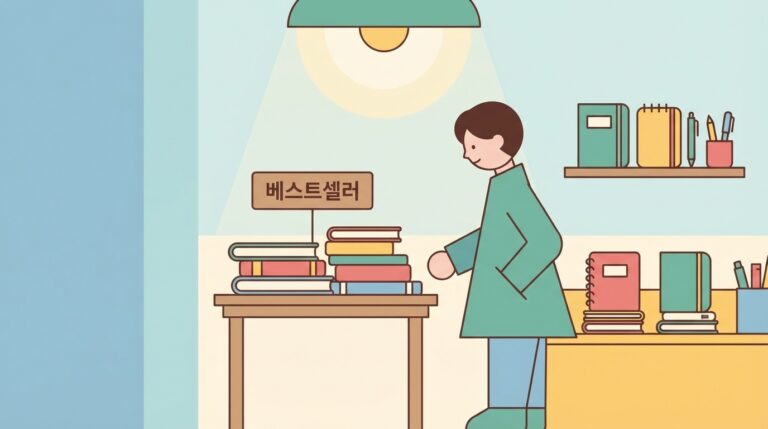
Phase 1: Immersive Opening (The Bookstore Vibe)
Hello! I’m the Lead Editor of Daily Hangul.
Imagine this: You push open the heavy glass doors of Kyobo Bookstore in Gwanghwamun, Seoul. The signature scent of fresh paper and a subtle, calming fragrance (they actually pump in a custom scent called ‘The Scent of Page’) washes over you. It’s totally giving that cozy K-Drama aesthetic.
You stroll over to the Bestseller (베스트셀러) section. You want to pick up that poetry book you saw in Goblin, or maybe the healing essay recommended by your favorite K-Pop idol. But the piles of books are overwhelming, the titles are in Hangul, and your map app is completely useless indoors. You need to ask a busy clerk for help, but your mind goes blank.
Don’t worry! In today’s session, we’re going to learn exactly how to navigate a Korean bookstore, ask for recommendations, and find that specific book you’re hunting for. Let’s turn you from a lost tourist into a confident local reader! 📚
Phase 2: Deep Dive into Key Expressions
Let’s look at the absolute must-know phrases when browsing the bestseller section.
1. 요즘 제일 잘 나가는 책이 뭐예요?
- Pronunciation: Yojeum jeil jal naganeun chaegi mwoyeyo? [Yoh-jeum jeh-il jjal nah-gah-neun cheh-gi mwo-yeh-yo?]
- Meaning: What’s the best-selling book these days? (Literal: What is the book that goes out the best these days?)
- K-Culture Moment: You’ll hear the idiom ‘잘 나가다’ (to go out well) everywhere in Korea. It means something or someone is very popular or successful. If a K-Pop group is topping the charts, they are ‘잘 나가는 아이돌’.
- Editor’s Insight: Instead of the stiff ‘가장 인기 있는 (most popular)’, using ‘잘 나가는’ instantly makes you sound like you’ve lived in Seoul for years. It’s casual but totally acceptable to use with store clerks.
- Situation Spectrum:
[🚫 절대 금지] ———— [⚠️ 주의] ———— [✅ 자유롭게]
- To a friend (Casual): ✅ (요즘 제일 잘 나가는 책이 뭐야?)
- To a store clerk (Semi-formal): ✅
- In a formal academic presentation (Formal): ⚠️ (Stick to ‘베스트셀러’ or ‘인기 있는’)
- 🤔 Think About It: Korean uses a lot of dynamic, movement-based idioms (going out = selling). Does your native language have a physical metaphor for popularity?
2. 이 책 재고 있나요?
- Pronunciation: I chaek jaego innayo? [Ee chek jeh-go in-nah-yo?]
- Meaning: Do you have this book in stock?
- K-Culture Moment: You searched for RM’s latest book recommendation on the store’s computer, but the shelf is empty! Fans move fast. This is the phrase you need to ask if there are any copies left in the back.
- Editor’s Insight: ‘재고’ (jaego) means ‘stock’ or ‘inventory’. Just hold up your phone with the book cover and say this. It’s short, polite, and highly effective.
- Situation Spectrum:
[🚫 절대 금지] ———— [⚠️ 주의] ———— [✅ 자유롭게]
- Any shopping situation (Bookstores, Olive Young, Convenience stores): ✅
3. 이거 샘플(견본) 있어요?
- Pronunciation: Igeo saempeul (gyeonbon) isseoyo? [Ee-geo sem-peul (gyun-bon) is-suh-yo?]
- Meaning: Is there a sample for this?
- K-Culture Moment: In Korea, many comic books, magazines, and expensive art books are tightly wrapped in plastic so people don’t ruin them. You can’t just rip it open!
- Editor’s Insight: Look for a sticker that says ‘견본’ (Sample) or ‘샘플’. If you don’t see one, you can ask the clerk this question. They might open one for you if you’re lucky!
Phase 3: Textbook vs Real Life
| Situation | 📖 Textbook Korean | 🗣️ Real Korean | 💡 Why the difference? |
|---|---|---|---|
| Asking for popular books | 가장 인기 있는 책은 무엇입니까? | 요즘 제일 잘 나가는 게 뭐예요? | ‘잘 나가다’ is a common slang-turned-standard idiom for ‘trendy/bestselling’. |
| Looking for a specific book | 이 책을 찾고 있습니다. | (Showing phone) 이거 어딨어요? | Koreans value speed (빨리빨리). Showing a picture and asking ‘where is this?’ is the fastest way. |
| Asking to read a sealed book | 이 책의 비닐을 벗겨도 됩니까? | 이거 샘플(견본) 있어요? | Ripping the plastic (비닐) is a big no-no. Asking for the designated sample is the polite approach. |
Phase 4: Cultural Deep Dive
4-1. Non-verbal Communication: The Printout Culture
In a massive Korean bookstore, don’t just wander around! Look for the 도서 검색대 (Book Search Kiosk). You type in the book title, and it prints out a tiny receipt with a complicated code (e.g., A-15-3). You then follow the overhead signs to find your section. If you show this little receipt to a clerk and look confused, they’ll immediately know you need directions and will point you exactly where to go—no words needed!
4-2. K-Culture Connection: The “Idol Reading List” Phenomenon
Korean bookstores often have a dedicated table for “Books seen on TV” or “Idol Recommendations.” When a famous K-Pop star is seen reading a specific poetry book or a “healing essay” (힐링 에세이), it instantly shoots to #1 on the bestseller list. These essays usually feature cute, pastel illustrations and comforting words. It’s a huge part of modern K-Culture—finding solace from a hyper-competitive society through a warm cup of coffee and a gentle, comforting book.
Phase 5: Immersive Roleplay
Setting: Saturday afternoon at a large bookstore in Gangnam. You are trying to find a novel by Han Kang, the Nobel Prize-winning Korean author, but the shelf is completely empty.
Characters:
– YOU: A B1-level Korean learner, determined to buy the original Korean version.
– Clerk (직원): 20s, wearing a bookstore apron, organizing books at a fast pace.
직원: (Organizing books) 찾으시는 책 있으세요?
(Chajeusineun chaek isseuseyo?)
[Are you looking for a specific book?]
YOU: 네, 한강 작가님 소설 찾고 있는데요.
(Ne, Han Kang jakganim soseol chatgo inneundeyo.)
[Yes, I’m looking for a novel by author Han Kang.]
직원: 아, 그 책은 베스트셀러 코너에 있는데… 잠시만요. (Checks the computer) 죄송합니다, 지금 다 나갔네요.
(A, geu chaegeun beseuteuselleo koneoe inneunde… jamsimanyo. Joesonghamnida, jigeum da nagatneyo.)
[Ah, that book is in the bestseller section, but… hold on. I’m sorry, they’re all sold out right now.]
🔀 Your Turn! How should you respond?
– A) “언제 다시 들어와요?” (When will it come back in stock?)
– B) “너무 슬퍼요!” (I’m so sad!)
– C) “저기요! 빨리 찾아주세요!” (Excuse me! Find it quickly!)✅ Best Choice: A — “언제 다시 들어와요?” (Eonje dasi deureowayo?) is the most natural way to ask about restocks!
⚠️ Choice C Analysis: Absolutely 🚫! Demanding a clerk to find an out-of-stock item quickly is considered very rude (갑질 – abusing power).
YOU: 아… 언제 다시 들어와요?
(A… eonje dasi deureowayo?)
[Ah… when will it come back in stock?]
직원: 다음 주 수요일 오후에 입고될 예정입니다. 예약해 드릴까요?
(Daeum ju suyoil ohue ipgodwel yejeongimnida. Yeyakhae deurilkkayo?)
[It is scheduled to be restocked next Wednesday afternoon. Shall I reserve it for you?]
YOU: 아, 네! 부탁드립니다!
(A, ne! Butakdeurimnida!)
[Ah, yes! Please do!]
Phase 6: 10-Second Shadowing Drill
Practice your rhythm! Pay attention to the pauses (/) and the emotion tags.
- 😊 친근하게 (Friendly): 요즘 / 어떤 책이 / 제일 잘 나가요?
(yojeum / eotteon chaegi / jeil jal nagayo?) - 🥺 아쉽게 (Disappointed): 혹시 / 이 책 / 재고 없나요?
(hoksi / i chaek / jaego eomnayo?) - 🤔 궁금하게 (Curious): 도서 검색대는 / 어디에 있어요?
(doseo geomsaekdaeneun / eodie isseoyo?)
Phase 7: K-Culture Glossary
| Korean | Romanization | English | Context |
|---|---|---|---|
| 베스트셀러 | beseuteuselleo | Bestseller | Found right at the entrance of the store. |
| 재고 | jaego | Stock/Inventory | What you check when the shelf is empty. |
| 견본(품) | gyeonbon(pum) | Sample | The unwrapped book you are allowed to read. |
| 도서 검색대 | doseo geomsaekdae | Book Search Kiosk | The computers used to locate books. |
| 힐링 에세이 | hilling esei | Healing Essay | A popular genre offering comfort, often featuring cute art. |
Phase 8: Traveler’s Survival Kit
Whether you’re looking for a guidebook or a K-Pop magazine, these phrases will save you!
🆘 Survival Phrases for the Bookstore
– 🇰🇷 “이거 계산해 주세요.” (igeo gyesanhae juseyo.)
– 🗣️ Meaning: Please ring this up. / I’d like to pay for this.
– 📍 Where to use: At the checkout counter (계산대).
– 💡 Pro Tip: When buying a book, they might ask, “봉투 필요하세요?” (Do you need a bag?). Bags cost about 100 won, so just say “네” (Yes) or “아니요, 괜찮아요” (No, I’m fine).📌 Editor’s Travel Note
– Reading Culture: Korean bookstores like Kyobo have massive wooden tables where you can sit and read for hours for free! It’s a popular indoor date spot.
– Stationery: Don’t miss the ‘Hottracks’ (핫트랙스) section usually located inside or next to large bookstores. It’s a paradise for cute K-stationery, diaries, and K-pop albums!
Phase 9: Think Deeper — “한 발 더 깊이”
Trend Culture & Identity: The Rise of ‘Healing’ Books
Have you noticed that the Korean bestseller list is almost always dominated by “Healing Essays” (힐링 에세이)? Titles like I Decided to Live as Me or I Want to Die but I Want to Eat Tteokbokki resonate deeply with Koreans. This reflects the intense pressure of Korea’s hyper-competitive education and work environments. In a society where ‘빨리빨리’ (hurry hurry) is the norm, these short, comforting essays serve as a literary warm hug. They tell the reader, “It’s okay to not be perfect.”
💬 Your Turn: Does your country have a “healing” genre in literature? What kind of books top the bestseller lists where you live? Share in the comments!
Phase 10: FAQ & Troubleshooting
Q: Can I just sit on the floor and read?
Yes! While large tables are provided, you’ll often see people sitting on the stairs or in the aisles reading. As long as you aren’t blocking a walkway, it’s culturally acceptable.
Q: If a book is wrapped, can I open it just to peek?
No! 🚫 Unless there is a sticker saying ‘견본’ (Sample), you cannot tear the plastic. If you do, you must buy it.
❌ Common Mistake #1: Asking “이 책 어디 있어요?” (Where is this book?) without checking the kiosk first.
✅ How to fix: Bookstore clerks are incredibly busy. It is basic etiquette to use the 도서 검색대 (Book Search Kiosk) first. Only ask the clerk if the kiosk says there is stock, but you still can’t find it on the shelf!
Phase 11: Wrap-up & Action Items
Today’s One-Liner: To find the hottest books in Korea, just ask, “요즘 제일 잘 나가는 게 뭐예요?”
🎯 Action Missions:
– 🥉 Bronze: Say “이 책 재고 있나요?” out loud 3 times while imagining you’re looking at an empty shelf.
– 🥈 Silver: Search online for “Kyobo Bookstore Bestseller” and see what the #1 book is this week.
– 🥇 Gold: Next time you are in a Korean bookstore (or any store!), ask the clerk “요즘 제일 잘 나가는 게 뭐예요?” for a recommendation.
🌟 K-Culture Mission:
Go to Google or Twitter and search “[Your Favorite Idol Name] 추천 도서” (Recommended books). You’ll be surprised by their literary taste!
Phase 12: Interactive Quiz
1. You want to ask the clerk what book is trending right now. What is the most natural B1-level expression?
A) 베스트셀러가 무엇입니까?
B) 요즘 제일 잘 나가는 책이 뭐예요?
C) 빨리 책을 주세요.
2. Fill in the blank: You found the book you want, but it’s wrapped in plastic. You want to read a little bit before buying.
“이거 _______ 있어요?”
A) 재고 (Stock)
B) 비닐 (Plastic wrap)
C) 견본 (Sample)
3. True or False: It is considered extremely rude to sit and read a book for an hour inside a Korean bookstore without buying it.
(Answers below!)
Click to see answers!
1. B (‘잘 나가는’ is the perfect natural expression for ‘trending/selling well’.)
2. C (견본 or 샘플 is what you ask for when you want to look inside a sealed book.)
3. False (Large bookstores in Korea encourage reading in the store and even provide huge reading tables!)
Frequently Asked Questions (FAQ)
Q: What does "요즘 제일 잘 나가는 책이 뭐예요?" mean in Korean and how do you pronounce it?
A: In Korean, "요즘 제일 잘 나가는 책이 뭐예요?" is pronounced [Yojeum jeil jal naganeun chaegi mwoyeyo? [Yoh-jeum jeh-il jjal nah-gah-neun cheh-gi mwo-yeh-yo?] and means: What's the best-selling book these days? (Literal: What is the book that goes out the best these days?)
Q: What does "이 책 재고 있나요?" mean in Korean and how do you pronounce it?
A: In Korean, "이 책 재고 있나요?" is pronounced [I chaek jaego innayo? [Ee chek jeh-go in-nah-yo?] and means: Do you have this book in stock?
Q: What does "이거 샘플(견본) 있어요?" mean in Korean and how do you pronounce it?
A: In Korean, "이거 샘플(견본) 있어요?" is pronounced [Igeo saempeul (gyeonbon] and means: Is there a sample for this?







