

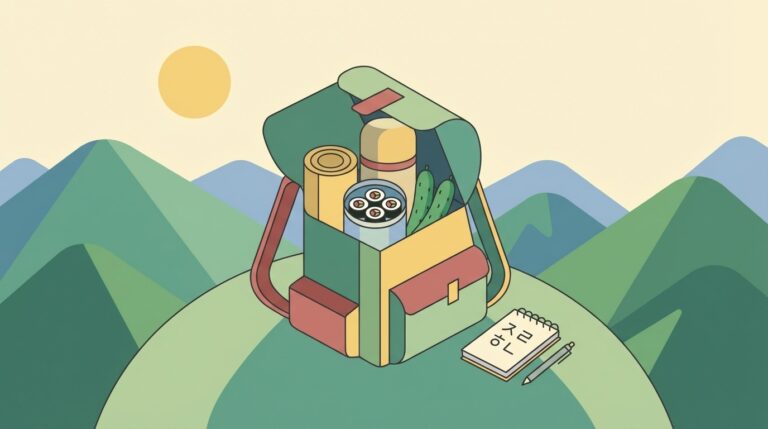
Hello! I’m your Daily Hangul Editor. Grab your backpack and lace up your boots, because today we are heading to the mountains!
Phase 1: Immersive Hook — The Peak of K-Culture
Picture this K-Drama scene: The main character is dragged on a mandatory weekend hike with their boss. Everyone is wearing head-to-toe neon Gore-Tex gear. When they finally reach the peak, exhausted and out of breath, they don’t just take a sip of water. Oh no. They unzip their backpacks, lay out a mat, and suddenly—it’s a full-blown buffet! Out come the hard-boiled eggs, cherry tomatoes, and the two absolute stars of Korean hiking: Gimbap (김밥) and raw Cucumbers (오이).
If you ever hike Bukhansan or Namsan in Seoul, you will experience this. A friendly group of middle-aged hikers (our beloved Ajummas and Ajeossis) might wave you over and offer you a piece of their lunch. If you don’t know how to react, you might just awkwardly stare at a raw cucumber. But if you know the right phrases? You’ll instantly become an ‘Insider’ and experience the warmest side of Korean culture.
Let’s learn how to pack, share, and eat like a true Korean hiker! This guide is based on real stories from my expat students who survived (and loved) their first Korean mountain feast.
Phase 2: Deep Dive — Essential Hiking Food Phrases
Here are the top phrases you need when the backpacks open at the summit.
1. 제가 김밥 싸 왔어요.
- Pronunciation: Jega gimbap ssa wasseoyo. [ssa sounds like a snake hissing ‘ss’ followed by a short ‘ah’]
- Meaning: I packed/brought gimbap.
- K-Culture Moment: You reach the resting area. You proudly unzip your bag and declare this to your friends. It shows you are prepared and caring!
- Editor’s Insight: The verb ‘싸다’ literally means ‘to wrap’ or ‘to pack’. When you say ‘싸 왔어요’, you’re saying “I packed it and brought it here.” It has a very warm, ‘I made this for us’ feeling.
- Situation Spectrum:
[🚫 절대 금지] ———— [⚠️ 주의] ———— [✅ 자유롭게]
- Casual (Friends): ✅ (Say: 내가 김밥 싸 왔어!)
- Semi-formal (Coworkers): ✅ (Jega gimbap ssa wasseoyo!)
- Formal (Boss): ✅
- 🤔 Think About It: Why is bringing your own packed food so much more appreciated in Korea than just buying something at the top?
2. 오이 좀 드실래요?
- Pronunciation: Oi jom deusillaeyo? [Oi sounds exactly like ‘Oh-ee’]
- Meaning: Would you like some cucumber?
- K-Culture Moment: An older hiker sees you sweating on the trail and holds out a freshly sliced, crunchy cucumber to save your life.
- Editor’s Insight: ‘드실래요?’ is the magical, polite way to offer food. Never say ‘먹을래요?’ (Do you want to eat?) to someone older than you—it sounds a bit like you’re challenging them!
- Situation Spectrum:
[🚫 절대 금지] ———— [⚠️ 주의] ———— [✅ 자유롭게]
- Casual (Friends): ⚠️ (Too polite! Just say: 오이 먹을래?)
- Semi-formal (Strangers on trail): ✅
- Formal (Older hikers): ✅
- 🤔 Think About It: In many cultures, offering food to strangers is rare. Why do Koreans feel the urge to feed people they just met on a mountain?
3. 잘 먹겠습니다!
- Pronunciation: Jal meokgetseumnida! [Jal sounds like ‘Chall’ with a soft Ch]
- Meaning: I will eat well! (Thank you for the food)
- K-Culture Moment: The moment someone hands you a piece of Gimbap. You say this loudly before popping it into your mouth.
- Editor’s Insight: This isn’t just a phrase; it’s a social contract. It means “I acknowledge your effort in providing this food, and I will enjoy it gratefully.”
- Situation Spectrum:
[🚫 절대 금지] ———— [⚠️ 주의] ———— [✅ 자유롭게]
- Casual: ✅ (Say: 잘 먹을게!)
- Semi-formal/Formal: ✅ (Always use the full phrase!)
Phase 3: Textbook vs. Real Life
| Situation | 📖 Textbook Korean | 🗣️ Real Korean | 💡 Why the difference? |
|---|---|---|---|
| Offering food | 이것을 먹어 보시겠습니까? (Would you like to try eating this?) | 이거 좀 드셔보세요. (Please try some of this.) | Textbooks sound like a robot butler. ‘좀’ (a little) softens the sentence and makes it friendly! |
| Accepting food | 감사합니다. 먹겠습니다. (Thank you. I will eat.) | 아이고, 감사합니다! 잘 먹겠습니다! (Oh my, thank you! I will eat well!) | Adding ‘아이고’ (Aigo) shows pleasant surprise and makes you sound super local. |
| Expressing thirst | 저는 물이 필요합니다. (I need water.) | 아, 목말라. 물 좀 마실게요. (Ah, I’m thirsty. I’ll drink some water.) | Koreans often talk to themselves (‘Ah, I’m thirsty’) before stating their action. |
Phase 4: Cultural Deep Dive
4-1. Non-verbal Communication: The Two-Handed Rule
When that lovely Ajumma hands you a piece of cucumber, do not grab it with one hand! In Korea, receiving something from an older person with one hand is a big no-no. Always use two hands (or place your left hand lightly on your right arm) while taking the food. Combine this with a slight bow and “잘 먹겠습니다!”, and they will absolutely adore you.
4-2. K-Culture Connection: Why Cucumbers? (오이의 비밀)
If you watch K-Dramas, you might wonder why people bite into raw cucumbers like apples while hiking. In Korean hiking culture, cucumbers are nature’s sports drink. They are 95% water, cheap, easy to pack, and they instantly cool down your body temperature. Plus, eating heavy food while climbing is tough, so the refreshing crunch of a cucumber is exactly what you need. It’s the ultimate K-Hiking survival hack!
Phase 5: Immersive Roleplay
Scenario A: The Mountain Peak Feast
Setting: Saturday morning, halfway up the steep stairs of Bukhansan. The air is crisp. You are sitting on a wooden bench with Min-su, your Korean coworker who invited you on this hike. He unzips his brightly colored backpack.
Min-su: 자, 여기서 조금 쉬었다 가요. (Let’s rest here for a bit.)
YOU: 좋아요. 다리가 진짜 아파요. (Sounds good. My legs really hurt.)
(🎭 Stage Direction: Min-su pulls out a Tupperware container full of perfectly rolled Gimbap and sliced cucumbers.)
Min-su: 제가 아침에 김밥 싸 왔어요! 오이도 좀 드실래요?
(Jega achime gimbap ssa wasseoyo! Oido jom deusillaeyo?)
(I packed Gimbap this morning! Would you like some cucumber too?)
🔀 Your Turn! How should you respond?
– A) “아니요, 괜찮아요. 제 물 마실게요.” (No, it’s okay. I’ll drink my water.)
– B) “우와! 진짜요? 잘 먹겠습니다!” (Wow! Really? I will eat well!)
– C) “저도 먹을래요.” (I want to eat too.)✅ Best Choice: B — Showing enthusiastic gratitude (“우와!”) and saying “잘 먹겠습니다!” is the perfect, polite way to accept his hard work.
⚠️ Choice A Analysis: Refusing food in this context might make Min-su feel a bit rejected. If you really can’t eat it, say “감사하지만 제가 배가 불러서요” (Thanks, but I’m full).
YOU: (Choosing B) 우와! 진짜요? 잘 먹겠습니다!
Min-su: 많이 먹어요! 산에서 먹는 김밥이 최고예요. (Eat a lot! Gimbap eaten on a mountain is the best.)
Bonus Scenario: Buying Snacks at the Trailhead
Before starting the hike, you stop by a small shop (김밥천국 – Gimbap Heaven) at the bottom of the mountain.
Clerk: 어서 오세요! (Welcome!)
YOU: 안녕하세요. 여기 김밥 두 줄 포장해 주세요. (Hello. Please pack two rolls of gimbap here.)
Clerk: 네, 금방 싸 드릴게요. (Yes, I’ll roll them right away.)
Phase 6: 10-Second Shadowing Drill
Time to practice your acting skills! Read these aloud, matching the emotion.
- 😊 Brightly / Surprised:
우와! / 김밥 / 진짜 / 맛있겠다!
(U-wa! / gimbap / jin-jja / ma-sit-get-da!)
(Wow! The gimbap looks really delicious!) -
🥺 Politely asking:
오이 / 하나만 / 먹어도 돼요?
(O-i / ha-na-man / meo-geo-do dwae-yo?)
(May I eat just one cucumber?) -
😤 With determination (starting the hike):
자, / 이제 / 올라갑시다!
(Ja, / i-je / ol-la-gap-si-da!)
(Alright, let’s go up now!)
Phase 7: K-Culture Glossary
| Korean | Romanization | English | Cultural Context |
|---|---|---|---|
| 등산 | deungsan | Hiking | Not just walking in nature, but a serious national pastime involving gear and food. |
| 오이 | oi | Cucumber | The holy grail of hiking hydration in Korea. |
| 도시락 | dosirak | Packed lunch | A lunch box, often packed with love (and side dishes) for picnics or hikes. |
| 아저씨 | ajeossi | Middle-aged man | The friendly (and very fit) older men you see flying past you on the trail. |
| 정 | jeong | Affection/Bond | The deep, unspoken emotional bond that compels Koreans to share their food with you. |
Phase 8: Traveler’s Survival Kit
If you’re visiting Korea, hiking is a must-do activity. Here is your survival kit for prepping at the convenience store (편의점) before your hike!
🆘 Survival Phrases for the Trailhead
– 🇰🇷 “이거 한 줄에 얼마예요?” (igeo han jure eolmayeyo?)
– 🗣️ Meaning: How much is this for one roll (of Gimbap)?
– 📍 Where to use: Small Kimbap shops near the mountain entrance.
– 💡 Pro Tip: Gimbap is counted in ‘줄’ (jul – meaning lines/rolls). “한 줄 (1 roll), 두 줄 (2 rolls)”.
- 🇰🇷 “봉투 필요 없어요.” (bongtu piryo eopseoyo)
- 🗣️ Meaning: I don’t need a plastic bag.
- 📍 Where to use: Convenience stores.
- 💡 Pro Tip: Put the snacks straight into your hiking backpack to save the environment (and the 50 won bag fee)!
📌 Editor’s Travel Note:
Download KakaoMap or Naver Map. Google Maps doesn’t work well for hiking trails in Korea, but local apps show every tiny mountain path perfectly!
Phase 9: Think Deeper — “Food & Identity”
🧠 Think Deeper:
Why do Koreans insist on eating together, even halfway up a 800-meter mountain? Historically, Korea was an agricultural society where villages survived by working the rice fields together. Eating together wasn’t just socializing; it was a symbol of shared survival and community. Today, passing a slice of cucumber to a tired stranger on a mountain trail is a modern continuation of that exact same communal spirit. Food in Korea is never just calories; it’s the physical form of Jeong (정) — care, love, and connection.💬 Your Turn: Does your culture have a specific food you must bring on outdoor trips? How do you share food with strangers? Tell me in the comments!
Phase 10: FAQ & Troubleshooting
Q: An older hiker offered me Makgeolli (Korean rice wine) on the mountain, but I don’t drink. Can I say no?
Yes! While drinking Makgeolli at the peak is a huge part of Korean hiking culture, you can politely decline. Say: “아, 제가 술을 못 마셔서요. 감사합니다!” (Ah, I can’t drink alcohol. Thank you!)
Q: Can I use “잘 먹겠습니다” even if I bought the food myself?
No. You only say it when someone else provided or bought the food for you. If you brought your own Gimbap and are eating alone, you don’t need to say it out loud!
❌ Common Mistake #1: Calling older hikers “You” (당신 – Dangsin).
✅ Do this instead: Never use “당신”. If you need to get their attention, politely say “저기요” (Excuse me) or respectfully call them “아버님/어머님” (Father/Mother – used respectfully for elders) or “선생님” (Teacher).
Phase 11: Wrap-up & Action Items
One-Liner Summary: A successful Korean hike isn’t about reaching the top fastest; it’s about sharing your Gimbap and cucumbers with a grateful “잘 먹겠습니다!”
Your Action Missions for Today:
– 🥉 Bronze (Solo): Stand in your kitchen, hold an imaginary piece of food, and proudly declare: “제가 김밥 싸 왔어요!”
– 🥈 Silver (Online): Leave a comment below telling us what your favorite hiking snack is, using the word 도시락 (Dosirak)!
– 🥇 Gold (Real Life): Go to a local Korean mart, buy a roll of Gimbap, and offer a piece to your friend saying “드셔보세요!” (Try some!).
🎒 Special K-Culture Mission:
Go on YouTube and search “Bukhansan hiking vlog”. Pay attention to the scenes at the peak. I guarantee you will spot at least three people eating Gimbap or cucumbers. Count them!
Phase 12: Interactive Quiz
Test your new K-Hiking knowledge!
1. You are resting on a trail. A nice Ajumma hands you a cherry tomato. What is the BEST reaction?
A) Take it with one hand and say “고마워.” (Gomawo)
B) Take it with two hands and say “잘 먹겠습니다!” (Jal meokgetseumnida!)
C) Shake your head and walk away.
(Answer: B! Two hands and polite gratitude are the golden rules.)
2. Fill in the blank: “제가 아침에 김밥 _____ 왔어요.” (I packed/brought Gimbap this morning.)
A) 사 (sa)
B) 싸 (ssa)
C) 해 (hae)
(Answer: B! 싸 왔어요 means ‘packed and brought’. 사 왔어요 means ‘bought and brought’, which is also okay, but ‘싸’ implies you made it!)
3. True or False: In Korea, it is considered rude to eat raw vegetables like cucumbers on a mountain.
(Answer: False! It is the most normal, practical, and culturally authentic thing you can do!)
Frequently Asked Questions (FAQ)
Q: What does "제가 김밥 싸 왔어요." mean in Korean and how do you pronounce it?
A: In Korean, "제가 김밥 싸 왔어요." is pronounced [Jega gimbap ssa wasseoyo. [ssa sounds like a snake hissing 'ss' followed by a short 'ah'] and means: I packed/brought gimbap.
Q: What does "오이 좀 드실래요?" mean in Korean and how do you pronounce it?
A: In Korean, "오이 좀 드실래요?" is pronounced [Oi jom deusillaeyo? [Oi sounds exactly like 'Oh-ee'] and means: Would you like some cucumber?
Q: What does "잘 먹겠습니다!" mean in Korean and how do you pronounce it?
A: In Korean, "잘 먹겠습니다!" is pronounced [Jal meokgetseumnida! [Jal sounds like 'Chall' with a soft Ch] and means: I will eat well! (Thank you for the food)






