

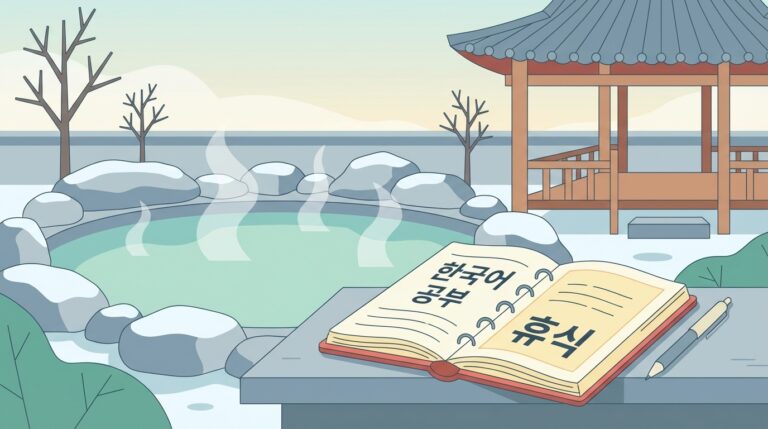
Don’t Just Say It’s Hot! Master Advanced Korean Hot Spring Vocabulary Like a Local
Welcome! I’m your Lead Editor at Daily Hangul.
Imagine this classic K-Drama scene: The protagonist, exhausted from corporate drama, escapes to a secluded winter resort. They step into a steaming outdoor hot spring, close their eyes, let out a deep breath, and say, “아, 시원하다~” (Ah, that’s refreshing!).
Wait, the water is 40°C (104°F)… how on earth is that “refreshing”?
As a C1 (Advanced) learner, you already know your way around a basic jjimjilbang. You know how to order sikhye and roasted eggs. But when you travel to famous hot spring destinations like Onyang or Asan, you need more than just “물이 뜨거워요” (The water is hot). You need to talk about efficacy (효능), water quality (수질), and that deep, philosophical Korean sense of wellness.
If you don’t know these expressions, you’re just taking a warm bath. But if you do? The local ahjummas and ahjussis will nod at you in deep respect. Let’s dive into the authentic expressions my advanced students always ask about!
Phase 2: Deep Dive into Real Hot Spring Talk
Here are the top 3 expressions you need to sound like a true Korean wellness expert.
1. “피로가 싹 가시는 기분이에요.”
- Pronunciation: [piroga ssak gasineun gibunieyo] (pi-ro-ga ssak ga-shi-neun gi-bun-i-e-yo)
- Meaning: Literal: I feel like my fatigue is disappearing. / Real Nuance: My exhaustion is completely melting away.
- K-Culture Moment: You’re on a hyodo-gwangwang (filial piety trip) with your Korean in-laws. You dip into the open-air bath, look up at the sky, and say this. Immediate son-in-law/daughter-in-law points!
- Editor’s Insight: At the C1 level, upgrade your vocabulary from “피로가 풀려요” to “가시다” (to completely clear up or disappear). The adverb “싹” (entirely/without a trace) adds that perfect native flavor.
- Situation Spectrum:
[🚫 ---------------- [⚠️] -------- [✅] ]- Casual/Friends: ✅
- Semi-formal (Colleagues): ✅
- Formal (Elders/Bosses): ✅ (It’s a polite description of your own feeling!)
- 🤔 Think About It: Korean culture heavily emphasizes “fatigue” (피로) as a tangible thing that accumulates and must be “released” (풀다). Does your language treat stress as something you physically wash away?
2. “물이 매끄러워서 피부가 보들보들해졌어요.”
- Pronunciation: [muri maekkeureowoseo pibuga bodeulbodeulhaejyeosseoyo]
- Meaning: Literal: The water is smooth, so my skin became soft. / Real Nuance: The water quality here is amazing; it makes your skin incredibly silky!
- K-Culture Moment: Chatting in the women’s bathhouse. Someone asks, “여기 물 괜찮죠?” (The water here is nice, right?). You respond with this, and suddenly you’re part of the inner circle.
- Editor’s Insight: True hot spring enthusiasts judge the sujil (수질, water quality). Hot spring water in Korea is famously alkaline, making your skin feel slippery. “보들보들” is an advanced mimetic word (의태어) that perfectly captures that soft, baby-skin texture.
- Situation Spectrum:
[🚫 -------- [⚠️] ---------------- [✅] ]- Casual/Friends: ✅ (Just drop the 요 for friends)
- Semi-formal: ✅
- Formal: ✅
3. “이거 신경통에 직방이래.”
- Pronunciation: [igeo singyeongtonge jikbangirae] (i-geo shin-gyeong-tong-e jik-bang-i-rae)
- Meaning: Literal: They say this is a direct hit for neuralgia. / Real Nuance: Rumor has it this is an instant cure/magic bullet for nerve and joint pain.
- K-Culture Moment: You’re reading the informational plaque next to a green-colored herbal bath. A local uncle points at it and shares this piece of unsolicited (but welcome) wisdom.
- Editor’s Insight: “직방이다” is a fantastic colloquialism for “an instant cure” or “highly effective right away.” It’s mostly used in spoken Korean. Using “이래” (short for 이라고 해) shows you’re quoting what you’ve heard—perfect for sharing hot spring rumors!
- Situation Spectrum:
[🚫 -------- [⚠️] -------- [✅] --------]- Casual/Friends: ✅
- Semi-formal: ⚠️ (A bit too slangy for professional settings)
- Formal: 🚫 (Use “효과가 아주 좋다고 합니다” instead)
- 🤔 Think About It: Notice how health advice is freely shared among strangers in Korean baths. It shows the unique “community care” aspect of the culture.
Phase 3: Textbook vs. Real Life
| Situation | 📖 Textbook Korean | 🗣️ Real Korean | 💡 Why the difference? |
|---|---|---|---|
| Entering a hot tub | “물이 매우 뜨겁습니다.” (The water is very hot.) | “아~ 시원하다!” (Ah, refreshing!) | “시원하다” here means releasing physical/mental tension, not actual temperature. |
| Evaluating the water | “이곳의 수질은 우수합니다.” (The water quality here is excellent.) | “여기 물 진짜 좋다. 미끄덩거려.” (Water’s great here. It’s slippery.) | Locals use sensory adjectives (미끄덩거리다) rather than clinical terms. |
| Describing the effect | “건강에 이로운 효과가 있습니다.” (It has beneficial health effects.) | “몸이 확 풀리는 기분이야.” (Feel like my body is completely unknotting.) | Spoken Korean prefers expressive adverbs (확, 싹) paired with emotional verbs. |
Phase 4: Cultural Deep Dive — The K-Wellness Vibe
4-1. Non-verbal Communication: The Pre-Wash Ritual
If there’s one thing you must know about Korean hot springs (온천) and bathhouses (목욕탕), it’s the non-verbal etiquette. You must shower thoroughly before entering any shared tub. Entering dry or unwashed is the ultimate faux pas. Also, always tie your hair up! Letting long hair float in the hot spring water will definitely earn you a sharp scolding from an elder.
4-2. K-Travel Connection: The “Hyodo-Gwangwang” (효도 관광)
Hot springs aren’t just for couples or friends; they are the ultimate destination for Hyodo-Gwangwang (filial piety tourism). Taking your aging parents to a famous hot spring like Onyang or Suanbo is considered a prime example of being a good son or daughter.
Critical View: While K-Dramas often show luxurious private pools for chaebols, real Korean hot spring culture is deeply communal. Sharing the large public baths (대중탕) is where the real bonding happens, stripping away social hierarchies along with your clothes.
Phase 5: Immersive Roleplay
Setting: A freezing winter evening. You and your Korean colleague, Minsoo, are on a business trip in Asan. After a long day, you both visit a famous outdoor hot spring (노천탕). The crisp cold air hits your face, but the water is steaming hot.
Characters:
– YOU: A foreign professional who understands deep Korean culture.
– Minsoo (34): Your friendly colleague who thinks he needs to guide you through everything.
Minsoo: (Stepping into the steaming tub) 으아~ 좋다! OOO 씨, 물 안 뜨거워요?
(eu-a~ jota! OOO ssi, mul an tteugeowoyo?)
[Ah~ so good! OOO, isn’t the water too hot for you?]
(🎭 Stage Direction: Minsoo sinks up to his neck and lets out a satisfied sigh)
YOU: 처음엔 좀 뜨거웠는데, 지금은 괜찮아요.
(cheoeumen jom tteugeowonneunde, jigeumeun gwaenchanayo.)
[It was a bit hot at first, but it’s fine now.]
Minsoo: 그렇죠? 여기가 수질이 진짜 좋기로 유명하거든요. 피부 한번 만져봐요.
(geureochyo? yeogiga sujiri jinjja jogiro yumyeonghageodeunyo. pibu hanbeon manjyeobwayo.)
[Right? This place is famous for having really good water quality. Try touching your skin.]
🔀 Your Turn! How do you respond to impress him?
– A) “네, 피부가 아주 부드럽습니다.” (Yes, my skin is very soft.) -> Too robotic/textbook.
– B) “진짜네요! 물이 매끄러워서 피로가 싹 가시는 기분이에요.” (It’s true! The water is smooth so I feel my fatigue melting away.) -> Smooth and native-like!
– C) “대박! 이거 신경통에 직방이네요!” (Jackpot! This is an instant cure for nerve pain!) -> A bit too casual/slangy for a colleague.✅ Best Choice: B — Reason: You combined the sensory description (매끄럽다) with the advanced expression for relieving fatigue (싹 가시다). Minsoo will be shocked by your fluency!
Minsoo: 와, ‘피로가 싹 가시다’라는 표현은 어디서 배웠어요? 한국 사람인 줄 알았네!
(wa, ‘piroga ssak gasida’raneun pyohyeoneun eodiseo baewosseoyo? hanguk saramin jul aranne!)
[Wow, where did you learn the expression ‘fatigue washes away’? I thought you were Korean!]
Phase 6: 10-Second Shadowing Drill
Practice this sentence to perfect your natural pacing and intonation!
😊 진짜네요! / 물이 매~~~끄러워서 / 피로가 / 싹! 가시는 기분이에요.
(jinjjaneyo! / muri mae~~~kkeureowoseo / piroga / ssak! gasineun gibunieyo.)
Tip: Drag out the “매” slightly to emphasize how smooth the water is, and say “싹” with a quick, crisp energy.
Phase 7: K-Culture Glossary
| Korean | Romanization | English | Context |
|---|---|---|---|
| 노천탕 | nocheontang | Open-air bath | The highlight of winter hot spring travel. Hot body, freezing face! |
| 효능 | hyoneung | Efficacy/Benefit | Used to describe the medical benefits of minerals in the water. |
| 수질 | sujil | Water quality | How Koreans judge a hot spring. “수질이 좋다” means the water feels rich. |
| 효도 관광 | hyodo gwangwang | Filial piety tour | Taking parents on a relaxing trip, often involving hot springs. |
| 때밀이 | ttaemiri | Scrubbing / Scrub master | The rigorous process of exfoliating dead skin with a rough towel. |
Phase 8: Traveler’s Survival Kit
Planning a trip to a Korean hot spring resort? Here are the survival phrases you need!
🆘 Survival Phrases for Hot Springs
– 🇰🇷 “수영복 입고 들어가야 하나요?” (suyeongbok ipgo deureogaya hanayo?)
– 🗣️ Meaning: Do I need to wear a swimsuit to enter?
– 📍 Where to use: At the ticket counter. Some hot springs are traditional naked baths, others are water-park style.
– 🇰🇷 “수건은 따로 빌려야 하나요?” (sugeoneun ttaro billyeoya hanayo?)
– 🗣️ Meaning: Do I need to rent towels separately?
– 🇰🇷 “여탕/남탕은 어디로 가나요?” (yeotang/namtangeun eodiro ganayo?)
– 🗣️ Meaning: Which way is the women’s/men’s bath?📌 Editor’s Travel Note
– Tattoos: Unlike Japan, where tattoos often strictly ban you from hot springs, Korea is generally more lenient. However, very large, intimidating tattoos might still draw uncomfortable stares from elders in traditional public baths.
– Amenities: Most Korean hot springs provide basic soap and toothpaste, but you should bring your own shampoo and conditioner (or buy single-use packets at the front desk).
Phase 9: Think Deeper — “한 발 더 깊이”
🧠 The Philosophy of ‘Jeong’ and Nakedness
In many Western cultures, public nakedness is associated with vulnerability or embarrassment. In Korea, however, the public bathhouse (목욕탕) is a space of ultimate egalitarianism. When you take off your clothes, you also take off your job title, your social status, and your age hierarchy to some extent. Friends, family members, and even business partners often visit hot springs together to build Jeong (정, deep emotional connection). The act of scrubbing each other’s backs is a profound gesture of trust and community care.
💬 Your Turn: Does your culture have a similar tradition where physical vulnerability leads to emotional bonding? Share it in the comments!
Phase 10: FAQ & Troubleshooting
❌ Common Mistake #1: Saying “시원하다” (refreshing) when you mean “춥다” (cold) in the bath context.
✅ Do This: Remember that “시원하다” inside a hot bath means “This is hitting the spot and relieving my tension.” If you actually feel cold in the outdoor bath, say “좀 쌀쌀하네요” (It’s a bit chilly).
K-Culture FAQ:
– “Can I take my phone into the hot spring?”
Absolutely NOT in traditional, gender-separated nude baths. It is strictly illegal due to privacy laws. However, if it’s a mixed-gender, swimsuit-required hot spring resort (like a water park), waterproof phones are fine!
Phase 11: Wrap-up & Action Missions
One-Liner Summary: A C1 Korean speaker doesn’t just feel the heat; they appreciate the water quality (수질) and how it magically washes away their fatigue (피로가 싹 가시다).
Action Mission:
– 🥉 Bronze: Stand in your shower today and say “피로가 싹 가시는 기분이에요” out loud.
– 🥈 Silver: Write a short journal entry in Korean about the last time you visited a spa or hot spring.
– 🥇 Gold: Next time you visit a Korean sauna or hot spring, compliment the water quality to a local!
K-Culture Mission: Search for “한국 온천 여행 브이로그” (Korean hot spring travel vlog) on YouTube and listen closely. I guarantee you’ll hear someone say “물 좋다” (The water is good) within the first 5 minutes!
Phase 12: Interactive Quiz
1. Fill in the blank:
“여기 온천은 진짜 ( ______ )이/가 좋네요. 피부가 보들보들해졌어요.”
A) 수영 (Swimming)
B) 수질 (Water quality)
C) 수건 (Towel)
Click for Answer
Answer: B (수질 – Water quality)
2. Situational Judgment:
You enter a boiling hot 42°C bath. An elderly Korean man next to you sighs, “아, 시원하다.” What does he mean?
A) The water is actually cold.
B) He is being sarcastic.
C) His muscular tension is being relieved by the heat.
Click for Answer
Answer: C. In Korean culture, intense heat that relieves body aches is described as ‘refreshing’ (시원하다).
3. True or False – K-Culture Edition:
“It is perfectly fine to dip your towel into the shared hot spring water to wash your face.”
Click for Answer
Answer: False! Towels should always be kept out of the water (often worn folded on the head) to maintain shared hygiene.
Frequently Asked Questions (FAQ)
Q: What does ""피로가 싹 가시는 기분이에요."" mean in Korean and how do you pronounce it?
A: In Korean, ""피로가 싹 가시는 기분이에요."" is pronounced [piroga ssak gasineun gibunieyo] and means: Literal: I feel like my fatigue is disappearing. / Real Nuance: My exhaustion is completely melting away.
Q: What does ""물이 매끄러워서 피부가 보들보들해졌어요."" mean in Korean and how do you pronounce it?
A: In Korean, ""물이 매끄러워서 피부가 보들보들해졌어요."" is pronounced [muri maekkeureowoseo pibuga bodeulbodeulhaejyeosseoyo] and means: Literal: The water is smooth, so my skin became soft. / Real Nuance: The water quality here is amazing; it makes your skin incredibly silky!
Q: What does ""이거 신경통에 직방이래."" mean in Korean and how do you pronounce it?
A: In Korean, ""이거 신경통에 직방이래."" is pronounced [igeo singyeongtonge jikbangirae] and means: Literal: They say this is a direct hit for neuralgia. / Real Nuance: Rumor has it this is an instant cure/magic bullet for nerve and joint pain.







