

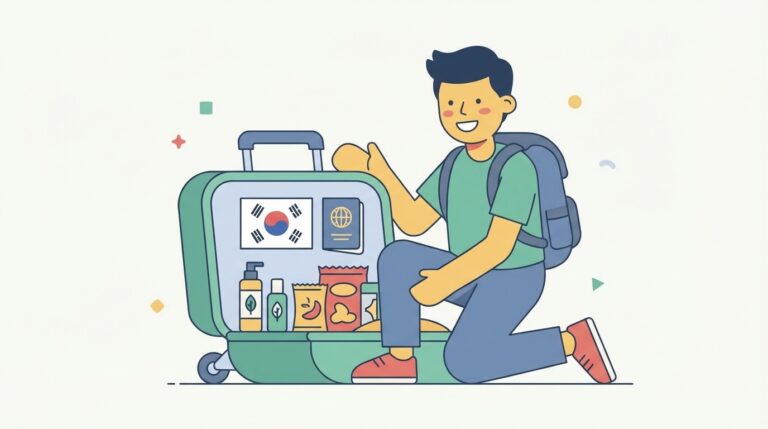
Phase 1: Immersive Hook — The Suitcase Staredown
Hello! It’s your Daily Hangul Editor. Grab a coffee, because today we are talking about something every traveler faces: the packing dilemma.
You’ve booked your flight to Seoul. You’ve planned your itinerary down to the last K-drama filming location. Now, you are staring at your open suitcase on the floor. In your head, you’re packing 10 different outfits for those aesthetic cafe photos in Seongsu-dong. But wait… what about all the K-beauty products and snacks you’ll buy there?
If you ask a Korean friend for packing advice, they won’t just say “pack light.” They will use a very specific Korean verb that means so much more than just putting things in a bag. Knowing these authentic packing phrases won’t just help you prepare; they will make you sound like a seasoned K-traveler before you even board the plane.
Let’s dive into the real Korean phrases you need for packing!
Phase 2: Deep Dive into Packing Expressions
Here are the top three expressions you need when preparing for your trip.
1. 뭐 챙겨야 돼요?
- Pronunciation: mwo chaeng-gyeo-ya dwaeyo?
- Sound-alike guide: ‘mwo’ sounds like ‘mwa’ but with an ‘o’. ‘chaeng’ rhymes with ‘sang’. ‘gyeo’ sounds like ‘gyo’ in Tokyo, but with an ‘eo’ (aw) sound.
- Meaning: What should I pack? (Literal: What must I take care of/gather?)
- K-Culture Moment: In reality shows like In the Soop or Bon Voyage, you’ll always see K-pop idols calling each other the night before a trip, asking, “Hyung, 뭐 챙겨야 돼요?”
- Editor’s Insight: The verb 챙기다 (chaeng-gida) is pure gold in Korean. It doesn’t just mean “to pack.” It means to prepare, to take care of, or to make sure you don’t forget something. It’s much more natural than the literal word for pack!
- Situation Spectrum:
[🚫 절대 금지] ———— [⚠️ 주의] ———— [✅ 자유롭게]
- Close Friends (Casual): ✅ (뭐 챙겨야 돼? – Drop the 요)
- Colleagues/Acquaintances: ✅ (뭐 챙겨야 돼요?)
- Boss/Elders: ⚠️ (Use: 무엇을 준비해야 할까요? instead)
- 🤔 Think About It: Why do Koreans use a word that means “to take care of” (챙기다) instead of just “to put in a bag”? Does packing feel like a responsibility to care for yourself and your travel buddies?
2. 짐 다 쌌어요?
- Pronunciation: jim da ssasseoyo?
- Sound-alike guide: ‘jim’ sounds like the name Jim. ‘ssa’ sounds like ‘sah’ said sharply.
- Meaning: Did you finish packing? (Literal: Did you wrap all the luggage?)
- K-Culture Moment: It’s the morning of the flight. The airport taxi is waiting downstairs. Your friend knocks on your hotel door and shouts this!
- Editor’s Insight: 짐 (jim) means luggage or baggage, and 싸다 (ssada) means to wrap or pack. If someone asks you this, they are usually rushing you! You can simply answer, “네, 다 쌌어요!” (Yes, I packed everything!).
- Situation Spectrum:
- Close Friends: ✅
- Hotel Staff asking you: ✅ (They might use a more polite form: 짐 다 싸셨어요?)
- Professional Business Trip: ⚠️
- 🤔 Think About It: The word ‘짐’ also means ‘burden.’ When a Korean says “I don’t want to be a burden (짐이 되기 싫어요),” they use the exact same word as luggage. Coincidence?
3. 캐리어 반은 비워두세요!
- Pronunciation: kaerieo baneun biwo-duseyo!
- Sound-alike guide: ‘kae-ri-eo’ sounds like carrier.
- Meaning: Leave half of your suitcase empty!
- K-Culture Moment: Every Korean local will tell you this before you visit Seoul. Why? Because you will end up buying half of Olive Young, Daiso, and underground mall clothes.
- Editor’s Insight: In Korea, we don’t usually say ‘suitcase’ (수트케이스). We use the Konglish word 캐리어 (Carrier). If you are packing for Korea, this is the most important advice you will ever hear.
- Situation Spectrum:
- Giving advice to a friend: ✅
- 🤔 Think About It: Have you ever noticed how shopping is treated as a core part of the travel experience in Korea?
Phase 3: Textbook vs Real Life Korean
Let’s look at how textbooks teach packing vs. how my friends and I actually talk.
| Situation | 📖 Textbook Korean | 🗣️ Real-life Korean | 💡 Why the difference? |
|---|---|---|---|
| Calling luggage | 여행 가방 (Travel bag) | 캐리어 (Carrier) | Koreans love efficient Konglish for modern items. |
| What should I pack? | 가방에 무엇을 넣을까요? (What shall I put in the bag?) | 뭐 챙겨야 돼요? (What should I prepare?) | “챙기다” implies taking care of essentials, not just physical packing. |
| I overpacked | 짐이 너무 많습니다. (Luggage is too much.) | 캐리어 터질 것 같아요. (My suitcase is going to explode.) | Koreans love dramatic, expressive metaphors in daily life! |
Bottom Note: As an A2 learner, stick to “짐이 너무 많아요” to be safe, but understanding “캐리어 터질 것 같아요” will make your Korean friends laugh out loud.
Phase 4: Cultural Deep Dive — K-Culture Connection
4-1. Non-verbal Communication: The “Nunchi” of Packing
When traveling with Koreans, packing isn’t just an individual task. Thanks to 눈치 (Nunchi – social awareness), it’s common to ask, “Are you bringing toothpaste? Then I won’t bring mine.” Sharing items like chargers, snacks, or toiletries is a sign of closeness. If you pack exactly everything for yourself and never share, it might feel a bit distant!
4-2. The “Daiso & Olive Young” Phenomenon
If you watch K-travel vlogs, you’ll see a recurring theme: arriving in Korea with an empty suitcase and buying another one to go home. Korea’s convenience store culture (편의점) and cosmetic shops (Olive Young) are everywhere.
Critical Viewpoint: While the media promotes endless shopping in Korea, real locals often travel extremely light. Backpacking (배낭여행) with just a small bag is huge among Korean college students. So, don’t feel pressured to buy everything!
Phase 5: Immersive Roleplay — The Video Call
Setting: It’s 10 PM. You are flying to Seoul tomorrow. Your suitcase is open on your bed, looking like a disaster zone. You video-call your Korean friend, Min-su.
Characters:
– YOU: Excited but stressed traveler.
– Min-su (30): Your Korean friend who lives in Seoul. Practical and loves giving advice.
Dialogue:
Min-su: 내일 비행기지? 짐 다 쌌어? ✈️
(naeil bihaeng-giji? jim da ssasseo?)
[Your flight is tomorrow, right? Did you finish packing?]
YOU: 아니요… 뭐 챙겨야 돼요? 😭
(aniyo… mwo chaeng-gyeo-ya dwaeyo?)
[No… what should I pack?]
Min-su: 일단 여권! 그리고 옷은 조금만 챙겨.
(ildan yeogwon! geurigo oseun jogeumman chaeng-gyeo.)
[Passport first! And only pack a few clothes.]
YOU: 왜요? 저 예쁜 카페 갈 거예요! ☕
(waeyo? jeo yeppeun kape gal geoyeyo!)
[Why? I’m going to go to pretty cafes!]
Min-su: 한국에서 다 사면 돼. 캐리어 반은 비워두세요~
(hangugeseo da samyeon dwae. kaerieo baneun biwo-duseyo~)
[You can just buy everything in Korea. Leave half your suitcase empty~]
YOU: 아, 맞다! 어댑터 챙겨야 돼요?
(a, matda! eodaepteo chaeng-gyeo-ya dwaeyo?)
[Oh, right! Do I need to pack an adapter?]
Min-su: 응, 220V 볼트야. 그리고 우산도 하나 챙겨.
(eung, ibaek-isip bolteuya. geurigo usando hana chaeng-gyeo.)
[Yeah, it’s 220V. And pack an umbrella too.]
🔀 Your Turn! How do you reply about the umbrella?
– A) “네, 알겠습니다.” (Standard, polite, but a bit robotic with a close friend.)
– B) “우산이요? 한국 편의점에서 살게요!” (Umbrella? I’ll buy it at a Korean convenience store!)
– C) “짐이 너무 많아요. 안 챙길래요.” (I have too much luggage. I won’t pack it.)✅ Best Choice: B.
Why? It shows you understand Korean culture! Convenience stores (CU, GS25) sell cheap, cute umbrellas everywhere. You don’t need to pack one.
⚠️ Choice C Analysis: It’s grammatically correct, but it might make Min-su feel like his advice was rejected too bluntly.
Phase 6: 10-Second Shadowing Drill
Let’s practice reading with the right emotion and pauses! The slash (/) means a tiny pause.
😫 아휴… / 짐이 / 너무 많아요.
(ahyu… / jimi / neomu manayo.)
(Sigh… I have too much luggage.)
Tip: Let out a real sigh at “ahyu…” to sound like a tired traveler!
😊 여권이랑 / 지갑만 / 챙기세요!
(yeogwon-irang / jigam-man / chaeng-giseyo!)
(Just pack your passport and wallet!)
Tip: Say it brightly, like a helpful guide!
Phase 7: K-Culture Glossary (Mini Dictionary)
| 한국어 | Romanization | English | Cultural Context |
|---|---|---|---|
| 캐리어 | kaerieo | Suitcase | Konglish. The default word Koreans use for rolling luggage. |
| 짐 | jim | Luggage / Burden | Used for bags, but also emotionally for “being a burden” (짐이 되다). |
| 보따리 | boddari | Cloth bundle | Traditional Korean packing method. Now used playfully for someone who packed way too much (“보따리 장수” – bundle merchant). |
| 득템 | deuk-tem | Great catch / Good find | Slang combining Hanja (득: to get) and English (Item). Used when you buy something awesome to pack in your suitcase. |
| 면세점 | myeon-se-jeom | Duty-free shop | A huge part of Korean travel culture at Incheon Airport. |
Phase 8: Traveler’s Survival Kit
You’ve packed, but now you are at the airport. Here are the survival phrases you need!
🆘 Survival Phrase #1: At the Check-in Counter
– 🇰🇷 “이거 기내에 가지고 타도 돼요?”
– (igeo ginaee gajigo tado dwaeyo?)
– 🗣️ Can I bring this on the plane? (Carry-on)
– 💡 Pro Tip: If you bought too many face masks or liquids, ALWAYS ask this before dropping your checked bag!🆘 Survival Phrase #2: When your bag is heavy
– 🇰🇷 “수하물 무게 제한이 얼마예요?”
– (suhamul muge jehani eolmayeyo?)
– 🗣️ What is the baggage weight limit?📌 Editor’s Travel Note
– Useful Apps: Before you pack, download Naver Map and Kakao T. Google Maps doesn’t work well in Korea!
– Voltage: Korea uses 220V with round pins (Type C/F). If you forget an adapter, ask your hotel desk: “어댑터 빌릴 수 있어요?” (Can I borrow an adapter?)
Phase 9: Think Deeper — “One Step Further”
🧠 Think Deeper: Food, Souvenirs, and Identity (Jeong – 정)
When packing to return home from Korea, you’ll likely pack boxes of snacks, seaweed, and ginseng for your friends and family. This isn’t just about “buying souvenirs.” In Korea, bringing food back for your community is a core expression of 정 (Jeong – affection/bonding). It shows that even while you were far away having fun, you were thinking of them. Sharing food is how Koreans build identity and community.
💬 Your Turn: In your culture, is it mandatory to bring back gifts or food when you travel? How do you say “souvenir” in your language? Share in the comments!
Phase 10: FAQ & Troubleshooting
🙋 “Can I use 챙기다 (chaeng-gida) for people?”
Yes! This is what makes this word so special. If you say “친구를 챙겨요,” it means you take care of your friend (making sure they are fed, safe, or included).
🙋 “Is it rude to say ‘짐’ to a person?”
Do NOT call a person a ‘짐’ unless you are jokingly saying they are a burden. For luggage, it’s totally fine.
❌ Common Mistake: Saying “내 수트케이스가 무거워요” (My suitcase is heavy).
✅ Do This Instead: Say “내 캐리어가 무거워요” (My carrier is heavy) or simply “짐이 무거워요” (My luggage is heavy). Koreans rarely use the word suitcase!
Phase 11: Wrap-up & Action Items
One-Liner Summary: Instead of just “packing” (싸다), remember to “take care of” (챙기다) your essentials, and always leave space in your 캐리어 (carrier) for Korean goodies!
Action Mission:
– 🥉 Bronze: Stand in front of your closet and ask yourself out loud, “뭐 챙겨야 돼요?”
– 🥈 Silver: Write down 3 items you want to pack for Korea using the structure: “[Item] 챙겨야 돼요.”
– 🥇 Gold: Message a Korean-learning friend and ask them, “한국 갈 때 뭐 챙겨야 돼요?”
🇰🇷 K-Culture Mission:
Go to YouTube and search for “왓츠인마이백” (What’s in my bag) or “캐리어 싸기” (Packing a carrier) vlogs by Koreans. Listen closely to see if you can hear the word 챙기다 or 짐!
Phase 12: Interactive Quiz — Challenge Yourself!
1. You are advising a friend who is packing 5 pairs of shoes for a 3-day trip to Seoul. What is the most natural thing to say?
A) 가방에 옷을 넣으세요.
B) 짐이 너무 많아요. 캐리어 반은 비워두세요.
C) 수트케이스가 무겁습니다.Answer: B. Remind them to leave space and that they are overpacking!
2. Fill in the blank: “여권 _____ 돼요?” (Should I pack my passport?)
A) 챙겨야
B) 사야
C) 버려야Answer: A. 챙겨야 돼요 (Have to pack/take care of).
3. True or False – K-Culture Edition: “When Koreans say ‘짐’, they are only ever talking about physical luggage bags.”
Answer: False! ‘짐’ can also mean an emotional or physical burden. If you say “짐이 되다,” it means to become a burden to someone.
💬 Leave a comment below: What is the one thing you MUST pack (챙겨야 돼요) when you travel? I’ll correct your Korean sentences!
Frequently Asked Questions (FAQ)
Q: What does "뭐 챙겨야 돼요?" mean in Korean and how do you pronounce it?
A: In Korean, "뭐 챙겨야 돼요?" is pronounced [mwo chaeng-gyeo-ya dwaeyo?] and means: What should I pack? (Literal: What must I take care of/gather?)
Q: What does "짐 다 쌌어요?" mean in Korean and how do you pronounce it?
A: In Korean, "짐 다 쌌어요?" is pronounced [jim da ssasseoyo?] and means: Did you finish packing? (Literal: Did you wrap all the luggage?)
Q: What does "캐리어 반은 비워두세요!" mean in Korean and how do you pronounce it?
A: In Korean, "캐리어 반은 비워두세요!" is pronounced [kaerieo baneun biwo-duseyo!] and means: Leave half of your suitcase empty!






