

Phase 1: Immersive Hook — The Future of K-Delivery is in the Sky 🚁🍗
Hello! It’s your Daily Hangul Editor.
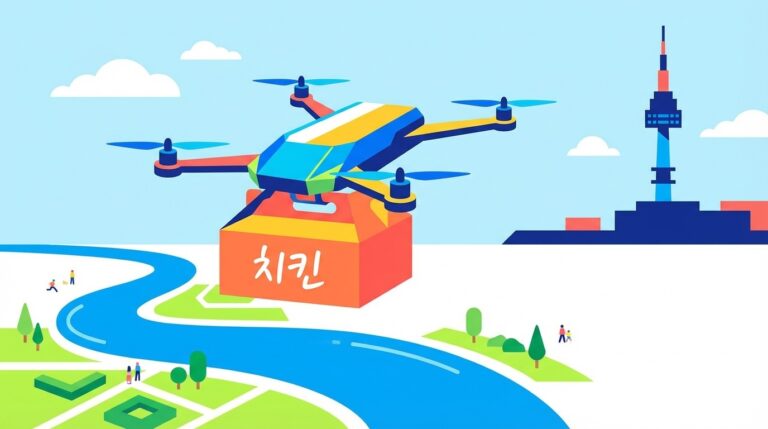
Imagine this: You’re sitting on a picnic mat at Yeouido Hangang Park. The sunset is painting the Seoul skyline a brilliant orange, and you’re craving some classic Chimaek (fried chicken and beer) like you’ve seen in a hundred K-Dramas. You open a delivery app, place an order, but instead of a rider on a motorbike weaving through the crowded park, you hear a soft hum from above. A sleek drone gracefully descends, dropping a piping hot box of garlic soy chicken right onto your mat.
Sounds like a sci-fi movie? Well, welcome to South Korea.
Korea is already globally famous for its mind-bogglingly fast and precise delivery culture—we literally call ourselves ‘배달의 민족 (The Delivery Nation)’. But right now, the country is racing toward the next massive paradigm shift: The commercialization of drone delivery (드론 배달의 상용화).
As a C1-level Korean learner, your goal isn’t just to order food; it’s to comfortably discuss these cutting-edge societal trends with your Korean friends, colleagues, or business partners. If you don’t know the vocabulary to talk about tech trends, you might find yourself left out of the most exciting conversations in Seoul’s cafes and boardrooms.
Today, we’re diving deep into the vocabulary, cultural mindset, and the “Ppalli-Ppalli” (hurry-hurry) ethos driving Korea’s drone delivery revolution. Let’s elevate your Korean to the stratosphere!
Phase 2: Deep Dive — Essential C1 Tech & Trend Expressions
To discuss the future of delivery like a Seoulite, you need these advanced expressions.
1. 상용화되다 (To be commercialized)
- Pronunciation: [sang-yong-hwa-doe-da] (‘sang’ rhymes with ‘bang’, ‘yong’ sounds like ‘young’, ‘hwa’ like ‘ha’ with a w)
- Meaning: Literal: to become commercial use. Real nuance: When a pilot tech finally becomes available for the general public to buy or use.
- K-Culture Moment: You’ll hear this non-stop on Korean news channels like YTN or in Pangyo (Korea’s Silicon Valley) cafes. “When will flying cars be commercialized?”
- Editor’s Insight: This word instantly makes you sound smart. It shows you’re not just a tourist, but someone who understands Korea’s tech-driven economy.
- Situation Spectrum:
[🚫 절대 금지] ———— [⚠️ 주의] ———— [✅ 자유롭게]
- Close Friends (Casual): ⚠️ (A bit too formal for grabbing a beer, unless you’re nerding out over tech)
- Colleagues (Semi-formal): ✅
- Boss/Seniors (Formal): ✅
- 🤔 Think About It: Korea is obsessed with being the “world’s first” to commercialize technology (like 5G). How does this reflect the nation’s historical drive to rebuild and lead after the Korean War?
2. 규제를 완화하다 (To deregulate / ease regulations)
- Pronunciation: [gyu-je-reul wan-hwa-ha-da]
- Meaning: Literal: to relax regulations. Real nuance: Breaking down legal barriers so startups can test cool stuff like drones.
- K-Culture Moment: In K-Dramas focusing on startups (think Start-Up with Suzy and Nam Joo-hyuk), the passionate young CEO is always fighting against outdated laws to get their tech approved.
- Editor’s Insight: Drones are heavily restricted in Korea due to security reasons (remember, North Korea is right next door!). So, gyu-je wan-hwa is the biggest hurdle for drone delivery.
- Situation Spectrum:
[🚫 절대 금지] ———— [⚠️ 주의] ———— [✅ 자유롭게]
- Close Friends (Casual): ⚠️
- Colleagues (Semi-formal): ✅
- Boss/Seniors (Formal): ✅
- 🤔 Think About It: Is there a balance between rapid technological innovation and national security in your home country?
3. 도입이 시급하다 (Introduction/implementation is urgent)
- Pronunciation: [do-ib-i si-geu-pa-da]
- Meaning: Literal: introduction is urgent. Real nuance: “We desperately need to bring this system/tech in right now!”
- K-Culture Moment: Koreans love efficiency. If an elevator is slow, or a delivery takes 40 minutes instead of 20, someone will invariably say, “We urgently need to introduce a new system!”
- Editor’s Insight: Use this when you want to strongly advocate for a solution. It carries that intense, passionate Korean energy.
- Situation Spectrum:
[🚫 절대 금지] ———— [⚠️ 주의] ———— [✅ 자유롭게]
- Close Friends (Casual): ✅ (Often used sarcastically: “Urgent introduction of more beer is needed!”)
- Colleagues (Semi-formal): ✅
- Boss/Seniors (Formal): ✅
Phase 3: Textbook vs Real Life
Let’s see how these concepts shift from the boardroom to the group chat.
| Situation | 📖 Textbook Korean | 🗣️ Real Korean | 💡 Why the difference? |
|---|---|---|---|
| Predicting the future | 드론 배달이 상용화될 것입니다. (Drone delivery will be commercialized.) | 조만간 드론이 치킨 쏘겠네. (Soon, drones will be shooting down chicken for us.) | Koreans use vivid, dynamic verbs (쏘다 – to shoot/buy) to make tech concepts feel more everyday and playful. |
| Complaining about laws | 정부의 규제 완화가 필요합니다. (Government deregulation is necessary.) | 규제 때문에 빡세서 뭘 하겠어. (It’s so tight/hard because of regulations, how can we do anything?) | “빡세다” (to be tough/intense) is the ultimate C1 slang for expressing frustration with difficult situations. |
| Expressing urgency | 이 기술의 도입이 시급합니다. (The introduction of this tech is urgent.) | 이거 당장 도입 시급함ㅋㅋ (Immediate intro of this is urgent lol) | Adding “함” (noun ending) and “ㅋㅋ” makes it perfect for a quick KakaoTalk message. |
Bottom Note: In a business meeting, stick to the textbook versions. But at a team dinner (회식) after a few shots of Soju, dropping “빡세다” will earn you instant local points!
Phase 4: Cultural Deep Dive — K-Tech Meets K-Food
4-1. Non-verbal Communication: The “Tracker Refresh” Tick
When waiting for a delivery in Korea, there’s a specific non-verbal behavior: constantly refreshing the delivery app map. Koreans have little patience for slow service (빨리빨리 culture). If a drone is delivering your coffee, expect the app to show its altitude, wind speed, and exact ETA down to the second.
When discussing this tech, lean forward, speak slightly faster, and use your hands to gesture an upward trajectory—reflecting the fast-paced, forward-looking nature of Korean business culture.
4-2. K-Culture Connection: The Evolution of the Iron Box (철가방)
To truly grasp why drone delivery is such a hot topic, you must understand the roots of K-Food delivery. Decades ago, delivery workers carried heavy steel boxes (철가방 – cheol-ga-bang) filled with Jajangmyeon (black bean noodles) on bicycles. Then came the era of motorbike riders weaving dangerously through traffic.
Now, drones represent the ultimate K-Tech fantasy. However, this brings up a massive societal debate. K-Dramas often portray the “Delivery Rider” as a hardworking underdog fighting for a better life (think of Strongest Deliveryman). If drones take over, what happens to them?
Critical Viewpoint: While foreign media praises Korea’s hyper-convenience, the domestic conversation is heavily focused on the gig economy and job security. A true C1 speaker discusses both the cool tech and the social impact.
Phase 5: Immersive Roleplay — The Pangyo Tech Meetup
Scenario A: Main Roleplay
Setting: A trendy, minimalist café in Pangyo (the Silicon Valley of Korea). You are grabbing an iced Americano with your Korean business partners after a tech conference. The topic turns to a recent pilot program for drone delivery in Jeju Island.
Characters:
– YOU: A foreign tech consultant who understands the Korean market.
– Jimin (지민, 34): A sharp, fast-talking project manager at a Korean tech firm.
지민: 이번 제주도 드론 배달 시범 사업 뉴스 보셨어요? 이제 산간벽지에도 치킨 배달이 된대요.
(ibeon je-ju-do geu-ron bae-dal si-beom sa-eop nyu-seu bo-syeos-eo-yo? i-je san-gan-byeok-ji-e-do chi-kin bae-dal-i doen-dae-yo.)
[Did you see the news about the drone delivery pilot in Jeju Island? They say chicken can now be delivered even to remote mountain areas.]
(🎭 Stage Direction: Jimin aggressively taps her iPad to show you the news article)
YOU: 네, 봤어요. 근데 한국은 아파트가 많아서 도심 상용화는 좀 빡세지 않을까요?
(ne, bwas-eo-yo. geun-de han-guk-eun a-pa-teu-ga man-a-seo do-sim sang-yong-hwa-neun jom ppak-se-ji an-eul-kka-yo?)
[Yes, I saw it. But since Korea has so many apartments, wouldn’t commercialization in the city center be a bit tough?]
지민: 맞아요. 베란다 창문으로 드론이 들어올 수도 없고. 게다가 규제 완화도 아직 멀었고요.
(ma-ja-yo. be-ran-da chang-mun-eu-ro geu-ron-i deu-reo-ol su-do eop-go. ge-da-ga gyu-je wan-hwa-do a-jik meol-eot-go-yo.)
[Exactly. Drones can’t just fly in through balcony windows. Plus, deregulation is still a long way off.]
지민: 그래도 배달비가 계속 오르니까, 드론 도입이 시급하긴 해요. 라이더분들 일자리가 걱정이긴 하지만요. 어떻게 생각하세요?
(geu-rae-do bae-dal-bi-ga gye-sok o-reu-ni-kka, geu-ron do-ib-i si-geu-pa-gin hae-yo. ra-i-deo-bun-deul il-ja-ri-ga geok-jeong-i-gin ha-ji-man-yo. eo-tteo-ke saeng-gak-ha-se-yo?)
[Still, with delivery fees constantly rising, the introduction of drones is urgent. Though I do worry about the riders’ jobs. What do you think?]
🔀 Your Turn! How do you respond?
– A) “드론이 최고예요! 라이더는 필요 없습니다.” (Drones are the best! Riders are unnecessary.)
– B) “맞아요. 기술 발전과 일자리 보호 사이의 균형이 필요할 것 같네요.” (You’re right. I think we need a balance between tech advancement and job protection.)
– C) “저 배고파요. 치킨 시켜주세요.” (I’m hungry. Order me chicken.)✅ Best Choice: B — At a C1 level, showing empathy and understanding the socio-economic balance is crucial in Korean business culture. It shows “Nunchi” and emotional intelligence.
⚠️ Choice A & C Analysis: A is too blunt and lacks empathy (a big no-no in Korean relational communication). C is a funny joke for close friends but wildly inappropriate for a business discussion!
Scenario B: Bonus K-Culture Moment
Setting: A camping site in Gapyeong. You and your friends forgot to buy instant coffee. You use a local app to request a drone drop.
Friend: 야, 커피 드론으로 쐈어. 3분 뒤에 도착한대.
(ya, keo-pi deu-ron-eu-ro sswas-eo. sam-bun dwi-e do-chak-han-dae.)
[Hey, I shot (ordered) coffee via drone. It arrives in 3 minutes.]
YOU: 진짜? 대박이다. 우리 어릴 땐 철가방 아저씨 기다렸는데, 이젠 하늘을 봐야 되네.
(jin-jja? dae-bak-i-da. u-ri eo-ril ttaen cheol-ga-bang a-jeos-si gi-da-ryeot-neun-de, i-jen ha-neul-eul bwa-ya doe-ne.)
[Really? That’s insane. When we were young we waited for the iron box delivery man, now we have to look at the sky.]
Phase 6: 10-Second Shadowing Drill
Master the rhythm of this C1-level sentence. Pay attention to the pauses!
😤 도심 속 / 드론 배달이 / 상용화되려면, / 규제 완화가 / 가장 시급합니다!
(do-sim sok / deu-ron bae-dal-i / sang-yong-hwa-doe-ryeo-myeon, / gyu-je wan-hwa-ga / ga-jang si-geu-pam-ni-da!)
[For drone delivery to be commercialized in city centers, deregulation is the most urgent!]
(Editor’s Tip: Make your voice firm and confident on “시급합니다” to sound like a true industry expert!)
Phase 7: K-Culture Glossary (Tech & Delivery Edition)
| 한국어 | Romanization | English | Context |
|---|---|---|---|
| 규제 샌드박스 | gyu-je saen-deu-bak-seu | Regulatory Sandbox | A safe zone where startups can test new tech (like drones) without legal restrictions. |
| 배달비 | bae-dal-bi | Delivery Fee | The fee that makes every Korean sigh. A major reason people want drone delivery. |
| 산간벽지 | san-gan-byeok-ji | Remote Mountain Areas | Korea is 70% mountains. Drones are solving the problem of delivering medicine and food here. |
| 핀셋 배달 | pin-set bae-dal | Pinpoint Delivery | Dropping an item in a highly specific location, like “Under the 3rd tree near Mapo Bridge.” |
| 철가방 | cheol-ga-bang | Iron Box | The nostalgic silver metal box used for Chinese food delivery in the 80s-90s. |
Phase 8: Traveler’s Survival Kit
Even if drone delivery is still in the pilot phase, you WILL order food outdoors in Korea (especially at the Han River). Here is what you must know.
🆘 Survival Phrases for Outdoor Delivery
– 🇰🇷 “여기 여의도 한강공원 배달존 2구역인데요.” (yeo-gi yeo-ui-do han-gang-gong-won bae-dal-jon i-gu-yeok-in-de-yo.)
– 🗣️ Meaning: I’m at Yeouido Hangang Park Delivery Zone 2.
– 📍 Where to use: Phone calls with delivery riders when you order to a park.
– 💡 Pro Tip: Motorbikes aren’t allowed inside the parks anymore. You must pick up your food at designated “배달존” (Delivery Zones). Expect massive crowds waiting for chicken on Friday nights!
📌 Editor’s Travel Note
– Useful Apps: Baedal Minjok (배달의 민족), Yogiyo (요기요), Coupang Eats (쿠팡이츠). They require a Korean phone number and card, but “Shuttle Delivery” offers English service and accepts foreign cards!
– Tipping: NO TIPPING! Whether it’s a human rider or a robot, do not tip. The “배달비” (delivery fee) is all you pay.
– Cleaning Up: If you order food outdoors, you must separate your trash (음식물 쓰레기 for food waste, 일반 쓰레기 for general). Never leave a mess on the grass!
Phase 9: Think Deeper — K-Delivery and the Human Connection
🧠 Language & Power / Technology vs Tradition
In traditional Korean culture, sharing food is the ultimate expression of Jeong (정 – deep affection and human connection). Historically, even the act of delivering food had a human touch—the local restaurant owner knowing your face, or the delivery rider chatting about the weather.
However, as Korea rapidly transitions into a hyper-convenient, AI-driven society, the language we use is changing. We now talk about “상용화” (commercialization) and “알고리즘 배차” (algorithm-based dispatch). Drone delivery promises unmatched speed, perfectly aligning with the Ppalli-Ppalli mindset.
But critics ask: Are we sacrificing our human connection for a 10-minute faster delivery time? When a machine drops our food from the sky, do we lose a small piece of the Jeong that makes Korean food culture so special?
💬 Your Turn: How is automation changing the food and service industry in your country? Are people resisting it, or embracing it? Share your thoughts below!
Phase 10: Troubleshooting & FAQ
Q: Can I use “상용화되다” for everyday things, like a new flavor of chips?
No! That would sound incredibly awkward. “상용화” is reserved for technology, scientific breakthroughs, or massive systems (AI, flying cars, new medical devices). For chips, just say “새로 나왔다” (It newly came out).
Q: How do I address a delivery rider if I need to speak to them?
Call them “기사님” (Gi-sa-nim – Driver/Engineer) or “배달원분” (Bae-dal-won-bun). Never say “아저씨” (A-jeos-si) to a young rider, as it can sound disrespectful.
❌ Common Mistake #1: Direct translation of “Delivery fee”.
Don’t say “배달 요금” (bae-dal yo-geum). Koreans almost exclusively say 배달비 (bae-dal-bi). The suffix “-비” (-bi) implies a cost or expense, and it rolls off the tongue much faster!
Phase 11: Wrap-up & Action Items
One-Liner Summary: To master advanced Korean business and tech discussions, understanding the vocabulary behind Korea’s transition to drone delivery is your golden ticket.
🚀 Your Action Missions:
– 🥉 Bronze (Solo): Stand in front of a mirror and deliver the Phase 6 Shadowing Drill like a serious tech CEO making an announcement.
– 🥈 Silver (Online): Find a Korean news video on YouTube about “드론 배달” and leave a comment: “도입이 시급합니다!”
– 🥇 Gold (Real Life): Next time you meet a Korean friend or language exchange partner, ask them: “한국에서 드론 배달 상용화가 언제쯤 될 거라고 생각해요?”
🍗 K-Culture Mission:
Tonight, fire up Naver Maps or Google Street View, look at “여의도 한강공원” (Yeouido Hangang Park), and imagine where you would set up your picnic mat to wait for your drone-delivered chicken!
Phase 12: Interactive Quiz
1. Situational Judgment: You are in a formal meeting discussing why your company’s new delivery drone cannot be launched yet. What is the most appropriate C1-level thing to say?
– A) 정부의 규제 완화가 필요합니다.
– B) 법이 너무 빡세서 못 해요.
– C) 드론 배달 안 할래요.
2. True or False – K-Culture Edition:
“When your food is delivered by a rider in Korea (or in the future, a drone), you should tip 10% for fast service.”
3. Fill in the Blank:
“빨리 치킨 먹고 싶다. 드론 배달의 (_______)이/가 시급하다!”
(I want to eat chicken quickly. The _________ of drone delivery is urgent!)
🚨 Click here for Answers!
- A is correct for a formal meeting. (B is C1 slang but too casual for a board meeting. C sounds like a child throwing a tantrum).
- False! There is absolutely no tipping culture in Korea. You just pay the app’s “배달비” (Delivery fee).
- 도입 (Introduction).
See you next time on Daily Hangul, where we make real Korean part of your daily life! 화이팅! (Hwaiting!)
Frequently Asked Questions (FAQ)
Q: What does "상용화되다 (To be commercialized)" mean in Korean and how do you pronounce it?
A: In Korean, "상용화되다 (To be commercialized)" is pronounced [sang-yong-hwa-doe-da] and means: Literal: to become commercial use. Real nuance: When a pilot tech finally becomes available for the general public to buy or use.
Q: What does "규제를 완화하다 (To deregulate / ease regulations)" mean in Korean and how do you pronounce it?
A: In Korean, "규제를 완화하다 (To deregulate / ease regulations)" is pronounced [gyu-je-reul wan-hwa-ha-da] and means: Literal: to relax regulations. Real nuance: Breaking down legal barriers so startups can test cool stuff like drones.
Q: What does "도입이 시급하다 (Introduction/implementation is urgent)" mean in Korean and how do you pronounce it?
A: In Korean, "도입이 시급하다 (Introduction/implementation is urgent)" is pronounced [do-ib-i si-geu-pa-da] and means: Literal: introduction is urgent. Real nuance: "We desperately need to bring this system/tech in right now!"







