

Hello! I’m your Lead Editor at Daily Hangul.
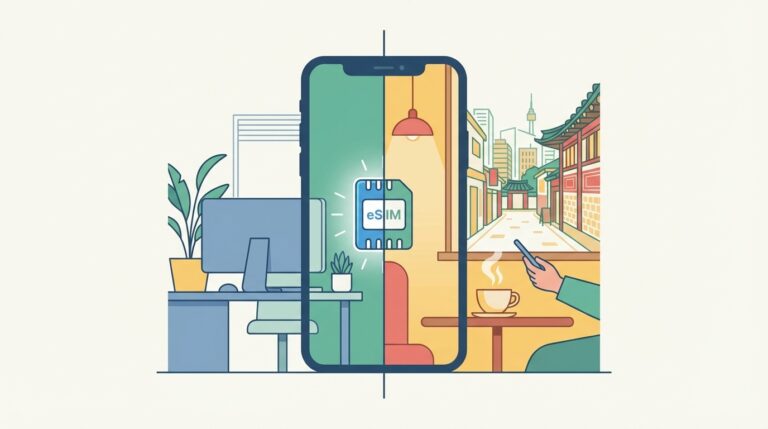
Have you ever watched a K-Drama where the sharp-suited CEO or the undercover detective dramatically pulls out a second smartphone from their coat pocket? In the past, carrying two clunky phones was the ultimate symbol of being a ‘very important (or very secretive) person.’ But walk into any bustling cafe in Gangnam today, and you’ll find that the ‘dual life’ has gone mainstream—no second device required.
Welcome to the era of the eSIM and Dual Numbers (투넘버) in Korea. For long-term expats, digital nomads, and C2-level Korean learners, mastering Korea’s digital ecosystem is the final boss of localization. In a country where your phone number is essentially your digital ID card (본인인증), having two numbers isn’t just about convenience; it’s a sophisticated cultural tool for boundary-setting, privacy, and adopting the ‘multi-persona’ lifestyle of modern Seoulites.
Let’s dive into the advanced vocabulary, subtle social cues, and digital etiquette of managing a dual life in Korea.
Phase 2: Deep Dive into Core Expressions
To navigate the digital divide between your personal and professional self, you need precise language. Here are the core expressions you’ll hear among Korean professionals.
1. 사생활이랑 업무를 분리하고 싶어서 투넘버 써요.
- Pronunciation: [Sasaenghwarirang eommureul bunrihago sipeoseo tuneombeo sseoyo.] / sa-saeng-hwa-ri-rang uhm-moo-reul boon-ri-ha-go shi-puh-suh too-num-buh ssuh-yo.
- Meaning: I use a dual number because I want to separate my private life and work.
- K-Culture Moment: The holy grail for the MZ generation in the Korean workforce is 워라밸 (Work-Life Balance). When a new employee joins a company, setting up a secondary number via eSIM to prevent weekend KakaoTalk messages from the boss is almost a rite of passage.
- Editor’s Insight: The word ‘분리하다’ (to separate) sounds slightly clinical, but in modern corporate Korean, it’s the standard, polite way to say “I need boundaries” without sounding uncooperative.
- Situation Spectrum:
[🚫 절대 금지] ———— [⚠️ 주의] ———— [✅ 자유롭게]
- Casual (Friends): ✅ (Explaining your setup)
- Semi-formal (Coworkers): ✅ (Setting expectations)
- Formal (Boss/Elders): ⚠️ (Use cautiously; some old-school bosses might view it as ‘distancing’ yourself from the team.)
- 🤔 Think About It: Historically, Korean corporate culture emphasized Jeong (정) and collective identity (우리), meaning colleagues often blurred the lines between work and personal life. Why do you think younger Koreans are so eager to build these digital walls now?
2. 당근 거래할 때는 안심번호나 서브 폰으로 연락해요.
- Pronunciation: [Danggeun georaehal ttaeneun ansimbeonhona seobeu poneuro yeollakhaeyo.] / dang-geun guh-rae-hal ttae-neun an-shim-bun-ho-na suh-beu po-neu-ro yullak-hae-yo.
- Meaning: When trading on Karrot, I contact people using a safe number or my sub-phone.
- K-Culture Moment: 당근마켓 (Karrot) is Korea’s premier secondhand neighborhood marketplace. While Koreans are generally highly trusting, sharing your primary digital ID (your main phone number) with a stranger on the internet feels increasingly risky. Enter the eSIM sub-number.
- Editor’s Insight: Notice how ‘당근’ (Carrot) is used almost as a verb or prefix here. A ‘서브 폰’ (Sub-phone) or ‘서브 번호’ (Sub-number) implies a disposable or secondary identity used purely for utility.
- Situation Spectrum:
[🚫 절대 금지] ———— [⚠️ 주의] ———— [✅ 자유롭게]
- Casual: ✅
- Semi-formal: ✅
- Formal: ✅
- 🤔 Think About It: How does the concept of ‘안심’ (peace of mind/safety) reflect the modern urbanite’s desire for privacy in a hyper-connected, high-density city like Seoul?
3. e심으로 알뜰폰 요금제 하나 개통하려고요.
- Pronunciation: [e-simeuro altteulpon yogeumje hana gaetongharyeogoyo.] / e-sheem-eu-ro al-tteul-pon yo-geum-je ha-na gae-tong-ha-ryuh-go-yo.
- Meaning: I’m planning to activate an MVNO (budget mobile) plan via eSIM.
- K-Culture Moment: Gone are the days of being locked into expensive 2-year contracts with the ‘Big 3’ telecoms (SKT, KT, LG U+). Savvy locals now use their physical SIM for their primary number and download a cheap ‘알뜰폰’ (Al-tteul-pon: budget phone) eSIM profile for extra data or a burner number.
- Editor’s Insight: ‘개통하다’ is a highly specific, advanced vocabulary word meaning ‘to activate/open a line or route.’ Using this instead of the basic ‘만들다’ (to make) instantly elevates your Korean to native-like fluency.
- Situation Spectrum:
[🚫 절대 금지] ———— [⚠️ 주의] ———— [✅ 자유롭게]
- You can use this freely at any telecom agency or when discussing finances with anyone. ✅
Phase 3: Textbook vs Real Life
Here is how you upgrade your textbook Korean to sound like a digital native living in Pangyo (Korea’s Silicon Valley).
| Situation | 📖 Textbook Korean | 🗣️ Real Korean | 💡 Why the difference? |
|---|---|---|---|
| Explaining your two numbers | 저는 두 개의 전화번호를 가지고 있습니다. (I have two phone numbers.) | 저 투넘버 돌려요. / 업무용 폰 따로 있어요. (I run dual numbers. / I have a separate work phone.) | ‘돌리다’ (to run/operate) is slang used for managing systems or multiple accounts efficiently. |
| Activating a phone | 새 전화번호를 만들고 싶습니다. (I want to make a new phone number.) | e심 기변(기기변경) 할게요. / 알뜰폰 개통할게요. (I’ll do an eSIM device change. / I’ll activate a budget plan.) | Koreans love abbreviations. 기기변경 (device change) becomes ‘기변’, and 번호이동 (number transfer) becomes ‘번이’. |
| Asking for privacy | 제 번호는 비밀입니다. (My number is a secret.) | 앗, 개인 폰이라서요. 이쪽(업무용)으로 연락 주세요. (Ah, this is my personal phone. Please contact this [work] one.) | Outright refusal is too blunt. Deflecting to a ‘purpose-built’ number is the polite K-corporate way. |
Bottom Note: At the C2 level, adopting corporate abbreviations like ‘투넘버’ and ‘기변’ shows you understand the fast-paced efficiency of Korean society.
Phase 4: Cultural Deep Dive
4-1. Non-verbal Communication: The Politics of KakaoTalk Profiles
Having a dual number in Korea isn’t just about the SIM card; it’s about 멀티 프로필 (Multi-profiles) on KakaoTalk, Korea’s ubiquitous messaging app. When you register a second number, you create a new digital boundary.
The Nunchi (눈치) Rule: If you add a business contact and notice their Kakao profile has absolutely no photos, a generic background, and just their name, do not ask why. They have likely added you to their ‘work profile’ (업무용 프로필) or are using their secondary work number. Prying into their ‘real’ profile is considered a breach of modern digital etiquette.
4-2. K-Culture Connection: The ‘본캐’ and ‘부캐’ Phenomenon
In recent years, the Korean entertainment industry popularized the terms 본캐 (Main Character) and 부캐 (Side Character). A celebrity might be a serious ballad singer as their ‘본캐’, but perform as a comedic trot singer as their ‘부캐’.
This concept has bled seamlessly into everyday digital life. Your primary number (physical SIM) is your ‘본캐’—used for banking, close friends, and family. Your eSIM dual number is your ‘부캐’—used for freelance gigs, online dating (Tinder/Bumble), Karrot market, and signing up for random websites. Having an eSIM allows Koreans to fluidly switch between their different societal roles without compromising their core identity.
Phase 5: Immersive Roleplay Scenario
Setting: A Friday evening at a trendy networking mixer in Seongsu-dong. The music is a chill Lo-Fi beat, and people are exchanging digital business cards. You’ve just had a great conversation with a potential freelance client, but they want to add you on KakaoTalk using the personal number you accidentally mentioned.
Characters:
– YOU: A savvy expat freelancer who cherishes their weekend privacy.
– Minsu (34, Male): An enthusiastic startup founder who has no concept of work-life boundaries.
Dialogue:
Minsu: 아, 방금 말씀하신 아이디어 너무 좋네요! 우리 카톡 하나 교환할까요? 제가 주말에 아이디어 떠오르면 바로바로 연락드릴게요! 📱
(Ah, banggeum malsseumhasin aidi-eo neomu jonneyo! Uri katok hana gyohwanhalkkayo? Jaega jumare aidi-eo tteo-oreumyeon barobaro yeollakdeurilgeyo!)
[Ah, the idea you just mentioned is great! Shall we exchange Kakao? If an idea pops up over the weekend, I’ll contact you right away!]
YOU: 아, 네! 좋습니다. 제 명함 여기 있습니다.
(A, ne! Joseumnida. Je myeongham yeogi itseumnida.)
[Ah, yes! Sounds good. Here is my business card.]
Minsu: 어? 아까 식당 예약하실 때 쓰신 번호랑 명함 번호가 다르네요? 아까 그 번호가 찐(진짜) 개인 폰이시죠? 거기로 저장할게요!
(Eo? Akka sikdang yeyakhasil ttae sseusin beonhorang myeongham beonhoga dareuneyo? Akka geu beonhoga jjin gae-in ponisijyo? Geogiro jeojanghalgeyo!)
[Huh? The number you used to book the restaurant earlier is different from the one on the card. That earlier one is your real personal phone, right? I’ll save that one!]
(🎭 Stage Direction: Minsu eagerly starts typing your personal number into his phone.)
🔀 Your Turn! How do you handle this boundary violation?
- A) “안 됩니다. 그건 제 개인 번호입니다.” (No. That is my personal number.)
- B) “아, 제가 투넘버를 써서요. 업무 연락은 명함에 있는 번호로 주시면 더 빨리 확인할 수 있습니다!”
- C) “네, 마음대로 하세요.”
✅ Best Choice: B — Reason: This is the ultimate diplomatic C2-level response. By framing the ‘work number’ as a way for him to get a faster response, you protect your boundary while making it sound like a benefit to him.
⚠️ Choice A Analysis: While grammatically flawless, it is far too direct and confrontational for Korean business networking, potentially killing the mood (갑분싸).
Minsu: 아하, 투넘버 쓰시는구나! 알겠습니다. 그럼 이쪽(업무용)으로 저장할게요. 주말 잘 보내세요!
(Aha, tuneombeo sseusineunguna! Algetseumnida. Geureom ijjeogeuro jeojanghalgeyo. Jumal jal bonaeseyo!)
[Aha, you use dual numbers! Understood. I’ll save this (work) one then. Have a great weekend!]
Phase 6: 10-Second Shadowing Drill
Let’s practice setting that polite but firm digital boundary. Pay attention to the pauses!
😊 아, 제가 / 투넘버를 써서요. / 😤 업무 연락은 / 명함에 있는 번호로 / 부탁드립니다!
(A, jega / tuneombeoreul sseoseoyo. / Eommu yeollageun / myeonghame inneun beonhoro / butakdeurimnida!)
[Ah, because I use dual numbers. For work contacts, please use the number on my business card!]
Phase 7: K-Culture Glossary
| Korean | Romanization | English | Contextual Meaning |
|---|---|---|---|
| 워라밸 | worabael | Work-life balance | A Konglish abbreviation (Work-Life Balance) driving the demand for eSIMs and dual numbers among Korean millennials and Gen Z. |
| 투넘버 | tuneombeo | Dual number | Having two distinct phone numbers on one device. |
| 본인인증 | bonininjeung | Identity Verification | The strict digital ID system in Korea where your phone number acts as your SSN for online accounts. |
| 알뜰폰 | altteulpon | Budget phone/MVNO | Cheap mobile plans riding on major networks, perfect for secondary eSIM profiles. |
| 찐 | jjin | Real / Authentic | Slang for ‘genuine’. e.g., ‘찐 번호’ (real number) vs ‘서브 번호’ (sub number). |
| 읽씹 / 안읽씹 | ilkssip / anilkssip | Read & ignore / Unread & ignore | The agonizing KakaoTalk statuses that dual numbers help manage (by letting you safely ignore work messages on the weekend). |
Phase 8: Traveler’s Survival Kit
If you are visiting Korea, eSIMs are a game-changer. You don’t need to queue at Incheon Airport to swap tiny pieces of plastic anymore.
🆘 Survival Expressions for eSIM Activation
- 🇰🇷 “e심으로 데이터 무제한 요금제 있나요?” (e-simeuro deiteo mujehan yogeumje innayo?)
- 🗣️ English Guide: Do you have an unlimited data plan via eSIM?
- 📍 Where to use: Airport telecom counters, convenience stores.
- 🇰🇷 “한국 번호도 같이 나오는 e심인가요?” (Hanguk beonhodo gachi naoneun e-simingayo?)
- 🗣️ English Guide: Does this eSIM come with a Korean phone number?
- 📍 Pro Tip: Many tourist eSIMs are data-only. If you need to put your name on waiting lists at trendy cafes (Catchtable) or call a KakaoTaxi, you absolutely need an eSIM that includes a local number starting with 010.
📌 Editor’s Travel Note
– Verification Warning: A tourist eSIM number cannot be used for official 본인인증 (Identity Verification) for things like food delivery apps (Baemin) or ticketing systems (Interpark). For true digital access, you need an ARC (Alien Registration Card) to register a postpaid number under your exact legal name.
Phase 9: Think Deeper — “한 발 더 깊이”
🧠 Think Deeper: The Multi-Persona Society (멀티 페르소나)
Why are Koreans so obsessed with separating their identities? In traditional Korean society, your identity was highly relational—you were defined by your family, your hometown, and your company. The phrase “우리가 남이가” (Are we strangers?) embodied this hyper-connected, boundary-less culture. However, as Korea rapidly modernized into a hyper-competitive, high-stress digital society, the psychological toll of being ‘always on’ became immense. The adoption of eSIMs and dual numbers is a technological rebellion against this collective intrusion. It allows individuals to curate a ‘본캐’ (Main Persona) for societal expectations and a ‘부캐’ (Side Persona) for absolute freedom, hobbies, and anonymity. It’s not just about managing phone calls; it’s a digital evolution of personal space in a country that historically had very little of it.
💬 Your Turn: Does your culture have a strict separation between ‘work identity’ and ‘personal identity’, or are they fluidly mixed? Share your thoughts in the comments!
Phase 10: Troubleshooting (FAQ & Common Mistakes)
Q: Is it rude to give a business partner my secondary number?
A: Not at all! In fact, it’s expected. As long as you present it professionally as your “업무용 폰” (work phone), it shows you are organized.
Q: Can I use an eSIM budget plan for my main banking and identity verification?
A: Yes! If you live in Korea and have an ARC, you can register an 알뜰폰 eSIM under your name. The system recognizes it just like a physical SIM from a major carrier for all 본인인증 purposes.
❌ Common Mistake:
Trying to sign up for Korean websites using a foreign passport name on an eSIM that was registered slightly differently.
✅ Do this instead: The spacing, capitalization, and spelling of your name on your ARC must match exactly with how the telecom agency inputs your name for the eSIM. A single misplaced space (e.g., SMITHJOHN vs SMITH JOHN) will cause every identity verification attempt to fail!
Phase 11: Wrap-up & Action Items
One-Liner Summary: Mastering the eSIM and dual number vocabulary empowers you to protect your digital boundaries and embrace Korea’s ‘multi-persona’ culture with tact.
Your Action Missions:
– 🥉 Bronze: Say “업무용 폰 따로 있어요” (I have a separate work phone) out loud 3 times to practice the rhythm.
– 🥈 Silver: Check your KakaoTalk settings to see how the ‘Multi-Profile’ feature works.
– 🥇 Gold: Next time you need to buy something secondhand on Karrot, or sign up for a minor app, research setting up a cheap ‘알뜰폰’ eSIM as your secondary line!
K-Culture Mission:
Watch an episode of a modern office K-Drama (like Misaeng or Start-Up). Can you spot a character ignoring a late-night call from their boss, or managing multiple phones? How does the director portray the stress of hyper-connectivity?
Have you ever experienced a ‘KakaoTalk disaster’ because you mixed up your work and personal life? Let me know below! 👇
Phase 12: Interactive Quiz
1. Situational Judgment:
You just bought a desk from a stranger on Karrot Market. They ask for your number to coordinate pickup. What is the most culturally appropriate C2-level response?
– A) 제 본인인증 번호 알려드릴게요. (I’ll give you my identity verification number.)
– B) 당근 채팅으로 연락주시거나 제 투넘버 알려드릴게요.
– C) 개인 번호 주기 싫습니다.
Answer: B. Offering to use the app’s chat or a dual number shows you understand local safety etiquette. (A is incredibly dangerous, and C is too blunt).
2. Fill in the Blank:
요즘 개인 시간이 너무 없어서, 퇴근 후에는 ______ 폰을 아예 꺼둡니다.
(Lately, I have no personal time, so after work, I completely turn off my _______ phone.)
– A) 사생활 (Private life)
– B) 업무용 (Work-use)
– C) 개통 (Activation)
Answer: B.
3. True or False – K-Culture Edition:
If a Korean coworker adds you on KakaoTalk and their profile has zero pictures or status updates, you should ask them why they don’t upload pictures.
Answer: False (F). They likely put you on a ‘multi-profile’ designed for work contacts. Asking about it is considered a breach of nunchi (눈치).
Frequently Asked Questions (FAQ)
Q: What does "사생활이랑 업무를 분리하고 싶어서 투넘버 써요." mean in Korean and how do you pronounce it?
A: In Korean, "사생활이랑 업무를 분리하고 싶어서 투넘버 써요." is pronounced [Sasaenghwarirang eommureul bunrihago sipeoseo tuneombeo sseoyo.] and means: I use a dual number because I want to separate my private life and work.
Q: What does "당근 거래할 때는 안심번호나 서브 폰으로 연락해요." mean in Korean and how do you pronounce it?
A: In Korean, "당근 거래할 때는 안심번호나 서브 폰으로 연락해요." is pronounced [Danggeun georaehal ttaeneun ansimbeonhona seobeu poneuro yeollakhaeyo.] and means: When trading on Karrot, I contact people using a safe number or my sub-phone.
Q: What does "e심으로 알뜰폰 요금제 하나 개통하려고요." mean in Korean and how do you pronounce it?
A: In Korean, "e심으로 알뜰폰 요금제 하나 개통하려고요." is pronounced [e-simeuro altteulpon yogeumje hana gaetongharyeogoyo.] and means: I’m planning to activate an MVNO (budget mobile) plan via eSIM.







