

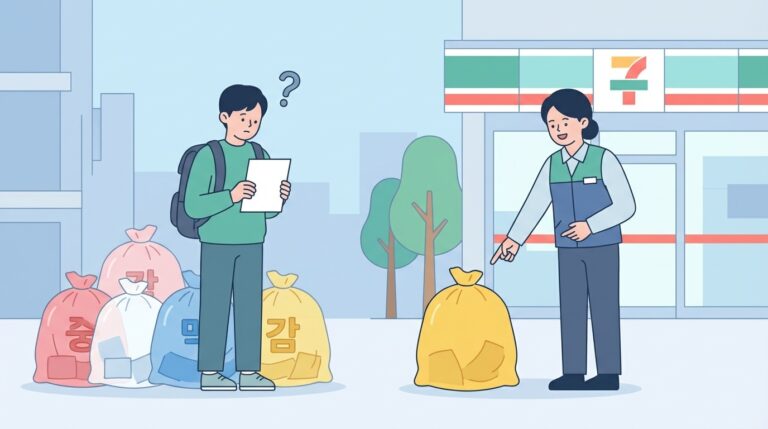
Phase 1: Immersive Hook – The Panic at the Trash Bin
Hello! I’m the Lead Editor at Daily Hangul.
Have you ever watched a K-Drama where the main character takes out the trash late at night, wearing comfy sweatpants, and accidentally bumps into their crush? It’s a classic rom-com trope! But if you look closely at their hands, they aren’t just holding any trash bag—they are holding very specific, brightly colored bags.
If you’ve ever stayed in an Airbnb in Seoul, or just moved into your first Officetel (studio apartment) in Korea, you’ve probably experienced the “Trash Panic.” You finish a delicious delivery meal (K-Food!), but now… where do the leftovers go? If you just throw everything into a black plastic bag, you might face the wrath of the building’s security guard or a hefty fine!
Today, we are going to master one of the most crucial survival skills for living in or traveling to Korea: 음식물 쓰레기는 종량제 봉투에 넣다 (Putting food waste in the standard garbage bag). This isn’t just about language; it’s about becoming a respected local. Let’s dive in!
Phase 2: Deep Dive into Core Expressions
1. 음식물 쓰레기 (Food Waste)
- Pronunciation: [eum-sing-mul sseu-re-gi] (Sounds like: oom-shing-mool soo-ray-ghee)
- Meaning: Food waste (Literal: Food matter garbage)
- K-Culture Moment: You’ll hear this constantly in Korean variety shows like I Live Alone when celebrities clean their homes after a big delivery feast. Young people often shorten this to “음쓰” (eum-sseu).
- Editor’s Insight: The word ‘쓰레기’ (trash) has a strong consonant sound (ㅆ), making it fun to say, but be careful! Calling a person “쓰레기” is a very harsh insult in K-Dramas.
- Situation Spectrum:
[🚫 절대 금지] ———— [⚠️ 주의] ———— [✅ 자유롭게]
- Casual (친구 사이): ✅ (Use “음쓰”)
- Semi-formal (직장 동료): ✅ (Use full word)
- Formal (어른): ✅ (Use full word)
- 🤔 Think About It: Why do Koreans separate food waste so strictly? (Hint: It’s turned into animal feed and fertilizer!)
2. 종량제 봉투 (Standard Garbage Bag)
- Pronunciation: [jong-nyang-je bong-tu] (Sounds like: jong-nyang-jay bong-too)
- Meaning: Volume-based garbage bag (Pay-as-you-throw bag)
- K-Culture Moment: When you visit a convenience store in Korea, you’ll see people asking the cashier for these bags instead of buying standard plastic shopping bags.
- Editor’s Insight: Every district (구) in Korea has a different color for their bags! If you move from Gangnam to Hongdae (Mapo-gu), you have to buy new bags.
- Situation Spectrum:
[🚫 절대 금지] ———— [⚠️ 주의] ———— [✅ 자유롭게]
- Used universally in all situations: ✅
- 🤔 Think About It: Does your home country charge you based on how much trash you throw away, or is it a flat tax?
3. ~에 넣다 / 따로 버리다 (To put in / To throw away separately)
- Pronunciation: [~e neota] / [tta-ro beo-ri-da]
- Meaning: To put into / To dispose of separately
- K-Culture Moment: A stressed roommate pointing at a half-eaten bowl of Tteokbokki saying, “이건 따로 버려!” (Throw this away separately!)
- Editor’s Insight: “따로” (separately) is a magic word in Korea. You use it for trash, but also when asking for sauce on the side at a restaurant (“소스는 따로 주세요”).
Phase 3: Textbook vs Real Life
| Situation | 📖 Textbook Korean | 🗣️ Real Life Korean | 💡 Why the Difference? |
|---|---|---|---|
| Telling a friend to throw away food waste | 음식물 쓰레기는 종량제 봉투에 넣으세요. | 야, 음쓰는 노란 봉투에 따로 버려. | Koreans love shortening long nouns. 음식물 쓰레기 -> 음쓰! |
| Asking to buy a bag at the store | 음식물 쓰레기용 종량제 봉투를 주시겠습니까? | 음식물 쓰레기 봉투 2리터짜리 주세요. | In daily life, “종량제” is often dropped because it’s implied. You just specify the size (e.g., 2 liters). |
| Sorting general trash | 일반 쓰레기를 버립니다. | 일쓰 버리고 올게. | Just like 음쓰, 일반 쓰레기 (general waste) becomes 일쓰. |
Phase 4: Cultural Deep Dive — The Art of “Nunchi” & Recycling
4-1. Non-verbal Communication: The “Villa Ajumma” Gaze
In Korea, trash separation areas usually have CCTVs, and older neighbors take recycling very seriously. If you mix food waste with general waste, you will definitely feel their 눈치 (Nunchi – judgmental/observant gaze). When taking out the trash, confidently carrying your brightly colored, correctly sorted bag shows you are a responsible adult!
4-2. K-Food Connection: The Delivery Culture Dilemma
Korea’s delivery culture (배달의 민족) is world-class. You can get a hot bowl of Malatang delivered at 2 AM. However, this creates a massive amount of plastic and food waste. When you finish eating, you cannot just throw the whole container away. You must:
1. Empty the leftover soup into the 음쓰 (Food waste).
2. Rinse the plastic container with water.
3. Put the clean plastic into the 재활용 (Recycling).
This meticulous process is practically a modern Korean ritual!
Phase 5: Immersive Roleplay — The Convenience Store Mission
Setting: 9 PM. You just finished a massive K-BBQ takeout meal at your Airbnb. You realize you have no trash bags. You rush down to the GS25 convenience store on the corner.
Characters:
– YOU: A slightly panicked traveler/expat.
– Cashier (알바생): A 20-something college student, listening to K-Pop, looking mildly bored.
알바생: 어서 오세요~ (Welcome~)
(eoseo oseyo~)
YOU: 저기요, 혹시 음식물 쓰레기 봉투 있나요?
(jeogiyo, hoksi eumsingmul sseuregi bongtu innayo?)
[Excuse me, do you happen to have food waste bags?]
알바생: 네, 몇 리터짜리 드릴까요?
(ne, myeot niteojjari deurilkkayo?)
[Yes, what liter size would you like?]
🔀 Your Turn! How do you answer?
– A) “제일 큰 거 주세요!” (Give me the biggest one!)
– B) “2리터짜리 세 장만 주세요.” (Give me three 2-liter ones, please.)
– C) “몰라요… 아무거나 주세요.” (I don’t know… just give me anything.)✅ Best Choice: B — Food waste smells bad quickly. Koreans usually buy small sizes (1L or 2L) so they can throw them out frequently.
⚠️ Choice A Analysis: The biggest bags are for restaurants. If you keep a 10L bag of food waste in your apartment until it fills up, your room will smell terrible!
YOU: 2리터짜리 세 장만 주세요.
(iriteojjari se jangman juseyo.)
알바생: 네, 일반 쓰레기 봉투도 필요하세요?
(ne, ilban sseuregi bongtudo piryohaseyo?)
[Okay, do you need general waste bags too?]
YOU: 아, 네! 10리터짜리로 하나 주세요. 감사합니다!
(a, ne! simniteojjariro hana juseyo. gamsahamnida!)
[Ah, yes! One 10-liter bag, please. Thank you!]
Phase 6: 10-Second Shadowing Drill
Let’s practice the most important phrase you will need when explaining the rules to a friend!
😤 (Firmly) 음식물 쓰레기는 / 반드시 / 전용 봉투에 / 버려야 해!
(eumsingmul sseuregineun / bandeusi / jeonyong bongtue / beoryeoya hae!)
“Food waste / absolutely must / in the designated bag / be thrown away!”
Phase 7: K-Culture Glossary (Mini Dictionary)
| Korean | Romanization | English | Context |
|---|---|---|---|
| 분리수거 | bullisugeo | Recycling / Sorting trash | The act of separating plastic, paper, glass, etc. |
| 일쓰 | ilsseu | General waste | Slang for 일반 쓰레기. Goes in the standard white/green bag. |
| 음쓰 | eumsseu | Food waste | Slang for 음식물 쓰레기. Goes in the yellow/blue bag (color varies by district). |
| 배달 | baedal | Delivery | Korea’s booming food delivery culture. |
Phase 8: Traveler’s Survival Kit
Are you staying in an Airbnb? Screenshot this card!
🆘 Survival Phrases for the Convenience Store
– 🇰🇷 “[종량제 봉투] 10리터짜리 주세요.” (jongnyangje bongtu simniteojjari juseyo.)
– 🗣️ Meaning: Please give me a 10-liter standard garbage bag.
– 📍 Where to use: Convenience stores, local supermarkets.
– 💡 Pro Tip: Cashiers will often ask if you need a bag for your groceries. If you buy a “종량제 봉투” (standard bag) to carry your groceries, you can reuse it later as your actual trash bag at home! Two birds, one stone!📌 Editor’s Travel Note
– Where to throw it out? Ask your host: “쓰레기 버리는 곳이 어디예요?” (Where is the trash disposal area?)
– Time limits: Some districts only allow you to put trash out after 8 PM.
Phase 9: Think Deeper — Food & Environment
🧠 Think Deeper: The Price of Banchan Culture
Korea is famous for its generous Banchan (side dishes) culture. When you order a main dish, you get kimchi, pickled radishes, bean sprouts, and more—for free! However, this beautiful culture of abundance naturally creates a massive amount of food waste. To balance this cultural identity with environmental sustainability, Korea implemented one of the world’s strictest food waste recycling systems in 1995. The “pay-as-you-throw” bags force citizens to physically see (and pay for) the waste they produce, shifting the entire society’s mindset toward zero-waste.💬 Your Turn: Does your culture have a tradition that accidentally creates environmental challenges? How does your country handle food waste? Share in the comments!
Phase 10: FAQ & Troubleshooting
❌ Common Mistake #1: The Chicken Bone Trap!
Many foreigners think “If it’s food, it goes in the food waste bag.” WRONG!
The golden rule in Korea: If an animal (like a pig) cannot eat it, it is NOT food waste.
– Chicken bones (치킨 뼈), pork bones, eggshells (계란 껍질), onion peels, and fruit pits MUST go into the 일반 쓰레기 (General Waste) bag. If you put chicken bones in the food waste, the disposal machine breaks!
❌ Common Mistake #2: Using the wrong district’s bag
If you buy a garbage bag in Gangnam-gu, you CANNOT use it in Mapo-gu. The trash collectors will simply leave it on the street with a red warning sticker.
Phase 11: Wrap-up & Action Items
One-Liner Summary: To survive in Korea, sort your trash strictly and buy the correct size “종량제 봉투” at the local convenience store!
Your Action Missions:
– 🥉 Bronze (Solo): Look at your dinner tonight and categorize what is “일쓰” (general) and what is “음쓰” (food waste).
– 🥈 Silver (Online): Post a picture of your favorite K-Food delivery on social media and use the hashtag #음쓰.
– 🥇 Gold (Real Life): Next time you are at a Korean convenience store, successfully buy a 2L food waste bag entirely in Korean!
Phase 12: Interactive Quiz 🏆
Q1. You just ate a delicious bowl of Samgyetang (Ginseng Chicken Soup). Where do the chicken bones go?
A) 음식물 쓰레기 봉투 (Food waste bag)
B) 일반 쓰레기 봉투 (General waste bag)
C) 그냥 창밖으로 던진다 (Throw them out the window)
(Toggle for Answer)
Answer: B! Remember the golden rule: pigs can’t eat bones, so it’s general waste (일반 쓰레기)!
Q2. True or False: You can buy a giant 50L food waste bag for your apartment.
Answer: False (technically). While large sizes exist for restaurants, homes usually buy 1L or 2L bags because food waste spoils and smells very quickly! Small and frequent is the Korean way.
Frequently Asked Questions (FAQ)
Q: What does "음식물 쓰레기 (Food Waste)" mean in Korean and how do you pronounce it?
A: In Korean, "음식물 쓰레기 (Food Waste)" is pronounced [eum-sing-mul sseu-re-gi] and means: Food waste (Literal: Food matter garbage)
Q: What does "종량제 봉투 (Standard Garbage Bag)" mean in Korean and how do you pronounce it?
A: In Korean, "종량제 봉투 (Standard Garbage Bag)" is pronounced [jong-nyang-je bong-tu] and means: Volume-based garbage bag (Pay-as-you-throw bag)
Q: What does "~에 넣다 / 따로 버리다 (To put in / To throw away separately)" mean in Korean and how do you pronounce it?
A: In Korean, "~에 넣다 / 따로 버리다 (To put in / To throw away separately)" is pronounced [~e neota] and means: To put into / To dispose of separately







