
 TOPIK 4
· 11 min read
Mastering Korean Honorifics: How to Read the Room and Choose the Right Politeness Level
 TOPIK 4
· 11 min read
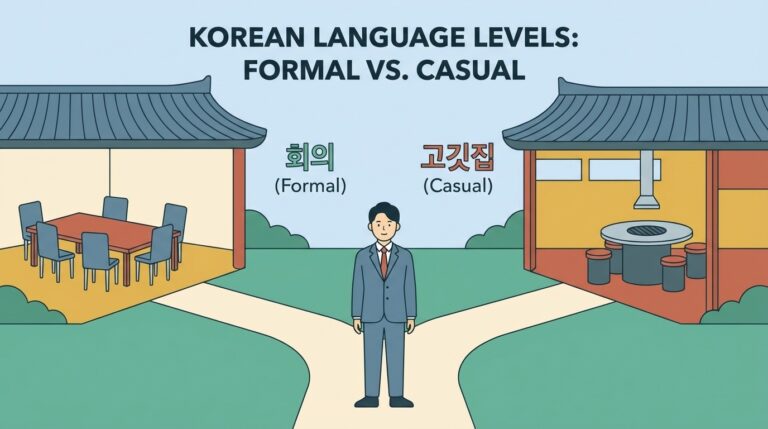
-요 (Polite) and -습니다 (Formal). But when do you switch? What happens when a textbook phrase sounds completely robotic at a Hongdae pub? \n\nIf you’ve ever caused a gapbunssa (awkward silence) by using the wrong politeness level, don’t worry. Today, we are going beyond the textbook. We’re going to learn how to read the room like a true Korean local.\n\n—\n\n## Phase 2: Deep Dive into Core Expressions\n\nLet’s break down the expressions that separate a textbook learner from an insider.\n\n### 1. Mixing Levels: The 70/30 Rule (-습니다 / -요)\n\n- Pronunciation: [-seumnida] / [-yo]\n- Meaning: Formal Polite vs. Casual Polite\n- K-Culture Moment: In a K-Drama boardroom scene, the protagonist presents their idea using -습니다 to sound professional. But when they smile and answer a personal question from the CEO, they softly switch to -요.\n- Editor’s Insight: Textbooks teach you to stick to one level. In real life, speaking 100% in -습니다 sounds like a military robot. Korean professionals use the 70/30 Rule: Use -습니다 for stating facts or ending a speech, but soften the conversation with -요 to build rapport.\n- Situation Spectrum: [🚫 Never] ———— [⚠️ Careful] ———— [✅ Freely]\n – Close Friends (Casual): 🚫 (Too formal)\n – Co-workers (Semi-formal): ✅ (Perfect mix)\n – Big Boss / Client Presentation (Formal): ⚠️ (Lean 90% towards -습니다)\n- 🤔 Think About It: Why does the Korean language have so many layers of politeness? How does the ability to “switch gears” reflect the Korean value of blending professionalism with warm human connection (정, Jeong)?\n\n### 2. 고생하셨습니다 (You’ve worked hard / suffered)\n\n- Pronunciation: Gosaenghasyeotseumnida [Go-sang-ha-syut-seum-ni-da]\n- Meaning: Literal: You have suffered. / Real nuance: Thank you for your hard work.\n- K-Culture Moment: The idol group finishes a 3-hour concert. Backstage, they bow 90 degrees to the staff, repeatedly saying “고생하셨습니다!”\n- Editor’s Insight: You probably learned 수고하셨습니다 (Sugohasyeotseumnida). However, saying 수고하세요 to someone older or higher in rank can actually sound condescending! 고생하셨습니다 is the much safer, deeply appreciative alternative when addressing elders or bosses.\n- Situation Spectrum: [🚫 Never] ———— [⚠️ Careful] ———— [✅ Freely]\n – Close Friends (Casual): ⚠️ (Usually say “고생했어”)\n – Boss / Elders (Formal): ✅\n- 🤔 Think About It: Acknowledging someone’s “suffering” or “hardship” is a core way of showing gratitude in Korea. Does your native language have a phrase that thanks someone by acknowledging their pain?\n\n### 3. 말씀 편하게 하세요 (Please speak comfortably)\n\n- Pronunciation: Malsseum pyeonhage haseyo [Mal-sseum pyun-ha-ge ha-se-yo]\n- Meaning: Literal: Please do your words comfortably. / Real nuance: Please feel free to drop the honorifics with me.\n- K-Culture Moment: You meet a friend’s older sibling. They keep using polite -요 to you. You smile and say this phrase to let them know they can treat you like a younger sibling.\n- Editor’s Insight: You cannot just decide to drop honorifics. It’s a negotiation. The younger/junior person usually offers this phrase to give the older/senior person “permission” to use Banmal (casual speech).\n- Situation Spectrum: [🚫 Never] ———— [⚠️ Careful] ———— [✅ Freely]\n – To an older person (offering them to use Banmal to you): ✅\n – To a younger person (telling them to use Banmal to you): ⚠️ (Usually, you say “말 편하게 해도 돼요?” – Can I speak comfortably?)\n\n—\n\n## Phase 3: Textbook vs. Real Life Korean\n\nLet’s compare what you studied with what you’ll actually hear on the streets of Seoul.\n\n| Situation | 📖 Textbook Korean | 🗣️ Real Life Korean | 💡 Why is it different? |\n|—|—|—|—|\n| Asking age | 나이가 어떻게 되십니까? | 몇 년생이세요? (What year were you born?) | Asking the birth year avoids the complex Korean age calculation system. |\n| Leaving work | 안녕히 계십시오. | 먼저 들어가 보겠습니다. (I will go in first.) | It shows humility, implying “I am leaving before you finish your hard work.” |\n| Saying “You” | 당신은요? | OO씨는요? / 대리님은요? | “당신” sounds confrontational in spoken Korean. Titles are essential. |\n\nBottom Note: At the B2 level, ditching “당신” (You) and replacing it with the person’s name + title (e.g., 민수 씨, 부장님) is the fastest way to sound fluent.\n\n—\n\n## Phase 4: Cultural Deep Dive\n\n### 4-1. Non-verbal Communication: The Art of Nunchi\nLanguage is only 50% of communication in Korea. The rest is Nunchi (눈치)—the ability to read the room. When using honorifics, your body language must match the verb ending.\n- If you use -습니다, your posture should be straight.\n- When pouring a drink for a senior while saying “한잔 받으세요” (Please accept a glass), you must use two hands.\n- Direct, unbroken eye contact with a strict senior while using polite language can still be perceived as defiant. Soften your gaze.\n\n### 4-2. K-Drama Connection: The “Banmal” Romance Trope\nIf you’ve watched K-Dramas, you know the moment. The male and female leads have been bickering in polite Korean (-요) for 6 episodes. Then, in a moment of crisis or romantic tension, one of them suddenly drops the -요 and uses Banmal. \n\nCritical View: While dramas romanticize this sudden switch, in real life, abruptly dropping honorifics without mutual agreement (말을 놓다) is highly offensive. Even couples who have been dating for months might still use -요 out of mutual respect!\n\n—\n\n## Phase 5: Immersive Roleplay Scenario\n\n### Scenario A: The Company Hoesik (Dinner)\n\nSetting: Friday, 7 PM. A smoky BBQ restaurant near Gangnam Station. Soju bottles line the table. You are on a business trip to Seoul and were invited to a team dinner.\nCharacters:\n- YOU: Foreign professional, eager to make a good impression.\n- Min-su (32): Your friendly Korean peer.\n- Manager Kim (45): The strict but warm-hearted team leader.\n\nMin-su: (Flipping the meat) 와, 오늘 부장님이 소고기 쏘신대요!\n(Wa, oneul bujangnimi sogogi ssosindaeyo!)\n[Wow, Manager Kim is treating us to beef today!]\n\nManager Kim: 허허, 다들 고생했으니까 많이들 먹어.\n(Heoheo, dadeul gosaenghaesseunikka manhideul meogeo.)\n[Haha, everyone worked hard, so eat up.]\n\nMin-su: (Looking at you) OO씨, 한국식 바비큐 어때요? 입에 맞아요?\n(OO-ssi, hanguksik babikyu eottaeyo? Ibe majayo?)\n[OO, how’s Korean BBQ? Does it suit your taste?]\n\nYOU: 네, 정말 맛있어요!\n(Ne, jeongmal masisseoyo!)\n[Yes, it’s really delicious!]\n\n(Manager Kim picks up a Soju bottle and gestures towards your empty glass.)\n\nManager Kim: OO씨, 소주 한잔 받을 텐가?\n(OO-ssi, soju hanjan badeul tenga?)\n[OO, will you take a shot of soju?]\n\n> 🔀 Your Turn! How do you respond to the Manager?\n> – A) “아니요, 괜찮아요.” (No, I’m okay.)\n> – B) “네, 감사합니다! 잘 마시겠습니다!” (Yes, thank you! I will drink well!)\n> – C) “수고하셨습니다. 한잔 주세요.” (You worked hard. Give me a glass.)\n>\n> ✅ Best Choice: B — Hold your glass with two hands! It’s polite, enthusiastic, and uses the correct formal ending (-겠습니다) for receiving a treat.\n> ⚠️ Choice A Analysis: A bit too direct. If you don’t drink alcohol, politely say: “감사하지만 제가 술을 잘 못 마십니다. 대신 사이다로 받겠습니다!” (Thank you, but I can’t drink well. I’ll take Sprite instead!)\n> 🚫 Choice C Analysis: Remember Phase 2? Do not use 수고하셨습니다 to the boss!\n\n### Scenario B: Bonus K-Culture Scenario (The Fan Meeting)\nYou are at a fan meeting for your favorite K-Pop idol. You finally get to the front of the line.\n\nIdol: 안녕하세요! 만나서 반가워요~\n(Annyeonghaseyo! Mannaseo bangawoyo~)\n[Hello! Nice to meet you~]\n\nYOU: 헉… 저 진짜 오래된 팬이에요. 혹시… 반말해도 돼요?\n(Heok… jeo jinjja oraedoen paenieyo. Hoksi… banmalhaedo dwaeyo?)\n[Gasp… I’m a really old fan. By any chance… can I speak casually (use banmal)?]\n\nIdol: (Laughs) 그럼요! 편하게 해!\n(Geureomyo! Pyeonhage hae!)\n[Of course! Speak comfortably!]\n\n—\n\n## Phase 6: 10-Second Shadowing Drill\n\nPractice your intonation and pacing! Repeat after the guide.\n\n😊 부장님! / 오늘 / 정말 / 고생하셨습니다!\n(Bujangnim! / oneul / jeongmal / gosaenghasyeotseumnida!)\nTone: Bright, respectful, with a slight bow of the head.\n\n🥺 아… / 제가 / 먼저 / 들어가 보겠습니다.\n(A… / jega / meonjeo / deureoga bogetseumnida.)\nTone: Apologetic, slightly lowering your voice, showing humility for leaving early.\n\n—\n\n## Phase 7: K-Culture Glossary\n\n| Korean | Romanization | English | Cultural Context |\n|—|—|—|—|\n| 눈치 | nunchi | Social sense / tact | The essential Korean survival skill. The ability to assess the mood and hierarchy of a room instantly. |\n| 회식 | hoesik | Company dinner | Not just eating; it’s an extension of work where hierarchy and bonding collide. |\n| 반말 | banmal | Casual speech | Used among close friends or by older people to younger people. Intimacy marker. |\n| 존댓말 | jondaetmal | Honorific speech | The default politeness level for strangers, colleagues, and elders. |\n| 갑분싸 | gapbunssa | Sudden awkward silence | Slang for “갑자기 분위기 싸해짐” (The mood suddenly turns freezing cold). |\n\n—\n\n## Phase 8: Traveler’s Survival Kit\n\nEven if you aren’t working in Korea, knowing how to adjust your politeness is vital for travel.\n\n> 🆘 Survival Phrases: Formal vs. Casual Spaces\n> \n> 1. At a 5-Star Hotel (Highly Formal)\n> – 🇰🇷 “체크인 부탁드립니다.” (Chekeuin butakdeurimnida – Please do the check-in.)\n> – 💡 Tip: Service workers at high-end places use extreme honorifics. Match their respect with -습니다.\n> \n> 2. At Gwangjang Market (Warm & Casual)\n> – 🇰🇷 “이모님~ 이거 얼마예요?” (Imonim~ igeo eolmayeyo? – Auntie~ how much is this?)\n> – 💡 Tip: Calling older female vendors “이모님” (Auntie) instantly builds Jeong. Use the softer -요 form.\n> \n> 3. In a Taxi\n> – 🇰🇷 “기사님, 서울역으로 가주세요.” (Gisanim, seoulyeogeuro gajuseyo – Driver, please go to Seoul Station.)\n\n📌 Editor’s Travel Note:\nKorean society does not have a tipping culture. Excellent service is considered a standard, not an extra. If you try to tip a taxi driver or restaurant owner, they might run down the street to give your change back! A warm “잘 먹었습니다” (I ate well) is the best tip.\n\n—\n\n## Phase 9: Think Deeper – “한 발 더 깊이”\n\n🧠 Think Deeper: Language & Power\nKorean honorifics are basically a verbal map of social hierarchy. Every time two Koreans meet, they rapidly scan for age, job title, and social status to determine the “rank” of the conversation. While this might seem exhausting to Westerners who are used to flat structures (like calling a boss “Dave”), this linguistic system creates a deep sense of social order, respect, and mutual obligation. It’s not just about “who is more powerful” — the older person is also linguistically bound to protect, treat, and take care of the younger person.\n\n💬 Your Turn: How does your culture express respect for elders or bosses? Is it through language, body language, or actions? Let us know in the comments!\n\n—\n\n## Phase 10: Troubleshooting & FAQ\n\nQ: Can I use 반말 (casual speech) when writing a fan letter to my favorite K-Pop idol?\nA: Yes and No. Many international fans write letters entirely in 반말 because it translates to “casual English.” While idols understand this, using polite -요 form actually sounds much more endearing and respectful to Korean ears. \n\nQ: I didn’t catch what someone said. Can I say “뭐?” (What?)\nA: NO! 🚫 Saying “뭐?” to anyone other than a close friend sounds incredibly rude, almost like “What’s your problem?” Instead, say: “네?” (Yes?) or “다시 한번 말씀해 주시겠어요?” (Could you say that once more?).\n\n> ❌ Common Mistake #1: Using “당신” (Dangsin) for “You.”\n> ✅ Do this instead: Look at their name tag, or ask for their title. If you don’t know, drop the subject entirely! Korean is a pro-drop language; “밥 먹었어요?” perfectly implies “Did you eat?”\n\n—\n\n## Phase 11: Wrap-up & Action Missions\n\n📌 One-Liner Summary: Mastering B2 Korean isn’t just about knowing -요 and -습니다; it’s about blending them gracefully and knowing your audience.\n\n🎯 Action Missions:\n- 🥉 Bronze: Stand in front of a mirror and practice saying “고생하셨습니다” while bowing slightly. \n- 🥈 Silver: Write a comment on a Daily Hangul post or a Korean forum using the 70/30 rule (Mix -요 and -습니다).\n- 🥇 Gold: Go to a Korean restaurant or grocery store, look the staff in the eye, and say “먼저 들어가 보겠습니다!” when you leave.\n\n🎥 K-Culture Mission: \nWatch one episode of a K-Drama set in an office (like Misaeng or Business Proposal). Pay close attention to the verb endings the junior employees use when speaking to the CEO versus their peers.\n\n—\n\n## Phase 12: Interactive Quiz\n\nLet’s test your Nunchi!\n\n1. Situational Judgment: You are leaving the office at 6 PM. Your team leader (부장님) is still working at their desk. What is the BEST thing to say?\nA) 안녕히 계세요.\nB) 부장님, 수고하세요!\nC) 부장님, 먼저 들어가 보겠습니다.\n\nAnswer: C. (A is too textbook and a bit cold. B is a huge mistake because ‘수고하세요’ should not be directed upward!)\n\n2. True or False – K-Culture Edition:\n”It is perfectly fine to drop honorifics with someone if you discover you are the exact same age (동갑).”\n\nAnswer: False! Even if you are the same age, you must formally agree to drop the honorifics first by saying “우리 말 놓을까요?” (Shall we speak casually?). Doing it without asking is considered very rude.\n\n3. Fill in the Blank:\nWhen an older person wants to make you feel comfortable and tells you to stop using formal language, they will say: “말씀 ______ 하세요.”\n\nAnswer: 편하게 (Pyeonhage – comfortably)\n\n—\nDid you enjoy today’s deep dive? What situation do you struggle with the most in Korean? Drop a comment below!
 TOPIK 1
Phase 1: Why "I Am a Chef" Trips Up Almost Every Beginner 안녕하세요! 매일한글 에디터입니다. (Annyeongh…
 TOPIK 4
Phase 1: Empathy (Opening) 안녕하세요! 매일한글 에디터입니다. (Hello! This is your Daily Hangul editor.…

 TOPIK 6
Beyond 'Yes' and 'No': Decoding High-Context Korean Refusals Phase 1: Why 'I'll Think Ab…
 TOPIK 1
#1
Phase 1: Introduction Hello! It’s your editor from Daily Hangul. Picture this: You are w…
 TOPIK 5
#2
Hello! It's Daily Hangul! (DailyHangul.com) 👋 Annyeonghaseyo! Welcome back to Daily Hang…
 TOPIK 1
#3
Introduction Annyeonghaseyo! Hello everyone! This is Daily Hangul, here to upgrade your …